Cardano Founder Slams ‘Clickbait’ Reports He Blamed ADA Users

bitcoinistXuất bản vào 2025-11-05Cập nhật gần nhất vào 2025-11-05

Tóm tắt

Charles Hoskinson issued a rebuttal on November 3, rejecting circulating headlines that claimed he blamed Cardano’s users for the network’s...

Trusted Editorial content, reviewed by leading industry experts and seasoned editors. Ad Disclosure

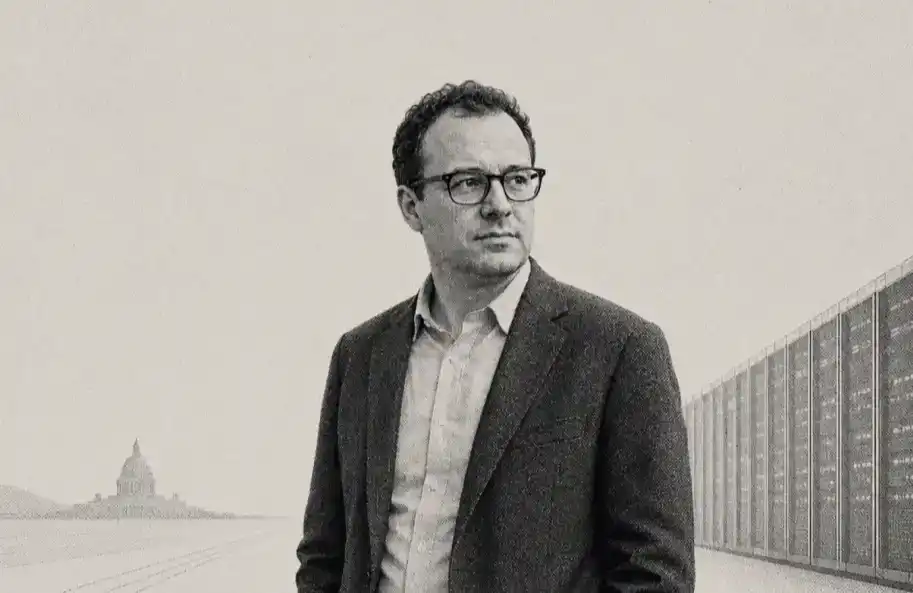
Charles Hoskinson issued a rebuttal on November 3, rejecting circulating headlines that claimed he blamed Cardano’s users for the network’s decentralized finance shortfall. In a brief video, the Cardano founder said media outlets misrepresented his prior comments about participation patterns across the ecosystem, stressing that his point was a structural “mismatch” between who stakes and governs versus who takes part in DeFi—not blame.

“I never once blamed anyone from the Cardano ecosystem for the DeFi [woes],” Hoskinson said, naming The Crypto Basic as an example of outlets whose framing he called fundamentally inaccurate. “I’m sorry crypto media that you guys are […] and you just want clickbait headlines. You guys have to cut this the […] out.” He added that there is “not a single person in the Cardano ecosystem who I am blaming for our DeFi situation right now.”

Cardano’s DeFi Gap Is A Participation Mismatch

Hoskinson’s core claim is numerical and directional rather than accusatory. He argued there is a demonstrable divergence between Cardano’s high participation in staking and governance and its lower participation in DeFi protocols, which depresses total value locked. “I pointed out in a video that there is a mismatch between the people who participate in staking and governance and the people who participate in DeFi. And if there was proportionality there… our TVL would be at least five to 10 billion,” he said. He characterized the recent headlines as “materially wrong and factually wrong” because they attributed intent—“blaming users”—that he explicitly disavowed.

The founder anchored his point in a specific user count comparison. Some third-party measurements, he said, “are asserting that Cardano has only 10,000 to 50,000 actual users when there’s 1.3 million who are using staking.” For Hoskinson, that delta underscores that Cardano “has a large population, a large wallet base, and a lot of users as evidenced by the enormous level of participation in both governance and staking,” even if those participants are not currently “deploying to the other side of the aisle, to the TVL side, to the DeFi side.”

He repeatedly emphasized that diagnosing the participation gap is an ecosystem responsibility, not a morality play. “I’m not blaming them for not participating,” he said. “Never once said it’s their fault and they’re bad people and they’ve done something wrong.” Instead, he called for a frank community conversation about the drivers behind users’ choices. “It could be slippage. It could be fees. It could be user experience. It could be yields. It could be safety concerns. It could be education. There could be 150,000 different reasons for that. But we as an ecosystem have to have that discussion.”

The remedy, in his view, is a coordinated governance agenda rather than a media narrative. He urged Cardano stakeholders to treat the participation gap as a 2026 workstream and to fund targeted initiatives through delegated authority. “We as an ecosystem have to ask why that mismatch exists and how can we correct that mismatch… as a 2026 governance agenda, and get some delegated authority funding and effort to correct that,” he said. If the proportionality problem were addressed, Hoskinson argued, “that alone can get our TVL up 5 billion to 10 billion,” potentially placing Cardano “in the top ranks of TVL, the top five to top 10.”

The dispute originated, he said, when media took a narrow, data-driven observation about where Cardano users allocate capital and translated it into a blame narrative. “People say something very specific, very targeted, and then it gets misinterpreted, and then everybody judges you based upon the headlines,” he said. “I’m not going to allow the crypto media to go ahead and put words in my mouth.” He reiterated the same point multiple times for emphasis: “I did not blame the Cardano ecosystem. I did not blame the Cardano users for anything. I was very careful, guarded, and specific in the things that I said.”

Hoskinson coupled the clarification with a broader critique of crypto media practices. “If you continue to broadcast, you’re lying to people,” he said, adding, “I expect that from the crypto media because they are scum. They do lie. Everything’s sensational. Everything’s clickbait.” He framed his intervention as a corrective to prevent a headline cycle from hardening into accepted fact: “The record has been corrected.”

Beyond media criticism, the practical substance of his message focused on mobilizing existing users rather than conjuring new ones. “We have the users. We have the capital,” he said. “For some reason, those users with their capital are not participating in DeFi.” While he acknowledged having personal “suspicions” and hearing “frustrations” from ecosystem participants, he stopped short of diagnosing root causes, instead calling for an open, data-first process to “systematically chip away” at barriers that deter stakers and governance participants from crossing into DeFi activity.

Across the video, Hoskinson’s throughline never deviated: the issue is proportional participation by an already large user base. “There is a mismatch between the people participating in staking and governance—of which it’s seven figures over a million people—and the people participating in DeFi,” he said. “We have to get to the bottom of that mismatch as an ecosystem… But I’m not blaming the Cardano users for that mismatch. I’m not saying it’s their fault. I’m not saying that they did something wrong.”

At press time, ADA traded at $0.538.
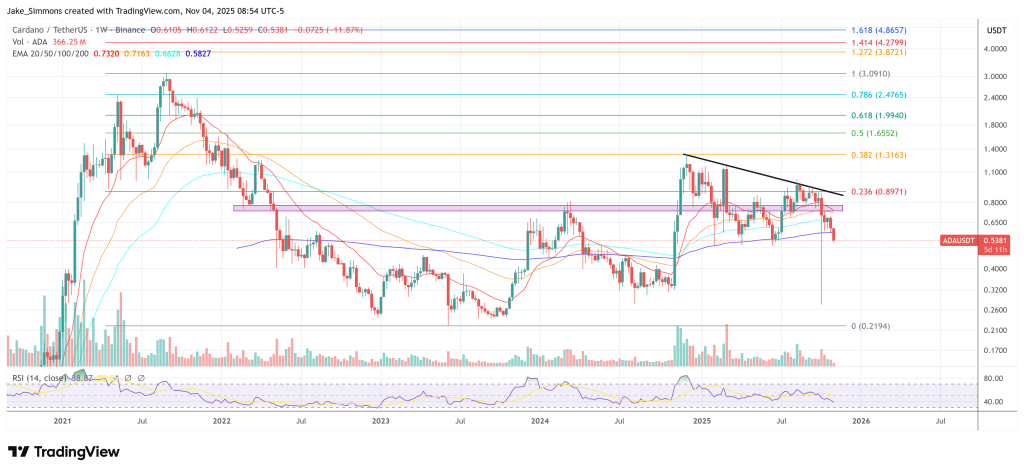
Cardano price
ADA drops below the EMA200, 1-week chart | Source: ADAUSDT on TradingView.com
Featured image created with DALL.E, chart from TradingView.com
Editorial Process for bitcoinist is centered on delivering thoroughly researched, accurate, and unbiased content. We uphold strict sourcing standards, and each page undergoes diligent review by our team of top technology experts and seasoned editors. This process ensures the integrity, relevance, and value of our content for our readers.

Jake Simmons has been a Bitcoin enthusiast since 2016. Ever since he heard about Bitcoin, he has been studying the topic every day and trying to share his knowledge with others. His goal is to contribute to Bitcoin's financial revolution, which will replace the fiat money system. Besides BTC and crypto, Jake studied Business Informatics at a university. After graduation in 2017, he has been working in the blockchain and crypto sector. You can follow Jake on Twitter at @realJakeSimmons.

Tiền kỹ thuật số thịnh hành

Nội dung Liên quan

Sau bảy tháng thừa nhận thất bại, Farcaster lại tìm kiếm bên tiếp quản

Sau chưa đầy bảy tháng điều hành, Farcaster, một giao thức mạng xã hội phi tập trung, lại một lần nữa tìm kiếm bên tiếp quản vận hành. Đại diện của Neynar, công ty hiện đang quản lý, thừa nhận không đạt được các mục tiêu đặt ra đầu năm và cho rằng đội ngũ hiện tại không phù hợp cho giai đoạn phát triển tiếp theo. Lý do được đưa ra là sự kết hợp giữa cộng đồng gắn kết, chi phí vận hành ứng dụng chính (client) còn cao và thị trường tăng trưởng chậm, đòi hỏi một cấu trúc tổ chức và nguồn vốn khác. Farcaster cho phép người dùng giữ nguyên danh tính, nội dung và mối quan hệ khi dùng nhiều ứng dụng khác nhau. Mặc dù Neynar đã giảm 80% chi phí hạ tầng và tiếp tục mở rộng mạng lưới xác thực (validator), bài toán tăng trưởng người dùng cuối cho ứng dụng chính vẫn chưa được giải quyết. Người sáng lập trước đó từng nói cần tăng số người dùng hoạt động hàng tháng lên 10-100 lần để đạt quy mô bền vững. Đây là lần thứ hai Farcaster thay đổi đội ngũ điều hành trong vòng một năm, phản ánh thách thức chung của các nền tảng mạng xã hội Web3: giao thức phi tập trung có thể hoạt động độc lập, nhưng việc vận hành và phát triển một ứng dụng tiêu dùng (client) thân thiện lại đòi hỏi một công ty với nguồn lực và chiến lược phù hợp để chịu chi phí và thúc đẩy tăng trưởng. Hiện các sản phẩm vẫn hoạt động bình thường, Neynar đang trong quá trình tìm kiếm và thảo luận với các nhóm tiềm năng, nhưng cấu trúc chuyển giao cụ thể (toàn bộ hay tách rời) vẫn chưa được công bố.

marsbit15 phút trước

Sau bảy tháng thừa nhận thất bại, Farcaster lại tìm kiếm bên tiếp quản

marsbit15 phút trước

Cổ phiếu của Compound tăng vọt sau khi dự án công bố chuyển hướng sang thị trường tổ chức trị giá 52 triệu đô la

Công ty Compound, một trong những giao thức cho vay phi ngân hàng đầu tiên, đã phê duyệt ngân sách kỷ lục 52 triệu USD để phát triển và tái cơ cấu ban lãnh đạo, tập trung vào các chuyên gia từ lĩnh vực tài chính truyền thống. Động thái này đánh dấu sự chuyển hướng sang tập trung vào thị trường tổ chức. Token COMP của giao thức đã tăng hơn 10% sau thông báo. Tổng giá trị bị khóa (TVL) trên Compound hiện khoảng 1,2 tỷ USD, giảm mạnh so với mức đỉnh 12 tỷ USD năm 2021. Ngân sách 52 triệu USD được Compound DAO thông qua, với 14 triệu USD được sử dụng ngay. Phần lớn sẽ được phân bổ cho hoạt động và phát triển Compound V4 - phiên bản mới áp dụng mô hình "trung tâm - ngoại vi" nhằm thu hút đối tác tổ chức. Ban lãnh đạo mới bao gồm các cựu lãnh đạo từ Coinbase Custody, Near Foundation, và Maple Finance. Họ cho rằng DeFi hiện tại chưa đáp ứng nhu cầu của các tổ chức tài chính truyền thống. Động thái của Compound diễn ra trong bối cảnh nhiều dự án crypto đang tìm cách thu hút vốn tổ chức, với dự báo quy mô DeFi có thể đạt 2,7 nghìn tỷ USD vào năm 2030.

cryptonews.ru35 phút trước

Cổ phiếu của Compound tăng vọt sau khi dự án công bố chuyển hướng sang thị trường tổ chức trị giá 52 triệu đô la

cryptonews.ru35 phút trước

Giao dịch

Giao ngay

Bài viết Nổi bật

Làm thế nào để Mua ADA

Chào mừng bạn đến với HTX.com! Chúng tôi đã làm cho mua Cardano (ADA) trở nên đơn giản và thuận tiện. Làm theo hướng dẫn từng bước của chúng tôi để bắt đầu hành trình tiền kỹ thuật số của bạn.Bước 1: Tạo Tài khoản HTX của BạnSử dụng email hoặc số điện thoại của bạn để đăng ký tài khoản miễn phí trên HTX. Trải nghiệm hành trình đăng ký không rắc rối và mở khóa tất cả tính năng. Nhận Tài khoản của tôiBước 2: Truy cập Mua Crypto và Chọn Phương thức Thanh toán của BạnThẻ Tín dụng/Ghi nợ: Sử dụng Visa hoặc Mastercard của bạn để mua Cardano (ADA) ngay lập tức.Số dư: Sử dụng tiền từ số dư tài khoản HTX của bạn để giao dịch liền mạch.Bên thứ ba: Chúng tôi đã thêm những phương thức thanh toán phổ biến như Google Pay và Apple Pay để nâng cao sự tiện lợi.P2P: Giao dịch trực tiếp với người dùng khác trên HTX.Thị trường mua bán phi tập trung (OTC): Chúng tôi cung cấp những dịch vụ được thiết kế riêng và tỷ giá hối đoái cạnh tranh cho nhà giao dịch.Bước 3: Lưu trữ Cardano (ADA) của BạnSau khi mua Cardano (ADA), lưu trữ trong tài khoản HTX của bạn. Ngoài ra, bạn có thể gửi đi nơi khác qua chuyển khoản blockchain hoặc sử dụng để giao dịch những tiền kỹ thuật số khác.Bước 4: Giao dịch Cardano (ADA)Giao dịch Cardano (ADA) dễ dàng trên thị trường giao ngay của HTX. Chỉ cần truy cập vào tài khoản của bạn, chọn cặp giao dịch, thực hiện giao dịch và theo dõi trong thời gian thực. Chúng tôi cung cấp trải nghiệm thân thiện với người dùng cho cả người mới bắt đầu và người giao dịch dày dạn kinh nghiệm.

Tổng lượt xem 1.5kXuất bản vào 2024.12.10Cập nhật vào 2026.06.02

Làm thế nào để Mua ADA

Thảo luận

Chào mừng đến với Cộng đồng HTX. Tại đây, bạn có thể được thông báo về những phát triển nền tảng mới nhất và có quyền truy cập vào thông tin chuyên sâu về thị trường. Ý kiến ​​của người dùng về giá của ADA (ADA) được trình bày dưới đây.

活动图片