2025 Korean CEX Listing Review: Investing in New Tokens = 70% Loss?

marsbitXuất bản vào 2026-03-12Cập nhật gần nhất vào 2026-03-12

Tóm tắt

The analysis examines the performance of new tokens listed on major Korean cryptocurrency exchanges (Upbit and Bithumb) in 2025, comparing them with Binance. The study finds that investing $100 in each new KRW trading pair on Upbit (59 tokens) and Bithumb (144 tokens) would have resulted in a portfolio value of only 31% of the original investment by March 11, 2026, equivalent to a 70% loss. Binance (92 tokens) performed similarly with a 29% return. Only two tokens on Upbit (KITE +232.8%, BARD +9.3%) and eight on Bithumb ended in profit. Median returns were -80.9% for Upbit and -82.1% for Bithumb, indicating worse typical performance than the average suggests. Tokens listed in the second half of the year performed better, likely due to shorter exposure to the bear market. Notably, tokens listed on both exchanges (50 tokens) showed nearly identical losses (-69.4%) to those listed only on Bithumb (-68.9%), indicating that multiple listings do not guarantee better performance. The study concludes that the loss is structural: initial buying pressure inflates prices on listing day, followed by a predictable decline. This pattern is global, not specific to Korea or any exchange.

Original Author: @c4lvin, Four Pillars

Original Compilation: AididiaoJP, Foresight News

Core Conclusion

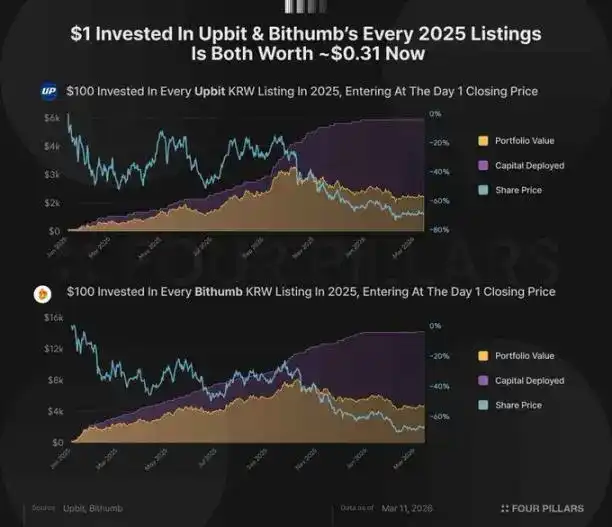
If you invested $100 in each of the 59 new tokens listed for Korean Won (KRW) trading pairs on Upbit in 2025, as of March 11, 2026, the value of this portfolio would be only 31% of the original investment (i.e., each dollar dropped to $0.31). Bithumb (144 tokens) performed identically, also at 31%; Binance (92 tokens) was slightly lower at 29%. All three major exchanges resulted in approximately a 70% loss of capital.

Of the 59 tokens listed on Upbit, only two ultimately turned a profit: KITE (up 232.8%) and BARD (up 9.3%). Bithumb performed slightly better, with 8 out of 144 tokens maintaining positive returns. The median return on Upbit was -80.9%, while on Bithumb it was -82.1%.

For the 50 tokens listed on both major Korean exchanges, their average return (-69.4%) was almost identical to that of the 94 tokens listed only on Bithumb (-68.9%). This data indicates that listing on multiple major exchanges does not guarantee subsequent price performance.

Research Background

The inspiration for this analysis came from a data chart published today by Messari research analyst @Degenerate_DeFi.
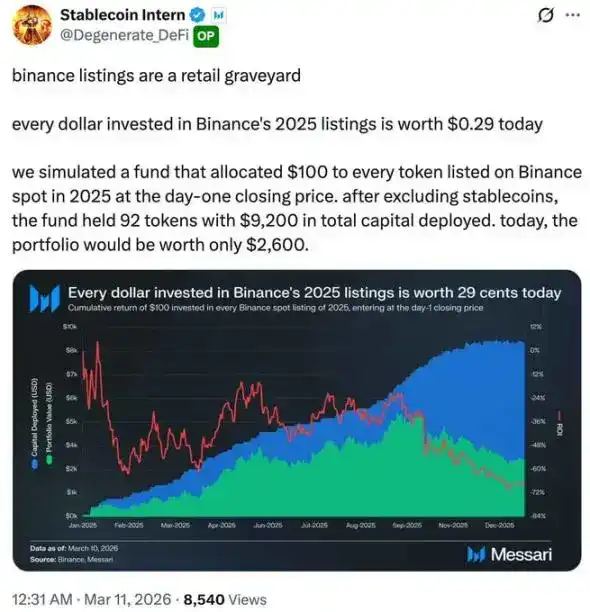
Data Source: @Degenerate_DeFi

The chart shows that if you invested $100 in each of the 92 new tokens listed on Binance in 2025, as of today, each dollar invested is worth only $0.29. This means that out of a total investment of $9,200, the cumulative loss reached 71.7%, leaving a remaining value of approximately $2,600.

As the world's largest cryptocurrency exchange by trading volume, Binance's listing standards are generally considered stricter than those of smaller platforms, and its liquidity advantage is unparalleled. If the data from Binance looks like this, what about the situation on Korean exchanges? The Korean market is retail-investor dominated, with trading patterns significantly different from the global market. Do these differences affect the performance of newly listed tokens? Or will the data ultimately reveal similar patterns?

This article will adopt the same methodology as the Binance analysis to systematically analyze all tokens that gained Korean Won trading pairs on Upbit and Bithumb throughout 2025.

Research Methodology

Scope Definition and Screening Criteria

This study covers all tokens that had new KRW market trading pairs added on Upbit and Bithumb between January 1, 2025, and December 31, 2025. This includes 59 tokens on Upbit and 144 tokens on Bithumb. For tokens listed in 2025 but subsequently delisted, such as Elixir (ELX), Strike (STRIKE), and AI16Z, this study treats them as complete losses.

The investment simulation rules follow the unified framework used in Messari's analysis of Binance listings. We assume an investment of $100 at the closing price on the first day of listing for each token and hold until the present without any selling. By tracking the cumulative value and return rate of this portfolio daily, a time-series dataset is constructed.

Choosing the first day's closing price as the entry point was a deliberate decision. On Korean exchanges, the opening price on the first day is often significantly inflated due to extreme volatility and speculative buying. Using the closing price effectively filters out this short-term noise.

Data Collection

Price data was obtained directly through the public REST APIs of each exchange. For Upbit, we used the daily candlestick (K-line) interface to collect complete daily OHLCV data for each token from its listing date until March 11, 2026, and cross-verified the current price using the ticker interface (/v1/ticker). For Bithumb, the 24-hour K-line interface was used to gather data for the same period. To simplify the model, this study did not consider exchange rate fluctuations between the US Dollar and the Korean Won.

Overall Performance

The chart below visually presents the simulation results. Subsequent sections will provide a detailed interpretation and analysis of this data.

Comparison of the Three Major Exchanges
The performance comparison of new tokens listed in 2025 on the three major exchanges is as follows:
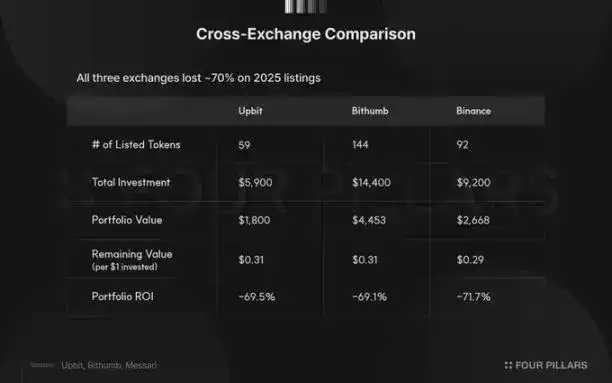
All three exchanges recorded losses of approximately 70%. Upbit (-69.5%) and Bithumb (-69.1%) performed almost equally, with Binance (-71.7%) also being very similar. Regardless of which exchange was chosen, investors buying new tokens at the first day's closing price lost about seventy percent of their initial capital on average.

Return Distribution Characteristics

The overall average is not enough to reveal the differences in individual token performance. The following breaks down the returns of each token in detail by interval:
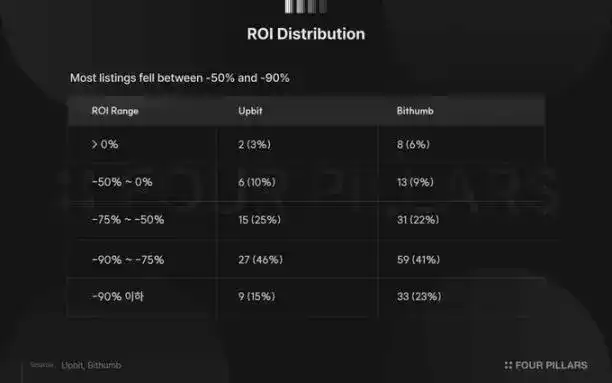
On both exchanges, over 40% of the tokens were concentrated in the loss interval of -75% to -90%. On Upbit, this interval accounted for 46%, with an additional 9 tokens (15%) suffering extreme losses exceeding 90%. Only two tokens ultimately achieved positive returns: Kite (KITE, up 232.8%) and Lombard (BARD, up 9.3%).

Bithumb's return distribution was more dispersed. It had a higher number of profitable tokens, totaling 8, but also had 33 tokens that experienced extreme losses exceeding 90%. This dispersion is partly due to the larger sample size of 144 tokens, but it also reflects that Bithumb's listing strategy covers a wider range of project types compared to Upbit.

The median return reveals a harsher reality: -80.9% for Upbit and -82.1% for Bithumb, both lower than their respective averages. This indicates that a few relatively resilient tokens pulled up the overall average, and the typical performance of newly listed tokens is actually more dismal than the surface data suggests.

Impact of Listing Timing on Performance

To examine whether the timing of listing affects subsequent results, we divided the data into two periods: the first half (January to June) and the second half (July to December) for comparison.
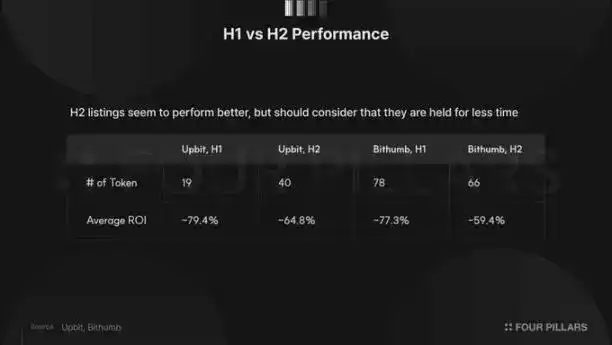
The data shows that tokens listed in the second half performed better on both exchanges. This phenomenon is intuitive: tokens listed earlier in the year experienced a longer period of decline. Given that the overall crypto market was in a downtrend in 2025, the longer the holding period, the higher the natural probability of accumulating greater losses.

It is worth noting that the performance gap between the two halves is quite significant. On Bithumb, the difference in returns between tokens listed in the first half (-77.3%) and those listed in the second half (-59.4%) is about 18 percentage points, a difference that cannot be explained by time factor alone. Possibilities include: tokens listed in the second half indeed had stronger fundamental support, or market expectations had become more rational due to the lessons learned in the first half.

The Paradox of Choice

Relationship Between Number of Listings and Performance

Throughout 2025, Upbit added 59 new KRW trading pairs, while Bithumb added 144. Bithumb's number is more than double that of Upbit and also significantly exceeds Binance's 92. Upbit is renowned for having the strictest listing standards among Korean exchanges. However, despite the vast difference in the number of listings, the portfolio returns of the two exchanges are almost identical: -69.5% for Upbit and -69.1% for Bithumb.

Analysis of Cross-Listed Tokens

To investigate further, we compared the performance of tokens listed on both exchanges with those listed only on Bithumb. The data shows that 50 tokens were listed on both Upbit and Bithumb.
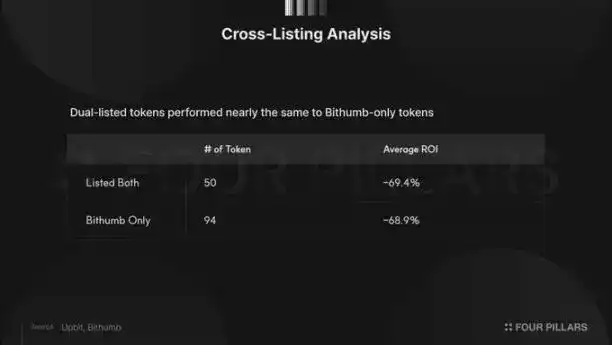
Logically, projects that manage to list on both major exchanges should possess a certain degree of industry recognition. However, the average return of these 50 tokens (-69.4%) is almost exactly the same as that of the 94 tokens listed only on Bithumb (-68.9%).

This finding leads to two conclusions:

First, listing on multiple major exchanges does not provide any guarantee for subsequent price performance.

Second, the first-day price inflation triggered by the listing event is a structural phenomenon, and its occurrence is unrelated to how much attention the project itself receives.

Whether a token has the "honor" of being listed on Upbit as well, or is quietly listed only on Bithumb, the losses ultimately borne by first-day buyers show no significant difference.

Analysis of the Few Survivors

Among the 59 tokens listed on Upbit, only KITE (up 232.8%) and BARD (up 9.3%) ultimately achieved positive returns. Only 8 tokens limited their losses to within 50%.

The 8 profitable tokens on Bithumb constitute a more diverse sample.
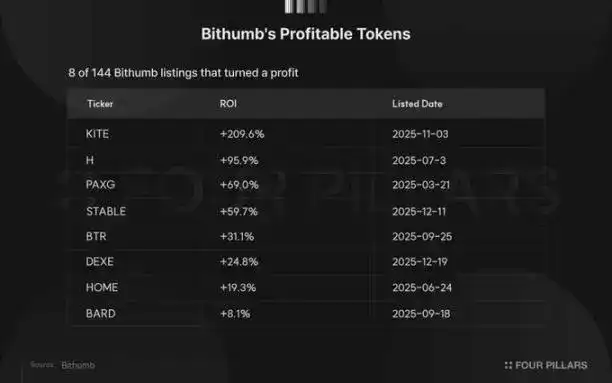
KITE recorded a gain of 209.6%, a significant outlier. However, it should be noted that this token has only been listed for four months; interpreting its performance as a sustainable long-term outcome is premature. STABLE and DEXE also require cautious viewing due to their short tracking record of only three months.

The case of PAXG is more instructive. As a token pegged 1:1 to the spot price of gold, its 69.0% gain was entirely driven by the steady rise in gold prices throughout 2025. This performance has nothing to do with cryptocurrency market fundamentals; it is merely a reflection of macro gold trends. In other words, the most reliable way to achieve profit on Bithumb was ironically not to invest in a cryptocurrency project itself.

Conclusion

This study concludes that the performance of newly listed tokens on Korean exchanges in 2025 is not fundamentally different from that on Binance at a structural level. Although the Korean market is characterized by a high proportion of retail participation, listing strategies vary among exchanges, and the regulatory environment is distinct, the average loss for first-day buyers converges around 70% across all three major exchanges.

We believe the core insight revealed by this data is: the root of the problem lies not in the listing standards of a specific exchange, nor in the quality of individual tokens, but in the structural dynamics inherent to the listing event itself. When a token is newly listed on a major exchange, concentrated retail demand pushes up the price on the first day. Over time, the price naturally regresses, causing losses for first-day buyers. The convergent performance of tokens listed on both exchanges and those listed on only one further confirms that these losses are not due to a specific exchange or token, but are a structural feature of the listing event.

It is important to note that this study measures the performance of one specific strategy: buying at the first day's closing price and holding until now. Strategies that utilize short-term price fluctuations in the days following the listing, or strategies that enter the market after a significant price correction, might yield completely different conclusions. However, such strategies require extremely precise timing, which is far removed from the actual behavior of most retail investors.

The data from 2025 provides a clear message: buying a token simply because it is newly listed on a major exchange is a systematically losing strategy, regardless of which exchange is chosen. This phenomenon is not unique to the Korean market; it is a global structural issue. The reason is not that exchanges are selecting inferior projects, but that the listing event itself creates a dynamic of concentrated demand that is persistently unfavorable to first-day buyers.


Câu hỏi Liên quan

QWhat was the average percentage loss for investors who bought new tokens on their first day of listing on major Korean exchanges (Upbit and Bithumb) in 2025 and held until March 11, 2026?

AInvestors experienced an average loss of approximately 70%. The portfolio value dropped to 31% of the original investment on both Upbit and Bithumb, equating to a 69% loss.

QHow many tokens listed on Upbit in 2025 ended up being profitable for investors who bought at the first day's closing price?

AOnly two tokens listed on Upbit in 2025 were profitable: KITE (up 232.8%) and BARD (up 9.3%).

QDid listing on multiple major exchanges (cross-listing) provide any guarantee of better performance for a token?

ANo, listing on multiple major exchanges did not provide any guarantee. The 50 tokens listed on both Upbit and Bithumb had an average return of -69.4%, which was almost identical to the -68.9% return of tokens listed only on Bithumb.

QWhat was a key structural reason identified in the article for the consistent poor performance of newly listed tokens?

AThe poor performance was attributed to a structural dynamic of the listing event itself. Concentrated retail demand artificially inflates the price on the first day, which then naturally corrects downward over time, systematically disadvantaging those who bought at the inflated first-day price.

QBesides KITE and BARD, what was another profitable token on Bithumb and what was the reason for its positive performance?

APAXG was another profitable token on Bithumb, with a gain of 69.0%. Its performance was not related to cryptocurrency market fundamentals but was solely driven by the steady rise in the spot price of gold, to which the token is pegged 1:1.

Nội dung Liên quan

Mira Murati, Cựu CTO OpenAI và nghệ thuật vị kỷ tinh tế: Vừa trao dao lại là người đầu tiên giảng hòa

Bằng chứng và lời khai từ phiên tòa Musk kiện Altman đã tiết lộ vai trò toàn diện của cựu CTO OpenAI Mira Murati trong cuộc "đảo chính" tháng 11/2023: bà vừa là lực lượng chủ chốt thúc đẩy việc sa thải Altman, lại là người đầu tiên ký đơn đòi đưa ông trở lại khi chiều gió đổi chiều. Mâu thuẫn bắt nguồn từ tháng 9/2022, khi Murati gửi cho Altman một danh sách phàn nàn về phong cách quản lý áp lực, thiếu nhất quán và việc đặt doanh thu lên trên tinh thần nghiên cứu của OpenAI. Đến năm 2023, bà cung cấp hàng loạt bằng chứng nội bộ cho đồng sáng lập Ilya Sutskever, góp phần quan trọng vào quyết định sa thải của Hội đồng quản trị. Sau khi Altman bị sa thải ngày 16/11 và bà được bổ nhiệm làm CEO tạm thời, Murati có hành động hai mặt: một mặt thông báo lập trường cứng rắn của Hội đồng quản trị với Altman, mặt khác bí mật tìm kiếm sự hỗ trợ từ CEO Microsoft Nadella để lật ngược quyết định. Khi nhận thấy Hội đồng quản trị không thể đứng vững, Murati nhanh chóng đổi phe. Bà từ chối ủng hộ tuyên bố của Hội đồng, báo tin họ sắp từ chức cho Microsoft, và cuối cùng trở thành người đầu tiên ký vào lá đơn có chữ ký của 750 nhân viên đòi Altman tái đắc cử. Một cựu giám đốc nhận xét Murati "cực kỳ không hợp tác" sau vụ sa thải, không chịu thừa nhận vai trò của mình, khiến nhân viên hiểu lầm đây là cuộc tấn công bất ngờ từ các giám đốc bên ngoài. "Bà ấy chờ xem gió thổi chiều nào, mà không nhận ra chính bà ấy là làn gió đó." Xuyên suốt cuộc khủng hoảng, Murati luôn chỉ đứng về phía có lợi cho bản thân.

marsbit9 phút trước

Mira Murati, Cựu CTO OpenAI và nghệ thuật vị kỷ tinh tế: Vừa trao dao lại là người đầu tiên giảng hòa

marsbit9 phút trước

Hóa đơn suy luận AI tăng phi mã, Shopify, Roblox cảnh báo: Tiền tiết kiệm từ cắt giảm nhân sự không đủ trả phí chip

Các báo cáo tài chính quý I/2026 của các ông lớn công nghệ như Shopify và Roblox cho thấy một nghịch lý: trong khi AI giúp cắt giảm nhân sự, thì chi phí cho phần cứng (GPU) và sử dụng mô hình (token) lại đang tăng vọt, thậm chí vượt quá khoản tiết kiệm từ việc tinh giản lao động. Shopify cho biết AI đảm nhận hơn 50% công việc viết code, giúp công ty phát triển sản phẩm mà không cần tăng người. Tuy nhiên, chi phí sử dụng LLM (mô hình ngôn ngữ lớn), đặc biệt từ AI trợ lý Sidekick, đang làm xói mòn lợi nhuận gộp của mảng dịch vụ đăng ký. Mặc dù lợi nhuận gộp duy trì ở 80%, chi phí cơ sở hạ tầng liên quan đến AI đã tăng 20%. Roblox cũng báo cáo tình hình tương tự. Khoảng một phần tư mức điều chỉnh giảm dự báo lợi nhuận cả năm của họ trực tiếp đến từ các khoản đầu tư tăng thêm cho AI. Công ty đang xử lý 1,5 triệu lượt suy luận AI mỗi giây. Để đối phó, Roblox dự kiến sẽ tính phí đối với các tính năng AI cao cấp như "Roblox Reality" thay vì cung cấp miễn phí. Trên quy mô ngành, bốn gã khổng lồ Amazon, Meta, Microsoft và Google dự kiến chi tổng cộng 7250 tỷ USD cho đầu tư vào AI trong năm 2026, tăng 77%. So sánh cho thấy sự mất cân đối lớn: chi phí tiền lương toàn bộ nhân viên của Meta (khoảng 27 tỷ USD) chưa bằng 1/5 ngân sách cơ sở hạ tầng AI của họ. Một phân tích ước tính, cứ mỗi đô la chi cho năng lực tính toán AI, cần tiết kiệm gần mười đô la chi phí nhân sự để bù đắp. Tình thế này mang lại lợi nhuận cao cho các nhà cung cấp mô hình và chip như Nvidia, OpenAI, Anthropic. Trong khi đó, các công ty ứng dụng như Shopify và Roblox phải đối mặt với bài toán tài chính phức tạp: doanh thu phụ thuộc vào cường độ sử dụng AI, nhưng đường cong chi phí lại bị chi phối bởi giá của nhà cung cấp mô hình. Cách giải quyết chung là không thể chỉ dựa vào tiết kiệm từ cắt giảm nhân sự, mà phải tìm cách chuyển chi phí AI cho người dùng hoặc biến nó thành lợi thế chiến lược gắn kết khách hàng.

marsbit17 phút trước

Hóa đơn suy luận AI tăng phi mã, Shopify, Roblox cảnh báo: Tiền tiết kiệm từ cắt giảm nhân sự không đủ trả phí chip

marsbit17 phút trước

Hook Summer thực sự đã đến? Sato, Lo0p, FLOOD khởi động tương lai mới của Uniswap v4

Thị trường tiền điện tử đang chứng kiến sự nổi lên của một loạt đồng meme dựa trên giao thức Hook của Uniswap V4, mang đến làn gió mới cho hệ sinh thái Ethereum. Các đồng tiền như sato, sat1, Lo0p và FLOOD đã thu hút sự chú ý với vốn hóa từ vài triệu đến hàng chục triệu USD. Hook được ví như "plugin hợp đồng thông minh" cho các pool thanh khoản trên Uniswap V4, cho phép các nhà phát triển thêm logic tùy chỉnh vào các thời điểm then chốt, biến AMM thành những "viên gạch LEGO" có thể lập trình. - **sato**: Cơ chế đúc và đốt độc đáo, vốn hóa đạt đỉnh trên 38 triệu USD, hiện khoảng 28 triệu USD. - **sat1**: Được quảng bá là "phiên bản tối ưu của sato" nhưng nhanh chóng suy giảm, vốn hóa từ trên 10 triệu USD về còn khoảng 800.000 USD. - **Lo0p**: Tập trung vào giao thức cho vay AMM, cho phép người dùng thế chấp đồng LO0P để vay ETH, vốn hóa đỉnh gần 6,6 triệu USD. - **FLOOD**: Tích hợp với Aave v3 để tạo thu nhập thụ động từ dự trữ tài sản, vốn hóa đỉnh gần 6 triệu USD. Các đồng tiền Hook này được kỳ vọng sẽ thúc đẩy sự phát triển lâu dài của hệ sinh thái Uniswap, thu hút thêm tính thanh khoản và người dùng. Điều này, cùng với việc Uniswap đã bật công tắc phí để hủy UNI, tạo cơ bản tích cực cho UNI về dài hạn. Tuy nhiên, trong ngắn hạn, tác động trực tiếp lên giá UNI có thể hạn chế do các yếu tố như chu kỳ sống của đồng Hook, biến động giá và tình hình thị trường chung. Hiện tại, TVL của Uniswap V4 (khoảng 595 triệu USD) vẫn thấp hơn các phiên bản trước, cho thấy sự phát triển của hệ sinh thái Hook vẫn cần thời gian. *Lưu ý: Các dự án trên là sản phẩm thử nghiệm công nghệ giai đoạn đầu, tiềm ẩn nhiều rủi ro. Thông tin không phải là lời khuyên đầu tư.*

marsbit27 phút trước

Hook Summer thực sự đã đến? Sato, Lo0p, FLOOD khởi động tương lai mới của Uniswap v4

marsbit27 phút trước

Hook Summer thực sự đến rồi? sato、Lo0p、FLOOD châm ngòi câu chuyện mới của Uniswap v4

Thị trường meme coin trên hệ sinh thái Ethereum đang nóng trở lại, với sự nổi lên của các token như sato, sat1, Lo0p và FLOOD. Các đồng tiền này đều dựa trên cơ chế Hook của Uniswap V4 - một "hợp đồng thông minh dạng plugin" cho phép tùy chỉnh logic tự động tại các điểm then chốt trong vòng đời của nhóm thanh khoản (pool). Sato, với vốn hóa đỉnh trên 38 triệu USD, sử dụng cơ chế curve để đúc và đốt token. Lo0p, đạt đỉnh gần 6.6 triệu USD, tập trung vào tích hợp dịch vụ cho vay vào AMM để nâng cao hiệu quả vốn. Trong khi đó, FLOOD kết nối với Aave v3 để tài sản dự trữ tự động tạo ra lợi nhuận. Làn sóng token Hook này mang lại thanh khoản tập trung cho thị trường, hỗ trợ lâu dài cho sự phát triển hệ sinh thái Uniswap và có thể có lợi cho UNI về mặt cơ bản. Tuy nhiên, trong ngắn hạn, chúng khó có thể trực tiếp thúc đẩy giá UNI tăng mạnh do các yếu tố như tính bền vững của token, biến động giá và tình hình thị trường chung. TVL của Uniswap V4 hiện vẫn thấp hơn các phiên bản trước, cho thấy hệ sinh thái Hook vẫn cần thời gian để phát triển. Lưu ý: Các dự án trên là sản phẩm thử nghiệm công nghệ giai đoạn đầu, tiềm ẩn rủi ro như lỗi kỹ thuật. Thông tin không phải là lời khuyên đầu tư.

Odaily星球日报38 phút trước

Hook Summer thực sự đến rồi? sato、Lo0p、FLOOD châm ngòi câu chuyện mới của Uniswap v4

Odaily星球日报38 phút trước

Nhân viên Trung Quốc của SK Hynix bị 'thẳng tay': Tiền thưởng không bằng 5% so với người Hàn

Nhân viên Trung Quốc của SK Hynix bị tác động mạnh: Tiền thưởng thấp hơn 5% so với đồng nghiệp Hàn Quốc Dư luận gần đây xoay quanh dự báo tiền thưởng khổng lồ cho nhân viên SK Hynix, với mức có thể lên tới 3-6 triệu nhân dân tệ (khoảng 300-600 triệu VND) mỗi người vào năm 2026-2027, nhờ lợi nhuận tăng vọt từ cơn sốt nhu cầu bộ nhớ AI. Tuy nhiên, viễn cảnh này không đồng đều giữa các nhân viên tại Hàn Quốc và Trung Quốc. Một nhân viên kỹ thuật lâu năm của SK Hynix tại Trung Quốc tiết lộ: tiền thưởng năm của họ thấp hơn 5% so với đồng nghiệp Hàn Quốc. Trong khi nhân viên Hàn Quốc có thể nhận thưởng hàng trăm nghìn USD (tính theo tháng lương), mức thưởng cao nhất mà anh này nhận được ở Trung Quốc chỉ khoảng hơn 100.000 nhân dân tệ (khoảng 350 triệu VND). Trong giai đoạn khó khăn 2023-2024, thậm chí không có thưởng. Sự chênh lệch không chỉ ở tiền thưởng. Nhân viên Trung Quốc cũng ít có cơ hội thăng tiến lên vị trí quản lý cấp cao hoặc nhận các chính sách cổ phiếu ưu đãi so với đồng nghiệp Hàn Quốc. Các vị trí quản lý chủ chốt thường do người Hàn Quốc nắm giữ. SK Hynix có ba nhà máy chính tại Trung Quốc ở Vô Tích, Đại Liên và Trùng Khánh. Thông tin tuyển dụng cho thấy mức lương kỹ sư phổ biến từ 1-3,5 vạn nhân dân tệ/tháng (khoảng 35-120 triệu VND/tháng), với chế độ 13 tháng lương. Dù các dự báo lạc quan về thị trường bộ nhớ và nhu cầu HBM sẽ duy trì đà tăng trưởng trong 2-3 năm tới, sự khác biệt đáng kể trong chính sách đãi ngộ nội bộ này làm nổi bật khoảng cách giữa các chi nhánh của tập đoàn toàn cầu tại các thị trường khác nhau.

链捕手55 phút trước

Nhân viên Trung Quốc của SK Hynix bị 'thẳng tay': Tiền thưởng không bằng 5% so với người Hàn

链捕手55 phút trước

Giao dịch

Giao ngay
Hợp đồng Tương lai
活动图片