How 40.8M staked ETH could strengthen Ethereum’s edge over Bitcoin

ambcryptoPublished on 2026-07-21Last updated on 2026-07-21

Abstract

Ethereum is showing signs of strengthening against Bitcoin, driven by two key trends. First, significant whale accumulation is occurring, with large holders not just buying ETH but immediately staking 100% of it. This locks away supply, signaling long-term conviction. Ethereum's total staked ETH has reached a record 40.8 million, with a growing entry queue and 33.5% of supply now staked, further tightening liquid availability. Second, Ethereum's DeFi ecosystem is experiencing robust activity, with WETH whale transactions at a multi-year high and Total Value Locked (TVL) rising sharply. These converging factors—reduced supply from staking and increased on-chain demand—are translating into technical strength. The ETH/BTC ratio has broken above resistance and is approaching the 0.03 level, setting the stage for potential continued outperformance against Bitcoin.

Two key divergences show why Ethereum’s [ETH] outperformance against Bitcoin [BTC] may only be beginning.

Notably, Lookonchain flagged consecutive whale accumulation, with one whale withdrawing over 74,000 ETH and another more than 10,000 ETH. The key detail? Both whales staked 100% of the ETH they accumulated, marking a clear divergence from a typical whale accumulation setup. Simply put, instead of leaving the ETH idle, they’re locking it into staking, reducing the liquid supply while signaling long-term conviction.

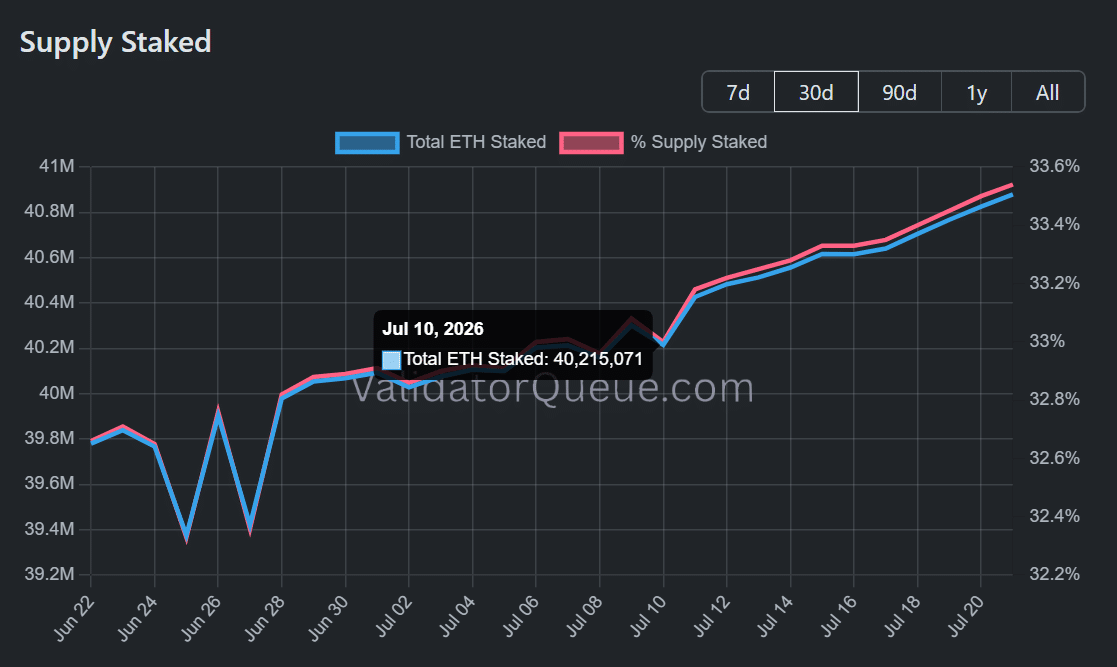
Ethereum’s staking data only reinforces that trend. As the chart below shows, the validator exit queue currently sits at zero, while the entry queue has climbed to 2.4 million ETH. At the same time, total staked ETH has climbed to a record 40.8 million, with 33.5% of the total ETH supply now sitting in staking. To put that into perspective, users have added nearly 600,000 ETH to staking in less than ten days.
Source: ValidatorQueue

In that context, these two whales staking 100% of their newly accumulated ETH isn’t an isolated event.

Instead, it aligns with a broader trend of supply being locked away, further tightening liquid ETH as staking demand continues to grow. And the impact is starting to show on the technical side.

On the daily chart, the rise in ETH staking flows has lined up with ETH/BTC breaking above the 0.025 resistance level, showing that stronger supply dynamics are beginning to translate into better Ethereum performance against Bitcoin.

Now, looking at the second divergence. While staking flows highlight long-term conviction, Ethereum’s DeFi ecosystem adds another important layer by shaping liquidity and on-chain activity across the network, creating another tailwind for Ethereum’s performance against Bitcoin.

Ethereum accumulation signals a bigger move

Random accumulation doesn’t really mean much on its own.

However, Ethereum’s whale accumulation is telling a much bigger story. While staking flows support long-term conviction, combining that with strong DeFi flows adds another layer of strength to Ethereum’s ecosystem. Currently, this combination could be highlighting ETH’s underlying demand.

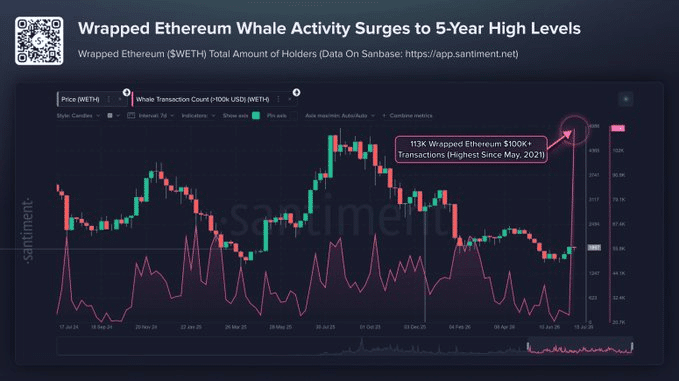
As the chart below shows, Wrapped Ethereum (WETH) recorded 113k whale transactions above $100k over the past week, marking its highest level since May 2021. This shows that large players are becoming more active on-chain. With Ethereum’s TVL also increasing by over $5 billion in less than ten days, the data points to rising liquidity and stronger activity across the Ethereum ecosystem.
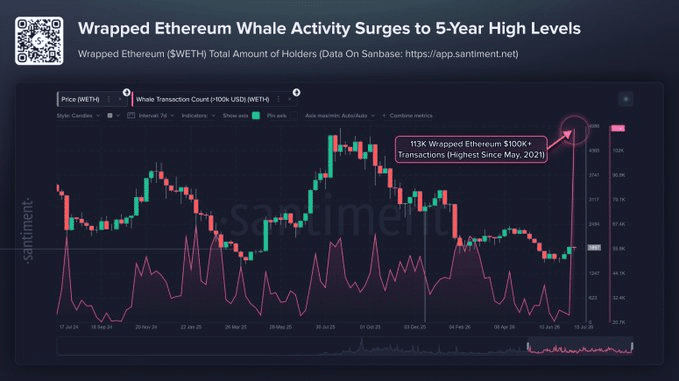
Source: Santiment

And the impact is starting to show.

On the technical side, Ethereum just posted its strongest weekly close against Bitcoin in eleven weeks. With the ETH/BTC ratio now approaching the key 0.03 resistance zone, the ongoing supply squeeze is adding more strength to the breakout setup, setting the stage for the next leg of ETH’s outperformance against BTC.


Final Summary

  • Whales are buying ETH and locking it into staking, reducing available supply while DeFi activity continues to grow.
  • ETH/BTC is showing strength, with the ratio nearing key resistance as supply tightening supports a potential breakout.


Trending Cryptos

Related Questions

QAccording to the article, what is the key difference between the recent whale accumulation of ETH and a typical whale accumulation setup?

AThe key difference is that the whales mentioned staked 100% of the ETH they accumulated, rather than leaving it idle. This locks the supply into staking, signaling long-term conviction and reducing the liquid supply.

QWhat specific data point does the article use to show the strong and growing demand for Ethereum staking?

AThe article states that the validator entry queue has climbed to 2.4 million ETH, while the exit queue is zero. Furthermore, nearly 600,000 ETH was added to staking in less than ten days, bringing the total staked ETH to a record 40.8 million.

QBesides staking flows, what other ecosystem factor does the article say is creating a tailwind for Ethereum's performance against Bitcoin?

AThe article cites Ethereum's DeFi (Decentralized Finance) ecosystem as another important factor. It shapes liquidity and on-chain activity, with rising Total Value Locked (TVL) and high whale transaction counts indicating stronger network activity.

QWhat on-chain metric for Wrapped Ethereum (WETH) reached its highest level since May 2021, and what does it signify?

AWETH recorded 113,000 whale transactions above $100,000 in the past week, its highest level since May 2021. This signifies that large players are becoming significantly more active on the Ethereum network.

QWhat is the key technical resistance level that the ETH/BTC ratio is approaching, according to the article's conclusion?

AThe ETH/BTC ratio is approaching the key 0.03 resistance zone. The ongoing supply squeeze from staking is adding strength to this breakout setup.

Related Reads

US Senate Makes Important Amendments to "Conflict of Interest" Section of Cryptocurrency Bill

The U.S. Senate has taken a key step regarding the CLARITY Act, which could shape the future of the U.S. crypto market. On July 29, Senators Tom Tillis and Ruben Gallego finalized amendments to the bill's "conflict of interest" rules, one of its most contentious aspects. The bipartisan bill aims to tighten restrictions on high-level federal officials' ties to digital assets. The new text, crafted as an alternative to a White House-endorsed ethics code, is expected to impose stricter rules limiting officials' ability to issue or directly participate in digital asset projects. However, with Congress entering an August recess and the revised text not yet reviewed by much of the Senate, the bill's timeline is uncertain. Senate Majority Leader John Thune indicated a procedural vote could occur between July 29 and August 1 but expressed doubt the full bill could pass before the break. The House-approved CLARITY Act, passed in July 2025, has been under Senate negotiation for over a year. Key goals of the CLARITY Act include clarifying jurisdictional boundaries between the SEC and CFTC, setting rules for digital commodity spot markets, and addressing topics like stablecoin yields, DeFi, and illicit financing. The stablecoin yield provisions could significantly impact U.S.-based DeFi protocols, exchanges, and issuers, affecting their global competitiveness. The outcome is being closely watched by both the U.S. and global digital asset markets.

cryptonews.ru6m ago

US Senate Makes Important Amendments to "Conflict of Interest" Section of Cryptocurrency Bill

cryptonews.ru6m ago

Pavel Durov Designated as a Terrorist in Russia. What Does This Mean for Telegram Users?

Pavel Durov, the founder of Telegram, has been added to Russia's list of terrorists and extremists by Rosfinmonitoring, as published on July 30. The entry includes his name and date of birth. The designation follows an announcement by the Russian Federal Security Service (FSB) on July 29, which charged Durov with aiding terrorist activity. The FSB alleges that a Telegram dating bot named "DaiVinchik" was used to recruit 46 individuals for attacks on police and arson, orchestrated by Ukrainian special services. The FSB also accuses Telegram's administration of failing to remove channels and bots used by Ukrainian intelligence and extremist groups. Durov is reportedly subject to an international arrest warrant. Inclusion on the Rosfinmonitoring list leads to significant restrictions: the freezing of Durov's bank accounts and assets, severe limitations on financial transactions, and a ban on election participation, media interaction, and event organization. Transfers to his accounts may be considered terrorism financing. For ordinary Russian Telegram users, purchasing Telegram Premium is not classified as financing terrorism, according to an IT expert. General use of the messenger—messaging, managing channels—does not automatically make a user a participant in extremist activity. There has been no official decision to ban Telegram itself. It is noted that French authorities are also investigating Durov over allegations of inadequate measures against criminal activity on the platform and insufficient cooperation with law enforcement. Durov denies all charges.

cryptonews.ru15m ago

Pavel Durov Designated as a Terrorist in Russia. What Does This Mean for Telegram Users?

cryptonews.ru15m ago

Trading

Spot

Hot Articles

Discussions

Welcome to the HTX Community. Here, you can stay informed about the latest platform developments and gain access to professional market insights. Users' opinions on the price of S (S) are presented below.

活动图片