Zcash Is Up 1,500% And Its Biggest Backer Says This Is Why

bitcoinistОпубликовано 2026-05-11Обновлено 2026-05-11

Введение

Zcash (ZEC) has surged approximately 1,500%, a rally attributed by prominent backer Josh Swihart to fundamental resets in governance, product strategy, narrative, and organization. Three years ago, Zcash had strong cryptography but weak momentum. Today, shielded transaction adoption has risen dramatically, and over $3 billion in value is held in shielded wallets. Key changes include a governance reset where direct funding to core institutions ended, breaking a perceived "stranglehold" and empowering the broader community. Product focus shifted to user adoption, exemplified by the Zodl wallet, which contributed to shielded supply rising from 11% to about 30%. The narrative moved from "privacy coin" to "unstoppable private money," improving institutional perception and leading to listings and investment. Organizationally, key developers formed the Zcash Open Development Lab (ZODL), raising $25 million to scale adoption. Current priorities are improving user experience, scalability (targeting faster block times), and post-quantum security. Swihart concluded these compounded efforts explain Zcash's accelerated growth.

Zcash’s sharp revival did not happen by accident, according to Josh Swihart, who argues that ZEC’s roughly 1,500% rally reflects a multi-year reset across governance, product strategy, narrative positioning and organizational structure. In a detailed update, Swihart framed Zcash’s recent strength as the result of hard decisions made in 2023 and 2024 that are now compounding across the ecosystem.

Three years ago, Swihart said, Zcash had strong cryptography but weak momentum. ZEC was trading around $30, less than 11% of supply was shielded, and community discussion was dominated by governance disputes. Today, he said, ZEC is around $600, roughly 31% of supply is shielded, more than $3 billion in value is held in user-controlled shielded wallets, and shielded transactions reached 86.5% in mid-March.

“Nothing happens by chance,” Swihart wrote. “Here were the unlocks and why growth is accelerating.”

Governance Reset Becomes Central To The Zcash Story

Swihart’s first explanation centers on governance. For Zcash’s first eight years, 20% of every block reward went to the same core institutions, later including Zcash Community Grants. In his view, that created an incumbency problem: organizations had guaranteed funding while also holding significant influence over protocol direction.

That changed in 2024, when Electric Coin Co. announced it would not accept direct funding. Swihart said the decision forced the legacy model to break. Network Upgrade 6 then cut direct funding and redirected 8% to Zcash Community Grants, while sending 12% into a protocol-controlled lockbox intended for ZEC holders to retroactively distribute grants to contributors delivering measurable value. Both streams expire at the end of the third halving in late 2028 unless renewed by overwhelming community consensus.

The trademark issue also mattered. Swihart said ECC’s August 2024 notice to terminate the trademark agreement, followed by the Zcash Foundation’s decision not to use the trademark for governance, ended a structure in which ECC and ZF held effective veto power over the protocol.

“The stranglehold on Zcash governance was broken, and coin holders and other groups across the ecosystem were able to be heard,” he wrote. “No single body, including the ZF’s ZCAP, has a monopoly on determining community sentiment. Zcash was finally set free.”

Zodl And Shielded Usage Put Product Back In Focus

The second shift was product. Swihart said ECC reoriented in January 2024 toward user adoption after years in which technical work produced strong privacy infrastructure but limited user growth. By 2023, he said, the community was contracting, X sentiment was heavily negative or neutral, and a ZURE survey showed ZEC holders had an NPS score of -60.

Zashi, later rebranded as Zodl, became the clearest expression of that shift. The wallet launched in March 2024 with shielded-by-default usage, hardware wallet support and token swaps. Swihart said shielded supply rose from about 11% to about 30% by the end of 2025, a more than 400% increase in absolute ZEC terms, while the wallet processed more than $600 million in ZEC swaps since October.

He emphasized that this activity was not simply exchange inventory or passive treasury accumulation. “These are real people choosing privacy and holding their own keys,” Swihart wrote.

Swihart also argued that Zcash had a narrative problem. The “privacy coin” label, he said, placed ZEC into a category associated with delistings, regulatory scrutiny and institutional hesitation, while obscuring the actual proposition: opt-in shielded payments, Bitcoin-style monetary policy and verifiable private transactions.

He said the new framing around “unstoppable private money” has made ZEC more legible to allocators and infrastructure providers. Swihart cited Robinhood’s listing, Multicoin disclosing a position, Grayscale’s ETF filing and Foundry launching a Zcash mining pool as examples of wider access and institutional engagement.

ZODL Raises $25 Million As Scaling And Quantum Work Advance

The organizational reset came in January 2026, when Swihart said the ECC team left to form Zcash Open Development Lab, or ZODL, after a dispute with Bootstrap’s board. He argued that Zcash needed startup-style capital and speed to build consumer products at scale.

ZODL has since closed a $25 million round backed by Paradigm, a16z crypto, Winklevoss Capital, Coinbase Ventures, Cypherpunk Technologies, Chapter One, Balaji Srinivasan and others. Swihart described the round as a strong signal for the team’s mission to scale Zcash adoption.

Near-term priorities now include UX, scalability and post-quantum readiness. Swihart said Zodl is working on better performance, more swap options, on- and offboarding, in-app coin-holder polling and requested user features. On scalability, Zcash is targeting 25-second block times, down from 75 seconds, while Tachyon aims to restructure the protocol around stateless wallets carrying recursive zero-knowledge proofs.

“Net, Zcash will be faster, easier to use, more feature-rich, more scalable, and post-quantum secure,” Swihart concluded.

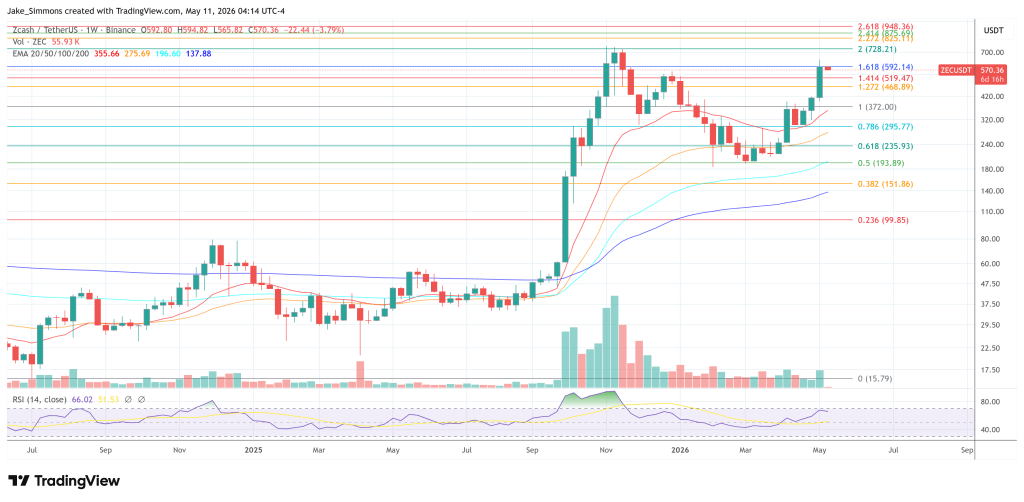
At press time, ZEC traded at $570.36.

ZEC faces the 1.618 Fib extension, 1-week chart | Source: ZECUSDT on TradingView.com

Похожее

STRC Breaks Below $95: Why Does It Continue to Depeg? Is There Default Risk?

"STRC Falls Below $95: Why the Persistent Depegging and Is There Default Risk?" The article discusses the recent decline in the price of STRC, a perpetual preferred stock issued by Strategy (MSTR) designed to trade around a $100 par value. As of publication, STRC traded at $94.65, raising market concerns. STRC is described as a high-yield cash flow product, offering an 11.50% annual dividend paid monthly. Its "preferred" status grants it priority over common stock for dividends and in liquidation. Key reasons cited for the price depegging include: 1. **Bitcoin's Price Drop:** MSTR's assets are heavily tied to Bitcoin (BTC), which fell over 21% from its recent high, pressuring all Strategy-related products. 2. **Competitive Pressure:** Rival Strive Asset Management's similar product, SATA, offers daily dividends and has maintained its $100 par value with a ~13% yield. In response, Strategy has proposed changing STRC's dividend frequency from monthly to bi-weekly, pending shareholder vote. 3. **Technical Selling:** A break below $100 may have triggered algorithmic selling and stop-losses, exacerbating the decline. Regarding default risk, the analysis suggests it is currently low. Strategy founder Michael Saylor confirmed the June 2026 dividend rate remains at 11.50% with no cuts or suspensions. The company's massive reserve of 843,706 BTC provides a significant backstop for its obligations. Industry opinions are mixed. Some analysts view the BTC holdings as reliable support for dividends, while critics like Peter Schiff warn of potential dividend cuts leading to price crashes and lawsuits. Others highlight inflation risk and the company's ability to reduce dividends without a formal default. In summary, STRC's drop is attributed to BTC volatility, competition, and technical factors. While immediate default risk appears contained, the product faces challenges from market conditions and competitive dynamics.

marsbit10 мин. назад

STRC Breaks Below $95: Why Does It Continue to Depeg? Is There Default Risk?

marsbit10 мин. назад

AI Trading Cools, South Korean Stocks Plunge 1.8%, Spot Gold Rises 1%, Bitcoin Dives

A sell-off in AI-related stocks, triggered by Broadcom's disappointing earnings forecast, sent shockwaves through global markets. South Korea's KOSPI led Asia's decline, plunging 1.8% as the risks from concentrated chip stock gains and surging leveraged investments came to the fore. The tech-heavy Nasdaq 100 futures fell 0.5% following Broadcom's 14% after-hours plunge, which signaled a slower-than-expected transition to AI clients. This pullback extended Wall Street's weakness, halting the S&P 500's nine-day rally amid hawkish Fed signals and renewed Middle East tensions. South Korean authorities convened an emergency meeting, pledging "immediate measures" against market volatility and warning of record-high stock margin debt. The adjustment rippled across assets: Bitcoin fell to around $64,000, its lowest since February, while safe-haven gold rose 1% on bargain hunting. Oil prices dipped on Middle East ceasefire news. Market analysts noted the sell-off was driven by profit-taking after massive gains, particularly in chip stocks like Samsung and SK Hynix, which now dominate the KOSPI. Wall Street banks are divided on Korea's outlook, with Goldman Sachs raising its target while Citigroup and others warn of overvaluation and a potential bubble. Bridgewater's Ray Dalio noted that great technological shifts often create bubbles. Meanwhile, Fed officials' hints at potential future rate hikes added to the cautious mood ahead of key U.S. jobs data.

华尔街日报36 мин. назад

AI Trading Cools, South Korean Stocks Plunge 1.8%, Spot Gold Rises 1%, Bitcoin Dives

华尔街日报36 мин. назад

Seeking Alpha's Hot Article: Why Might the U.S. Stock Market Crash in June?

In a recent Seeking Alpha article, financial professor and analyst Damir Tokic argues that the US stock market may be poised for a significant crash in June 2026. The core thesis centers on a "mega-bubble" in equities, particularly within the technology sector, which has driven the S&P 500 to near-record valuations, with a Shiller P/E ratio exceeding 40—a level comparable to the 2000 dot-com bubble. Tokic identifies two primary catalysts for a potential collapse. First, he points to unsustainable market exuberance fueled by what he terms the "Trump Stimulus"—massive AI capital expenditure by tech giants, which he believes is politically driven and cannot last. Second, and more urgently, he highlights the escalating Iran war as a critical threat. The ongoing closure of the Strait of Hormuz has created a severe global energy supply crunch. Strategic petroleum reserves are projected to hit critically low operational levels by June, potentially causing oil prices to spike above $200 per barrel and triggering a severe, supply-driven inflationary shock. This scenario, Tokic warns, would force the Federal Reserve's hand. Despite currently maintaining a dovish bias, the Fed would likely be compelled to officially pivot to a hawkish stance at its June FOMC meeting to combat soaring inflation and bond yields. He contends that such a shift—or even a failure to act, which would destroy Fed credibility—could be the trigger that punctures the market bubble. The resulting downturn, he concludes, could rival the bear markets of 2000 and 2008, advising investors to prepare for a major correction.

marsbit59 мин. назад

Seeking Alpha's Hot Article: Why Might the U.S. Stock Market Crash in June?

marsbit59 мин. назад

Торговля

Спот
Фьючерсы

Популярные статьи

Как купить S

Добро пожаловать на HTX.com! Мы сделали приобретение Sonic (S) простым и удобным. Следуйте нашему пошаговому руководству и отправляйтесь в свое крипто-путешествие.Шаг 1: Создайте аккаунт на HTXИспользуйте свой адрес электронной почты или номер телефона, чтобы зарегистрироваться и бесплатно создать аккаунт на HTX. Пройдите удобную регистрацию и откройте для себя весь функционал.Создать аккаунтШаг 2: Перейдите в Купить криптовалюту и выберите свой способ оплатыКредитная/Дебетовая Карта: Используйте свою карту Visa или Mastercard для мгновенной покупки Sonic (S).Баланс: Используйте средства с баланса вашего аккаунта HTX для простой торговли.Третьи Лица: Мы добавили популярные способы оплаты, такие как Google Pay и Apple Pay, для повышения удобства.P2P: Торгуйте напрямую с другими пользователями на HTX.Внебиржевая Торговля (OTC): Мы предлагаем индивидуальные услуги и конкурентоспособные обменные курсы для трейдеров.Шаг 3: Хранение Sonic (S)После приобретения вами Sonic (S) храните их в своем аккаунте на HTX. В качестве альтернативы вы можете отправить их куда-либо с помощью перевода в блокчейне или использовать для торговли с другими криптовалютами.Шаг 4: Торговля Sonic (S)С легкостью торгуйте Sonic (S) на спотовом рынке HTX. Просто зайдите в свой аккаунт, выберите торговую пару, совершайте сделки и следите за ними в режиме реального времени. Мы предлагаем удобный интерфейс как для начинающих, так и для опытных трейдеров.

1.4k просмотров всегоОпубликовано 2025.01.15Обновлено 2026.06.02

Как купить S

Sonic: Обновления под руководством Андре Кронье – новая звезда Layer-1 на фоне спада рынка

Он решает проблемы масштабируемости, совместимости между блокчейнами и стимулов для разработчиков с помощью технологических инноваций.

2.3k просмотров всегоОпубликовано 2025.04.09Обновлено 2025.04.09

Sonic: Обновления под руководством Андре Кронье – новая звезда Layer-1 на фоне спада рынка

HTX Learn: Пройдите обучение по "Sonic" и разделите 1000 USDT

HTX Learn — ваш проводник в мир перспективных проектов, и мы запускаем специальное мероприятие "Учитесь и Зарабатывайте", посвящённое этим проектам. Наше новое направление .

1.8k просмотров всегоОпубликовано 2025.04.10Обновлено 2025.04.10

HTX Learn: Пройдите обучение по "Sonic" и разделите 1000 USDT

Обсуждения

Добро пожаловать в Сообщество HTX. Здесь вы сможете быть в курсе последних новостей о развитии платформы и получить доступ к профессиональной аналитической информации о рынке. Мнения пользователей о цене на S (S) представлены ниже.

活动图片