XRP price retreats to $1.35 support – But ONE signal points to recovery

ambcryptoОпубликовано 2026-03-27Обновлено 2026-03-27

Введение

XRP's risk-adjusted returns, as measured by the Sharpe Ratio, have shown signs of recovery, moving into positive territory at 0.0267 after a significant decline in February. This suggests the asset may be generating better returns relative to its volatility. However, the price has repeatedly retreated to the $1.35 support level. For a sustained bullish recovery, increased spot demand and aggressive buyer activity are crucial. Recent data shows a drop in the Taker Buy-Sell Ratio, indicating sellers have regained dominance. Additionally, a recent spike in Open Interest and the Estimated Leverage Ratio points to increased speculative trading, which raises the risk of liquidation events and higher price volatility.

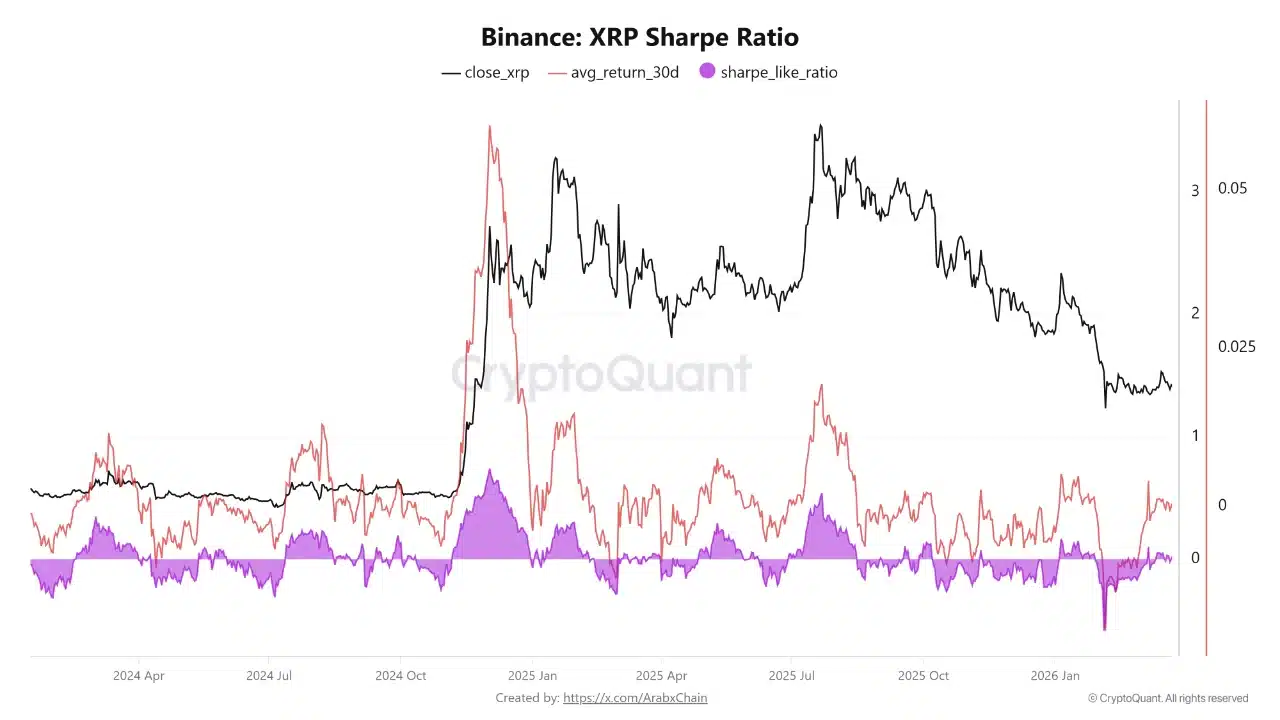
The risk-adjusted returns could be improving for Ripple [XRP], data showed. The Sharpe Ratio is used to help investors understand if an asset generates high returns, once adjusted for volatility.
Source: CryptoQuant

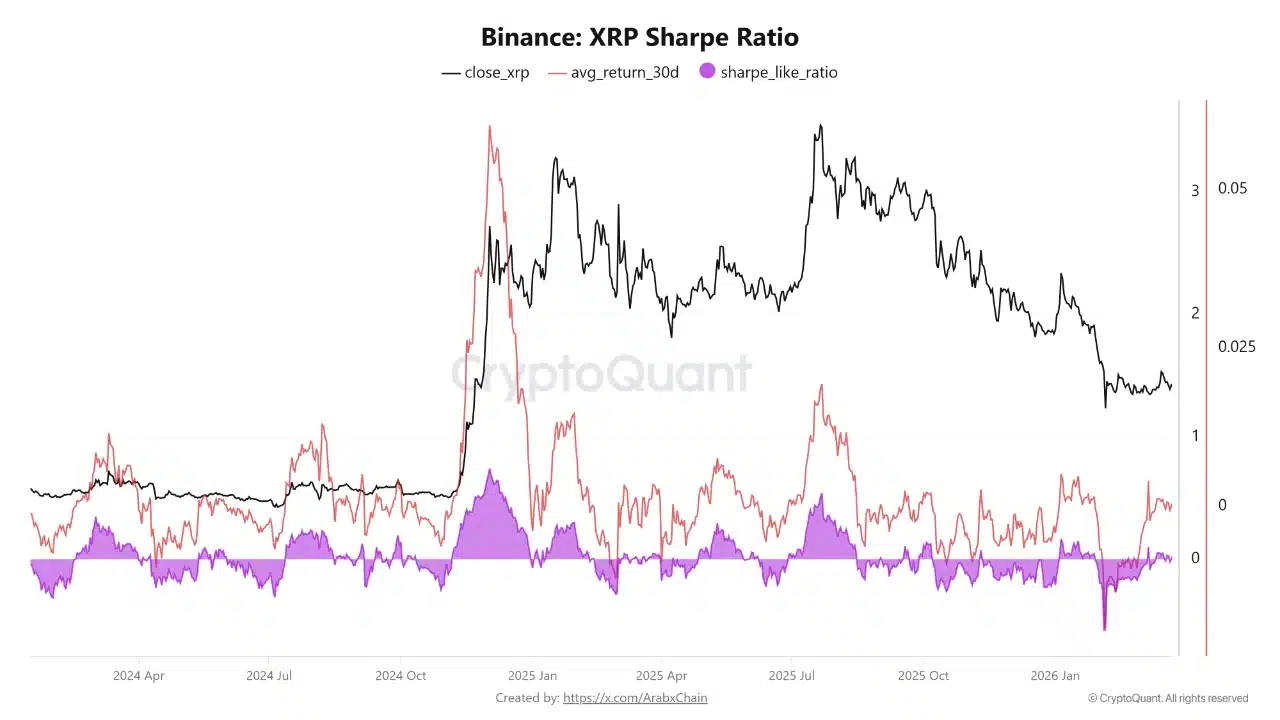
A rising Sharpe Ratio would imply a better risk-adjusted performance, observed an analyst in a post on CryptoQuant Insights. The metric saw a deep decline in February as the early January rally faded into a deeper downtrend. At that time, a Bitcoin [BTC] and crypto market-wide sell-off forced XRP prices from $2.35 to $1.21, a 48% drop.

The XRP gains in mid-March saw the 30-day returns spike higher. Recently, the Sharpe Ratio has improved gradually and has been hovering around the positive territory with a reading of 0.0267.

A sustained increase in the metric would mean that XRP is generating more gains with less volatility and could set the stage for a gradual bullish recovery. Yet, over the past six weeks, the price has kept pulling back to the $1.35 support, the same level XRP retested once more on the 26th of March.

The positive reading on the Sharpe Ratio showed that the risk-adjusted returns have improved moderately. It remains to be seen if the situation improves for the investors.

A drop-off in demand reflected bearish XRP sentiment

To keep the risk-adjusted returns rising, XRP needs increased demand which drive a sustained uptrend. A market that is not overleveraged would also keep the deep liquidity hunts at bay, reducing the daily volatility.
Source: CryptoQuant

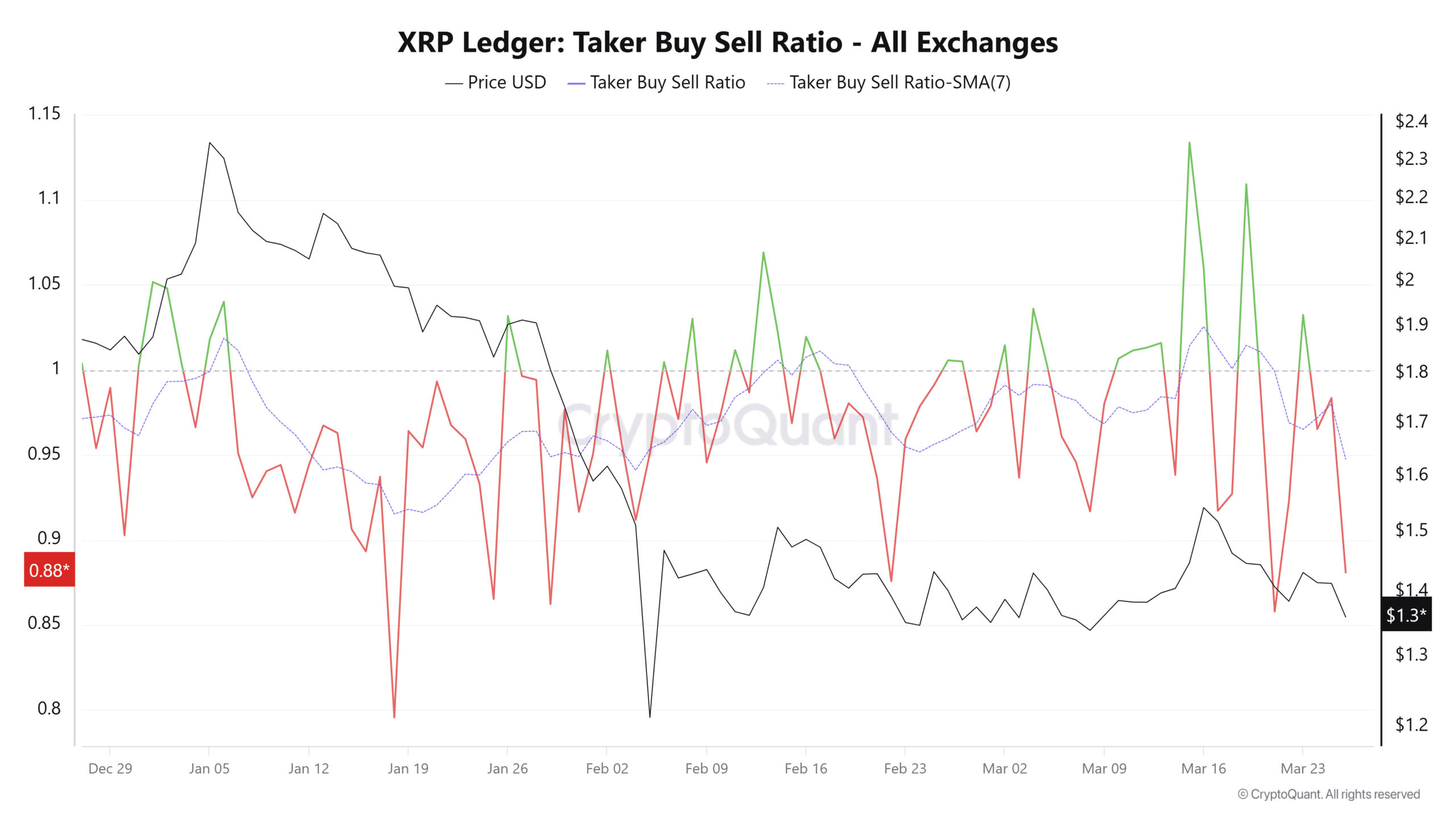
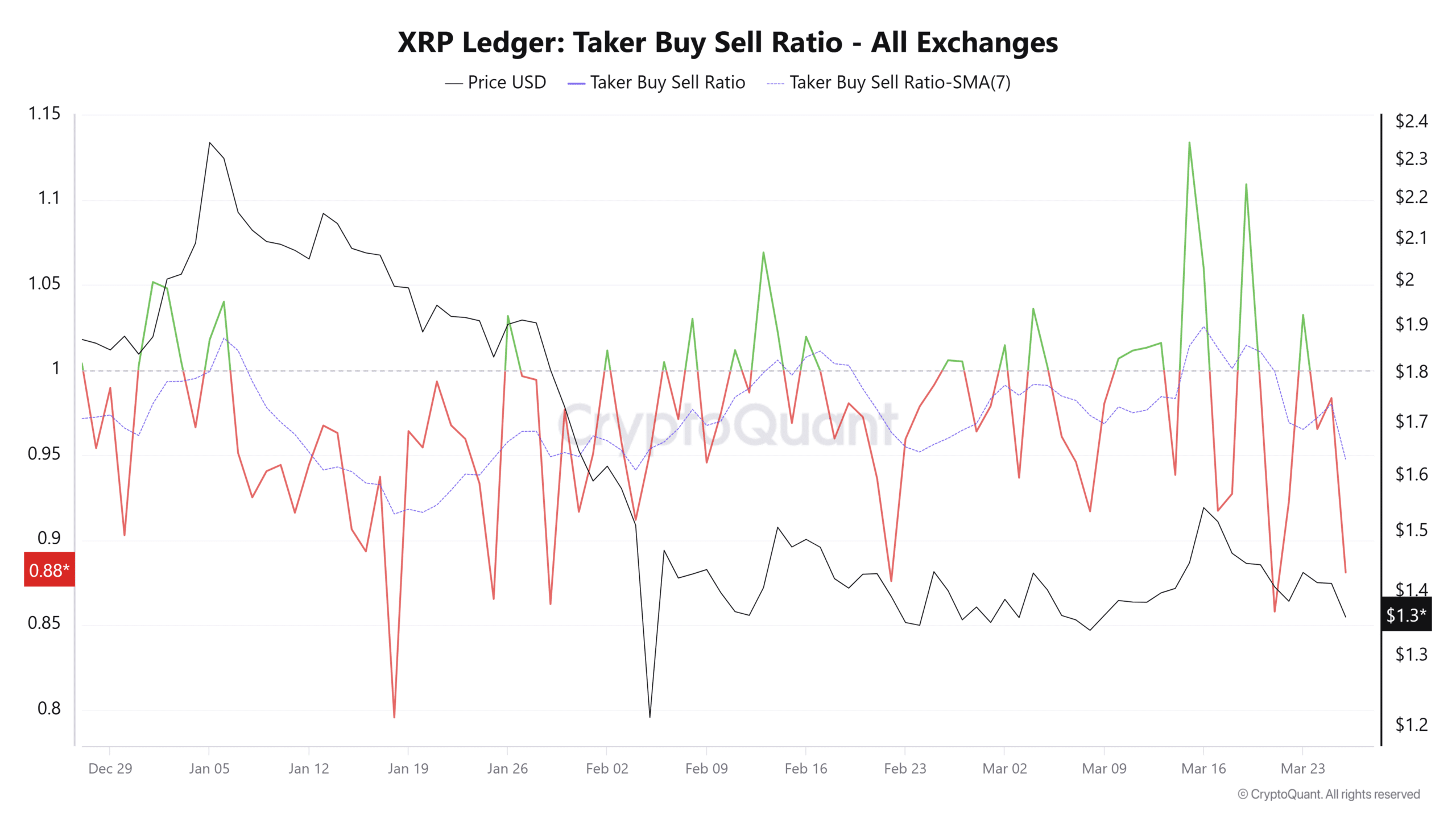
The Taker Buy-Sell Ratio was examined to understand the buyer aggression. In mid-March, when XRP rallied to $1.54 when Bitcoin reached $75k, the taker buy orders were prevalent. The 7-day moving average of the taker Buy/Sell Ratio climbed above 1 and stayed there for a few days, something that has only happened thrice in 2026.

This impetus didn’t last long. Over the past ten days, the crypto market correction saw sellers take the upper hand once again.
Source: CryptoQuant

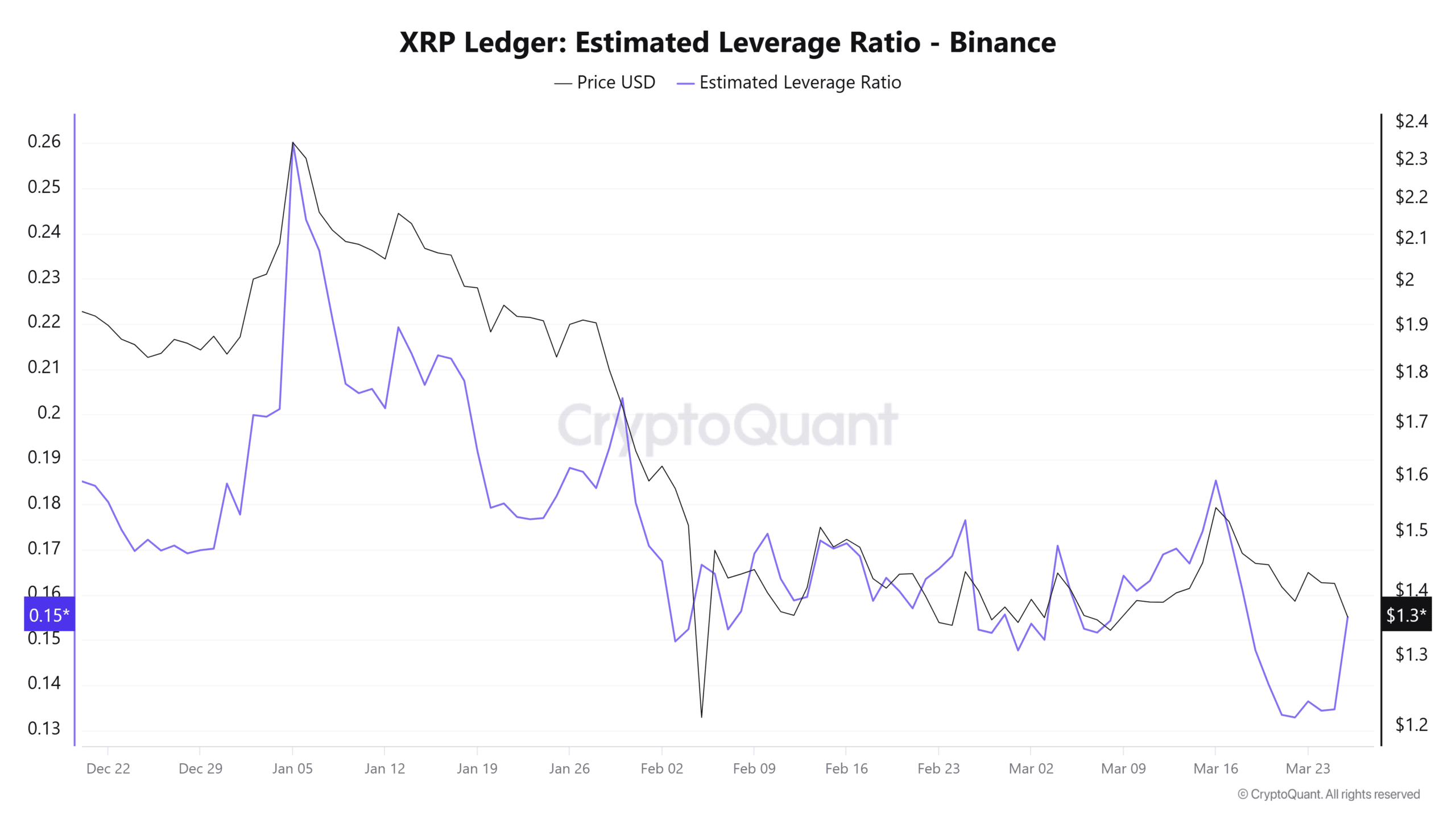
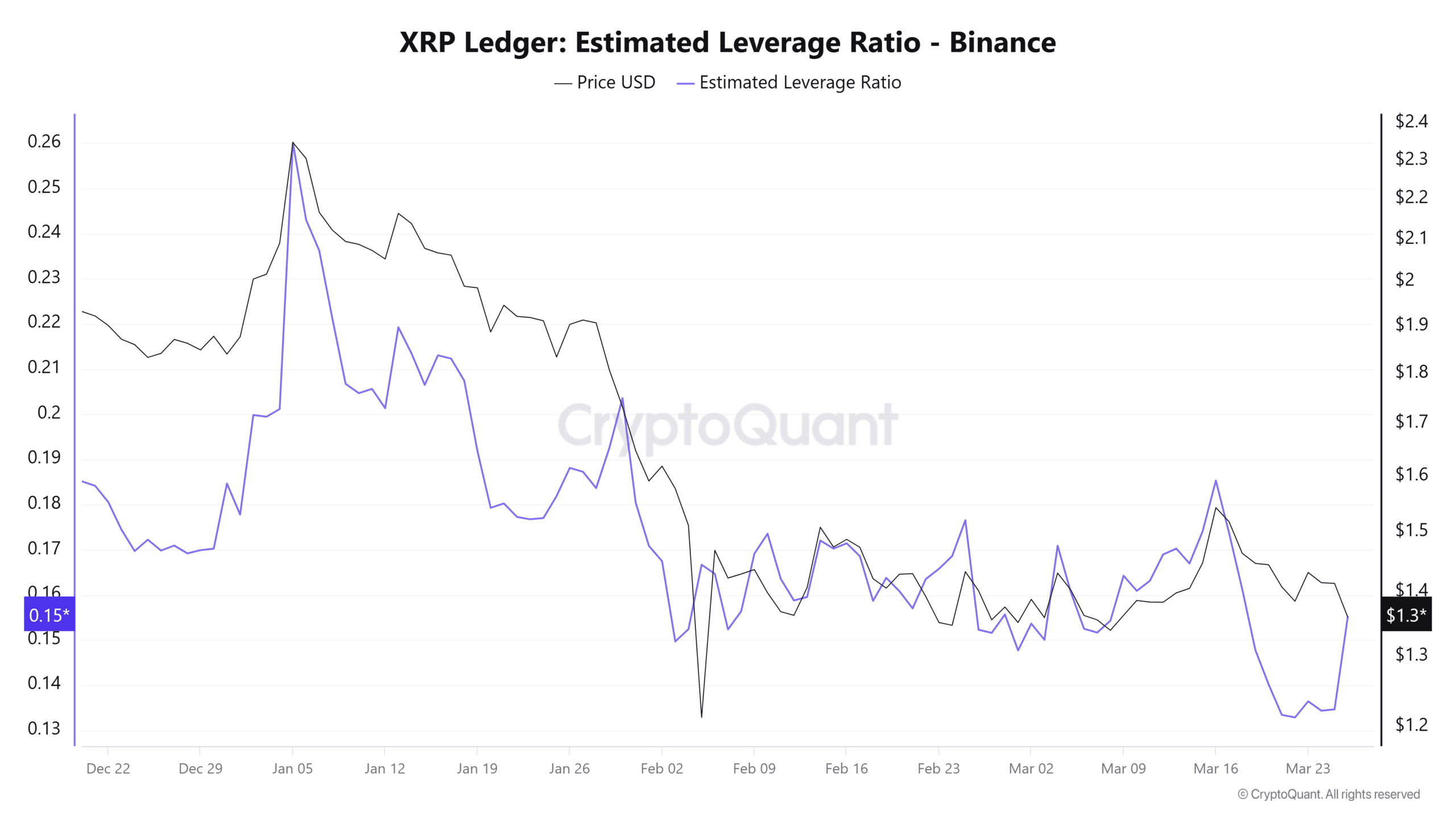
Additionally, the estimated leverage ratio has seen an uptick lately. An AMBCrypto report had pointed out that the reduced Open Interest (OI) behind XRP, combined with increased spot demand, meant that volatility risk was falling.

However, in the past 24 hours, the XRP OI has increased by 5.4%, the Estimated Leverage Ratio also spiked from 0.134 to 0.155. It signaled increased risk appetite from speculative traders. At the same time, it also warned of an increased threat of a hunt for liquidations and the associated price volatility.


Final Summary

  • The Sharpe ratio climbed back into positive territory after the deep drop during the February price correction.
  • Sustained spot demand and aggressive buyer activity are needed for XRP to defend the $1.20-$1.35 support and climb higher. Current market conditions were not favorable.


Связанные с этим вопросы

QWhat does the Sharpe Ratio indicate for Ripple (XRP) according to the article?

AThe Sharpe Ratio indicates that the risk-adjusted returns for XRP are improving, meaning it is generating more gains with less volatility, which could set the stage for a gradual bullish recovery.

QWhat was the price range of XRP during the February sell-off mentioned in the article?

ADuring the February sell-off, XRP prices dropped from $2.35 to $1.21, representing a 48% decline.

QWhat does the Taker Buy-Sell Ratio measure, and what did it show for XRP in mid-March?

AThe Taker Buy-Sell Ratio measures buyer aggression. In mid-March, it showed that taker buy orders were prevalent, and its 7-day moving average climbed above 1, indicating strong buying pressure.

QWhat recent change in the Estimated Leverage Ratio signals increased risk for XRP traders?

AThe Estimated Leverage Ratio spiked from 0.134 to 0.155, signaling an increased risk appetite from speculative traders and a heightened threat of liquidation hunts and price volatility.

QWhat are the two key factors needed for XRP to defend its support level and climb higher, as per the final summary?

ASustained spot demand and aggressive buyer activity are needed for XRP to defend the $1.20-$1.35 support level and climb higher.

Похожее

Breaking: OpenAI Undergoes Major Reorganization, President Brockman Assumes Command

OpenAI has announced a major internal reorganization just months before its anticipated IPO. The company is merging its three flagship product lines—ChatGPT, Codex, and the API platform—into a single, unified product organization. The most significant leadership change involves co-founder and President Greg Brockman moving from a background technical role to take full, permanent control over all product strategy. This follows the indefinite medical leave of AGI Deployment CEO Fidji Simo. Additionally, ChatGPT's longtime lead, Nick Turley, has been reassigned to enterprise products, with former Instagram executive Ashley Alexander taking over consumer offerings. The consolidation, internally framed as a strategic move towards an "Agentic Future," aims to break down internal silos and create a cohesive "Super App." This planned desktop application would integrate ChatGPT's conversational abilities, Codex's coding power, and a rumored internal web browser named "Atlas" to autonomously perform complex user tasks. The reorganization occurs amid significant internal and external pressures. OpenAI has recently seen a wave of high-profile departures, including Sora co-lead Bill Peebles and other senior technical leaders, leading to concerns about a thinning executive bench. Externally, rival Anthropic recently secured funding at a staggering $900 billion valuation, surpassing OpenAI's own. Google's upcoming I/O developer conference also poses a competitive threat. Analysts suggest the dramatic restructure is a pre-IPO move to present a clearer, more focused narrative to Wall Street—streamlining operations and demonstrating decisive leadership under Brockman to counter internal turbulence and intense market competition.

marsbit1 ч. назад

Breaking: OpenAI Undergoes Major Reorganization, President Brockman Assumes Command

marsbit1 ч. назад

Two Survival Structures of Market Makers and Arbitrageurs

Market makers and arbitrageurs represent two distinct survival structures in high-frequency trading. Market makers primarily use limit orders (makers) to profit from the bid-ask spread, enjoying high capital efficiency (nominally 100%) but bearing inventory risk. This "inventory risk" arises from passive, fragmented, and discontinuous order fills in the limit order book (LOB). This risk, while a potential cost, can also contribute to excess profit if managed within control boundaries, allowing for mean reversion. Market makers essentially sell "time" (uncertainty over execution timing) to the market for price control and low fees. In contrast, cross-exchange arbitrageurs typically use market orders (takers) to exploit price differences or funding rates, resulting in lower nominal capital efficiency (requiring capital on both exchanges) and higher transaction costs. Their risk exposure stems from asymmetries in exchange rules (e.g., minimum order sizes), execution latency, and infrastructure risks (e.g., ADL, oracle drift). These exposures are active, exogenous gaps that primarily erode profits rather than contribute to them. Arbitrageurs essentially sell "space" (capital sunk across venues) for localized, immediate certainty. Both strategies engage in a trade-off between execution friction and residual risk. Optimal systems allow for temporary, controlled risk exposure rather than enforcing zero exposure at all costs. Their evolution converges towards hybrid models: arbitrageurs may use maker orders to reduce costs, while market makers may use taker orders or hedges for risk management. Ultimately, both use different forms of risk exposure—market makers exposing inventory, arbitrageurs immobilizing capital—to extract marginal, hard-won certainty from the market.

链捕手1 ч. назад

Two Survival Structures of Market Makers and Arbitrageurs

链捕手1 ч. назад

Who Will Define the Rules of the AI Era? Anthropic Discusses the 2028 US-China AI Landscape

This article, based on Anthropic's analysis, outlines the intensifying systemic competition between the U.S./allies and China for AI leadership by 2028. It argues that access to advanced computing power ("compute") is the critical bottleneck, where the U.S. currently holds a significant advantage through chip export controls and allied innovation. However, China's AI labs remain competitive by exploiting policy loopholes—via chip smuggling, overseas data center access, and "model distillation" attacks to copy U.S. model capabilities—keeping them close to the frontier. The piece presents two contrasting scenarios for 2028. In the first, decisive U.S. action to tighten compute controls and curb distillation locks in a 12-24 month AI capability lead, cementing democratic influence over global AI norms, security, and economic infrastructure. In the second, policy inaction allows China to achieve near-parity through continued access to U.S. technology, enabling Beijing to promote its AI stack globally and integrate advanced AI into its military and governance systems, altering the strategic balance. Anthropic contends that maintaining a decisive U.S. lead is essential for shaping safe AI development and governance. The core recommendation is for U.S. policymakers to urgently close compute and model access loopholes while promoting global adoption of the U.S. AI technology stack to secure a lasting strategic advantage.

marsbit3 ч. назад

Who Will Define the Rules of the AI Era? Anthropic Discusses the 2028 US-China AI Landscape

marsbit3 ч. назад

Торговля

Спот
Фьючерсы

Популярные статьи

Как купить ONE

Добро пожаловать на HTX.com! Мы сделали приобретение Harmony (ONE) простым и удобным. Следуйте нашему пошаговому руководству и отправляйтесь в свое крипто-путешествие.Шаг 1: Создайте аккаунт на HTXИспользуйте свой адрес электронной почты или номер телефона, чтобы зарегистрироваться и бесплатно создать аккаунт на HTX. Пройдите удобную регистрацию и откройте для себя весь функционал.Создать аккаунтШаг 2: Перейдите в Купить криптовалюту и выберите свой способ оплатыКредитная/Дебетовая Карта: Используйте свою карту Visa или Mastercard для мгновенной покупки Harmony (ONE).Баланс: Используйте средства с баланса вашего аккаунта HTX для простой торговли.Третьи Лица: Мы добавили популярные способы оплаты, такие как Google Pay и Apple Pay, для повышения удобства.P2P: Торгуйте напрямую с другими пользователями на HTX.Внебиржевая Торговля (OTC): Мы предлагаем индивидуальные услуги и конкурентоспособные обменные курсы для трейдеров.Шаг 3: Хранение Harmony (ONE)После приобретения вами Harmony (ONE) храните их в своем аккаунте на HTX. В качестве альтернативы вы можете отправить их куда-либо с помощью перевода в блокчейне или использовать для торговли с другими криптовалютами.Шаг 4: Торговля Harmony (ONE)С легкостью торгуйте Harmony (ONE) на спотовом рынке HTX. Просто зайдите в свой аккаунт, выберите торговую пару, совершайте сделки и следите за ними в режиме реального времени. Мы предлагаем удобный интерфейс как для начинающих, так и для опытных трейдеров.

682 просмотров всегоОпубликовано 2024.04.12Обновлено 2025.06.06

Как купить ONE

Обсуждения

Добро пожаловать в Сообщество HTX. Здесь вы сможете быть в курсе последних новостей о развитии платформы и получить доступ к профессиональной аналитической информации о рынке. Мнения пользователей о цене на ONE (ONE) представлены ниже.

活动图片












