XRP ETFs Set To Trigger A Supply Squeeze? Here’s How Much Coins Are Left On Exchanges

bitcoinistОпубликовано 2025-12-30Обновлено 2025-12-30

Введение

XRP ETFs are driving a significant structural shift as institutional absorption rapidly reduces the liquid supply of XRP on exchanges. Approximately 750 million XRP have been withdrawn in recent weeks, leaving only an estimated 1.5 billion in exchange reserves. This sustained outflow, supported by regulatory clarity from the Clarity Act, indicates conviction-driven institutional accumulation rather than speculative trading. If this trend continues, exchange balances could reach critically low levels by early 2026, potentially triggering a supply shock. In such a scenario, price discovery would increasingly depend on liquidity mechanics and institutional flows rather than market sentiment, marking a structural inflection point for XRP.

XRP ETF activity is pushing the asset into a phase where market structure increasingly outweighs market sentiment, as exchange-held supply continues to contract while institutional access expands. Analysts are now examining whether sustained ETF absorption could function as a long-term demand sink, tightening liquid supply and reshaping the mechanics of price discovery.

Shrinking Supply? Institutional Absorption Of XRP ETFs Accelerates

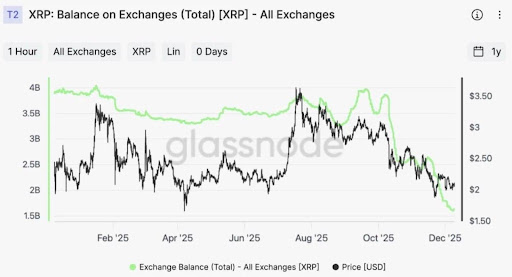
A market commentator on X has drawn attention to a sharp and sustained decline in XRP balances held across centralized exchanges, pointing to a structural change in how the asset is being absorbed and held. According to the figures cited, XRP ETFs have removed approximately 750 million XRP from exchanges within a matter of weeks, leaving an estimated 1.5 billion XRP remaining in liquid exchange reserves. This pace of absorption places exchange-held supply on a visibly contracting trajectory.

The same X account shared an on-chain chart that visually substantiates the decline in exchange-held XRP. The data shows total balances across centralized exchanges trending steadily lower throughout 2025. Notably, this contraction occurs while price action remains relatively contained, indicating that supply is being withdrawn from exchanges without provoking sharp directional moves. This separation between declining liquidity and stable pricing points to deliberate, conviction-driven absorption, consistent with long-term institutional positioning.

Source: Glassnode

ETF-held XRP, by design, functions as locked capital rather than short-term liquidity. Once absorbed into exchange-traded products and institutional custody structures, tokens are effectively sidelined from day-to-day trading activity. This creates a largely one-directional supply dynamic, reducing the amount of XRP available to respond to new demand. On-chain data visualized in the chart supports this interpretation, showing consistent outflows that persist through both local price peaks and pullbacks.

Regulatory developments further contextualize this trend. The market commentator explicitly links the tightening supply to the Clarity Act, which provides a framework for compliant institutional participation. With clearer legal treatment, XRP becomes suitable for long-term balance sheet exposure and operational use.

Why 2026 Is Emerging As A Structural Inflection Point

The supply narrative gains additional weight when viewed through a forward-looking lens. Projections pointing to early 2026 as a potential supply shock window are based not on aggressive acceleration, but on simple continuation. At the current rate of ETF-driven absorption, exchange balances could approach critically thin levels, creating a low-float market structure where marginal demand exerts disproportionate influence on price.

The chart underscores this risk. As exchange-held XRP compresses toward historically low territory, the remaining liquid supply increasingly defines price discovery. In such conditions, price formation shifts away from speculative churn and toward liquidity mechanics, where availability, custody constraints, and institutional flows dominate outcomes.

Taken together, falling exchange balances, sustained ETF absorption, and the regulatory clarity introduced by the Clarity Act all point to a market steadily tightening. Should these conditions persist into early 2026, XRP’s next major phase is likely to be shaped by scarcity and institutional liquidity dynamics, establishing a structural inflection point for the asset.

Price crashes after reversal | Source: XRPUSDT on Tradingview.com

Связанные с этим вопросы

QWhat is the main reason for the sharp decline in XRP balances on centralized exchanges?

AThe sharp decline is primarily due to the absorption of XRP by ETFs, which have removed approximately 750 million XRP from exchanges in a matter of weeks, indicating a structural change in how the asset is being held.

QHow much XRP is estimated to remain in liquid exchange reserves according to the article?

AAn estimated 1.5 billion XRP remains in liquid exchange reserves.

QWhat regulatory development is linked to the tightening supply of XRP?

AThe Clarity Act is linked to the tightening supply, as it provides a framework for compliant institutional participation, making XRP suitable for long-term balance sheet exposure and operational use.

QWhy is early 2026 considered a potential supply shock window for XRP?

AEarly 2026 is considered a potential supply shock window because, at the current rate of ETF-driven absorption, exchange balances could approach critically thin levels, creating a low-float market structure where marginal demand has a disproportionate impact on price.

QHow does the article describe the function of ETF-held XRP in the market?

AETF-held XRP functions as locked capital rather than short-term liquidity. Once absorbed into exchange-traded products and institutional custody, tokens are effectively sidelined from day-to-day trading, creating a one-directional supply dynamic that reduces available XRP for new demand.

Похожее

Arbitrum Pretends to Be the Hacker, 'Steals' Back the Money Lost by KelpDAO

Title: Arbitrum Poses as Hacker to Recover Stolen Funds from KelpDAO Last week, KelpDAO suffered a hack resulting in nearly $300 million in losses, marking the largest DeFi security incident this year. Approximately 30,765 ETH (worth over $70 million) remained on an Arbitrum address controlled by the attacker. In an unprecedented move, Arbitrum’s Security Council utilized its emergency authority to upgrade the Inbox bridge contract, adding a function that allowed them to impersonate the hacker’s address and initiate a transfer without access to its private key. The council’s action, approved by 9 of its 12 members, moved the stolen ETH to a frozen address in a single transaction before reverting the contract to its original state. The operation was coordinated with law enforcement, which attributed the attack to North Korea’s Lazarus Group. Community reactions are divided: some praise the recovery of funds, while others question the centralization of power, as the council can upgrade core contracts without governance votes. However, such emergency mechanisms are common among major L2s. Despite the partial recovery, over $292 million was stolen in total, with more than $100 million in bad debt on Aave and remaining funds scattered across other chains. The incident highlights escalating security challenges in DeFi, with state-sponsored hackers employing advanced tactics and L2s responding with elevated countermeasures.

marsbit12 мин. назад

Arbitrum Pretends to Be the Hacker, 'Steals' Back the Money Lost by KelpDAO

marsbit12 мин. назад

iQiyi Is Too Impatient

The article "iQiyi Is Too Impatient" discusses the controversy surrounding the Chinese streaming platform IQiyi's recent announcement of an "AI Actor Library" during its 2026 World Conference. IQiyi claimed over 100 actors, including well-known names like Zhang Ruoyun and Yu Hewei, had joined the initiative. CEO Gong Yu suggested AI could enable actors to "star in 14 dramas a year instead of 4" and that "live-action filming might become a world cultural heritage." The announcement quickly sparked backlash. Multiple actors named in the list issued urgent statements denying they had signed any AI-related authorization agreements. This forced IQiyi to clarify that inclusion in the library only indicated a willingness to *consider* AI projects, with separate negotiations required for any specific role. The incident, which trended on social media with hashtags like "IQiyi is crazy," is presented as a sign of the company's growing desperation. Facing intense competition from short-video platforms like Douyin and Kuaishou, as well as Bilibili and Xiaohongshu, IQiyi's financial performance has weakened, with revenues declining for two consecutive years. The author argues that IQiyi is "too impatient" to tell a compelling AI story to reassure the market, especially as it pursues a listing on the Hong Kong stock exchange. The piece concludes by outlining three key "AI questions" IQiyi must answer: defining its role as a tool provider versus a content creator, balancing the "coldness" of AI with the human element audiences desire, and properly managing the interests of platforms, actors, and viewers. The core dilemma is that while AI can reduce costs and increase efficiency, it risks creating homogenized, formulaic content and devaluing human performers.

marsbit1 ч. назад

iQiyi Is Too Impatient

marsbit1 ч. назад

Торговля

Спот
Фьючерсы

Популярные статьи

Как купить S

Добро пожаловать на HTX.com! Мы сделали приобретение Sonic (S) простым и удобным. Следуйте нашему пошаговому руководству и отправляйтесь в свое крипто-путешествие.Шаг 1: Создайте аккаунт на HTXИспользуйте свой адрес электронной почты или номер телефона, чтобы зарегистрироваться и бесплатно создать аккаунт на HTX. Пройдите удобную регистрацию и откройте для себя весь функционал.Создать аккаунтШаг 2: Перейдите в Купить криптовалюту и выберите свой способ оплатыКредитная/Дебетовая Карта: Используйте свою карту Visa или Mastercard для мгновенной покупки Sonic (S).Баланс: Используйте средства с баланса вашего аккаунта HTX для простой торговли.Третьи Лица: Мы добавили популярные способы оплаты, такие как Google Pay и Apple Pay, для повышения удобства.P2P: Торгуйте напрямую с другими пользователями на HTX.Внебиржевая Торговля (OTC): Мы предлагаем индивидуальные услуги и конкурентоспособные обменные курсы для трейдеров.Шаг 3: Хранение Sonic (S)После приобретения вами Sonic (S) храните их в своем аккаунте на HTX. В качестве альтернативы вы можете отправить их куда-либо с помощью перевода в блокчейне или использовать для торговли с другими криптовалютами.Шаг 4: Торговля Sonic (S)С легкостью торгуйте Sonic (S) на спотовом рынке HTX. Просто зайдите в свой аккаунт, выберите торговую пару, совершайте сделки и следите за ними в режиме реального времени. Мы предлагаем удобный интерфейс как для начинающих, так и для опытных трейдеров.

1.1k просмотров всегоОпубликовано 2025.01.15Обновлено 2025.03.21

Как купить S

Sonic: Обновления под руководством Андре Кронье – новая звезда Layer-1 на фоне спада рынка

Он решает проблемы масштабируемости, совместимости между блокчейнами и стимулов для разработчиков с помощью технологических инноваций.

2.2k просмотров всегоОпубликовано 2025.04.09Обновлено 2025.04.09

Sonic: Обновления под руководством Андре Кронье – новая звезда Layer-1 на фоне спада рынка

HTX Learn: Пройдите обучение по "Sonic" и разделите 1000 USDT

HTX Learn — ваш проводник в мир перспективных проектов, и мы запускаем специальное мероприятие "Учитесь и Зарабатывайте", посвящённое этим проектам. Наше новое направление .

1.8k просмотров всегоОпубликовано 2025.04.10Обновлено 2025.04.10

HTX Learn: Пройдите обучение по "Sonic" и разделите 1000 USDT

Обсуждения

Добро пожаловать в Сообщество HTX. Здесь вы сможете быть в курсе последних новостей о развитии платформы и получить доступ к профессиональной аналитической информации о рынке. Мнения пользователей о цене на S (S) представлены ниже.

活动图片