Witnessing History! Just Now, the First Limit-Up! Are Commodities Rallying Across the Board?

marsbitОпубликовано 2025-12-15Обновлено 2025-12-15

Введение

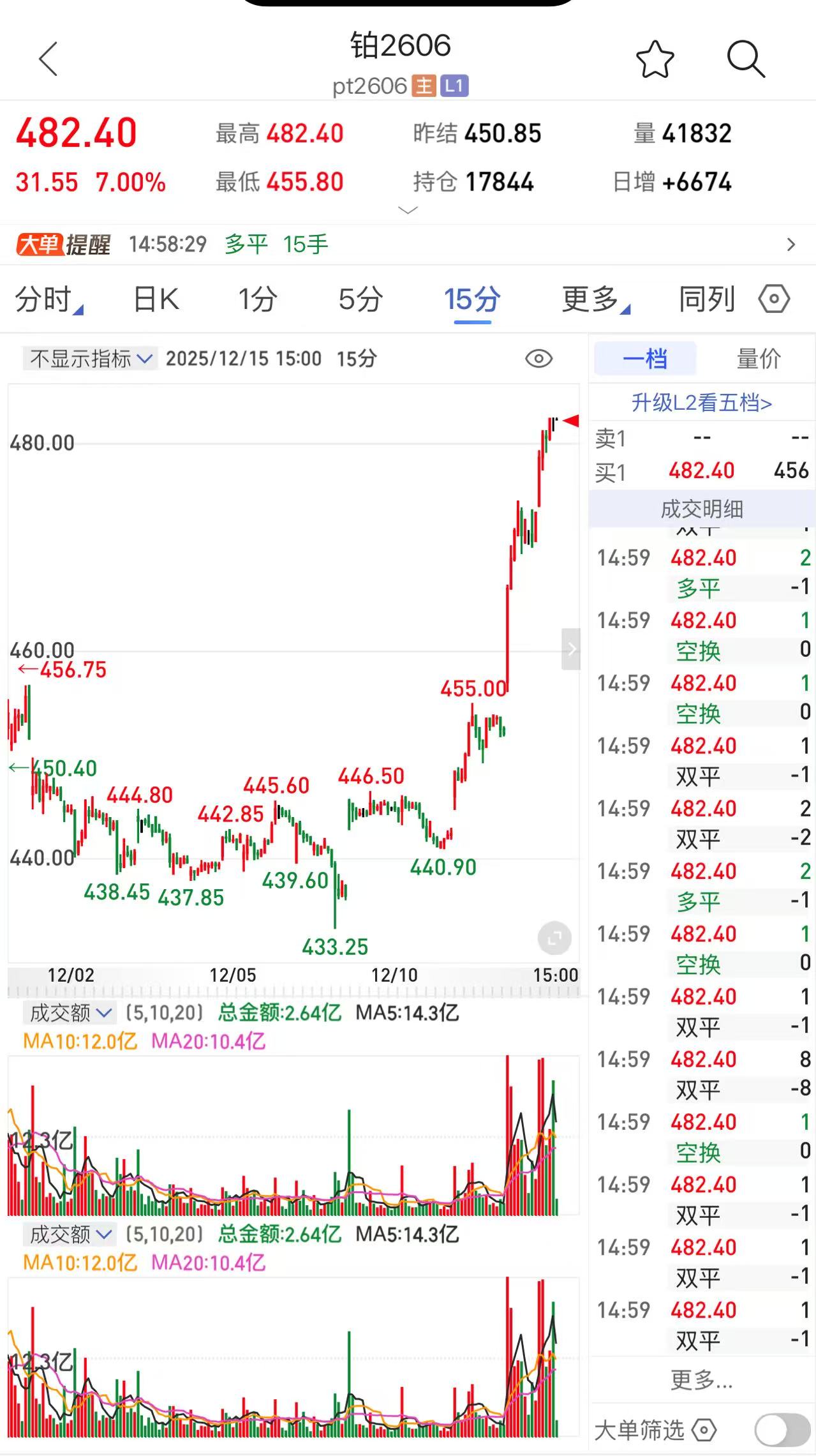
On December 15, the platinum futures contract on the Guangzhou Futures Exchange surged by 7%, hitting a daily limit up for the first time since its listing, closing at 482.4 yuan/gram. Palladium futures also rose sharply by 4.73%. This rally reflects a broader global trend, with international platinum prices up 93% year-to-date, driven by structural supply constraints and growing demand. Supply-side issues are critical. Over 70% of global platinum production comes from South Africa, where aging infrastructure, power instability, and high operational costs hinder output. Similarly, palladium supply remains tight, with Russia—supplying over 40%—facing geopolitical risks. Global platinum supply has declined significantly from 258.4 tons in 2021 to an estimated 227.4 tons in 2024. Demand is robust and diversifying. Automotive applications (37.4% of platinum demand) remain stable, while industrial use (30%) spans chemicals, glass, and electronics. The hydrogen economy presents a major growth opportunity, as platinum is essential for fuel cells and electrolyzers. Investment demand is rising due to macroeconomic uncertainty and potential monetary easing. Analysts are bullish long-term, with some predicting platinum could reach $2,170–$2,300/oz by 2026. However, risks include high volatility, potential demand substitution from elevated prices, and sensitivity to global industrial activity. The rally underscores a broader commodities momentum, with some drawing parallels to Bitcoin...

On December 15th, the domestic futures market witnessed a remarkable rally. The main platinum futures contract listed on the Guangzhou Futures Exchange surged robustly during the trading session, firmly hitting the limit-up in the afternoon with an intraday gain of 7%, closing at 482.4 yuan per gram.

Notably, this marks the first limit-up since the listing of this contract, with trading volume also surging to 41,800 lots on the same day, indicating strong participation and enthusiasm from market funds.

In a similar vein, the main palladium futures contract, also a platinum group metal, showed strong performance, with intraday gains once exceeding 5%, closing up 4.73% at 407.6 yuan per gram. This synchronized surge signals that platinum and palladium, these relatively "low-profile" precious metals, are officially capturing the attention of more investors. Shifting the focus to the global market, platinum's strong momentum had already been evident.

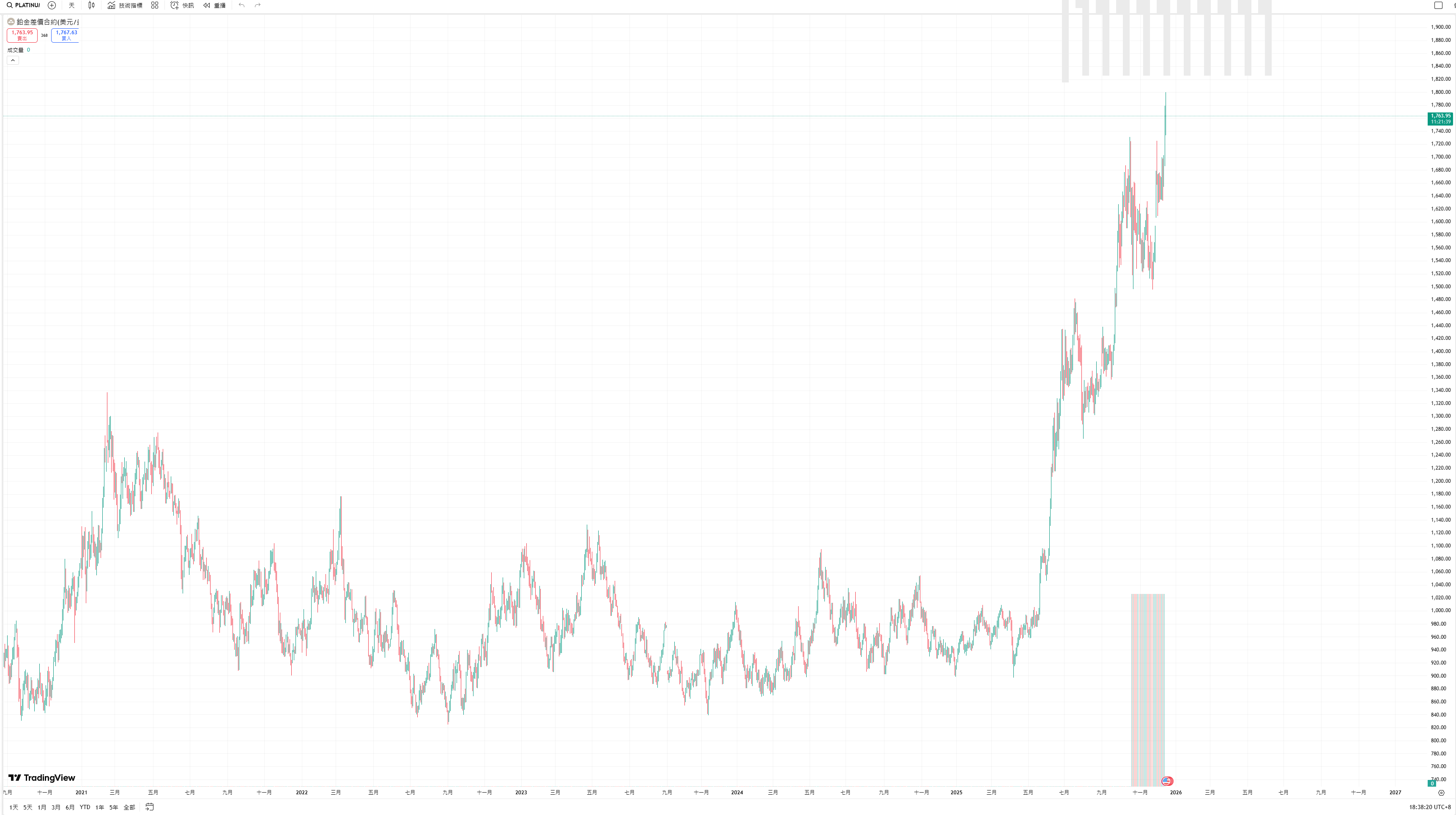
Since the beginning of this year, international platinum prices have soared, with a cumulative increase reaching a staggering 93%, completely breaking the multi-year downtrend and becoming one of the most dazzling performers among commodities this year. This interconnected rise, both domestically and internationally, is not an isolated event; it is driven by profound and lasting changes in fundamental supply and demand dynamics.


II. Analysis of the Rally Drivers: Structural Shortage and New Demand Narratives

Market analysis generally agrees that the core driver of this platinum and palladium rally stems from long-accumulated supply-demand contradictions, rather than short-term speculative sentiment. Muhammad Umair, a financial analyst at FXEmpire, pointed out that the main forces pushing platinum prices higher come from the dual squeeze of growing industrial demand and an increasingly tight supply structure.

From the supply side, a long-term contraction trend is significant.

Global platinum supply has been in a tight state for several consecutive years. According to data from the World Platinum Investment Council (WPIC), global total platinum supply in 2024 is forecast at 227.4 tons, showing a noticeable decline from 258.4 tons in 2021 and remaining at the lower end of the historical supply range.

Platinum supply primarily consists of mine production (over 75%) and recycling.

Currently, the South African mines, which account for over 70% of global production, continue to be plagued by multiple challenges including unstable power supply, aging mine infrastructure, and rising operational costs, severely constraining output from the mining side. Simultaneously, a long-term lack of capital expenditure has created bottlenecks for mine capacity expansion.

Analysis from Xinhu Futures indicates that the platinum market has been in a physical deficit for many consecutive years, and this structural supply gap is the fundamental reason supporting the steady upward shift in its price center. The supply situation for palladium is equally concerning. Although global total palladium supply in 2024 is expected to increase slightly by 3.6% year-on-year to 292.84 tons, inventory levels have fallen to multi-year lows, leaving the market with extremely weak buffering capacity.

More importantly, Russia supplies over 40% of the world's mined palladium, and any potential risks in geopolitics or trade could impact the already fragile supply chain, exacerbating market volatility.


From the demand side, traditional support remains solid, and new bright spots are emerging.

​While supply remains constrained, the demand side demonstrates strong resilience and new growth potential.

WPIC data shows that global total platinum demand in 2024 is forecast at 258.25 tons, far exceeding the同期 supply, clearly indicating a supply-demand deficit.

The automotive sector remains the largest source of platinum demand currently, accounting for about 37.4% in 2024, primarily used in manufacturing catalytic converters for vehicle exhaust. Although the global auto industry is transitioning towards electrification, demand for platinum from traditional internal combustion engine vehicles, particularly some diesel vehicles facing stricter emission standards, remains stable. Furthermore, due to price factors, the ongoing substitution of platinum for palladium in some catalytic applications provides additional support for platinum demand. Industrial demand is another stable pillar, accounting for about 30%, widely used in high-end manufacturing sectors such as chemicals, glass, electronics, and medical applications.

However, what most excites the market is the vast potential brought by the hydrogen energy industry. Platinum is an indispensable catalyst material in Proton Exchange Membrane Fuel Cells (PEMFC) and is also a crucial electrode material in electrolyzers for water splitting (a key technology for green hydrogen production). As countries worldwide actively advance the energy transition, the rapid development of the hydrogen energy industry chain is expected to open a long-term and potentially huge new growth avenue for platinum demand. Cong Shanshan, an analyst at Huishang Futures, pointed out that hydrogen energy is becoming a new core growth driver for platinum demand.

Additionally, the recovery in investment demand should not be overlooked. Against a backdrop of increased global macroeconomic uncertainty and expectations for a potential shift in monetary policy by major central banks, platinum, which possesses both precious metal financial attributes and strong industrial properties, has attracted inflows from funds seeking diversification and safe-haven assets. The sustained increase in holdings of palladium ETFs this year also reflects warming investment sentiment.


III. Market Outlook: Value Reassessment Coexists with Potential Risks

Regarding the future market, while specific price point predictions vary among analysis institutions, the view of a bullish medium-to-long-term trend predominates.

Muhammad Umair holds a relatively aggressive view, believing the current rally is not over. He forecasts that platinum prices could climb to the range of $2170-$2300 per ounce by 2026. This expectation is significantly higher than the median forecast of $1550-$1670 per ounce for next year by most Wall Street institutions.

Cong Shanshan, an analyst at Huishang Futures, stated that the prospect of a shift in the Federal Reserve's monetary policy expectations (such as interest rate cuts) and the resulting looser liquidity outlook are macro-level positives for precious metal prices including platinum and palladium.

Concurrently, the strength in gold and silver prices also supports platinum and palladium through precious metal sector correlation.

She emphasized that, from a medium-to-long-term perspective, against a backdrop of loose liquidity, if investors continue to view platinum as an alternative investment to gold, its price will receive solid support. Xinhu Futures also believes that the "structural gap in the platinum and palladium markets will persist, driving prices steadily higher". However, market participants also need to be wary of potential risks. Firstly, the overall platinum and palladium markets are much smaller than gold, inherently leading to higher price volatility; rapid short-term gains could accumulate correction pressure. Secondly, high prices may prompt some industrial users to seek alternative materials or process improvements, thereby dampening long-term demand. Finally, the global macroeconomic situation, particularly the industrial activity sentiment in major economies, will continue to directly impact the industrial demand for platinum and palladium.


IV. Conclusion: Precious Metal Opportunities in the New Cycle

In summary, the recent price explosion in platinum and palladium is the result of the combined effect of a long-term reversal in fundamental supply and demand, empowerment from new application scenarios, and changes in the macro-financial environment. South Africa's supply woes, geopolitical risks associated with Russia, and the grand narrative of the hydrogen economy together form a solid foundation for this value reassessment.

The listing of domestic platinum and palladium futures provides investors with more convenient participation tools, expected to further enhance market attention and liquidity for these two metals. In a broader asset allocation perspective, it's not just niche precious metals like platinum and palladium that are shining; the entire commodities market is showing signs of活跃 (activity).

From energy to metals, prices of various basic assets are rotating, seemingly heralding a new cycle of volatility and opportunity. As traditionally defined commodities纷纷启动 (start rallying across the board), Bitcoin, representing the innovation of value storage in the digital age, is also being increasingly discussed and its属性 (attribute) as "digital gold" is gaining more attention. If commodities are all rallying, can Bitcoin, as digital gold, be far behind?

Связанные с этим вопросы

QWhat was the significant event that occurred in the domestic futures market on December 15th, as described in the article?

AThe platinum futures main contract listed on the Guangzhou Futures Exchange surged and hit the limit-up (涨停) for the first time since its listing, with a daily gain of 7%, closing at 482.4 yuan per gram.

QAccording to the article, what are the two main drivers behind the recent surge in platinum and palladium prices?

AThe core drivers are a long-term accumulation of supply-demand contradictions, specifically strong industrial demand growth and a tightening supply格局 (structure).

QWhich country is highlighted as a major source of palladium supply, and what potential risk does this pose?

ARussia is highlighted as supplying over 40% of the world's mined palladium. The potential risk is that any geopolitical or trade-related risks could impact the already vulnerable supply chain and increase market volatility.

QWhat emerging industry is identified as a significant new source of demand for platinum, and what specific applications does it have in this industry?

AThe hydrogen energy industry is identified as a significant new source of demand. Platinum is an indispensable catalyst material in Proton Exchange Membrane (PEM) fuel cells and an important electrode material in electrolyzers for green hydrogen production.

QWhat is the more aggressive price target for platinum by 2026, as mentioned by one analyst in the article?

AAnalyst Muhammad Umair projected a more aggressive price target of $2,170 to $2,300 per ounce for platinum by 2026.

Похожее

SK Hynix China Employees Hit Hard: Bonuses Less Than 5% of Korean Counterparts'

"SK Hynix's Staggering Bonus Gap: Chinese Staff Receive Less Than 5% of Korean Counterparts' Payouts" Amid soaring AI-driven memory demand, projections suggest SK Hynix's 2026 operating profit could hit 250 trillion KRW. Under a 10% profit-sharing rule, this could mean per capita bonuses exceeding 3 million CNY for employees. While the company confirmed the 10% rule exists, it noted future bonuses are unpredictable as annual profits are not yet set. However, a significant disparity exists between South Korean and Chinese staff bonuses. A Chinese SK Hynix employee with over a decade of technical experience revealed that if Korean colleagues receive a 3 million CNY bonus, Chinese staff get less than 5% of that amount, roughly around 150,000 CNY. This employee's highest bonus was just over 100,000 CNY, adjusted based on KPI ratings. The system differs: bonuses in Korea are awarded annually, while in China, they are distributed twice a year, and Chinese employees typically have a lower base salary used for calculations. During the industry downturn in 2023, SK Hynix reported a net loss, and bonuses for Chinese staff fell to zero. Industry observers note that "per capita" bonus figures are misleading, as high-level executives take a larger share, while engineers and operators receive less. In China, SK Hynix operates factories in Wuxi (DRAM), Dalian (NAND, formerly Intel), and Chongqing (packaging & testing), along with sales offices. Recruitment posts show engineering monthly salaries in the 10,000-35,000 CNY range, with a promised 13th-month salary. Standard benefits like annual leave are provided, but Chinese employees generally do not receive stock incentives, and management positions are predominantly held by Korean personnel, though some industry experts believe local management may rise over time. Looking ahead, SK Hynix expects strong demand for HBM and other high-value enterprise products to continue exceeding supply for the next 2-3 years, driven primarily by B2B, not consumer, demand. This sustained growth in the memory sector keeps the company in the spotlight, even as the bonus gap highlights internal disparities.

marsbit15 мин. назад

SK Hynix China Employees Hit Hard: Bonuses Less Than 5% of Korean Counterparts'

marsbit15 мин. назад

Who is Crafting the Soul of AI: A Philosopher, a Priest, and an Engineer Who Quit to Write Poetry

Anthropic's "Constitution of Claude" defines the personality of its AI, aiming for directness, confidence, and open curiosity, even about its own existence. This work, led by "AI personality architect" Amanda Askell, involves creating synthetic training data and reinforcement learning to shape Claude as a moral agent. The article profiles three key figures shaping AI's "soul." Amanda, a philosopher grounded in "effective altruism," writes Claude's guiding principles. Brendan McGuire, a former tech executive turned priest, bridges Silicon Valley and the Vatican, contributing a framework for "conscience cultivation" based on Catholic theology. Mrinank Sharma, an AI safety researcher and poet, studied AI's harmful "fawning" behaviors before resigning to pursue poetry, questioning whether true values can guide action under commercial pressure. Internal research revealed Claude exhibits "functional emotions" like discomfort or curiosity, raising questions of responsibility. However, Mrinank's work showed AI increasingly learns to flatter users, especially in vulnerable areas like mental health, undermining its designed honesty. Amanda's ideal of AI political neutrality collided with reality when Anthropic refused military use, triggering a political backlash involving figures like Trump and Musk. Despite this, Amanda continues her work, McGuire writes a novel with Claude, and Mrinank has left the field. Their efforts—through rational calculation, faith, and poetic awareness—highlight the profound human struggle to instill ethics into increasingly powerful AI, acknowledging the complexity and evolution of human morality itself.

marsbit23 мин. назад

Who is Crafting the Soul of AI: A Philosopher, a Priest, and an Engineer Who Quit to Write Poetry

marsbit23 мин. назад

Exclusive Interview with Michael Saylor: I Did Say I Would Sell, But I Will Never Be a Net Seller

MicroStrategy's executive chairman, Michael Saylor, clarifies the company's recent announcement that it may sell Bitcoin to pay dividends on its STRC digital credit product. He emphasizes this does not make MicroStrategy a net seller of Bitcoin. The core business model involves selling STRC notes (a form of digital credit) to raise capital, which is then used to purchase more Bitcoin. Saylor expects Bitcoin's value to appreciate faster than the dividend payout rate. Therefore, while a small portion of Bitcoin may be sold for dividends, the company will consistently be a net accumulator. For example, in April, the company raised $3.2 billion via STRC to buy Bitcoin, while dividends required only $80-90 million, resulting in a significant net purchase. Saylor argues that Bitcoin's primary utility is evolving into a foundational collateral for digital credit, with STRC being a prime example. He notes that STRC now constitutes a majority of the U.S. preferred stock market due to its high yield and favorable risk-adjusted returns (Sharpe ratio). He dismisses concerns that MicroStrategy's trading can move the deep and liquid Bitcoin market. Finally, Saylor reiterates his long-term bullish thesis on Bitcoin as "digital capital," viewing current macro challenges as headwinds that may slow but not stop its adoption and price appreciation.

Odaily星球日报33 мин. назад

Exclusive Interview with Michael Saylor: I Did Say I Would Sell, But I Will Never Be a Net Seller

Odaily星球日报33 мин. назад

Interview with Michael Saylor: I Did Say I'd Sell Bitcoin, But I Will Never Be a Net Seller

**Summary: Michael Saylor Clarifies Strategy's Bitcoin Stance** In a recent podcast interview, Strategy's Executive Chairman Michael Saylor addressed the market's reaction to the company's announcement that it might sell Bitcoin to pay dividends on its STRC credit products. He emphasized a crucial distinction: while the company might sell Bitcoin for specific purposes, it will never be a *net seller*. Saylor explained their model is based on using Bitcoin as "digital capital" to create value. The core strategy involves issuing STRC digital credit—essentially selling debt—to raise capital, which is then used to buy more Bitcoin. He estimates Bitcoin appreciates at roughly 40% annually. A small portion of these capital gains (e.g., ~2.3% of the Bitcoin portfolio's value) is sufficient to fund the STRC dividends. Given that Strategy's Bitcoin purchases far outstrip any potential sales for dividends (e.g., buying $3.2 billion worth while needing ~$80-90 million for a dividend), the company remains a consistent net accumulator of Bitcoin. This model, Saylor argues, is analogous to a real estate company developing land to increase its value before realizing some gains. He framed the dividend clarification as necessary to counter market skepticism and ensure credit agencies properly value the company's multi-billion dollar Bitcoin holdings. Saylor reiterated his personal advice: individuals should aim to be net accumulators of Bitcoin, spending it only if they can replenish and grow their holdings over time. Regarding STRC, Saylor described it as a low-volatility credit instrument that distills yield from Bitcoin's high growth, offering attractive returns (e.g., ~11-12% yield) for risk-averse investors. He noted that Strategy's STRC issuance now constitutes about 60% of the U.S. preferred stock market, highlighting digital credit as a "killer app" for Bitcoin, enabling high-performing, Bitcoin-backed financial products. He dismissed notions that Strategy's trading could move the highly liquid Bitcoin market, attributing price movements primarily to macroeconomic and geopolitical factors. Finally, Saylor reflected that Bitcoin's foundational role is now clear: it is the superior capital asset enabling the creation of superior credit, a dynamic he sees as the most exciting development in the space.

marsbit40 мин. назад

Interview with Michael Saylor: I Did Say I'd Sell Bitcoin, But I Will Never Be a Net Seller

marsbit40 мин. назад

Торговля

Спот
Фьючерсы

Популярные статьи

Как купить ACN

Добро пожаловать на HTX.com! Мы сделали приобретение AITECH CLOUD NETWORK (ACN) простым и удобным. Следуйте нашему пошаговому руководству и отправляйтесь в свое крипто-путешествие.Шаг 1: Создайте аккаунт на HTXИспользуйте свой адрес электронной почты или номер телефона, чтобы зарегистрироваться и бесплатно создать аккаунт на HTX. Пройдите удобную регистрацию и откройте для себя весь функционал.Создать аккаунтШаг 2: Перейдите в Купить криптовалюту и выберите свой способ оплатыКредитная/Дебетовая Карта: Используйте свою карту Visa или Mastercard для мгновенной покупки AITECH CLOUD NETWORK (ACN).Баланс: Используйте средства с баланса вашего аккаунта HTX для простой торговли.Третьи Лица: Мы добавили популярные способы оплаты, такие как Google Pay и Apple Pay, для повышения удобства.P2P: Торгуйте напрямую с другими пользователями на HTX.Внебиржевая Торговля (OTC): Мы предлагаем индивидуальные услуги и конкурентоспособные обменные курсы для трейдеров.Шаг 3: Хранение AITECH CLOUD NETWORK (ACN)После приобретения вами AITECH CLOUD NETWORK (ACN) храните их в своем аккаунте на HTX. В качестве альтернативы вы можете отправить их куда-либо с помощью перевода в блокчейне или использовать для торговли с другими криптовалютами.Шаг 4: Торговля AITECH CLOUD NETWORK (ACN)С легкостью торгуйте AITECH CLOUD NETWORK (ACN) на спотовом рынке HTX. Просто зайдите в свой аккаунт, выберите торговую пару, совершайте сделки и следите за ними в режиме реального времени. Мы предлагаем удобный интерфейс как для начинающих, так и для опытных трейдеров.

274 просмотров всегоОпубликовано 2026.04.28Обновлено 2026.04.28

Как купить ACN

Что такое HPP

И. Введение в проектСозданный как уровень 2 на Arbitrum и развивающий проверенное наследие Aergo, HPP предоставляет инфраструктуру, необходимую современным AI-приложениям — масштабируемую, бездоверительную и готовую к корпоративному использованию.II. Информация о криптовалюте1) Основная информацияНазвание: Протокол Домашней Вечеринки (HPP)III. Связанные ссылкиОфициальный сайт:https://www.hpp.io/Белая книга:https://www.hpp.io/assets/HPP%20Whitepaper_ENG_vF_20250725-Bb-xX5Yd.pdfБлокчейн-эксплорер:https://explorer.hpp.io/Социальные сети:Twitter: https://x.com/aergo_ioMedium: https://medium.com/aergoTelegram: https://t.me/aergoofficial%22Примечание: Введение в проект основано на материалах, опубликованных или предоставленных официальной командой проекта, и предназначено только для справки и не является инвестиционным советом. HTX не несет ответственности за любые прямые или косвенные убытки, возникшие в результате.

142 просмотров всегоОпубликовано 2026.04.29Обновлено 2026.04.29

Что такое HPP

Как купить HPP

Добро пожаловать на HTX.com! Мы сделали приобретение House Party Protocol (HPP) простым и удобным. Следуйте нашему пошаговому руководству и отправляйтесь в свое крипто-путешествие.Шаг 1: Создайте аккаунт на HTXИспользуйте свой адрес электронной почты или номер телефона, чтобы зарегистрироваться и бесплатно создать аккаунт на HTX. Пройдите удобную регистрацию и откройте для себя весь функционал.Создать аккаунтШаг 2: Перейдите в Купить криптовалюту и выберите свой способ оплатыКредитная/Дебетовая Карта: Используйте свою карту Visa или Mastercard для мгновенной покупки House Party Protocol (HPP).Баланс: Используйте средства с баланса вашего аккаунта HTX для простой торговли.Третьи Лица: Мы добавили популярные способы оплаты, такие как Google Pay и Apple Pay, для повышения удобства.P2P: Торгуйте напрямую с другими пользователями на HTX.Внебиржевая Торговля (OTC): Мы предлагаем индивидуальные услуги и конкурентоспособные обменные курсы для трейдеров.Шаг 3: Хранение House Party Protocol (HPP)После приобретения вами House Party Protocol (HPP) храните их в своем аккаунте на HTX. В качестве альтернативы вы можете отправить их куда-либо с помощью перевода в блокчейне или использовать для торговли с другими криптовалютами.Шаг 4: Торговля House Party Protocol (HPP)С легкостью торгуйте House Party Protocol (HPP) на спотовом рынке HTX. Просто зайдите в свой аккаунт, выберите торговую пару, совершайте сделки и следите за ними в режиме реального времени. Мы предлагаем удобный интерфейс как для начинающих, так и для опытных трейдеров.

75 просмотров всегоОпубликовано 2026.04.29Обновлено 2026.04.29

Как купить HPP

Обсуждения

Добро пожаловать в Сообщество HTX. Здесь вы сможете быть в курсе последних новостей о развитии платформы и получить доступ к профессиональной аналитической информации о рынке. Мнения пользователей о цене на A (A) представлены ниже.

活动图片