Wisdom Tree + Glassnode: Reframing Blockchains as Economic Systems

insights.glassnodeОпубликовано 2026-03-17Обновлено 2026-03-17

Введение

The digital asset ecosystem is increasingly viewed as an emerging financial system with its own infrastructure and economic structure. This report, a collaboration between Wisdom Tree and Glassnode, reframes blockchain networks as multi-layered economic systems that mirror traditional markets in function and incentives. Key insights include the use of transaction fees as a direct measure of blockchain health, the economic models of security (energy-backed for Bitcoin, capital-backed for Ethereum), and the industrialization of mining. Systemically important crypto exchanges and custodians now link on-chain activity to traditional capital markets, facilitating institutional adoption. Stablecoins serve as the core settlement and liquidity layer, while DeFi and tokenization extend financial functions on-chain with growing integration into traditional finance. The full analysis provides a data-driven framework for evaluating digital assets beyond price, using observable on-chain metrics and macroeconomic benchmarks.

The digital asset ecosystem is increasingly being evaluated not as a collection of speculative assets, but as an emerging financial system with its own infrastructure, economic inputs, and market structure.

In our joint analysis with Wisdom Tree, we reframe blockchain networks and digital assets as a multi-layered economic system that increasingly mirrors traditional markets in structure, incentives, and economic function.

For financial professionals, this framing demonstrates how digital assets can be analyzed through observable data and compared against traditional macroeconomic benchmarks, offering a more robust foundation for valuation and risk assessment than a price-centric analysis alone.

Key Takeaways

  • Transaction fees provide a direct, price-independent measure of a blockchain's growth, health and maturity. The transparency of blockchain data allows analysts to quantify economic activity with a level of fidelity that is difficult to achieve in other financial systems.
  • In blockchain systems, transaction security and settlement finality are enforced through economic incentives built into the protocol. Bitcoin represents an energy-backed security model, while Ethereum is an example of a capital-backed security model.
  • Mining has evolved into an industrialized commodity business: Cost structures, margin dispersion, and consolidation dynamics increasingly resemble traditional energy and extractive industries.
  • Crypto exchanges and custodians have become systemically relevant: they function as the primary financial gateways, linking on-chain activity to traditional capital markets, and driving the transition from retail-dominated ownership to institutional participation through regulated channels.
  • Stablecoins underpin settlement and liquidity across the ecosystem. Acting as the primary unit of account, stablecoins enable real-time clearing and continuous capital mobility across global markets.
  • DeFi and tokenization extend financial functionality on-chain. Trading, lending, and capital deployment are increasingly executed via rules-based systems, with growing integration into traditional finance.

The full report is freely available for download in PDF format.

Download report PDF

Quantifying Network Demand

At the foundation of the blockchain economy is blockspace, a scarce digital resource consumed by every transaction, smart contract execution, and settlement event, and priced dynamically through transaction fees.

Transaction fees, in this context, are not incidental costs but market-based pricing for network usage, offering a direct lens into network demand. Unlike traditional economic data, this activity is observable in near real time, enabling a high-fidelity view of system utilization.

While fee levels remain cyclical and sensitive to market conditions, the longer-term trend in the data points toward sustained growth in infrastructure-level demand. This dynamic positions blockspace as a core economic primitive for evaluating the ecosystem.

Security as an Economic Input

Blockchain networks replace institutional trust with explicitly funded security models, where participants are economically incentivized to validate transactions and maintain system integrity.

In Bitcoin’s Proof-of-Work model, this relationship is observable through hashrate, or the total computational power securing the network, which reflects the aggregate energy and capital deployed to maintain transaction finality. As the economic value of the network grows, so too does the incentive to invest in this security layer.

In practice, this has given rise to increasingly industrialised operations (most notably in Bitcoin mining), where cost efficiency, scale, and capital access shape competitive positioning.
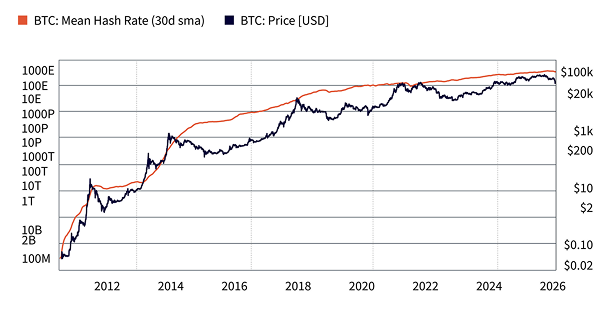
Bitcoin Hashrate vs. BTC Price

Financial Gateways and Institutional Integration

If blockchain networks form the economic substrate, then exchanges and custodians operate as the primary and systemically important financial gateways to traditional capital markets.

As infrastructure has matured, so too has the investor base. Ownership is increasingly shifting toward institutional and regulated capital, marking a transition from early adopters toward participants operating within formal mandates, governance frameworks, and risk constraints.
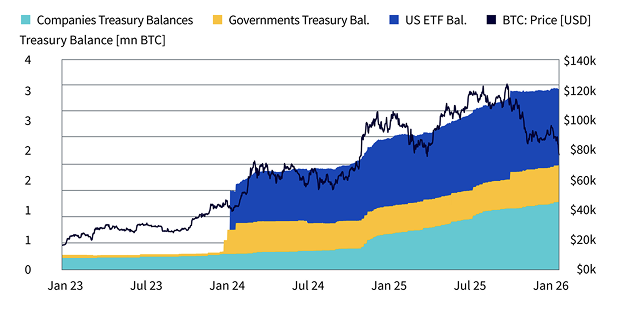
Institutional & Corporate Ownership of Bitcoin (Time Series)

The System’s Monetary Layer

Stablecoins have emerged as the core liquidity and settlement instrument within the blockchain economy. Functionally, they operate as the primary unit of account, medium of exchange, and collateral asset across both centralized and decentralized venues. Their ability to enable instant, final settlement makes them a growing rail for cross-border value transfer.

Growth in stablecoin supply reflects a broader structural shift: capital migrating from traditional banking infrastructure onto blockchain rails to support trading, settlement, and financial activity.
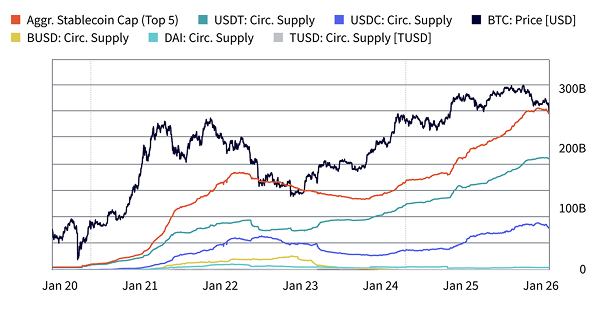
Stablecoin Supply Over Time

Extending Markets Beyond Traditional Rails

DeFi today represents an alternative financial system, where trading, lending, and capital deployment are executed through rules-based protocols rather than intermediaries.

This architecture enables continuous, transparent market activity, with mechanisms such as automated market making and on-chain credit replacing traditional structures.

At the same time, tokenization is extending this system outward: bringing traditional financial assets on-chain and deepening the integration between blockchain infrastructure and global capital markets.
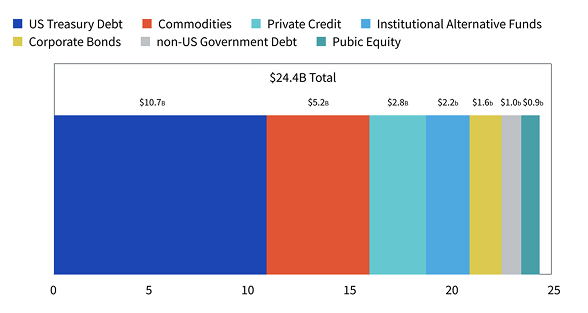
Tokenized Assets by Category

To read the full analysis, download the report in PDF format.

Download report PDF

Disclaimer: This report does not provide any investment advice. All data is provided for information and educational purposes only. No investment decision shall be based on the information provided here and you are solely responsible for your own investment decisions. We urge users to exercise caution and discretion when utilizing these metrics. Glassnode shall not be held responsible for any discrepancies or potential inaccuracies.


  • Follow us on X for timely market updates and analysis
  • Join our Telegram channel
  • For on-chain metrics, dashboards, and alerts, visit Glassnode Studio

Связанные с этим вопросы

QWhat is the primary measure of a blockchain's growth, health, and maturity that is independent of price?

ATransaction fees provide a direct, price-independent measure of a blockchain's growth, health, and maturity.

QHow do the security models of Bitcoin and Ethereum differ according to the report?

ABitcoin represents an energy-backed security model, while Ethereum is an example of a capital-backed security model.

QWhat role do stablecoins play in the blockchain ecosystem?

AStablecoins underpin settlement and liquidity across the ecosystem, acting as the primary unit of account and enabling real-time clearing and continuous capital mobility across global markets.

QWhat is the function of crypto exchanges and custodians in the blockchain economy?

ACrypto exchanges and custodians function as the primary financial gateways, linking on-chain activity to traditional capital markets and driving the transition from retail-dominated ownership to institutional participation.

QWhat is the core economic primitive for evaluating the blockchain ecosystem, as described in the 'Quantifying Network Demand' section?

ABlockspace is the core economic primitive for evaluating the ecosystem, as it is a scarce digital resource consumed by every transaction and priced dynamically through transaction fees.

Похожее

Аster уже запустил 112 рынков RWA, так почему же ASTER всё ещё стоит на месте?

В первой половине 2026 года платформа Aster продемонстрировала значительный рост: запустила собственный блокчейн L1, ввела стейкинг, расширилась на 112 рынков токенизированных реальных активов (RWA) и привлекла строителей через Aster Code, генерируя объем в $12 миллиардов. Ключевое изменение для нативного токена ASTER произошло в июне — теперь 99% ежедневных комиссий платформы используются для выкупа и сжигания токенов, что теоретически может со временем вывести из обращения 5 миллиардов ASTER. Несмотря на эти фундаментальные улучшения и дорожную карту, включающую Aster Vault, Aster Card и расширение предложений TradFi, цена ASTER остается в боковом тренде около $0.626. Технические индикаторы, такие как RSI, показывают нейтралитет, а объем баланса (OBV) недостаточен для уверенного пробоя. Открытый интерес в деривативах снизился до примерно $149 миллионов, что указывает на осторожность трейдеров. Рынок, по-видимому, ждет более убедительных доказательств того, что новые инициативы приведут к реальному росту активности, увеличению комиссий и, как следствие, устойчивому спросу на токен ASTER.

ambcrypto23 мин. назад

Аster уже запустил 112 рынков RWA, так почему же ASTER всё ещё стоит на месте?

ambcrypto23 мин. назад

Владельцы XRP стали получать прибыль, но спрос на спотовом рынке исчез: Удержит ли цена $1.10?

Недавняя рыночная структура XRP демонстрирует противоречивые сигналы. Несмотря на то, что краткосрочные держатели снова стали получать прибыль (30-дневный MVRV превысил 1.0), активность сместилась с спотового рынка на рынок деривативов. Спотовый спрос практически исчез, объемы упали примерно на 99%, в то время как открытый интерес и коэффициент левериджа выросли. Это означает, что текущая консолидация цены в диапазоне $1.086-$1.113 в основном поддерживается спекулятивными позициями с использованием заемных средств, а не притоком нового капитала. Устойчивость такого роста левериджа сейчас зависит от прибыльности держателей. Поскольку давление для фиксации прибыли может усилиться, а новый спотовый спрос отсутствует, ключевой уровень поддержки $1.10 находится под угрозой, и XRP становится уязвимым для резкой коррекции в случае изменения рыночных настроений.

ambcrypto26 мин. назад

Владельцы XRP стали получать прибыль, но спрос на спотовом рынке исчез: Удержит ли цена $1.10?

ambcrypto26 мин. назад

Kalshi пообещал подать апелляцию после того, как судья в Вашингтоне признал, что рынок прогнозов, вероятно, нарушает законы штата об азартных играх

Компания Kalshi, оператор прогнозных рынков, регулируемых Комиссией по торговле товарными фьючерсами (CFTC), пообещала подать апелляцию после того, как судья в штате Вашингтон выдал предварительный судебный запрет. Суд постановил, что деятельность компании, вероятно, нарушает законы штата об азартных играх и защите прав потребителей. Иск был подан генеральным прокурором штата, который утверждает, что платформа Kalshi позволяет делать ставки на широкий круг событий, включая спорт и выборы, что представляет собой незаконный онлайн-гемблинг по местным законам. Kalshi отвергает претензии, настаивая на том, что её контракты на события регулируются федеральным Законом о товарных биржах и находятся под исключительной юрисдикцией CFTC, а не властей штатов. Компания заявила, что штаты не имеют права регулировать подобные рынки. Однако суд на предварительной стадии заключил, что федеральный закон не отменяет действие законов Вашингтона об азартных играх. Это дело является частью более широкой правовой битвы по вопросу о том, подпадают ли федерально регулируемые прогнозные рынки исключительно под федеральный надзор или также под действие законов штатов об азартных играх. Исход апелляции может оказать существенное влияние на будущее регулирование этой растущей отрасли по всей стране. Окончательное решение по судебному запрету ожидается 5 августа.

ambcrypto47 мин. назад

Kalshi пообещал подать апелляцию после того, как судья в Вашингтоне признал, что рынок прогнозов, вероятно, нарушает законы штата об азартных играх

ambcrypto47 мин. назад

Зарядка Bitcoin для $70K здесь, несмотря на слабый спрос на споте — вот как!

Рынок сигнализирует о возможной повышенной волатильности Bitcoin. Несмотря на слабый спрос на спотовом рынке (показатель упал до -170 тыс. BTC), данные Glassnode и CryptoQuant указывают на накопление крупными держателями («китами») 66,7 тыс. BTC за последние 60 дней. Это может свидетельствовать о переходе активов в «более сильные руки» (LTH). Одновременно наблюдается рост позиций с плечом: положительные funding-ставки выросли более чем на 20% за 72 часа, что создаёт риск массовых ликвидаций лонгов при отсутствии свежего покупательского спроса. Однако недавний рост цены выше $66 тыс. сопровождался ликвидацией шортов на сумму свыше $80 млн. Общая картина предполагает, что текущая ситуация может привести либо к коррекции из-за перегретых лонгов, либо, если спрос восстановится, к пробою в сторону уровня $70 тыс., что вызовет ликвидацию оставшихся медведей. Ключевым фактором станет динамика спотового спроса.

ambcrypto1 ч. назад

Зарядка Bitcoin для $70K здесь, несмотря на слабый спрос на споте — вот как!

ambcrypto1 ч. назад

Занижена ли стоимость Биткойна? Почему $66 тыс. могут не отражать всей картины о BTC

Биткоин (BTC) вновь преодолел отметку в $66 000, впервые с 17 июня, на фоне общего восстановления рынка криптовалют. Однако данные аналитической платформы CryptoQuant указывают, что BTC всё ещё может быть недооценен. Метрика MVRV Percentile, оценивающая текущую цену относительно исторических данных, находится на уровне 5-го процентиля. Это означает, что актив торгуется ниже, чем в 95% случаев за всю историю наблюдений, что традиционно сигнализирует о периоде недооценки и в прошлом предшествовало устойчивому росту. В то же время активность на спотовом рынке демонстрирует нейтралитет. Индикатор Spot Taker Cumulative Volume Delta (CVD) показывает баланс между объёмами покупок и продаж с 14 июня, что указывает на отсутствие доминирования быков или медведей. Чистый приток средств (Netflow) в спотовый рынок остаётся положительным, но недостаточно сильным: около $34,66 млн за 24 часа и $1,22 млрд за 30 дней. Это свидетельствует об осторожном накоплении, но не о мощном покупательском давлении. Таким образом, несмотря на технический сигнал недооценки по метрике MVRV, для подтверждения устойчивого бычьего тренда и продолжения роста выше $66 000 рынку требуется более значительный и уверенный приток покупательского объёма в спотовом сегменте.

ambcrypto2 ч. назад

Занижена ли стоимость Биткойна? Почему $66 тыс. могут не отражать всей картины о BTC

ambcrypto2 ч. назад

Торговля

Спот
活动图片