Will Japan's Interest Rate Hike Trigger a Global Liquidity Shock?

marsbitОпубликовано 2025-12-18Обновлено 2025-12-18

Введение

As the Bank of Japan's December 19 monetary policy meeting approaches, market concerns are rising over a potential hawkish interest rate hike. A report by Western Securities on December 16 analyzes whether this move could end the era of cheap yen and trigger a global liquidity crisis. Key drivers for a rate hike include Japan’s sustained inflation above the 2% target, low unemployment supporting wage growth, and expansionary fiscal policy. These factors may push the BOJ toward tightening, raising fears of unwinding large-scale carry trades and causing global financial stress. However, the report suggests the most dangerous phase of liquidity shock may have already passed. Previous rate hikes in July and January had diminishing market impact, speculative short positions in yen have largely been closed, and the macro environment—including a resilient U.S. economy and Fed easing—reduces urgency for rapid unwinding. The Fed’s expanded balance sheet also acts as a buffer. Despite theoretical stability, global markets remain fragile after a six-year bull run, with elevated valuations and AI-related泡沫 concerns. A BOJ hike could act as a catalyst for a liquidity shock, though any sharp sell-off may prompt stronger Fed easing, leading to a quick recovery. Investors are advised to monitor the situation closely. If U.S. markets experience repeated “stock-bond-currency triple sell-offs,” it may signal a liquidity crisis. Over the medium term, global monetary easing is expected to con...

Original Author: Long Yue

Original Source: Wall Street News

As the Bank of Japan's monetary policy meeting on December 19 approaches, market concerns about a potential hawkish interest rate hike are intensifying. Could this move mark the end of the era of cheap yen and trigger a global liquidity crisis? A recent strategy report released by Western Securities on December 16 provides an in-depth analysis.

High Inflation Makes Hawkish Rate Hike by Japan Inevitable

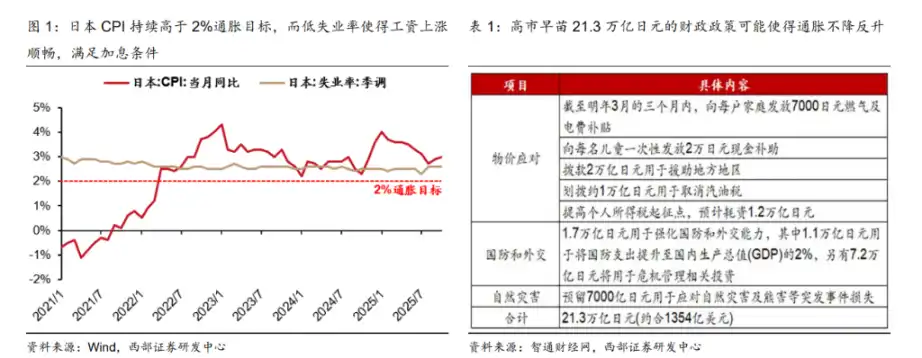
The report points out that multiple factors are behind the BOJ's potential rate hike. Firstly, Japan's CPI has consistently remained above the official 2% inflation target. Secondly, the unemployment rate has long stayed below 3%, creating favorable conditions for nominal wage growth. Market expectations for significant wage increases in next year's "Shunto" (spring labor negotiations) are high, which will further increase inflationary pressures. Finally, the 21.3 trillion yen fiscal policy introduced by Takayuki Kobayashi could also exacerbate inflation.

These factors collectively force the Bank of Japan to adopt a more hawkish stance. The market worries that once the rate hike is implemented, it could lead to the concentrated unwinding of the massive "carry trade" positions accumulated during Japan's YCC (Yield Curve Control) era, thereby causing a liquidity shock to global financial markets.


Theoretical Analysis: Why the Most Dangerous Phase of Liquidity Shock Might Be Over

Despite market anxieties, the report analyzes that, theoretically, the current impact of a Japanese rate hike on global liquidity is limited.

The report lists four reasons:

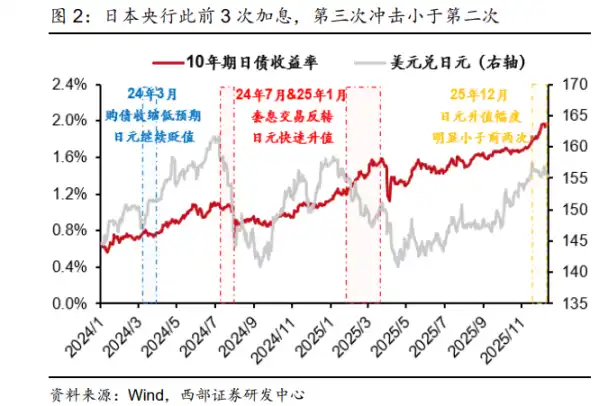
Risk Partially Released: The Bank of Japan has already implemented 3 rate hikes since March last year. Among these, the hike in July last year, coupled with the exit from YCC, did cause a significant liquidity shock, but the impact from the January hike this year has noticeably weakened, indicating increasing market adaptation.

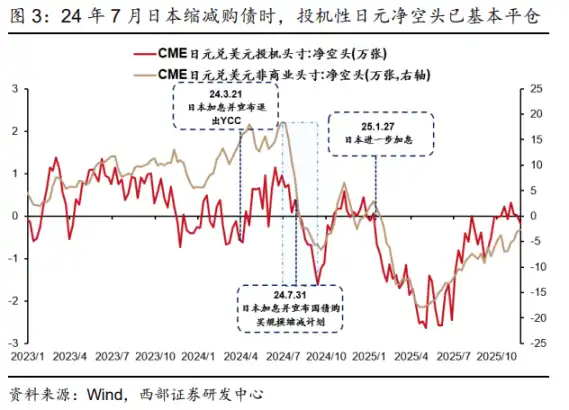
Speculative Positions Already Exited: Data from the futures market shows that most speculative yen short positions were unwound in July last year. This means the most active "carry trades" most likely to cause chain reactions have receded, and the most dangerous phase of the liquidity shock has passed.

Different Macro Environment: The current U.S. is not experiencing a "recession trade" similar to July last year, dollar depreciation pressure is not significant, and the yen itself remains weak due to geopolitical and debt issues. This weakens expectations for yen appreciation, thereby reducing the urgency to unwind "carry trades".

The Fed's "Safety Cushion": The report specifically mentions that the Federal Reserve has begun to pay attention to potential liquidity risks and has initiated balance sheet expansion (quasi-QE) policies, which can effectively stabilize market liquidity expectations and provide a buffer for the global financial system.


Actual Risk: A "Catalyst" in a Fragile Market

The report emphasizes that theoretical safety does not mean one can rest easy. The current fragility of global markets is the real root cause of the potential shock triggered by a Japanese rate hike. The report describes it as a "catalyst".

The report analyzes that the reason the July rate hike last year had such a large impact was the resonance of two major factors: "massive unwinding of active carry trades" and the "U.S. recession trade". Currently, the former condition has weakened. However, new risks are emerging: Global stock markets, represented by U.S. stocks, have experienced a 6-year "big water bull" market (prolonged bull market fueled by liquidity), accumulating substantial profits and inherent fragility. Simultaneously, concerns about an "AI bubble" are resurfacing in the U.S. market, leading to strong risk-off sentiment among investors.

In this context, the certainty of a Japanese rate hike could likely become a trigger, sparking panic selling and inducing a global liquidity shock. However, the report also offers a relatively optimistic judgment: such a liquidity shock would most likely force the Federal Reserve to introduce stronger easing policies (QE), so global stock markets, after a brief sharp decline, are very likely to recover quickly.

Watch and Wait, Monitor the Signal of "Stocks, Bonds, Forex Triple Kill"

Faced with this complex situation, the report advises investors to "watch and wait".

The report believes that since the Bank of Japan's decision is basically an "open secret," but capital flows are unpredictable, the best strategy is to observe.

Scenario One: If capital does not exhibit panic flight, the actual impact of the Japanese rate hike will be very limited, and investors need not take action.

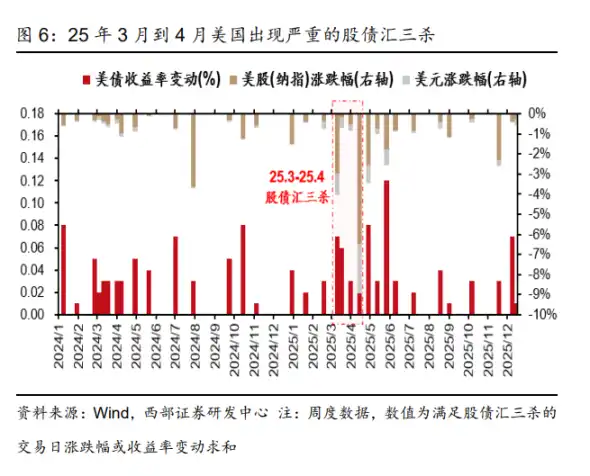
Scenario Two: If capital panic does trigger a global liquidity shock, investors need to closely monitor a key signal—whether the U.S. market experiences 2-3 consecutive instances of a "stocks, bonds, forex triple kill" (simultaneous decline in stock, bond, and foreign exchange markets). The report points out that if a situation similar to early April this year repeats, it indicates a significantly increased probability of a liquidity shock.

Finally, the report believes that even if a Japanese rate hike causes short-term turbulence, it will not change the broader long-term trend of global monetary easing. In this context, it continues to be bullish on the strategic allocation value of gold. Meanwhile, as China's export surplus expands and the Federal Reserve restarts interest rate cuts, the RMB exchange rate is expected to return to a medium-to-long-term appreciation trend, accelerating cross-border capital inflows, which is positive for Chinese assets. The report is optimistic about AH shares experiencing a "Davis Double Click" of earnings and valuation. For U.S. stocks and bonds, the report holds a震荡 (volatile/oscillating) view.

Связанные с этим вопросы

QWhat are the main factors driving the Bank of Japan's potential hawkish interest rate hike?

AThe main factors include Japan's CPI consistently exceeding the 2% inflation target, a low unemployment rate below 3% that supports nominal wage growth, high expectations for wage increases in the upcoming 'Shunto' spring wage negotiations, and the inflationary pressure from the 21.3 trillion yen fiscal policy introduced by Takayuki Kobayashi.

QWhy does the report suggest that the most dangerous phase of a global liquidity shock from a BOJ hike may have already passed?

AThe report cites four reasons: risks have been partially released through three previous rate hikes since last March, speculative short positions in the yen were largely closed last July, the current environment lacks a 'recession trade' in the US and the one seen in July last year, and the Federal Reserve has begun expanding its balance sheet to provide a liquidity buffer.

QWhat role could a BOJ rate hike play in the current fragile global market, according to the report?

AThe report suggests that a BOJ rate hike could act as a 'catalyst', triggering a panic-driven capital flight and potentially inducing a global liquidity shock, given the existing fragility in markets like the US stock market after a 6-year bull run and rising concerns about an 'AI bubble'.

QWhat key signal should investors watch for to gauge the probability of a liquidity shock?

AInvestors should watch for a key signal of 2-3 consecutive occurrences of 'stock, bond, and currency markets falling together' (a 'triple kill') in the US market, similar to the situation in early April, which would indicate a significantly increased probability of a liquidity shock.

QWhat is the report's medium to long-term outlook for global monetary policy and its implications for assets?

AThe report believes that a BOJ hike will not change the medium to long-term trend of global monetary easing. It remains bullish on the strategic allocation value of gold, expects the RMB exchange rate to appreciate due to China's export surplus expansion and Fed rate cuts, and is optimistic about a 'Davis double play' for AH shares. It holds a震荡 (volatile/oscillating) view on US stocks and bonds.

Похожее

Warsh Hearing Concludes: What Are the Notable Signals for the Crypto Industry?

The Senate Banking Committee held a confirmation hearing for Judy Shelton, a Federal Reserve nominee, who faced intense questioning regarding her ability to maintain the central bank's independence amid pressure from President Trump to lower interest rates. Shelton denied any pre-arranged commitments on rate cuts and emphasized her independence, though Democrats remained skeptical, citing contradictions with Trump's public statements. Shelton characterized post-pandemic inflation as a major policy failure and called for a "regime change" in the Fed’s approach, including reforms to inflation measurement and communication strategies. She criticized the current practice of Fed officials frequently signaling future rate moves and did not commit to maintaining post-meeting press conferences, suggesting potential reductions in transparency. Regarding crypto markets, Shelton’s extensive investments in digital asset companies—including Solana, DeFi, and blockchain infrastructure—were noted, though she has pledged to divest these holdings due to ethics rules. Her familiarity with the crypto industry and deregulatory leanings may signal a more open, though cautious, stance toward digital assets. However, concerns were raised about potential conflicts of interest, especially given Trump family involvement in crypto-financial ventures. The timing of her confirmation remains uncertain, pending a Justice Department investigation into current Chair Powell. Shelton’s potential leadership could lead to a more hawkish, productivity-focused Fed with tighter policy communication—factors that may significantly influence liquidity conditions and macro narratives for crypto markets.

marsbit4 ч. назад

Warsh Hearing Concludes: What Are the Notable Signals for the Crypto Industry?

marsbit4 ч. назад

Торговля

Спот
Фьючерсы

Популярные статьи

Как купить S

Добро пожаловать на HTX.com! Мы сделали приобретение Sonic (S) простым и удобным. Следуйте нашему пошаговому руководству и отправляйтесь в свое крипто-путешествие.Шаг 1: Создайте аккаунт на HTXИспользуйте свой адрес электронной почты или номер телефона, чтобы зарегистрироваться и бесплатно создать аккаунт на HTX. Пройдите удобную регистрацию и откройте для себя весь функционал.Создать аккаунтШаг 2: Перейдите в Купить криптовалюту и выберите свой способ оплатыКредитная/Дебетовая Карта: Используйте свою карту Visa или Mastercard для мгновенной покупки Sonic (S).Баланс: Используйте средства с баланса вашего аккаунта HTX для простой торговли.Третьи Лица: Мы добавили популярные способы оплаты, такие как Google Pay и Apple Pay, для повышения удобства.P2P: Торгуйте напрямую с другими пользователями на HTX.Внебиржевая Торговля (OTC): Мы предлагаем индивидуальные услуги и конкурентоспособные обменные курсы для трейдеров.Шаг 3: Хранение Sonic (S)После приобретения вами Sonic (S) храните их в своем аккаунте на HTX. В качестве альтернативы вы можете отправить их куда-либо с помощью перевода в блокчейне или использовать для торговли с другими криптовалютами.Шаг 4: Торговля Sonic (S)С легкостью торгуйте Sonic (S) на спотовом рынке HTX. Просто зайдите в свой аккаунт, выберите торговую пару, совершайте сделки и следите за ними в режиме реального времени. Мы предлагаем удобный интерфейс как для начинающих, так и для опытных трейдеров.

1.2k просмотров всегоОпубликовано 2025.01.15Обновлено 2025.03.21

Как купить S

Sonic: Обновления под руководством Андре Кронье – новая звезда Layer-1 на фоне спада рынка

Он решает проблемы масштабируемости, совместимости между блокчейнами и стимулов для разработчиков с помощью технологических инноваций.

2.2k просмотров всегоОпубликовано 2025.04.09Обновлено 2025.04.09

Sonic: Обновления под руководством Андре Кронье – новая звезда Layer-1 на фоне спада рынка

HTX Learn: Пройдите обучение по "Sonic" и разделите 1000 USDT

HTX Learn — ваш проводник в мир перспективных проектов, и мы запускаем специальное мероприятие "Учитесь и Зарабатывайте", посвящённое этим проектам. Наше новое направление .

1.8k просмотров всегоОпубликовано 2025.04.10Обновлено 2025.04.10

HTX Learn: Пройдите обучение по "Sonic" и разделите 1000 USDT

Обсуждения

Добро пожаловать в Сообщество HTX. Здесь вы сможете быть в курсе последних новостей о развитии платформы и получить доступ к профессиональной аналитической информации о рынке. Мнения пользователей о цене на S (S) представлены ниже.

活动图片