Why I Am Not Bullish on Ethereum at Its Current State?

marsbitОпубликовано 2026-01-19Обновлено 2026-01-19

Введение

Why I'm Not Bullish on Ethereum at Current Prices The author expresses skepticism about Ethereum's current valuation, not its long-term business growth potential (user base and transaction volume are expected to increase). The author believes the price is too high relative to its fundamentals, based on the following analysis: - Active users and transaction counts have reached new highs but are growing slower than some leading e-commerce platforms. - Monthly transaction fees are only 0.6% of the previous cycle's peak, and average fees per transaction are 0.5% of previous highs. This slow growth comes at the cost of drastically reduced service prices, which is unfavorable in any industry. - If Ethereum is viewed as a company selling block space, its price-to-fee (PF) ratio exceeds 2,000x and its price-to-sales (PS) ratio exceeds 10,000x. It has negative net profit, so no P/E ratio exists. In comparison, traditional cloud service companies have P/E ratios of 20-30 and single-digit PS ratios. - If considered a commodity (like digital oil), Ethereum faces competition from other chains and rollups offering similar services. Its value proposition may not justify such a high premium, especially as its narrative as a store of value (like Bitcoin) has faded. - There is a lack of new, product-market-fit crypto native applications this cycle, leading to oversupply of block space and stagnant growth in the public chain sector. - Grand visions of Ethereum becoming a decentralized "Wall S...

Author: Alex Xu

Not being bullish doesn't mean I am pessimistic about Ethereum's business development (referring to long-term growth in user scale and transaction volume, which I believe will continue), but rather that I am unwilling to buy at the current price because it is too expensive relative to its fundamentals.

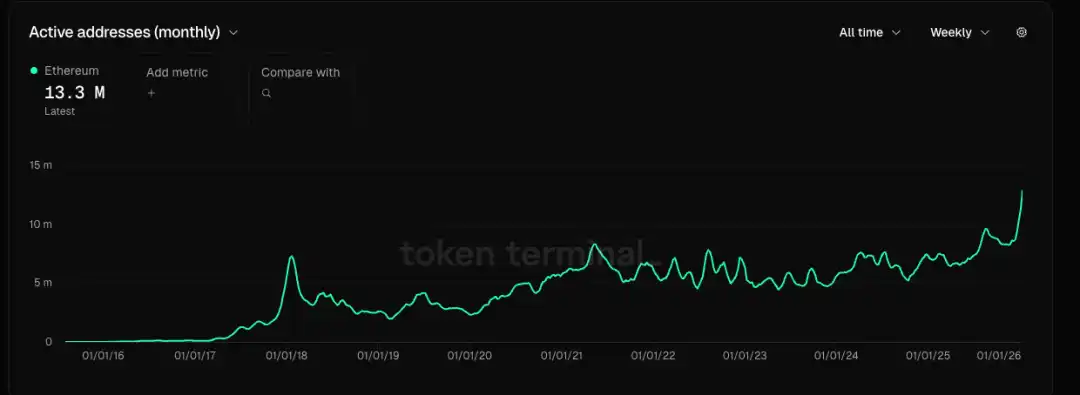
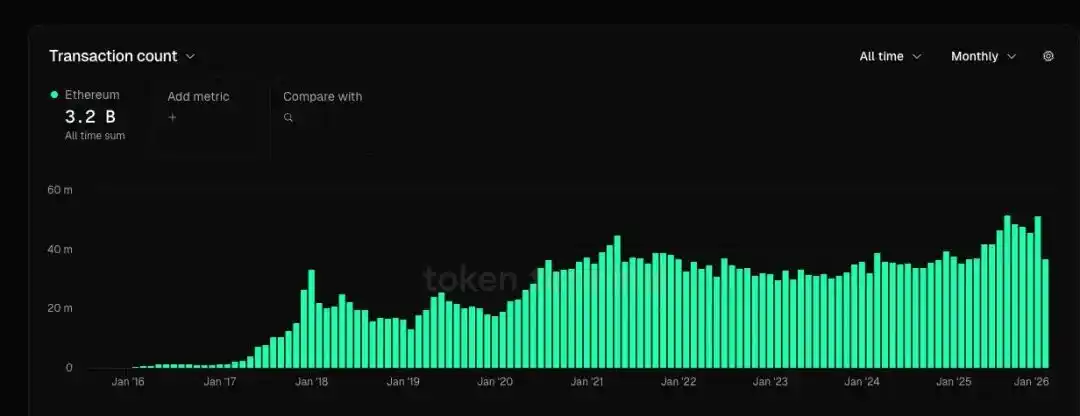
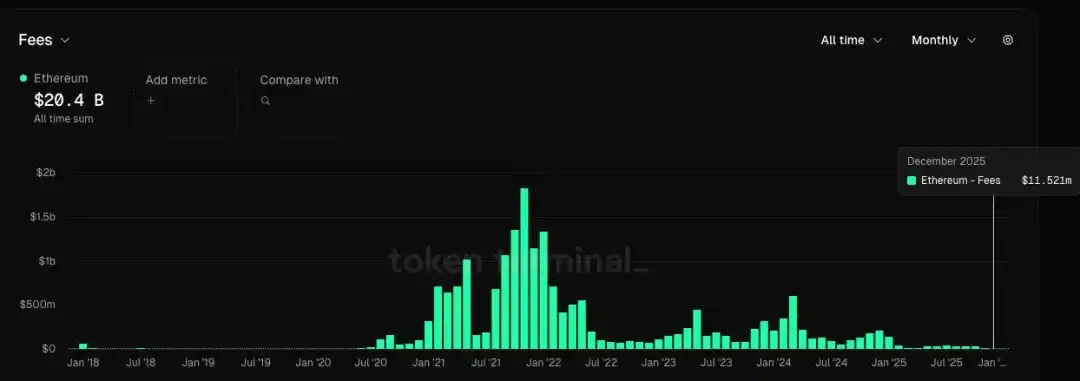
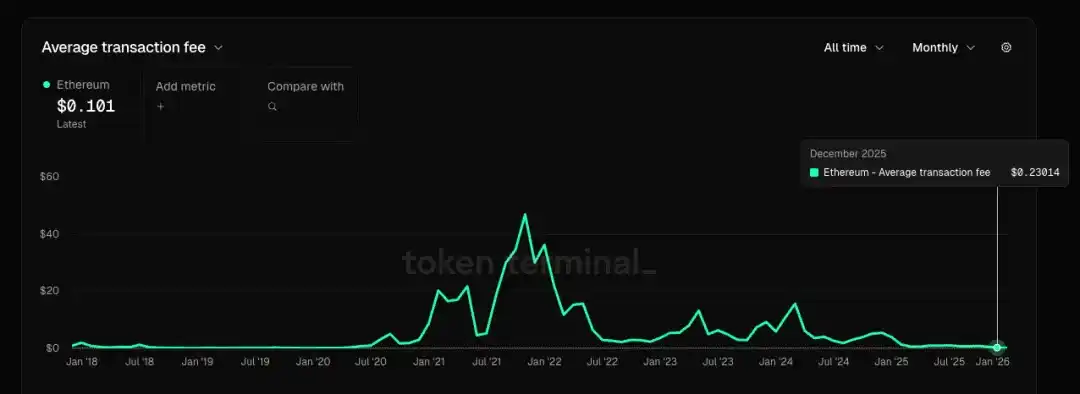
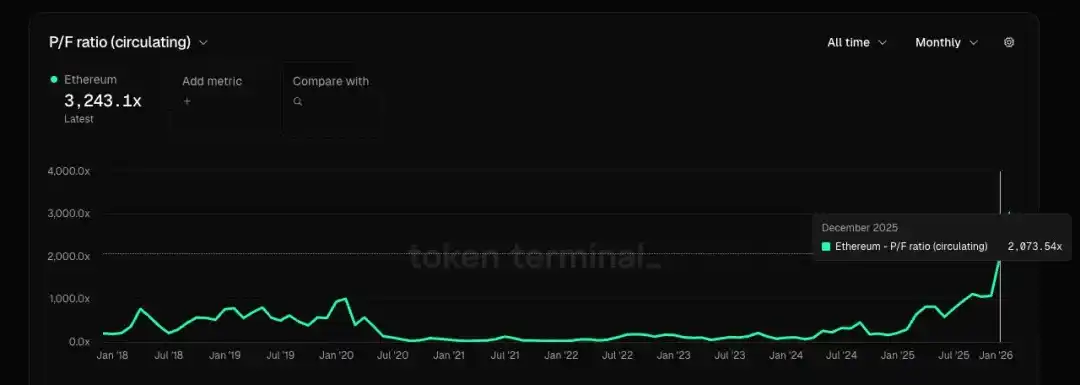
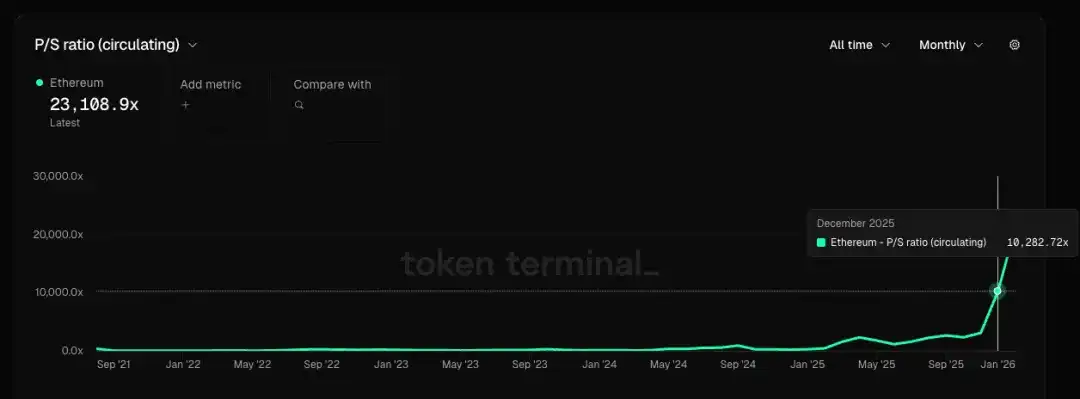
From a few charts, we can paint a picture of Ethereum's current state:

1. The number of active users has risen in waves to new highs (44% higher than the peak of the last cycle), and the number of transactions has also reached new highs (13% higher than the peak of the last cycle). However, the growth rate of these two metrics is still slower than the GMV growth of some leading e-commerce platforms.

2. The current monthly transaction fees are only 0.6% of the peak of the last cycle, and the average transaction fee per transaction is only 0.5% of the peak of the last cycle. This means that the slow growth in users and transaction volume has been achieved at the cost of a sharp decline in service prices. When growth comes at the expense of drastic price reductions for products and services, it is not a good sign for any company in any industry.

3. If we view Ethereum as a company providing block space services, based on December data, its P/F (Price-to-Fee ratio) exceeds 2,000x, and its P/S (Price-to-Sales ratio) exceeds 10,000x. Its net profit is negative, so there is no P/E ratio. In comparison, traditional cloud service companies typically have P/E ratios between 20-30 and P/S ratios in the single digits.

4. If Ethereum is considered not a company but a commodity (similar to digital oil), its challenge lies in the fact that other public chains and rollups can provide similar block space services (akin to substitutable oil). Some may argue that Ethereum's decentralization and censorship-resistant properties make it more valuable as a commodity resource, but is it really worth that much more? The previous narrative that ETH could replace BTC as a store of value has largely disappeared, as consensus has shifted: compared to BTC's status as digital gold, ETH is more like a tech company + specialized cloud service provider, and its commodity positioning is also highly substitutable.

5. Crypto-native applications with product-market fit (PMF) have almost disappeared in this cycle, with almost no high-value applications emerging. Insufficient demand and increased supply (the continued growth of rollups and public chains) have led to a severe oversupply of block space, and the public chain sector itself is experiencing sluggish growth or even contraction.

6. The grand vision painted by Tom Lee and some domestic VCs—"Ethereum is the Wall Street on-chain, and everything will eventually be on Ethereum"—lacks sufficient data and factual evidence to support this story. There is no concrete logical derivation, and it seems more like a promotional pitch. Our investment decisions should be based on rationality, not faith. I am not ready to buy into their narrative yet. If future data and facts gradually support this story, it will be time to reconsider.

Связанные с этим вопросы

QWhat is the author's main reason for not being optimistic about Ethereum at its current price?

AThe author believes the current price is too expensive relative to its fundamentals, such as its high valuation multiples and declining fee revenue, despite some growth in user base and transaction count.

QHow does the author compare Ethereum's current performance to the previous cycle's peak in terms of transaction fees?

AThe author states that the current monthly transaction fees are only 0.6% of the previous cycle's peak, and the average fee per transaction is only 0.5% of the previous high.

QWhat valuation multiples does the author use to argue that Ethereum is overvalued, and how do they compare to traditional cloud service companies?

AThe author uses a Price-to-Fees (PF) ratio of over 2000x and a Price-to-Sales (PS) ratio of over 10,000x for Ethereum, while noting that traditional cloud service companies typically have a PS ratio in the single digits and a PE ratio between 20-30.

QAccording to the author, what is a key challenge to Ethereum's 'digital oil' commodity narrative?

AThe author argues that other blockchains and rollups can provide similar block space services, making Ethereum's commodity-like resource highly substitutable and questioning if its premium valuation is justified.

QWhy does the author express skepticism about the narrative that Ethereum will become the 'Wall Street of on-chain' activities?

AThe author finds this narrative lacks supporting data and concrete logical derivation, viewing it more as promotional 'shilling' rather than a rational investment thesis based on current evidence.

Похожее

Google and Amazon Simultaneously Invest Heavily in a Competitor: The Most Absurd Business Logic of the AI Era Is Becoming Reality

In a span of four days, Amazon announced an additional $25 billion investment, and Google pledged up to $40 billion—both direct competitors pouring over $65 billion into the same AI startup, Anthropic. Rather than a typical venture capital move, this signals the latest escalation in the cloud wars. The core of the deal is not equity but compute pre-orders: Anthropic must spend the majority of these funds on AWS and Google Cloud services and chips, effectively locking in massive future compute consumption. This reflects a shift in cloud market dynamics—enterprises now choose cloud providers based on which hosts the best AI models, not just price or stability. With OpenAI deeply tied to Microsoft, Anthropic’s Claude has become the only viable strategic asset for Google and Amazon to remain competitive. Anthropic’s annualized revenue has surged to $30 billion, and it is expanding into verticals like biotech, positioning itself as a cross-industry AI infrastructure layer. However, this funding comes with constraints: Anthropic’s independence is challenged as it balances two rival investors, its safety-first narrative faces pressure from regulatory scrutiny, and its path to IPO introduces new financial pressures. Globally, this accelerates a "tri-polar" closed-loop structure in AI infrastructure, with Microsoft-OpenAI, Google-Anthropic, and Amazon-Anthropic forming exclusive model-cloud alliances. In contrast, China’s landscape differs—investments like Alibaba and Tencent backing open-source model firm DeepSeek reflect a more decoupled approach, though closed-source models from major cloud providers still dominate. The $65 billion bet is ultimately about securing a seat at the table in an AI-defined future—where missing the model layer means losing the cloud war.

marsbit1 ч. назад

Google and Amazon Simultaneously Invest Heavily in a Competitor: The Most Absurd Business Logic of the AI Era Is Becoming Reality

marsbit1 ч. назад

Computing Power Constrained, Why Did DeepSeek-V4 Open Source?

DeepSeek-V4 has been released as a preview open-source model, featuring 1 million tokens of context length as a baseline capability—previously a premium feature locked behind enterprise paywalls by major overseas AI firms. The official announcement, however, openly acknowledges computational constraints, particularly limited service throughput for the high-end DeepSeek-V4-Pro version due to restricted high-end computing power. Rather than competing on pure scale, DeepSeek adopts a pragmatic approach that balances algorithmic innovation with hardware realities in China’s AI ecosystem. The V4-Pro model uses a highly sparse architecture with 1.6T total parameters but only activates 49B during inference. It performs strongly in agentic coding, knowledge-intensive tasks, and STEM reasoning, competing closely with top-tier closed models like Gemini Pro 3.1 and Claude Opus 4.6 in certain scenarios. A key strategic product is the Flash edition, with 284B total parameters but only 13B activated—making it cost-effective and accessible for mid- and low-tier hardware, including domestic AI chips from Huawei (Ascend), Cambricon, and Hygon. This design supports broader adoption across developers and SMEs while stimulating China's domestic semiconductor ecosystem. Despite facing talent outflow and intense competition in user traffic—with rivals like Doubao and Qianwen leading in monthly active users—DeepSeek has maintained technical momentum. The release also comes amid reports of a new funding round targeting a valuation exceeding $10 billion, potentially setting a new record in China’s LLM sector. Ultimately, DeepSeek-V4 represents a shift toward open yet realistic infrastructure development in the constrained compute landscape of Chinese AI, emphasizing engineering efficiency and domestic hardware compatibility over pure model scale.

marsbit1 ч. назад

Computing Power Constrained, Why Did DeepSeek-V4 Open Source?

marsbit1 ч. назад

Торговля

Спот
Фьючерсы

Популярные статьи

Manyu: восходящая мем-звезда на Ethereum, готовая открыть новую эру культуры Shiba

Manyu - это мемтокен на Ethereum, который приносит децентрализованную культурную и развлекательную ценность через вирусное влияние в соцсетях и вовлечённость сообщества.

1.9k просмотров всегоОпубликовано 2025.11.27Обновлено 2025.11.27

Manyu: восходящая мем-звезда на Ethereum, готовая открыть новую эру культуры Shiba

Обсуждения

Добро пожаловать в Сообщество HTX. Здесь вы сможете быть в курсе последних новостей о развитии платформы и получить доступ к профессиональной аналитической информации о рынке. Мнения пользователей о цене на ETH (ETH) представлены ниже.

活动图片