Why $HYPER Keeps Climbing: Investing in Infrastructure

bitcoinistОпубликовано 2026-02-09Обновлено 2026-02-09

Введение

The current market cycle shows capital shifting from speculative assets to critical infrastructure, particularly Bitcoin Layer 2 solutions. Bitcoin Hyper ($HYPER) is emerging as a key player by integrating Solana Virtual Machine (SVM) with Bitcoin’s security, aiming to solve scalability issues and enable high-speed, low-cost transactions. This architecture supports complex dApps while using Bitcoin as a secure settlement layer. With over $31M raised and significant whale accumulation during its presale, $HYPER reflects strong institutional interest. The project offers high APY staking to encourage long-term holding, positioning itself as infrastructure that enhances Bitcoin’s utility rather than competing with it.

The current market cycle is defined by a distinct rotation: capital is moving from speculative assets into critical infrastructure. While meme coins dominate social media volume, on-chain data reveals that ‘smart money’ is increasingly positioning itself in the rails that will carry the next generation of decentralized finance (DeFi).

Bitcoin remains the undisputed king of crypto, but let’s be honest, its utility has historically been capped by technical limitations. The network is secure, yes, but slow. While the Lightning Network attempted to solve payments, the broader issue of programmability remains. Institutions are watching this gap. Unlocking even 1% of Bitcoin’s dormant capital for decentralized applications represents a trillion-dollar opportunity.

The future isn’t about whether Bitcoin will recover and how high it climbs again. It’s about turning it from a place where Bitcoin isn’t just a store of value, but the settlement layer for a bustling ecosystem of high-speed applications. This structural shift is directing liquidity toward Layer 2 solutions that promise to modernize the network without compromising security.

Bitcoin Hyper ($HYPER) is capitalizing on this demand, effectively merging the speed of Solana with the security of Bitcoin. This makes it one of the best crypto to buy.

Solving The Scalability Trilemma With SVM Integration

The main driver here is the ‘Scalability Trilemma,’ the challenge of achieving speed, security, and decentralization all at once. Most Bitcoin layers sacrifice performance for security. The result? Sluggish user experiences that fail to retain retail users. Bitcoin Hyper addresses this by integrating the Solana Virtual Machine (SVM) directly into a Bitcoin Layer 2 framework.
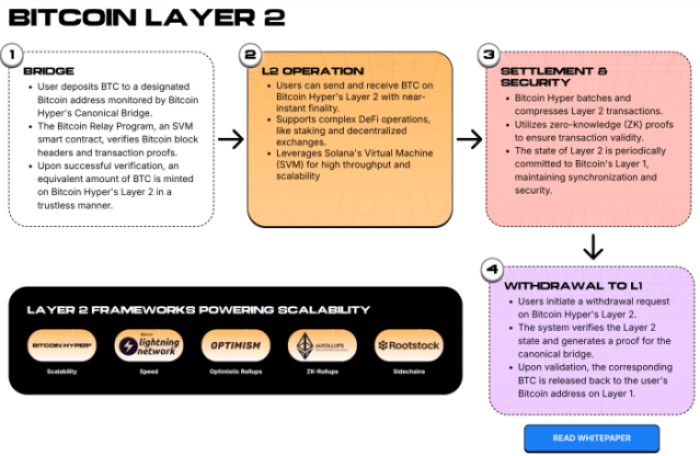
That matters because the SVM is currently the gold standard for high-throughput execution. By using this architecture, Bitcoin Hyper delivers sub-second finality and negligible transaction fees, a stark contrast to the costly execution found on traditional Ethereum-based L2s or the mainnet itself. It’s not just a technical upgrade; it’s a user experience revolution.

It lets developers build complex dApps, such as high-frequency trading platforms and interactive gaming, using Bitcoin’s robust liquidity as the settlement layer.

From a development perspective, this modular approach, using Bitcoin L1 for settlement and a real-time SVM L2 for execution, lowers the barrier to entry. Developers can use Rust to build applications that feel as fast as Solana but settle on the world’s most secure blockchain. Plus, the decentralized Canonical Bridge reduces friction, allowing for seamless $BTC transfers. Want a full project play-by-play? Check out our ‘What is Bitcoin Hyper ($HYPER)?‘ guide.

For investors, the value proposition is clear: infrastructure that eliminates bottlenecks captures value.

EXPLORE THE $HYPER ECOSYSTEM

Smart Money Flows Favor Early-Stage Infrastructure

Technical architecture provides the thesis, but on-chain flows provide the timing. Traders often look for divergences between price action and capital accumulation. In the case of Bitcoin Hyper ($HYPER), the funding data indicates significant demand for this infrastructure-focused approach.

$HYPER has already raised over $31M. That figure underscores strong conviction from early backers. With tokens currently priced at $0.0136753, the entry point reflects an early valuation relative to established Layer 2 competitors like Stacks. The sheer volume suggests the market is validating the ‘SVM on Bitcoin’ thesis before the mainnet is fully saturated.

Crucially, high-net-worth individuals are already taking positions. Smart money is moving. Etherscan data shows that during the presale, whales have bought up over $1M, with the largest purchase totalling $500K. Whale accumulation during a presale phase is a notable signal; it implies that sophisticated actors are locking in supply, anticipating a supply shock post-TGE.

Plus, the protocol’s decision to offer high APY staking immediately after the Token Generation Event (TGE), with a short 7-day vesting period for presale stakers, incentivizes long-term holding over short-term flipping.

$HYPER isn’t competing with $BTC; it’s lifting it up to what it can be, maximizing its potential.

BUY YOUR $HYPER FROM THE OFFICIAL PRESALE PAGE

The content provided in this article is for informational purposes only and does not constitute financial advice. Cryptocurrency markets are volatile, and presale investments carry inherent risks. Always perform your own due diligence before investing.


Связанные с этим вопросы

QWhat is the main reason capital is moving from speculative assets to infrastructure according to the article?

AThe main reason is that 'smart money' is increasingly positioning itself in the infrastructure that will carry the next generation of decentralized finance (DeFi), seeing a trillion-dollar opportunity in unlocking Bitcoin's dormant capital.

QHow does Bitcoin Hyper ($HYPER) aim to solve the Scalability Trilemma?

ABitcoin Hyper addresses the Scalability Trilemma by integrating the Solana Virtual Machine (SVM) into a Bitcoin Layer 2 framework, achieving high speed, security, and decentralization simultaneously.

QWhat key advantage does the Solana Virtual Machine (SVM) provide to the Bitcoin Hyper network?

AThe SVM provides the advantage of high-throughput execution, enabling Bitcoin Hyper to deliver sub-second finality and negligible transaction fees.

QWhat on-chain data is provided as evidence of significant demand for the $HYPER token?

AThe article cites that $HYPER has raised over $31M, with Etherscan data showing whales bought over $1M during the presale, including a single purchase of $500K.

QWhat is the value proposition of $HYPER for investors, as stated in the article?

AThe value proposition for investors is that infrastructure which eliminates bottlenecks in the blockchain ecosystem captures value, and $HYPER provides this by modernizing Bitcoin's network without compromising security.

Похожее

Anthropic's IPO Launch: Commercial Miracle or Valuation Bubble?

Anthropic has confidentially filed for an IPO, led by Morgan Stanley and Goldman Sachs, potentially going public by October. Following its latest $650 billion funding round, its pre-IPO valuation stands at $965 billion, with projections reaching up to $2 trillion at listing, which would make it the highest-valued private company ever. The article, written by Fu Sheng, addresses skepticism that this represents an AI bubble akin to the 2000 dot-com crash. It argues the current situation differs fundamentally. Unlike the internet bubble era, which relied on speculative narratives with little revenue, Anthropic's valuation is backed by unprecedented, measurable financial performance. Key data points include: * **Revenue Growth:** ARR skyrocketed from $10 billion in early 2025 to $470 billion by May 2026, targeting $100 billion by year-end—a growth curve unmatched in business history. * **Profitability:** It achieved operating profitability in Q2 2026 with an estimated $5.6 billion profit. * **Efficiency:** With ~3,000 employees and ~$470 billion ARR, its revenue per employee exceeds $10 million. Products like Claude Code, launched less than a year ago, already generate $25 billion in annualized revenue. * **Enterprise Adoption:** It boasts a strong enterprise client base, with 8 of the Fortune 10 and over 1,000 large firms spending over $1 million annually on Claude. The valuation is framed using a traditional SaaS model (e.g., a 10x Price-to-Sales multiple on $100 billion revenue). The author contends the core question for analysts has shifted from "How big could this be?" to "How much is it earning and will earn next quarter?" The discussion extends beyond Anthropic to a broader paradigm shift: the transition from a "carbon-based" to a "silicon-based" economy. Companies are increasingly prioritizing investment in compute and AI capabilities over human resources, as these directly scale productivity and competitive advantage. Anthropic's IPO is thus positioned not just as a corporate milestone, but as a price anchor for this new economic era.

链捕手46 мин. назад

Anthropic's IPO Launch: Commercial Miracle or Valuation Bubble?

链捕手46 мин. назад

Near Returns to the AI Stage: Transformation into a Public Chain Due to 'Payroll Difficulties,' Agent and Privacy Emerge as New Growth Narratives

NEAR Returns to AI Origins: From Payroll Struggles to Blockchain, Now Focusing on AI Agents and Privacy NEAR Protocol's journey began not with grand blockchain ambitions, but from a practical hurdle: its AI startup founders, including Transformer paper co-author Illia Polosukhin, couldn't efficiently pay international developers in 2017. This led them to pivot and build a high-performance, scalable blockchain. After years navigating various crypto narratives like sharding and cross-chain interoperability, NEAR is now leveraging its AI roots to re-enter the AI arena. A key driver is its "NEAR Intents" layer, which abstracts complex cross-chain transactions. Users simply state their goal (e.g., swap BTC for ETH), and a solver network finds the optimal route. This system has processed over $20B in cross-chain volume, generating significant fee revenue. A major growth area is private transactions via "Confidential Intents/Swaps," which hide trade details until settlement to protect against MEV and front-running. Remarkably, private swaps recently accounted for over 40% of NEAR's transaction volume, highlighting strong demand but also potential regulatory scrutiny. With its AI-founder pedigree, NEAR is positioning itself at the intersection of blockchain, AI agents, and privacy, aiming to become infrastructure for the emerging agent economy while navigating the challenges of its rapid adoption.

marsbit3 ч. назад

Near Returns to the AI Stage: Transformation into a Public Chain Due to 'Payroll Difficulties,' Agent and Privacy Emerge as New Growth Narratives

marsbit3 ч. назад

From Ethereum to AI's 'CROPS': What Exactly is This Set of 'Slow Variables' That Vitalik Repeatedly Emphasizes?

In recent discussions, Vitalik Buterin has frequently emphasized the concept of "CROPS," a framework defining core values for Ethereum's development. CROPS stands for Censorship Resistance, Capture Resistance, Open Source, Privacy, and Security. Initially outlined in the Ethereum Foundation's "EF Mandate," it represents a commitment to user sovereignty, ensuring that the network resists external control, remains open, protects privacy, and prioritizes security. The relevance of CROPS extends beyond Ethereum's foundational principles, becoming crucial in the context of AI integration. As AI agents begin handling wallet operations and automated transactions, the risk increases that users may cede control over their digital assets, privacy, and intentions to centralized AI service providers. A "CROPS AI" would therefore emphasize local execution where possible, privacy-preserving remote model calls (e.g., using zero-knowledge proofs), and transparent, verifiable processes to maintain user agency. Vitalik highlights a significant convergence between "CROPS Ethereum access layer" and "CROPS AI." Both address the same fundamental challenge: how users can access powerful services—be it blockchain data via RPCs or AI models—without exposing sensitive information or relinquishing ultimate control. This intersection points toward a future digital entry point that is more private, secure, and user-controlled. Ultimately, CROPS is not merely an abstract ideal but a practical guidepost. It steers development—from protocol resilience and wallet design to AI agent safety—towards a future where users retain self-sovereignty even as digital systems grow more complex and powerful. In an era of accelerating AI adoption, these "slow variables" of censorship resistance, openness, privacy, and security may define Ethereum's enduring value.

marsbit3 ч. назад

From Ethereum to AI's 'CROPS': What Exactly is This Set of 'Slow Variables' That Vitalik Repeatedly Emphasizes?

marsbit3 ч. назад

Торговля

Спот
Фьючерсы
活动图片




