Why Did OpenAI Decide to Make a Phone? ChatGPT Is Taking the Permissions Apple Won't Give

marsbitОпубликовано 2026-05-18Обновлено 2026-05-18

Введение

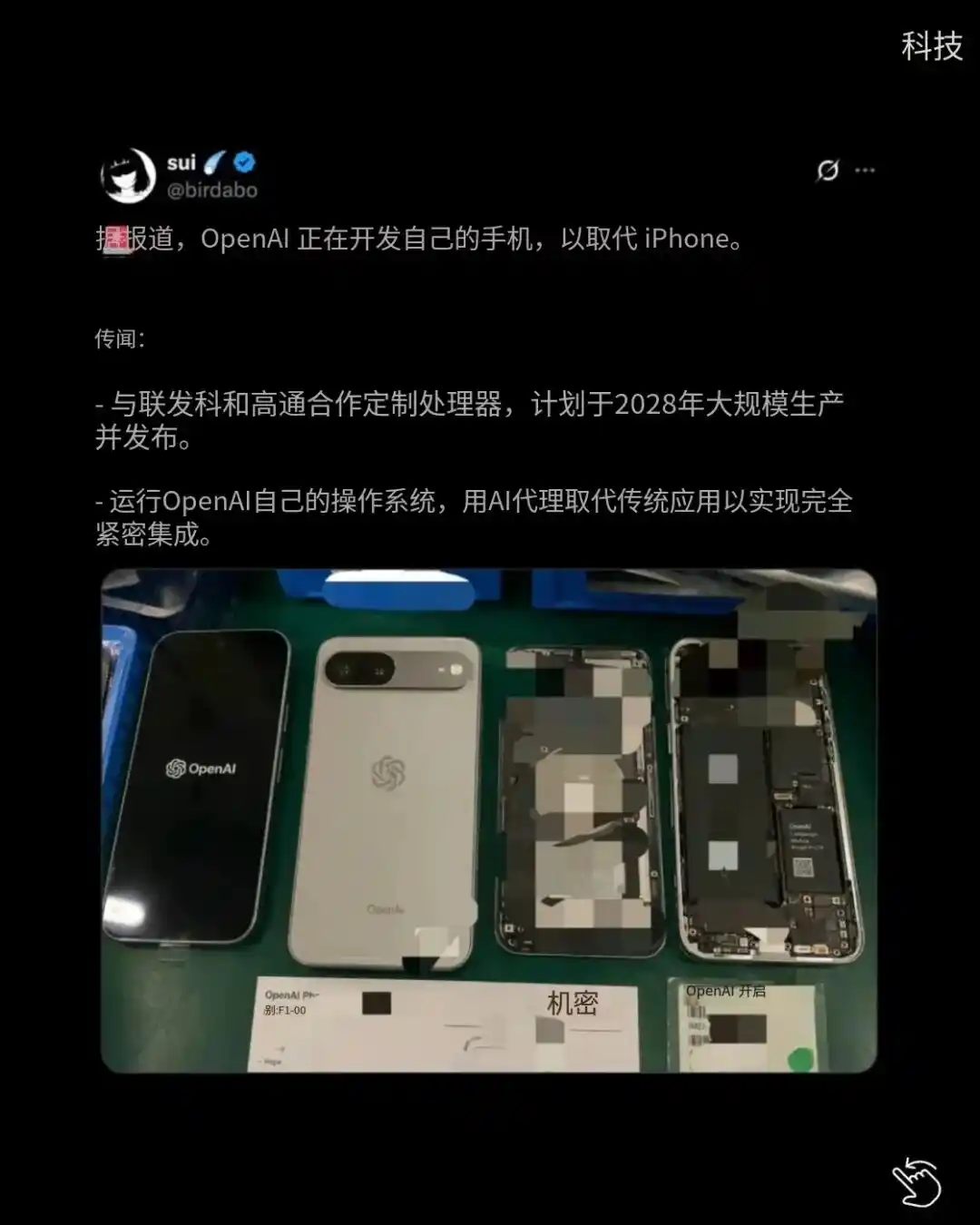
The article discusses OpenAI's surprising move into developing its own AI-powered smartphone, reportedly targeting a 2027 launch. Initially driven by faith that superior AI models alone would secure its dominance—evidenced by ChatGPT's viral success—OpenAI now faces a strategic pivot. Key challenges include slower-than-expected revenue growth and competition from rivals like Anthropic's Claude Code, which successfully monetized a specific, high-value user base (developers) by deeply integrating into workflows. OpenAI recognizes that for ChatGPT to evolve from a conversational tool into a true "AI Agent" that completes tasks (e.g., booking travel, managing files), it needs direct system-level permissions and a default user interface. Currently, as a service integrated into platforms like Apple's iOS and Microsoft's Windows, ChatGPT lacks the necessary access and control ("sovereignty") over hardware, data, and user interactions. Building its own device is seen as a way to give ChatGPT its "first body"—a dedicated terminal where it can operate with full autonomy, bypassing the limitations imposed by partner ecosystems. This shift underscores a broader realization: in the AI Agent era, owning the end-user device and experience is critical to capturing value and maintaining competitive advantage, even if it means directly competing with former allies like Apple.

This summer, Musk is going to do something unprecedented in history. Taking a large language model company and packing it into a rocket company, then taking them public together.

The last thing OpenAI should do right now is probably make a phone. But Sam Altman doesn't seem to think so.

In the first quarter of this year, OpenAI's revenue and user growth both fell short of expectations. Its rival Anthropic, with Claude Code, snatched away the group most willing to pay. Following this script, OpenAI should now be consolidating, focusing, and first proving it can make money, gearing up for an IPO by the end of this year or early next.

But the supply chain tells a different story. It's going to challenge the world's most mature, most closed, and most profitable consumer electronics category: the iPhone.

According to leaks, OpenAI is accelerating development of its first AI Agent phone, with mass production as early as the first half of 2027 and a target of shipping 30 million units over the next two years.

Is it crazy?

Probably not. OpenAI has likely already seen a more dangerous problem clearly: ChatGPT is smart, but it doesn't have hands.

It can answer you, but it has a hard time completing tasks for you. It lives in other people's systems—Apple's, Microsoft's, operating systems, browsers—so it can't get the real permissions.

What we want to discuss next isn't why OpenAI wants to build a phone. It's how this company came to realize, step by step, that without its own terminal device, ChatGPT can never truly break free.

ChatGPT's Success is Also a Form of Path Dependency

In April 2026, SpaceX secured an option: it could acquire Cursor for up to $60 billion later in the year.

OpenAI's initial belief wasn't in phones, browsers, or any particular App. It believed in the model—or more precisely, in intelligence itself.

In its worldview, as long as the model is powerful enough, the entry point, product, and business model will all be pushed forward by intelligence.

This wasn't just talk. In 2020, OpenAI published the later frequently cited Scaling Laws paper, establishing a relatively optimistic belief: by scaling up the model, data, and compute together, intelligence would improve in a predictable way.

In other words, the most important thing wasn't to grab an entry point first, but to make the model even stronger. With strong enough intelligence, the world would naturally make way.

This belief was realized on November 30, 2022.

That day ChatGPT launched. It had no flashy interface, no hardware, no platform pre-installation, just an input box on a webpage. But it gave ordinary people an experience they'd never had before: you type a sentence, and it replies like a human.

The awe wasn't just that AI could talk, but that it had barely relied on any traditional entry point. No phone manufacturers pushed it, no operating system placed it in a prominent spot; users found it themselves.

Two months, 100 million monthly active users—the fastest-growing consumer application in human history.

OpenAI seemed to be right. Microsoft immediately doubled down, embedding its capabilities into Copilot, Office, and Bing; Apple also integrated ChatGPT into Apple Intelligence at WWDC 2024.

At that moment, OpenAI stood at the center of the era. The strongest model, the most users, the deepest partnerships.

But that's precisely where the problems started.

ChatGPT's success was too dazzling. So dazzling that it easily made OpenAI believe: the model itself is the entry point. It didn't need to own a phone first, nor control an operating system first—if the intelligence was impressive enough, users would come find it.

The real cracks that emerged later also started here.

Claude Code Rewrote the Rules of Monetization

The first crack came from Anthropic.

In May 2025, it released Claude Code. No flashy demo, no blockbuster launch event. This product simply entered developers' terminals, codebases, and Git workflows, helping engineers get the job done.

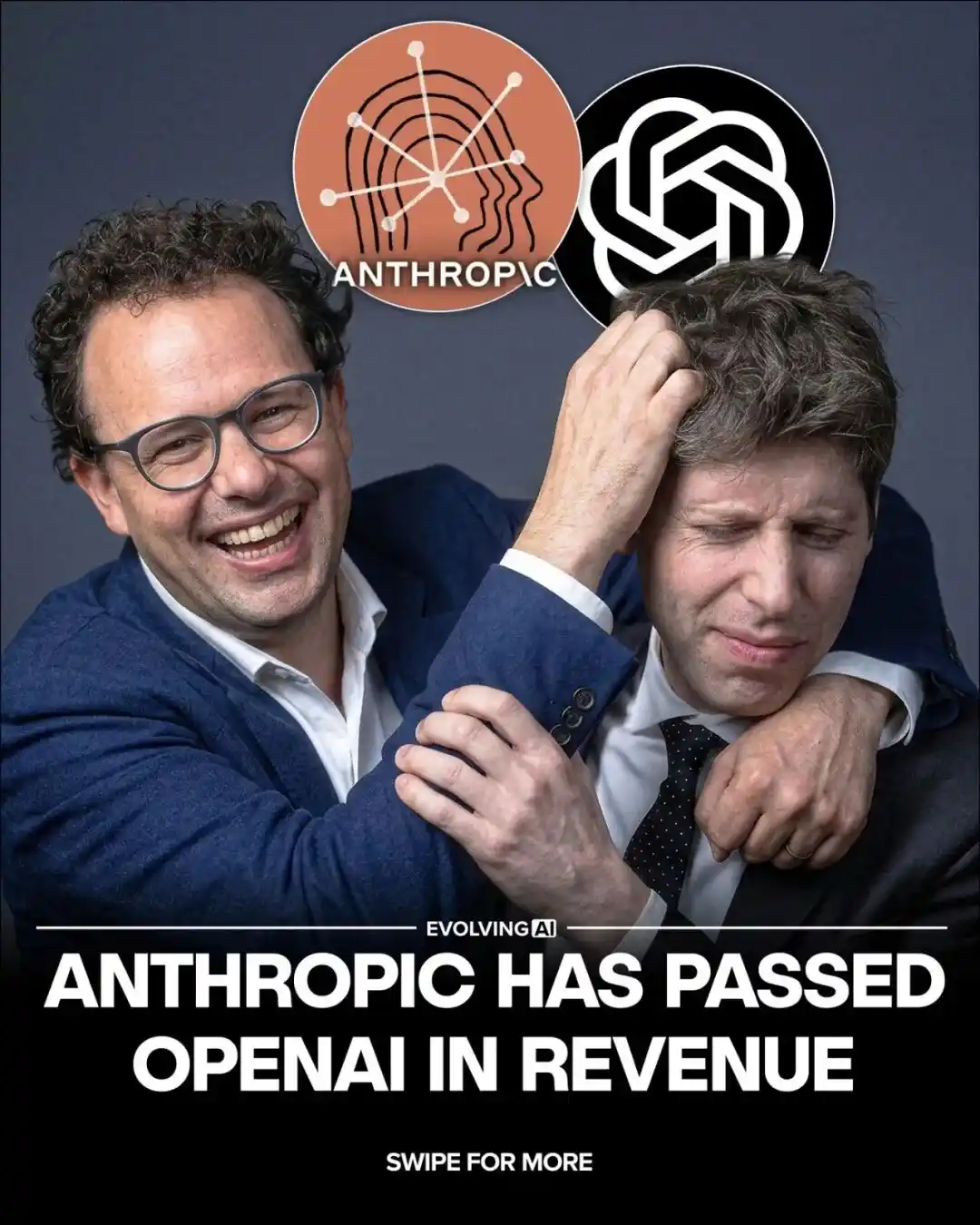
Six months after launch, Claude Code reached a $1 billion annual run rate; in less than a year, over $2.5 billion. By April 2026, Anthropic's overall annualized revenue crossed $30 billion.

Meanwhile, OpenAI was at $2 billion monthly revenue, or roughly $24 billion annualized.

Anthropic achieved higher revenue with far fewer users than ChatGPT. This is what OpenAI should truly be worried about.

The reason is simple—it captured a group of people most willing to pay.

The question is, why was OpenAI a step slower?

Not because it couldn't see Agents. It was because ChatGPT's success was too dazzling, so dazzling that OpenAI continued moving forward with its original inertia: make a stronger model, expand the user base, find the next universal entry point.

So over these past two years, you've seen OpenAI attempt many 0-to-1 projects—GPT Store, Sora, Operator, Deep Research—all born from this line of thinking. They collectively point to one judgment: as long as the model is strong enough, new products, new entry points, new business models will naturally emerge.

But Anthropic chose a different path. It didn't first create a super entry point for everyone. Instead, it nailed Claude Code into developers' workflows, repeatedly polishing one thing—letting AI finish the job.

This is where OpenAI was slow. It wasn't that it didn't make new products, but that it didn't immediately take a high-paying-use-case scenario from 1 to 100.

Sora is a classic example. It stunned the world upon release, but video generation consumed vast amounts of compute, and user retention and the business model weren't clear enough. When OpenAI later shut down Sora, it was, in a sense, a pruning—it began to realize that creating a stunning AI demo and penetrating a high-value workflow are two different things.

Model capabilities can create highlights, but commercial efficiency comes from consistently delivering results.

At this point, OpenAI finally realized: Agent isn't an add-on feature; it's the core of the next phase of AI commercialization. ChatGPT can't just prove it's smart; it must prove it can complete tasks for users.

But when it truly starts taking over tasks, what it hits isn't the ceiling of model capability, but the ceiling of permissions.

900 Million Users, How to Turn Them into Money

OpenAI is, of course, catching up. In May 2025, it launched Codex, directly responding to Claude Code. By April 2026, Codex reached 3 million weekly active users.

But in the coding battle, OpenAI will find it hard to win back in the short term—Anthropic has already captured the mindshare for coding Agents, leaving the follower to play catch-up.

This is also why OpenAI began reallocating resources: shifting attention from projects that easily create hype but struggle to achieve commercial closure, towards Agents, the enterprise market, and more fundamental research.

But what it really needs to look at is its bigger card—900 million weekly active users.

These people aren't programmers; they won't pay for code. But they all have needs: writing emails, making proposals, researching, booking travel, shopping, organizing files.

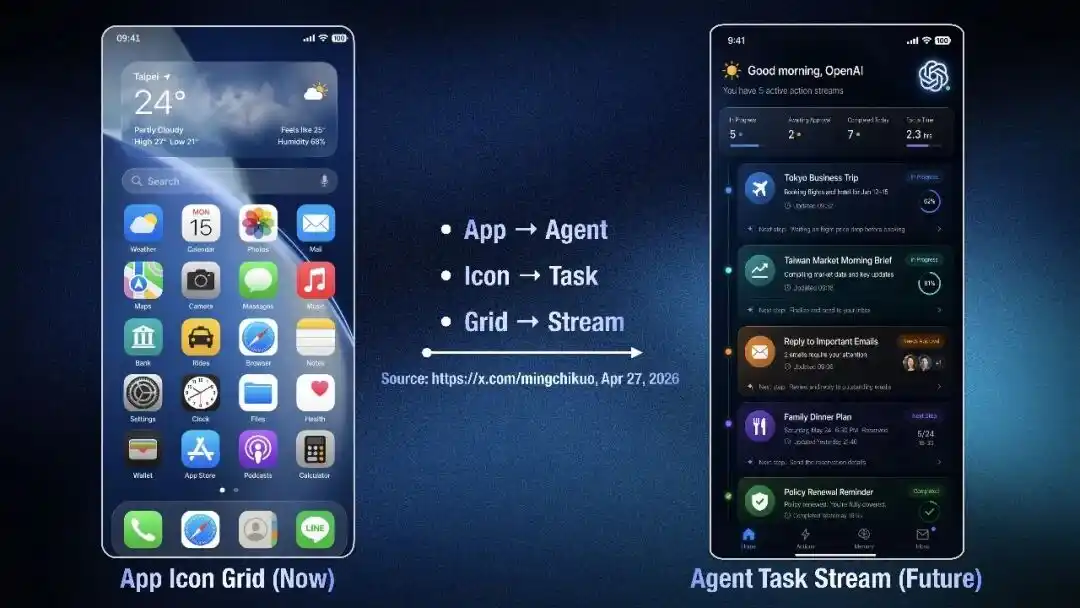
If ChatGPT can evolve from a "conversational" entry point to a "task-completing" entry point, that would be OpenAI's true commercial capability.

Imagine this scenario: you want to buy a plane ticket, tell ChatGPT the time, budget, preferences. It searches flights, compares prices, checks hotels for you, and finally gives you a confirmation button.

At that moment, part of Ctrip's value is bypassed. Price comparison, ad slots, commissions, user decision influence—all would be redistributed. Buying insurance, paying credit card bills, settling utility bills follow the same logic. As long as the Agent can complete tasks for you, OpenAI has a chance to take a cut of every transaction commission, every advertising influence within.

This is where the true value of 900 million users lies—ChatGPT no longer just answers questions, but starts taking over task and transaction entry points.

But once AI starts handling tasks, it's no longer just a model in a chatbox. It needs to know where you are, see what's happening on your screen, and access your files, calendar, emails, and payments.

The problem thus shifts from "Is the model strong enough?" to "Who has the permissions?"

And permissions are precisely what OpenAI lacks.

ChatGPT Lives in Someone Else's House

OpenAI initially thought partnerships could solve the entry point problem. Apple gave it the iPhone, Microsoft gave it Office, Windows, and enterprise customers. At the time, this looked like a victory for OpenAI's faith in models.

But with the advent of the Agent era, the problem changed.

In Apple's world, ChatGPT is an external expert that gets called upon. It can answer questions, but it cannot truly take over the screen, camera, notifications, payments, and files—Apple won't hand over these permissions. Otherwise, the iPhone's "soul" would no longer belong to Apple.

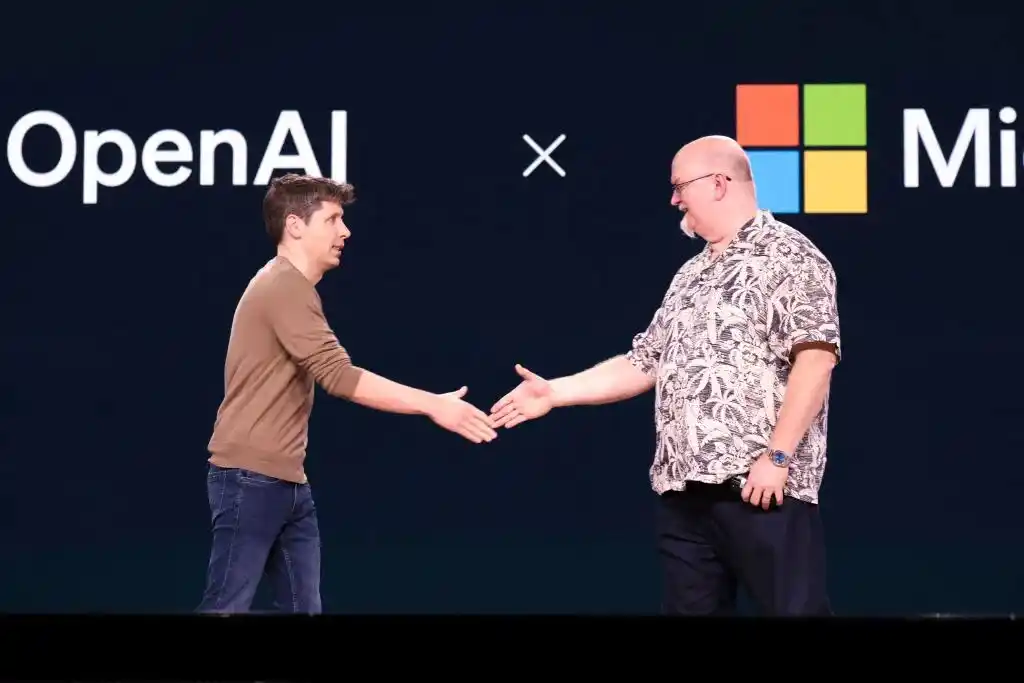
It's similar with Microsoft. In the past, OpenAI provided the model, and Microsoft was responsible for integrating AI into entry points like Office. But when OpenAI itself started making Codex and enterprise Agents, it stepped onto Microsoft's turf—Agents inherently enter workflows, write code, process files, and complete tasks for employees, which is exactly the core of Microsoft's sovereignty.

So, the relationship between OpenAI and Microsoft hasn't broken immediately, but the boundaries have shifted. In April 2026, the two parties renegotiated their agreement, with Microsoft's exclusive licensing becoming non-exclusive, allowing OpenAI to serve customers on any cloud.

The meaning of this is clear: OpenAI doesn't want to be just a supplier within the Microsoft ecosystem. It wants to face customers itself, deliver Agents itself, and capture entry points itself.

At this point, its relationships with Apple and Microsoft become delicate. Because what an Agent needs isn't a showcase spot, but the default entry point, system permissions, and the intelligent terminal the user interacts with first every day.

These things, Apple won't give, and Microsoft won't either. They can't.

Ultimately, ChatGPT is strong, but it always lives in someone else's house—Apple's house, Microsoft's house, the browser's house, the operating system's house. It can be called upon, integrated, and be a great supplier, but it can't decide when it appears, nor what permissions it gets.

And the phone is the one closest to its resource endowment. 900 million weekly active users are already willing to hand questions to ChatGPT—migrating this mindset to a device is a shorter path than building an operating system or a browser from scratch.

It's not trying to make another iPhone filled with Apps, but a phone dedicated to Agents—a body that allows ChatGPT to see, call upon, and execute tasks.

This is also why in May 2025, OpenAI spent approximately $6.5 billion to acquire Jony Ive's hardware company. This person is the industrial designer of the original iPhone, one of the most important figures beside Steve Jobs. OpenAI sought him not just to make a beautiful piece of hardware, but to redefine personal devices for the AI era.

Returning to the opening question: why would a large language model company make a phone?

What OpenAI wants isn't a phone; it's sovereignty.

It wants to find a default entry point that belongs to ChatGPT itself. But making a phone essentially pushes OpenAI into direct opposition with Apple. In the past, Apple could treat ChatGPT as a supplier; if OpenAI truly makes a phone for the AI era, it's no longer a supplier but a competitor to Apple for personal entry points.

Looking back over these past few years, OpenAI's story has actually undergone a reversal.

It once believed that if the model was strong enough, the world would actively reorganize itself around intelligence. ChatGPT's explosion did prove this—it had no hardware, no pre-installation, just a webpage input box, and pulled hundreds of millions of users into the AI era.

But when the Agent era arrived, OpenAI found it still lacked the most crucial thing: sovereignty.

ChatGPT's success was a victory, but also a form of path dependency. It made OpenAI believe for too long that the model itself was the answer. It wasn't until Claude Code reached a $2.5 billion annual run rate, and until Apple and Microsoft were unwilling to hand over system permissions, that OpenAI realized: no matter how strong the model is, it still needs to capture the entry point, permissions, and tasks.

So, when OpenAI makes a phone, what it truly wants to make isn't a phone; it's ChatGPT's first body.

This article is from the WeChat public account "Pixel 301", author: Pixel 301

Связанные с этим вопросы

QWhat is the primary reason OpenAI is reportedly developing an AI phone, according to the article?

ATo gain sovereign control over a default entry point and system permissions for ChatGPT, allowing it to function as a true AI Agent that can execute tasks, rather than relying on other platforms like Apple or Microsoft which limit its access.

QWhat key competitor move exposed a flaw in OpenAI's growth strategy, and how did it outperform ChatGPT financially?

AAnthropic's release of Claude Code targeted the high-paying developer workflow, generating $25 billion in annualized revenue within a year by focusing on completing tasks, while OpenAI, with more users, had lower annualized revenue of about $240 billion, highlighting that user scale doesn't automatically translate to commercial efficiency in specific high-value workflows.

QWhat strategic shift did OpenAI's acquisition of Jony Ive's hardware firm represent?

AIt represented a move beyond being just a model provider to aiming to redefine personal AI devices. OpenAI sought Ive's expertise to build not just a smartphone, but a dedicated 'body' or terminal for its AI Agent, ChatGPT, to have its own sovereign interface.

QHow did the success of ChatGPT create a 'path dependency' or strategic blind spot for OpenAI?

AChatGPT's viral, hardware-independent success led OpenAI to believe that superior model intelligence alone was sufficient to attract users and define new entry points. This made them slower to prioritize developing deep, commercially closed-loop Agent capabilities for specific high-value tasks, as demonstrated by Anthropic.

QWhy can't partnerships with Apple or Microsoft solve OpenAI's need for system-level permissions in the Agent era?

ABecause neither Apple nor Microsoft will relinquish core system permissions (like screen control, notifications, payments, or deep file access) to an external AI. These permissions define platform sovereignty. For OpenAI's ChatGPT to act as a true task-executing Agent, it needs these permissions, which requires its own controlled hardware entry point.

Похожее

Bitcoin's Weak Rebound Fails to Mask Adjustment Trend, HYPE's Top Signal Warns of Short-Term Risks | Invited Analysis

**Title:** Bitcoin's Weak Rebound Fails to Mask Downtrend; HYPE Top Signal Alerts of Short-Term Risks | Exclusive Analysis **Abstract:** This weekly market analysis examines the current technical structures of Bitcoin and HYPE, outlining key trading strategies. Bitcoin's daily chart shows it has broken below the median line of its primary ascending channel, indicating structural weakness. It is currently experiencing a weak rebound within a short-term descending channel, targeting resistance at $75,000-$76,000. Failure to break above this zone could lead to a resumption of the downtrend, testing support at $69,500-$70,500. Trading strategies include positioning for a rebound rejection (Plan A) or a breakdown below key support (Plan B) with controlled short positions. For HYPE, the 4-hour chart reveals a potential seven-wave advance from the May 14 low, now showing signs of exhaustion. A bearish divergence (momentum weakening) has been observed, coupled with a top signal from the proprietary "Spread Trading Model" at potential endpoint 47. The key this week is to monitor if a confirmed top forms here, especially upon a breach of the $62.5-$64.57 support area. If broken, a larger corrective move towards $54-$56.30 is anticipated. The short-term strategy for HYPE focuses on cautious long entries only upon confirmed stabilization within the support zone. The report also details a successful short BTC trade from the previous week, yielding a ~5.07% profit, executed based on model signals and price action. Strict risk management rules, including dynamic stop-loss adjustments, are emphasized.

marsbit10 мин. назад

Bitcoin's Weak Rebound Fails to Mask Adjustment Trend, HYPE's Top Signal Warns of Short-Term Risks | Invited Analysis

marsbit10 мин. назад

Bitcoin's Weak Rebound Fails to Conceal Adjustment Trend; HYPE's Top Signals Warn of Short-Term Risks | Guest Analysis

Bitcoin's Weak Bounce Fails to Mask Correction Trend; HYPE Top Signals Warn of Short-Term Risks | Invited Analysis Core Weekly View: Bitcoin's daily chart structure has weakened. The key question is whether its short-term rebound can effectively break above the upper boundary of the descending channel. Has HYPE's seven-wave advance reached its conclusion? This analysis systematically examines the current market structure across multiple timeframes and outlines operational strategies for the week. **Bitcoin (BTC) Analysis:** The daily chart shows BTC trading within a long-term rising channel (yellow) since February but has recently broken below its midline, indicating structural weakness. It is currently confined within a short-term descending channel (blue) originating from the May 6 high. The ongoing bounce appears to be a weak technical correction targeting the blue channel's upper rail (approx. $75,000-$76,000). The 4-hour chart reveals a complex 10-segment corrective structure from the May high, containing two downward pivot zones (Central D and E). The current rebound (segment 36-37) is expected to face resistance in the $75,000-$76,000 area. A failure to break above could lead to a resumption of the downtrend, testing support at $69,500-$70,500 and potentially $65,000. **BTC Weekly Strategy:** The price is currently below the "Bull-Bear Channel," placing it in a technically weak zone. The core focus is on the test of the $75,000-$76,000 resistance and $69,500-$70,500 support. * *Medium-term*: Consider initiating short positions (up to 30% allocation) if the price rejects the $75,000-$76,000 area. Increase exposure to 60% if the long-term rising channel's lower support fails. * *Short-term (30% allocation)*: Two scenarios are outlined: * *Plan A (Sell on Rally)*: Short on rejection at $75,000-$76,000, with a stop-loss above $77,000. * *Plan B (Breakdown Sell)*: Short on a confirmed breakdown below $69,500-$70,500, with a stop-loss above $72,000. **HYPE Analysis:** The 4-hour chart shows HYPE has completed a seven-wave advance from its May 14 low, including a central consolidation zone. A bearish divergence was noted at the prior high (point 45), leading to a 13% correction. The current rally leg (46-47) shows weakening momentum compared to the initial leg (42-43), suggesting a potential momentum divergence. Furthermore, the proprietary "Spread Trading Model" has triggered a strong top warning signal at point 47. A confirmed top here, combined with the momentum divergence, could signal the end of the current uptrend. **HYPE Weekly Strategy:** The core is observing whether a confirmed top at point 47 coincides with the momentum divergence. * Monitor the key support zone of $62.5-$64.75. A hold and bounce from this area, supported by model buy signals, could allow for a light long position (<30% allocation). * A decisive break below this support would indicate a shift to a larger-degree correction, targeting the $54-$56.3 area. **Trade Review:** A previous short trade on BTC was executed at $77,449 based on model top signals (bearish candlestick pattern, spread model warning, momentum divergence) and closed at $73,519 for a 5.07% profit. **Risk Management Reminder:** Always set an initial stop-loss immediately upon entry. Move the stop-loss to breakeven once a 1% profit is achieved, and trail it upwards to lock in profits as the trade progresses. *Disclaimer: Market conditions change rapidly. All views, models, and strategies are for educational purposes and personal trading logs only, not investment advice. Trading carries significant risk.*

Odaily星球日报16 мин. назад

Bitcoin's Weak Rebound Fails to Conceal Adjustment Trend; HYPE's Top Signals Warn of Short-Term Risks | Guest Analysis

Odaily星球日报16 мин. назад

How to Define "Real U.S. Stocks": Differences Between On-Chain Tokens, Price Contracts, and Direct Broker Connections

**Title:** Defining "Real US Stocks": Differences Among On-Chain Tokens, Price Contracts, and Broker-Direct Access **Summary:** In 2026, using stablecoins to purchase US stocks is mainstream, but products marketed as "buying US stocks with USDT" offer fundamentally different assets. This article analyzes three primary models. **1. Tokenized Stocks:** These are on-chain tokens representing economic exposure to underlying stocks, held by an issuer or custodian. They offer benefits like 24/7 trading and DeFi composability (e.g., use as loan collateral). However, users lack direct legal shareholder status; dividends may not be paid in cash, and voting rights are typically non-binding advisory expressions. Examples include platforms like Ondo Finance. **2. Stock Futures / Equity Perpetuals:** These are derivative contracts tracking a stock's price, allowing leveraged long/short positions 24/7, similar to crypto perpetuals. They offer high efficiency and flexibility but involve funding fees, which can be a significant long-term cost, especially during strong trends. Crucially, they confer no ownership rights (dividends, voting) to the holder. **3. Broker-Direct Model:** This model provides access to real securities via licensed broker-dealers. Stocks/ETFs are bought and held within the US clearing and custodial system (e.g., DTCC), making it the only path to genuine stock ownership. Users receive cash dividends and formal proxy voting rights (where applicable). It supports thousands of stocks and ETFs, far exceeding the coverage of the other two models. Key advantages include no funding fees, a clean cost structure for long-term holds, and the potential to transfer holdings to other brokers. Some platforms facilitate stablecoin (USDT/USDC) deposits, reducing reliance on traditional banking. A critical distinction exists *within* the broker-direct model: the underlying brokerage architecture (e.g., Fully Disclosed IB, Omnibus IB, Self-Clearing) determines how client assets are held, protected, and how safeguards like SIPC insurance are conveyed. Users should verify the specific clearing structure and regulatory compliance of any platform. In conclusion, "buying US stocks with USDT" can mean holding an on-chain economic proxy (Tokenized Stocks), trading a price derivative (Stock Futures), or owning the actual security (Broker-Direct). For users seeking full ownership rights and long-term investment, the broker-direct model is the definitive choice, though its implementation details require careful scrutiny.

marsbit1 ч. назад

How to Define "Real U.S. Stocks": Differences Between On-Chain Tokens, Price Contracts, and Direct Broker Connections

marsbit1 ч. назад

NVIDIA Launches DSX Platform, Expanding into AI Factory Infrastructure

NVIDIA has unveiled the DSX platform at its GTC Taipei event, marking a strategic expansion from GPU sales into comprehensive AI factory infrastructure solutions. The platform addresses challenges like power supply, cooling, and resource orchestration as AI models scale, shifting the industry focus from single-chip performance to overall infrastructure efficiency. DSX integrates NVIDIA's chips, systems, software, and partner technologies to cover the entire AI factory lifecycle—from design and simulation to deployment and operations. It aims to accelerate deployment, improve reliability and operational efficiency, and reduce the cost per generated token in AI inference. The software suite includes DSX MaxLPS, which uses 45°C liquid cooling and rack-level optimization to allow up to 40% more GPUs per megawatt, and DSX OS, an open-source platform for AI factory operations. The platform also encompasses reference designs, digital twin simulation (DSX Sim), dynamic workload adjustment based on grid conditions (DSX Flex), and data exchange between systems. Early adopters include cloud providers like CoreWeave and Lambda. Major hardware partners, including Dell, HPE, Lenovo, and Supermicro, are developing DSX-ready systems. Pilot projects for DSX Flex are underway with energy providers. Strategically, DSX represents NVIDIA's ongoing transition from an AI chip supplier to a full-stack AI infrastructure platform provider, aiming to set industry standards and solidify its market leadership.

marsbit1 ч. назад

NVIDIA Launches DSX Platform, Expanding into AI Factory Infrastructure

marsbit1 ч. назад

After Burning Tens of Billions of Dollars in Tokens, Silicon Valley Giants Start Limiting Employee Token Usage

After burning tens of billions of dollars on AI tokens, major Silicon Valley firms are now restricting employee usage. Companies like Microsoft, Uber, and Salesforce, which heavily promoted AI for "efficiency," are facing a cost crisis. The practice of "tokenmaxxing"—pushing employees to maximize AI tool usage—led to wasteful spending on trivial tasks like checking the weather or writing birthday messages, with studies showing significant hidden costs for bug fixes and code rewrites. The core issue is a misalignment between individual productivity gains and actual business value. While employees use AI to automate tasks they dislike, such as writing reports, this often doesn't translate to increased company revenue or improved core business outcomes. For instance, AI-generated code speeds up development but also sees an 800% increase in "code churn" (code being discarded or rewritten). As a result, only 14% of CFOs report seeing a clear, measurable return on AI investments. Firms are now shifting strategies. Microsoft has revoked most internal licenses for Claude Code, while others are implementing monitoring and cost controls. New tools from companies like Harness and CloudZero aim to track AI spending and tie costs to business results. Some AI vendors, like HubSpot, are moving from token-based pricing to charging based on outcomes, such as "resolved conversations" or "leads generated." This represents a necessary correction in the AI adoption cycle. The challenge now is for companies to move beyond using AI merely to speed up old tasks and instead rethink their workflows and business models fundamentally. The future of enterprise AI depends on proving its value, not just its usage.

marsbit1 ч. назад

After Burning Tens of Billions of Dollars in Tokens, Silicon Valley Giants Start Limiting Employee Token Usage

marsbit1 ч. назад

Торговля

Спот
Фьючерсы

Популярные статьи

Как купить LA

Добро пожаловать на HTX.com! Мы сделали приобретение Lagrange (LA) простым и удобным. Следуйте нашему пошаговому руководству и отправляйтесь в свое крипто-путешествие.Шаг 1: Создайте аккаунт на HTXИспользуйте свой адрес электронной почты или номер телефона, чтобы зарегистрироваться и бесплатно создать аккаунт на HTX. Пройдите удобную регистрацию и откройте для себя весь функционал.Создать аккаунтШаг 2: Перейдите в Купить криптовалюту и выберите свой способ оплатыКредитная/Дебетовая Карта: Используйте свою карту Visa или Mastercard для мгновенной покупки Lagrange (LA).Баланс: Используйте средства с баланса вашего аккаунта HTX для простой торговли.Третьи Лица: Мы добавили популярные способы оплаты, такие как Google Pay и Apple Pay, для повышения удобства.P2P: Торгуйте напрямую с другими пользователями на HTX.Внебиржевая Торговля (OTC): Мы предлагаем индивидуальные услуги и конкурентоспособные обменные курсы для трейдеров.Шаг 3: Хранение Lagrange (LA)После приобретения вами Lagrange (LA) храните их в своем аккаунте на HTX. В качестве альтернативы вы можете отправить их куда-либо с помощью перевода в блокчейне или использовать для торговли с другими криптовалютами.Шаг 4: Торговля Lagrange (LA)С легкостью торгуйте Lagrange (LA) на спотовом рынке HTX. Просто зайдите в свой аккаунт, выберите торговую пару, совершайте сделки и следите за ними в режиме реального времени. Мы предлагаем удобный интерфейс как для начинающих, так и для опытных трейдеров.

683 просмотров всегоОпубликовано 2025.06.04Обновлено 2025.06.04

Как купить LA

Обсуждения

Добро пожаловать в Сообщество HTX. Здесь вы сможете быть в курсе последних новостей о развитии платформы и получить доступ к профессиональной аналитической информации о рынке. Мнения пользователей о цене на LA (LA) представлены ниже.

活动图片