Where Did the $362 Million Go? Hyperliquid Counters FUD, A Decentralization Route Debate Behind the Reconciliation

marsbitОпубликовано 2025-12-24Обновлено 2025-12-24

Введение

A technical report published on December 20, 2025, accused Hyperliquid, a decentralized exchange, of multiple severe issues—including insolvency and a "God mode backdoor"—claiming it was a centralized platform disguised as a blockchain. Hyperliquid issued a detailed response refuting the claims. The most serious allegation—a $362M shortfall in user funds—was debunked. The discrepancy arose because the accuser overlooked native USDC on HyperEVM during Hyperliquid’s transition from an L2 to an independent L1. Total reserves across Arbitrum and HyperEVM matched user balances. Other accusations were partially addressed: some code was testnet-related, limited broadcast nodes were an anti-MEV measure, and chain freezes were part of upgrade procedures. However, Hyperliquid did not fully respond to claims about unqueryable governance proposals and a lack of a cross-chain "escape hatch" for withdrawals. The exchange also compared itself to competitors like Lighter and Aster, criticizing their reliance on centralized sequencers and lack of transparency, while highlighting its own fully on-chain state verification. Additionally, Hyperliquid addressed community concerns about insider trading, attributing significant short selling to a former employee. The incident underscores broader challenges in DeFi transparency as protocols grow more complex, emphasizing the crypto mantra: "Don’t trust, verify."

On December 20, 2025, a technical article titled "Reverse Engineering Hyperliquid," published on blog.can.ac, directly deconstructed Hyperliquid's binary files through reverse engineering, accusing it of nine serious issues ranging from "insolvency" to a "God Mode backdoor." The article bluntly stated:

"Hyperliquid is a centralized trading platform disguised as a blockchain."

In response to the FUD, the official Hyperliquid team issued a lengthy reply. Perhaps this was not merely a simple refutation of rumors but also a declaration of war regarding "who truly possesses decentralized trading infrastructure." While the official response successfully clarified the fund security issues, it left intriguing "gaps" in some sensitive areas of decentralization.

Where Did the $362 Million Go? The Audit Blind Spot Under the "Dual Ledger" System

The most damaging accusation was that user assets within the Hyperliquid system were $362 million short compared to the on-chain reserves. If true, this would mean it was a "chain-based FTX" operating on fractional reserves.

However, upon verification, this was a misinterpretation due to information asymmetry caused by an "architecture upgrade." The auditor's logic was: Hyperliquid reserves = USDC balance on the Arbitrum cross-chain bridge. Based on this logic, they checked the cross-chain bridge address and found the balance was indeed less than the total user deposits.

Hyperliquid responded that it is undergoing a complete evolution from an "L2 AppChain" to an "independent L1." During this process, asset reserves have become a two-track system:

The accuser completely ignored the native USDC on HyperEVM. According to on-chain data (as of the time of writing):

· Arbitrum cross-chain balance: 3.989 billion USDC (verifiable on Arbiscan)

· HyperEVM native balance: 362 million USDC (verifiable on Hyperevmscan)

· HyperEVM contract balance: 59 million USDC

Total solvency = 3.989B + 0.362B + 0.059B ≈ 4.351B USDC

This figure completely matches the Total User Balances on HyperCore. The alleged "$362 million gap" is precisely the native assets that have already migrated to HyperEVM. This is not a disappearance of funds but a transfer of funds between different ledgers.

Checklist of 9 Accusations: What Was Clarified? What Was Avoided?
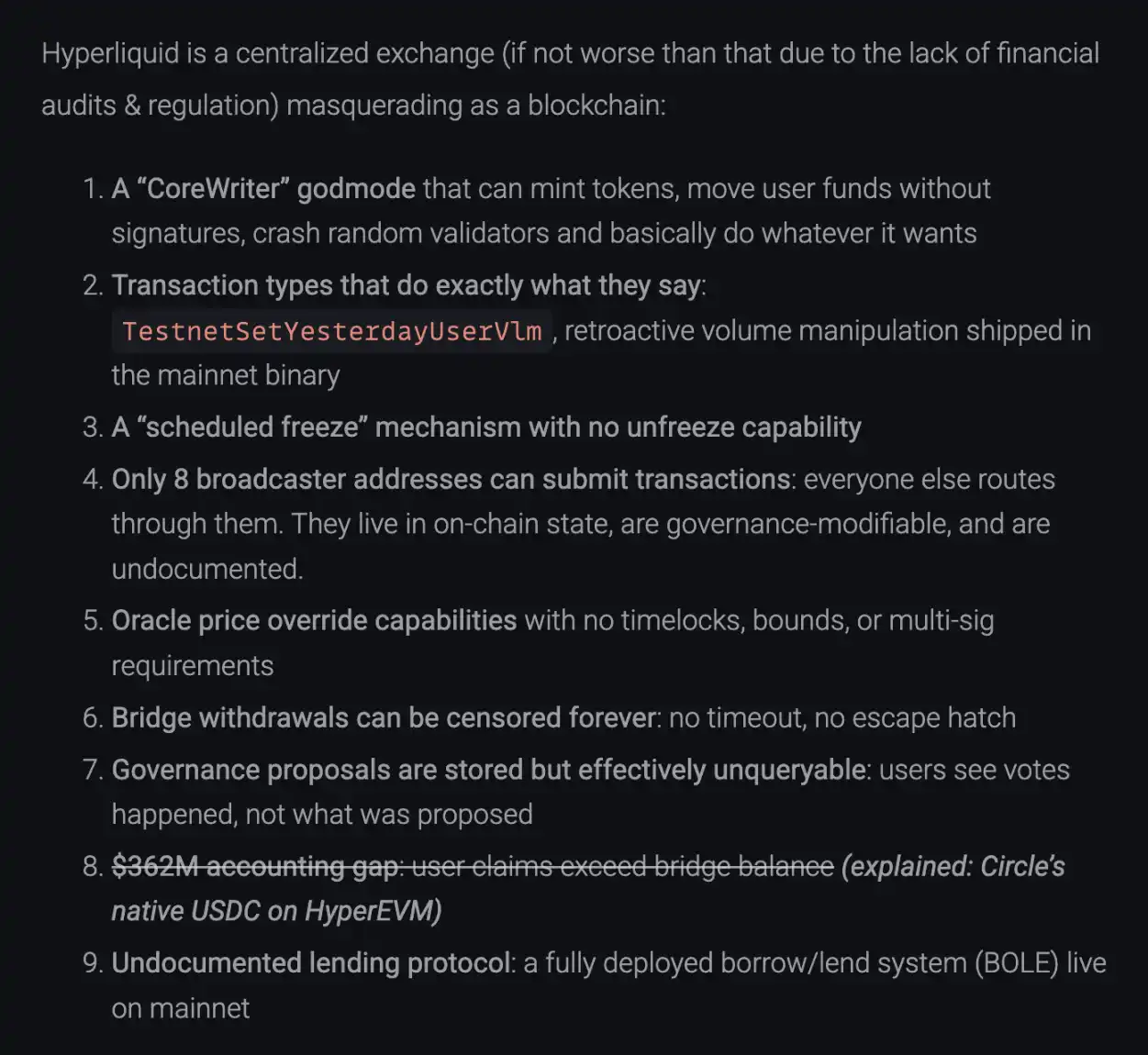
Clarified Accusations

Accusation: "CoreWriter" God Mode: Accused of being able to print money out of thin air and misappropriate funds.

Response: Officially explained that this is an interface for L1 to interact with HyperEVM (e.g., staking), with restricted permissions and no ability to misappropriate funds.

Accusation: $362 million funding gap.

Response: As described above, it was due to not accounting for Native USDC.

Accusation: Undisclosed lending protocol.

Response: Official pointed out that the spot/lending function (HIP-1) documentation is publicly available and in a pre-release stage, not secretly operating.

Acknowledged Accusations with Reasonable Explanations

Accusation: Binary file contains code to "modify trading volume" (TestnetSetYesterdayUserVlm).

Response: Acknowledged existence. Explained as testnet (Testnet) residual code used to simulate fee logic; the mainnet nodes have physically isolated this path, making execution impossible.

Accusation: Only 8 broadcast addresses can submit transactions.

Response: Acknowledged. Explained as an anti-MEV (Maximal Extractable Value) measure to prevent user transactions from being front-run. Committed to implementing a "multi-proposer" mechanism in the future.

Accusation: The chain can be "plannedly frozen" with no revocation function.

Response: Acknowledged. Explained as a standard process for network upgrades (Upgrade), requiring a full network pause to switch versions.

Accusation: Oracle price can be instantly overwritten.

Response: Explained as a system security design. To liquidate bad debt promptly during extreme volatility (like 10x), the validator oracle indeed does not have a time lock.

Missing / Vague Responses

In our review, two accusations were not directly addressed or fully resolved in the official response:

Accusation: Governance proposals are unqueryable. Users can only see that voting occurred, but the on-chain data does not contain the specific text content of the proposals.

Response: The official did not address this point in the long post. This means Hyperliquid's governance remains a "black box" for ordinary users—you can only see the results, not the process.

Accusation: Cross-chain bridge has no "escape hatch." Withdrawals could be censored indefinitely, and users cannot force withdrawals back to L1.

Response: Although the official explained that locking the bridge during the POPCAT incident was for safety, it did not refute the architectural fact of "no escape hatch." This indicates that at the current stage, the inflow and outflow of user assets highly depend on the permission of the validator set, lacking the anti-censorship forced withdrawal capability of L2 Rollups.

"Throwing Shade" at Competitors

The most interesting aspect of this incident is that it forced Hyperliquid to show its cards, giving us an opportunity to re-examine the landscape of the Perp (Perpetuals)赛道. The official response unusually "threw shade" at competitors, targeting Lighter, Aster, and even industry giant Binance.

It stated, "Lighter uses a single centralized sequencer, and its execution logic and zero-knowledge (ZK) circuits are not public. Aster uses centralized matching and even offers dark pool trading, which can only be achieved with a single centralized sequencer and an unverifiable execution process. Other protocols that include open-source contracts lack a verifiable sequencer."

Hyperliquid unabashedly categorized these competitors as relying on a "Centralized Sequencer." The official emphasized: on these platforms, no one except the sequencer operator can see the complete state snapshot (including order book history, position details). In contrast, Hyperliquid attempts to eliminate this "privilege" by having all validators execute the same state machine.

This wave of "throwing shade" might also stem from Hyperliquid's concerns about its current market share. According to DefiLlama's trading volume data for the past 30 days, the market has shown a tripartite balance of power:
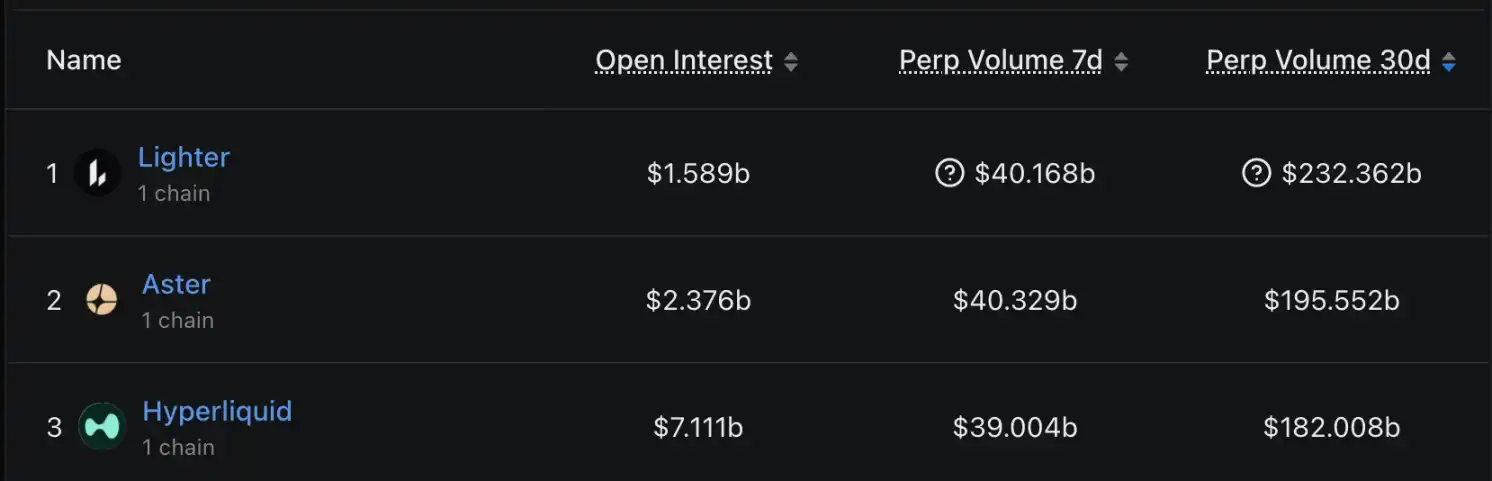
· Lighter: Trading volume $232.3 billion, temporarily leading,约占 26.6%.

· Aster: Trading volume $195.5 billion,位居第二,约占 22.3%.

· Hyperliquid: Trading volume $182.0 billion,位居第三,约占 20.8%.

Facing the trading volume of latercomers Lighter and Aster surpassing its own, Hyperliquid attempts to play the "transparency" card—meaning "although I have 8 centralized broadcast addresses, my entire state is on-chain and verifiable; while you can't even check yours." However, it is worth noting that although Hyperliquid's trading volume is slightly lower than the top two, it呈现碾压态势 in terms of Open Interest (OI).

Public Sentiment Response: Who is Shorting HYPE?

Beyond technical and fund issues, the community is also highly concerned about recent rumors that HYPE tokens were allegedly shorted and dumped by "insiders." In response, a Hyperliquid team member gave a定性回应 on Discord for the first time: "The shorting address starting with 0x7ae4 belongs to a former employee." This individual was once a team member but was fired in early 2024. The personal trading behavior of this former employee is unrelated to the current Hyperliquid team. The platform emphasized that it currently implements extremely strict HYPE trading restrictions and compliance reviews for all在职 employees and contractors, strictly prohibiting insider trading using their positions.

This response attempts to downgrade the accusation of "team misconduct" to "personal behavior of a former employee." However, regarding the transparency of token distribution and unlocking mechanisms, the community might still expect more detailed disclosure.

Don't Trust, Verify

Hyperliquid's clarification tweet can be considered a textbook example of crisis PR—relying not on emotional output but on data, code links, and architectural logic. It did not stop at proving its innocence but instead went on the offensive, strengthening its brand and advantage of "full state on-chain" by comparing competitor architectures.

Although the FUD was disproven, the profound thought left for the industry by this incident is far-reaching. As DeFi protocols evolve towards independent application chains (AppChain), architectures become increasingly complex, and asset distribution becomes more fragmented (Bridge + Native). The traditional method of checking balances by "looking at the contract balance" has become ineffective.

For Hyperliquid, proving "the money is there" is only the first step. How to gradually transfer the permissions of those 8 submission addresses while maintaining the advantages of high performance and anti-MEV, truly achieving the transition from "transparent centralization" to "transparent decentralization," is the necessary path to becoming the "ultimate DEX."

For users, this incident once again confirms the iron law of the crypto world: don't trust any narrative, verify every byte.


Трендовые криптовалюты

Связанные с этим вопросы

QWhat was the core accusation made in the 'Reverse Engineering Hyperliquid' blog post regarding user funds?

AThe blog post accused Hyperliquid of having a 362 million USDC shortfall, suggesting it was operating as a fractional-reserve exchange with user assets not fully backed by on-chain reserves.

QHow did Hyperliquid explain the alleged 362 million USDC discrepancy in its reserves?

AHyperliquid clarified that the 'missing' 362 million USDC was not a shortfall but was part of the native USDC balance on its new HyperEVM chain, which the accuser had failed to account for in their audit. The total reserves across Arbitrum and HyperEVM matched user balances.

QWhich two specific accusations did the article note were not fully addressed or resolved in Hyperliquid's official response?

AThe two accusations were: 1) Governance proposals are unqueryable (users cannot see the proposal text, only the voting result), and 2) The cross-chain bridge has no 'escape hatch' (users cannot force a withdrawal to L1, making withdrawals reliant on validator approval).

QWhat key competitive advantage did Hyperliquid claim over its rivals Lighter and Aster in its response?

AHyperliquid claimed its key advantage is transparency through 'full state on-chain,' arguing that while it uses 8 broadcast addresses, its entire state (like order book history) is publicly verifiable, unlike competitors it accused of relying on opaque, centralized sequencers.

QAccording to the article, what was Hyperliquid's explanation for the address that was shorting its HYPE token?

AHyperliquid stated that the address shorting HYPE belonged to a former employee who had been fired in early 2024 and that this was a personal trading action unrelated to the current team, which operates under strict trading restrictions.

Похожее

Аster уже запустил 112 рынков RWA, так почему же ASTER всё ещё стоит на месте?

В первой половине 2026 года платформа Aster продемонстрировала значительный рост: запустила собственный блокчейн L1, ввела стейкинг, расширилась на 112 рынков токенизированных реальных активов (RWA) и привлекла строителей через Aster Code, генерируя объем в $12 миллиардов. Ключевое изменение для нативного токена ASTER произошло в июне — теперь 99% ежедневных комиссий платформы используются для выкупа и сжигания токенов, что теоретически может со временем вывести из обращения 5 миллиардов ASTER. Несмотря на эти фундаментальные улучшения и дорожную карту, включающую Aster Vault, Aster Card и расширение предложений TradFi, цена ASTER остается в боковом тренде около $0.626. Технические индикаторы, такие как RSI, показывают нейтралитет, а объем баланса (OBV) недостаточен для уверенного пробоя. Открытый интерес в деривативах снизился до примерно $149 миллионов, что указывает на осторожность трейдеров. Рынок, по-видимому, ждет более убедительных доказательств того, что новые инициативы приведут к реальному росту активности, увеличению комиссий и, как следствие, устойчивому спросу на токен ASTER.

ambcrypto2 мин. назад

Аster уже запустил 112 рынков RWA, так почему же ASTER всё ещё стоит на месте?

ambcrypto2 мин. назад

Владельцы XRP стали получать прибыль, но спрос на спотовом рынке исчез: Удержит ли цена $1.10?

Недавняя рыночная структура XRP демонстрирует противоречивые сигналы. Несмотря на то, что краткосрочные держатели снова стали получать прибыль (30-дневный MVRV превысил 1.0), активность сместилась с спотового рынка на рынок деривативов. Спотовый спрос практически исчез, объемы упали примерно на 99%, в то время как открытый интерес и коэффициент левериджа выросли. Это означает, что текущая консолидация цены в диапазоне $1.086-$1.113 в основном поддерживается спекулятивными позициями с использованием заемных средств, а не притоком нового капитала. Устойчивость такого роста левериджа сейчас зависит от прибыльности держателей. Поскольку давление для фиксации прибыли может усилиться, а новый спотовый спрос отсутствует, ключевой уровень поддержки $1.10 находится под угрозой, и XRP становится уязвимым для резкой коррекции в случае изменения рыночных настроений.

ambcrypto5 мин. назад

Владельцы XRP стали получать прибыль, но спрос на спотовом рынке исчез: Удержит ли цена $1.10?

ambcrypto5 мин. назад

Kalshi пообещал подать апелляцию после того, как судья в Вашингтоне признал, что рынок прогнозов, вероятно, нарушает законы штата об азартных играх

Компания Kalshi, оператор прогнозных рынков, регулируемых Комиссией по торговле товарными фьючерсами (CFTC), пообещала подать апелляцию после того, как судья в штате Вашингтон выдал предварительный судебный запрет. Суд постановил, что деятельность компании, вероятно, нарушает законы штата об азартных играх и защите прав потребителей. Иск был подан генеральным прокурором штата, который утверждает, что платформа Kalshi позволяет делать ставки на широкий круг событий, включая спорт и выборы, что представляет собой незаконный онлайн-гемблинг по местным законам. Kalshi отвергает претензии, настаивая на том, что её контракты на события регулируются федеральным Законом о товарных биржах и находятся под исключительной юрисдикцией CFTC, а не властей штатов. Компания заявила, что штаты не имеют права регулировать подобные рынки. Однако суд на предварительной стадии заключил, что федеральный закон не отменяет действие законов Вашингтона об азартных играх. Это дело является частью более широкой правовой битвы по вопросу о том, подпадают ли федерально регулируемые прогнозные рынки исключительно под федеральный надзор или также под действие законов штатов об азартных играх. Исход апелляции может оказать существенное влияние на будущее регулирование этой растущей отрасли по всей стране. Окончательное решение по судебному запрету ожидается 5 августа.

ambcrypto25 мин. назад

Kalshi пообещал подать апелляцию после того, как судья в Вашингтоне признал, что рынок прогнозов, вероятно, нарушает законы штата об азартных играх

ambcrypto25 мин. назад

Зарядка Bitcoin для $70K здесь, несмотря на слабый спрос на споте — вот как!

Рынок сигнализирует о возможной повышенной волатильности Bitcoin. Несмотря на слабый спрос на спотовом рынке (показатель упал до -170 тыс. BTC), данные Glassnode и CryptoQuant указывают на накопление крупными держателями («китами») 66,7 тыс. BTC за последние 60 дней. Это может свидетельствовать о переходе активов в «более сильные руки» (LTH). Одновременно наблюдается рост позиций с плечом: положительные funding-ставки выросли более чем на 20% за 72 часа, что создаёт риск массовых ликвидаций лонгов при отсутствии свежего покупательского спроса. Однако недавний рост цены выше $66 тыс. сопровождался ликвидацией шортов на сумму свыше $80 млн. Общая картина предполагает, что текущая ситуация может привести либо к коррекции из-за перегретых лонгов, либо, если спрос восстановится, к пробою в сторону уровня $70 тыс., что вызовет ликвидацию оставшихся медведей. Ключевым фактором станет динамика спотового спроса.

ambcrypto1 ч. назад

Зарядка Bitcoin для $70K здесь, несмотря на слабый спрос на споте — вот как!

ambcrypto1 ч. назад

Занижена ли стоимость Биткойна? Почему $66 тыс. могут не отражать всей картины о BTC

Биткоин (BTC) вновь преодолел отметку в $66 000, впервые с 17 июня, на фоне общего восстановления рынка криптовалют. Однако данные аналитической платформы CryptoQuant указывают, что BTC всё ещё может быть недооценен. Метрика MVRV Percentile, оценивающая текущую цену относительно исторических данных, находится на уровне 5-го процентиля. Это означает, что актив торгуется ниже, чем в 95% случаев за всю историю наблюдений, что традиционно сигнализирует о периоде недооценки и в прошлом предшествовало устойчивому росту. В то же время активность на спотовом рынке демонстрирует нейтралитет. Индикатор Spot Taker Cumulative Volume Delta (CVD) показывает баланс между объёмами покупок и продаж с 14 июня, что указывает на отсутствие доминирования быков или медведей. Чистый приток средств (Netflow) в спотовый рынок остаётся положительным, но недостаточно сильным: около $34,66 млн за 24 часа и $1,22 млрд за 30 дней. Это свидетельствует об осторожном накоплении, но не о мощном покупательском давлении. Таким образом, несмотря на технический сигнал недооценки по метрике MVRV, для подтверждения устойчивого бычьего тренда и продолжения роста выше $66 000 рынку требуется более значительный и уверенный приток покупательского объёма в спотовом сегменте.

ambcrypto2 ч. назад

Занижена ли стоимость Биткойна? Почему $66 тыс. могут не отражать всей картины о BTC

ambcrypto2 ч. назад

Торговля

Спот

Популярные статьи

Как купить CAP

Добро пожаловать на HTX.com! Мы сделали приобретение Cap (CAP) простым и удобным. Следуйте нашему пошаговому руководству и отправляйтесь в свое крипто-путешествие.Шаг 1: Создайте аккаунт на HTXИспользуйте свой адрес электронной почты или номер телефона, чтобы зарегистрироваться и бесплатно создать аккаунт на HTX. Пройдите удобную регистрацию и откройте для себя весь функционал.Создать аккаунтШаг 2: Перейдите в Купить криптовалюту и выберите свой способ оплатыКредитная/Дебетовая Карта: Используйте свою карту Visa или Mastercard для мгновенной покупки Cap (CAP).Баланс: Используйте средства с баланса вашего аккаунта HTX для простой торговли.Третьи Лица: Мы добавили популярные способы оплаты, такие как Google Pay и Apple Pay, для повышения удобства.P2P: Торгуйте напрямую с другими пользователями на HTX.Внебиржевая Торговля (OTC): Мы предлагаем индивидуальные услуги и конкурентоспособные обменные курсы для трейдеров.Шаг 3: Хранение Cap (CAP)После приобретения вами Cap (CAP) храните их в своем аккаунте на HTX. В качестве альтернативы вы можете отправить их куда-либо с помощью перевода в блокчейне или использовать для торговли с другими криптовалютами.Шаг 4: Торговля Cap (CAP)С легкостью торгуйте Cap (CAP) на спотовом рынке HTX. Просто зайдите в свой аккаунт, выберите торговую пару, совершайте сделки и следите за ними в режиме реального времени. Мы предлагаем удобный интерфейс как для начинающих, так и для опытных трейдеров.

167 просмотров всегоОпубликовано 2026.06.26Обновлено 2026.06.26

Как купить CAP

Что такое TradFi

TradFi (традиционные финансы) - это централизованная финансовая система, в которой ключевую роль играют банки, фондовые биржи, компании по управлению активами и регулирующие органы.

720 просмотров всегоОпубликовано 2026.07.01Обновлено 2026.07.01

Что такое TradFi

Обсуждения

Добро пожаловать в Сообщество HTX. Здесь вы сможете быть в курсе последних новостей о развитии платформы и получить доступ к профессиональной аналитической информации о рынке. Мнения пользователей о цене на A (A) представлены ниже.

活动图片