Where Did the $362 Million Go? Hyperliquid Counters FUD, A Decentralization Route Debate Behind the Reconciliation

marsbitОпубликовано 2025-12-24Обновлено 2025-12-24

Введение

A technical report published on December 20, 2025, accused Hyperliquid, a decentralized exchange, of multiple severe issues—including insolvency and a "God mode backdoor"—claiming it was a centralized platform disguised as a blockchain. Hyperliquid issued a detailed response refuting the claims. The most serious allegation—a $362M shortfall in user funds—was debunked. The discrepancy arose because the accuser overlooked native USDC on HyperEVM during Hyperliquid’s transition from an L2 to an independent L1. Total reserves across Arbitrum and HyperEVM matched user balances. Other accusations were partially addressed: some code was testnet-related, limited broadcast nodes were an anti-MEV measure, and chain freezes were part of upgrade procedures. However, Hyperliquid did not fully respond to claims about unqueryable governance proposals and a lack of a cross-chain "escape hatch" for withdrawals. The exchange also compared itself to competitors like Lighter and Aster, criticizing their reliance on centralized sequencers and lack of transparency, while highlighting its own fully on-chain state verification. Additionally, Hyperliquid addressed community concerns about insider trading, attributing significant short selling to a former employee. The incident underscores broader challenges in DeFi transparency as protocols grow more complex, emphasizing the crypto mantra: "Don’t trust, verify."

On December 20, 2025, a technical article titled "Reverse Engineering Hyperliquid," published on blog.can.ac, directly deconstructed Hyperliquid's binary files through reverse engineering, accusing it of nine serious issues ranging from "insolvency" to a "God Mode backdoor." The article bluntly stated:

"Hyperliquid is a centralized trading platform disguised as a blockchain."

In response to the FUD, the official Hyperliquid team issued a lengthy reply. Perhaps this was not merely a simple refutation of rumors but also a declaration of war regarding "who truly possesses decentralized trading infrastructure." While the official response successfully clarified the fund security issues, it left intriguing "gaps" in some sensitive areas of decentralization.

Where Did the $362 Million Go? The Audit Blind Spot Under the "Dual Ledger" System

The most damaging accusation was that user assets within the Hyperliquid system were $362 million short compared to the on-chain reserves. If true, this would mean it was a "chain-based FTX" operating on fractional reserves.

However, upon verification, this was a misinterpretation due to information asymmetry caused by an "architecture upgrade." The auditor's logic was: Hyperliquid reserves = USDC balance on the Arbitrum cross-chain bridge. Based on this logic, they checked the cross-chain bridge address and found the balance was indeed less than the total user deposits.

Hyperliquid responded that it is undergoing a complete evolution from an "L2 AppChain" to an "independent L1." During this process, asset reserves have become a two-track system:

The accuser completely ignored the native USDC on HyperEVM. According to on-chain data (as of the time of writing):

· Arbitrum cross-chain balance: 3.989 billion USDC (verifiable on Arbiscan)

· HyperEVM native balance: 362 million USDC (verifiable on Hyperevmscan)

· HyperEVM contract balance: 59 million USDC

Total solvency = 3.989B + 0.362B + 0.059B ≈ 4.351B USDC

This figure completely matches the Total User Balances on HyperCore. The alleged "$362 million gap" is precisely the native assets that have already migrated to HyperEVM. This is not a disappearance of funds but a transfer of funds between different ledgers.

Checklist of 9 Accusations: What Was Clarified? What Was Avoided?
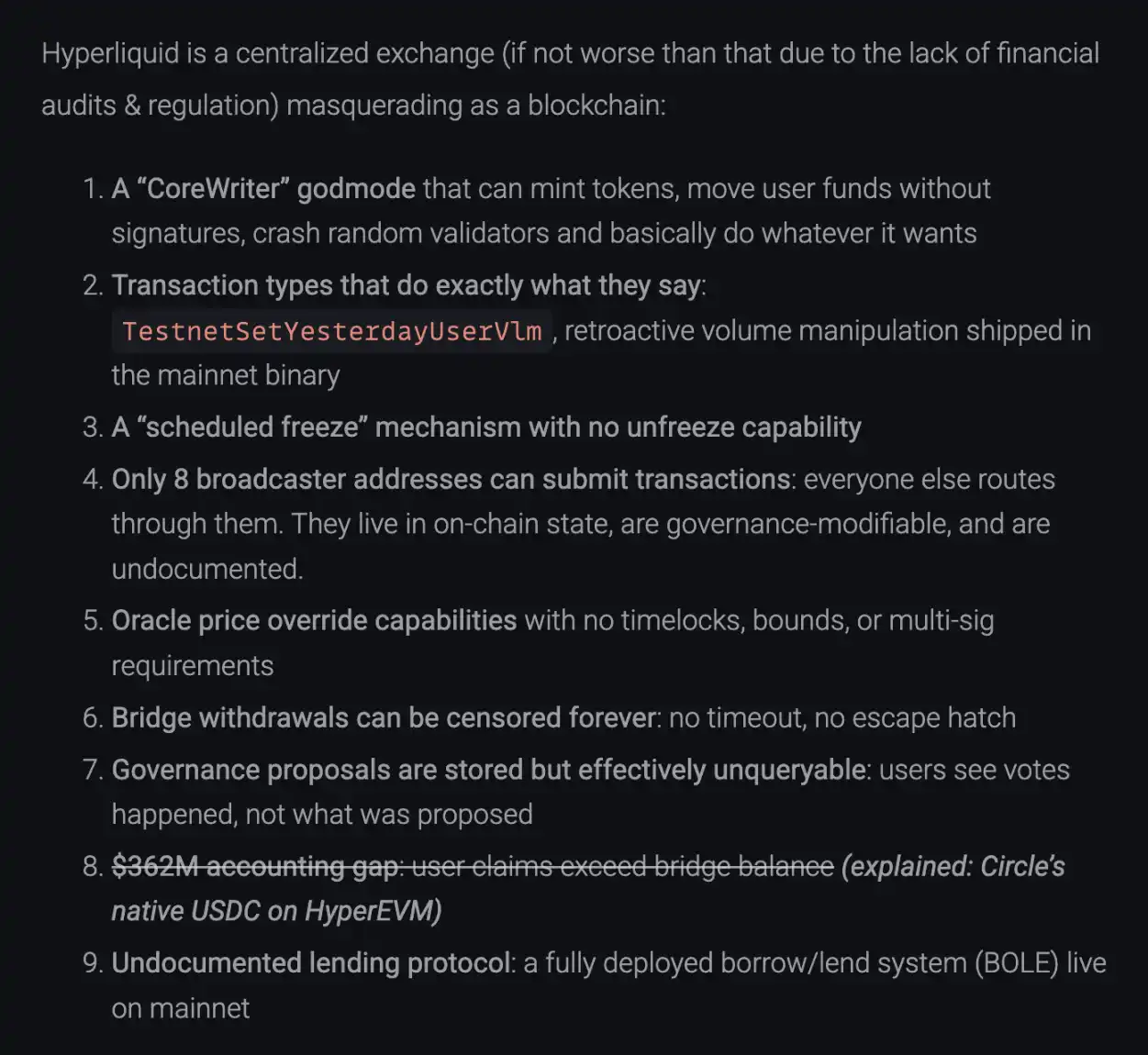
Clarified Accusations

Accusation: "CoreWriter" God Mode: Accused of being able to print money out of thin air and misappropriate funds.

Response: Officially explained that this is an interface for L1 to interact with HyperEVM (e.g., staking), with restricted permissions and no ability to misappropriate funds.

Accusation: $362 million funding gap.

Response: As described above, it was due to not accounting for Native USDC.

Accusation: Undisclosed lending protocol.

Response: Official pointed out that the spot/lending function (HIP-1) documentation is publicly available and in a pre-release stage, not secretly operating.

Acknowledged Accusations with Reasonable Explanations

Accusation: Binary file contains code to "modify trading volume" (TestnetSetYesterdayUserVlm).

Response: Acknowledged existence. Explained as testnet (Testnet) residual code used to simulate fee logic; the mainnet nodes have physically isolated this path, making execution impossible.

Accusation: Only 8 broadcast addresses can submit transactions.

Response: Acknowledged. Explained as an anti-MEV (Maximal Extractable Value) measure to prevent user transactions from being front-run. Committed to implementing a "multi-proposer" mechanism in the future.

Accusation: The chain can be "plannedly frozen" with no revocation function.

Response: Acknowledged. Explained as a standard process for network upgrades (Upgrade), requiring a full network pause to switch versions.

Accusation: Oracle price can be instantly overwritten.

Response: Explained as a system security design. To liquidate bad debt promptly during extreme volatility (like 10x), the validator oracle indeed does not have a time lock.

Missing / Vague Responses

In our review, two accusations were not directly addressed or fully resolved in the official response:

Accusation: Governance proposals are unqueryable. Users can only see that voting occurred, but the on-chain data does not contain the specific text content of the proposals.

Response: The official did not address this point in the long post. This means Hyperliquid's governance remains a "black box" for ordinary users—you can only see the results, not the process.

Accusation: Cross-chain bridge has no "escape hatch." Withdrawals could be censored indefinitely, and users cannot force withdrawals back to L1.

Response: Although the official explained that locking the bridge during the POPCAT incident was for safety, it did not refute the architectural fact of "no escape hatch." This indicates that at the current stage, the inflow and outflow of user assets highly depend on the permission of the validator set, lacking the anti-censorship forced withdrawal capability of L2 Rollups.

"Throwing Shade" at Competitors

The most interesting aspect of this incident is that it forced Hyperliquid to show its cards, giving us an opportunity to re-examine the landscape of the Perp (Perpetuals)赛道. The official response unusually "threw shade" at competitors, targeting Lighter, Aster, and even industry giant Binance.

It stated, "Lighter uses a single centralized sequencer, and its execution logic and zero-knowledge (ZK) circuits are not public. Aster uses centralized matching and even offers dark pool trading, which can only be achieved with a single centralized sequencer and an unverifiable execution process. Other protocols that include open-source contracts lack a verifiable sequencer."

Hyperliquid unabashedly categorized these competitors as relying on a "Centralized Sequencer." The official emphasized: on these platforms, no one except the sequencer operator can see the complete state snapshot (including order book history, position details). In contrast, Hyperliquid attempts to eliminate this "privilege" by having all validators execute the same state machine.

This wave of "throwing shade" might also stem from Hyperliquid's concerns about its current market share. According to DefiLlama's trading volume data for the past 30 days, the market has shown a tripartite balance of power:
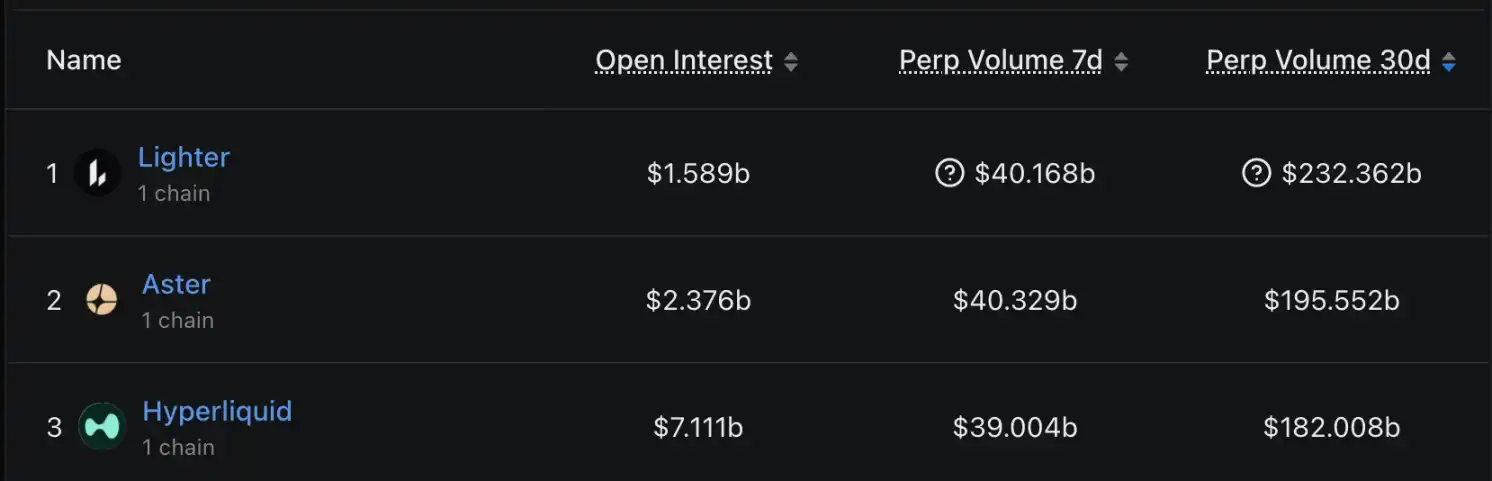
· Lighter: Trading volume $232.3 billion, temporarily leading,约占 26.6%.

· Aster: Trading volume $195.5 billion,位居第二,约占 22.3%.

· Hyperliquid: Trading volume $182.0 billion,位居第三,约占 20.8%.

Facing the trading volume of latercomers Lighter and Aster surpassing its own, Hyperliquid attempts to play the "transparency" card—meaning "although I have 8 centralized broadcast addresses, my entire state is on-chain and verifiable; while you can't even check yours." However, it is worth noting that although Hyperliquid's trading volume is slightly lower than the top two, it呈现碾压态势 in terms of Open Interest (OI).

Public Sentiment Response: Who is Shorting HYPE?

Beyond technical and fund issues, the community is also highly concerned about recent rumors that HYPE tokens were allegedly shorted and dumped by "insiders." In response, a Hyperliquid team member gave a定性回应 on Discord for the first time: "The shorting address starting with 0x7ae4 belongs to a former employee." This individual was once a team member but was fired in early 2024. The personal trading behavior of this former employee is unrelated to the current Hyperliquid team. The platform emphasized that it currently implements extremely strict HYPE trading restrictions and compliance reviews for all在职 employees and contractors, strictly prohibiting insider trading using their positions.

This response attempts to downgrade the accusation of "team misconduct" to "personal behavior of a former employee." However, regarding the transparency of token distribution and unlocking mechanisms, the community might still expect more detailed disclosure.

Don't Trust, Verify

Hyperliquid's clarification tweet can be considered a textbook example of crisis PR—relying not on emotional output but on data, code links, and architectural logic. It did not stop at proving its innocence but instead went on the offensive, strengthening its brand and advantage of "full state on-chain" by comparing competitor architectures.

Although the FUD was disproven, the profound thought left for the industry by this incident is far-reaching. As DeFi protocols evolve towards independent application chains (AppChain), architectures become increasingly complex, and asset distribution becomes more fragmented (Bridge + Native). The traditional method of checking balances by "looking at the contract balance" has become ineffective.

For Hyperliquid, proving "the money is there" is only the first step. How to gradually transfer the permissions of those 8 submission addresses while maintaining the advantages of high performance and anti-MEV, truly achieving the transition from "transparent centralization" to "transparent decentralization," is the necessary path to becoming the "ultimate DEX."

For users, this incident once again confirms the iron law of the crypto world: don't trust any narrative, verify every byte.


Трендовые криптовалюты

Связанные с этим вопросы

QWhat was the core accusation made in the 'Reverse Engineering Hyperliquid' blog post regarding user funds?

AThe blog post accused Hyperliquid of having a 362 million USDC shortfall, suggesting it was operating as a fractional-reserve exchange with user assets not fully backed by on-chain reserves.

QHow did Hyperliquid explain the alleged 362 million USDC discrepancy in its reserves?

AHyperliquid clarified that the 'missing' 362 million USDC was not a shortfall but was part of the native USDC balance on its new HyperEVM chain, which the accuser had failed to account for in their audit. The total reserves across Arbitrum and HyperEVM matched user balances.

QWhich two specific accusations did the article note were not fully addressed or resolved in Hyperliquid's official response?

AThe two accusations were: 1) Governance proposals are unqueryable (users cannot see the proposal text, only the voting result), and 2) The cross-chain bridge has no 'escape hatch' (users cannot force a withdrawal to L1, making withdrawals reliant on validator approval).

QWhat key competitive advantage did Hyperliquid claim over its rivals Lighter and Aster in its response?

AHyperliquid claimed its key advantage is transparency through 'full state on-chain,' arguing that while it uses 8 broadcast addresses, its entire state (like order book history) is publicly verifiable, unlike competitors it accused of relying on opaque, centralized sequencers.

QAccording to the article, what was Hyperliquid's explanation for the address that was shorting its HYPE token?

AHyperliquid stated that the address shorting HYPE belonged to a former employee who had been fired in early 2024 and that this was a personal trading action unrelated to the current team, which operates under strict trading restrictions.

Похожее

Точка перелома на бычьем рынке ИИ: маржинальные ликвидации, избыток вычислительных мощностей. Почему этот макроаналитик настроен полностью негативно

Автор аналитической фирмы Fidenza Macro, Джо Чен, объясняет причины своего решения полностью выйти из позиций в AI-полупроводниках и инфраструктуре в июне и излагает пессимистичный взгляд на будущее AI-бума. Он выделяет несколько ключевых факторов: 1. **Кризис кредитного плеча:** Параболический рост был во многом подпитан "некачественными" деньгами — в частности, южнокорейскими розничными инвесторами, агрессивно использовавшими левериджные ETF. Массовые ликвидации этих позиций (пострадал каждый 30-й взрослый в Корее) истощили сотни миллиардов долларов, создав серьезный технический надрыв на рынке. 2. **Угроза со стороны открытых моделей и Китая:** Появление мощных открытых моделей от китайских компаний, таких как Kimi K3 от Moonshot AI и Qwen 3.8 от Alibaba, начинает подрывать бизнес-модель закрытых гигантов вроде OpenAI и Anthropic. Это ведет к потенциальной коммодитизации ИИ-сервисов и снижению маржи, что ставит под вопрос выполнение их масштабных обязательств по аренде вычислительных мощностей. 3. **Перелом от дефицита к избытку вычислительных мощностей:** Аналитик указывает, что пик дефицита чипов часто совпадает с вершиной цикла. Огромные обязательства по капитальным расходам на AI-инфраструктуру со стороны крупных облачных провайдеров могут в течение 1-2 лет привести к избытку предложения. Признаки стресса уже видны в widening кредитных спредах облигаций AI-дата-центров. 4. **Макроэкономические риски:** Внешние факторы — затяжная война в Иране (источник длительной стагфляции) и действия ФРС под руководством Кевина Восша — создают дополнительное давление. ФРС, пытаясь реформироваться в условиях кризиса, теряет доверие рынка, что видно по росту доходности долгосрочных гособлигаций США выше 5.2%. Чен приходит к выводу, что комбинация этих факторов — исчерпание кредитного импульса, структурные изменения в отрасли ИИ и неблагоприятный макроклимат — сигнализирует о завершении бычьего рынка и предвещает сложный период для AI-активов.

marsbitТолько что

Точка перелома на бычьем рынке ИИ: маржинальные ликвидации, избыток вычислительных мощностей. Почему этот макроаналитик настроен полностью негативно

marsbitТолько что

Aave рассматривает закрытие 6 рынков V3 на блокчейнах, вывод 50 низкоиспользуемых резервов

Предложение по управлению Aave предусматривает закрытие V3 рынков протокола на шести блокчейнах (Sonic, Scroll, zkSync, Metis, Soneium и Aptos) и вывод 50 низкоиспользуемых резервов токенов. Это затронет активы на сумму 98,1 млн долларов и долг на 15,6 млн долларов. Поставщик услуг по оценке рисков LlamaRisk рекомендовал данные меры в рамках новой структуры управления рисками Aave, указывая на низкую ликвидность и доходность на этих сетях. Например, рынок на Aptos предлагается закрыть всего через 11 месяцев после запуска из-за падения ликвидности на 94% и квартальной выручки ниже 1000 долларов. Основатель Aave Стани Кулечов пояснил, что это не отказ от мультичейн-стратегии, а её пересмотр с фокусом на эффективных развертываниях для снижения экономических и технических рисков.

cointelegraph1 мин. назад

Aave рассматривает закрытие 6 рынков V3 на блокчейнах, вывод 50 низкоиспользуемых резервов

cointelegraph1 мин. назад

По данным аналитиков платформы для анализа блокчейна CryptoQuant, в биткоине наблюдается значительный бычий сигнал! Вот подробности

По данным аналитика CryptoQuant Акселя Адлера-младшего, доля краткосрочных инвесторов в реализованной капитализации биткоина упала до 23,5%, достигнув одного из самых низких уровней за всю историю криптовалюты. В то же время доля долгосрочных инвесторов выросла до 52,5%, приблизившись к историческому пику. Это указывает на переход биткоина от краткосрочных спекулянтов к долгосрочным держателям («сильным рукам») и снижение спекулятивной активности на рынке. Однако аналитик предупреждает, что такая концентрация предложения сама по себе не гарантирует роста цен. Ситуация схожа с минимумом медвежьего рынка 2022-2023 годов: для разворота тренда необходим значительный приток нового капитала и восстановление спроса. Без этого низкая торговая активность может сохраниться, а цены оставаться под давлением.

cryptonews.ru7 мин. назад

По данным аналитиков платформы для анализа блокчейна CryptoQuant, в биткоине наблюдается значительный бычий сигнал! Вот подробности

cryptonews.ru7 мин. назад

Саид Аль-Марри: Как токенизация открывает новые возможности для фондов морских перевозок

Саид Бин Салех Аль-Марри, глава Ethra Invest, видит в токенизации реальных активов (RWA) способ демократизировать инвестиции в капиталоемкий сектор морских перевозок. Токенизация позволяет дробить доли в судах, делая рынок доступным для мелких инвесторов, повышая прозрачность и эффективность учета. Однако Аль-Марри подчеркивает, что это не обход регулирования и не гарантия ликвидности: вторичный рынок требует реалистичной оценки активов, а операционное управление судном остается за профессионалами. Правовое обеспечение по-прежнему зависит от традиционной морской юриспруденции, а не только от смарт-контрактов. В торговой документации ключевым вызовом является не технология, а достижение глобального юридического признания цифровых стандартов. Ethra выступает за гибридные модели, сочетающие цифровые инструменты с поддержкой регулируемых институтов. Что касается декарбонизации флота к 2050 году, Аль-Марри призывает к прагматичному и консервативному подходу в финансировании перехода на экологичные виды топлива, чтобы защитить капитал инвесторов. Таким образом, эволюция морского финансирования заключается не просто в использовании блокчейна, а в мобилизации капитала для создания современного и устойчивого глобального флота.

cryptonews.ru16 мин. назад

Саид Аль-Марри: Как токенизация открывает новые возможности для фондов морских перевозок

cryptonews.ru16 мин. назад

Прогнозируемый объем торгов на рынке достиг рекордной отметки в 55,5 млрд долларов в июле, а количество сделок выросло до 383,9 млн

Прогнозный рынок в июле показал рекордные показатели: объем торгов достиг 55,5 млрд долларов, а количество сделок — 383,9 млн. Этот рост связан с чемпионатом мира по футболу, формат плей-офф которого идеально подошел для краткосрочных прогнозов. Платформа Kalshi сохранила лидерство, обеспечив около 70% от общего объема и числа сделок. В то время как рынок консолидируется наверху с Kalshi, в нижнем сегменте наблюдается расширение — несколько платформ вышли на девятизначные месячные объемы. После финала турнира еженедельные объемы снизились, но остаются выше допандемийного уровня. Ключевым вопросом остается, удержит ли сектор новых клиентов, привлеченных чемпионатом мира, или июльский всплеск окажется разовым событием.

cryptonews.ru16 мин. назад

Прогнозируемый объем торгов на рынке достиг рекордной отметки в 55,5 млрд долларов в июле, а количество сделок выросло до 383,9 млн

cryptonews.ru16 мин. назад

Торговля

Спот

Популярные статьи

Что такое ANSEM

I. Введение в проектЧёрный Бык ($ANSEM) — это прозрачная, управляемая сообществом мемкоин на Solana, основанная на одном кредо: двигаться вперёд, несмотря ни на что. Проект ориентирован на фронтенд и полностью поддаётся проверке — его веб-сайт отображает данные в реальном времени с блокчейна и рынка напрямую из Solana, включая цену, ликвидность, объём, рыночную капитализацию и распределение держателей, так что любой может проверить утверждения без входа в систему и без сбора пользовательских данных. Кроме токена, он предлагает Ansem-call Radar, некустодиальные пулы ликвидности сообщества на PumpSwap и браузерный мем-терминал. $ANSEM — это стандартный токен Pump.fun SPL (6 знаков после запятой), торгующийся против SOL и USDC.II. Информация о токенеСимвол токена: ANSEM (Чёрный Бык)III. Связанные ссылкиВебсайт:https://www.blackbullsol.com/X: https://x.com/blknoiz06Адрес контракта: https://solscan.io/token/9cRCn9rGT8V2imeM2BaKs13yhMEais3ruM3rPvTGpumpПримечание: Введение в проект основано на материалах, опубликованных или предоставленных официальной командой проекта, и предназначено только для справки и не является инвестиционной рекомендацией. HTX не несёт ответственности за любые прямые или косвенные убытки, возникшие в результате.

809 просмотров всегоОпубликовано 2026.07.01Обновлено 2026.07.01

Что такое ANSEM

Как купить ANSEM

Добро пожаловать на HTX.com! Мы сделали приобретение The Black Bull (ANSEM) простым и удобным. Следуйте нашему пошаговому руководству и отправляйтесь в свое крипто-путешествие.Шаг 1: Создайте аккаунт на HTXИспользуйте свой адрес электронной почты или номер телефона, чтобы зарегистрироваться и бесплатно создать аккаунт на HTX. Пройдите удобную регистрацию и откройте для себя весь функционал.Создать аккаунтШаг 2: Перейдите в Купить криптовалюту и выберите свой способ оплатыКредитная/Дебетовая Карта: Используйте свою карту Visa или Mastercard для мгновенной покупки The Black Bull (ANSEM).Баланс: Используйте средства с баланса вашего аккаунта HTX для простой торговли.Третьи Лица: Мы добавили популярные способы оплаты, такие как Google Pay и Apple Pay, для повышения удобства.P2P: Торгуйте напрямую с другими пользователями на HTX.Внебиржевая Торговля (OTC): Мы предлагаем индивидуальные услуги и конкурентоспособные обменные курсы для трейдеров.Шаг 3: Хранение The Black Bull (ANSEM)После приобретения вами The Black Bull (ANSEM) храните их в своем аккаунте на HTX. В качестве альтернативы вы можете отправить их куда-либо с помощью перевода в блокчейне или использовать для торговли с другими криптовалютами.Шаг 4: Торговля The Black Bull (ANSEM)С легкостью торгуйте The Black Bull (ANSEM) на спотовом рынке HTX. Просто зайдите в свой аккаунт, выберите торговую пару, совершайте сделки и следите за ними в режиме реального времени. Мы предлагаем удобный интерфейс как для начинающих, так и для опытных трейдеров.

371 просмотров всегоОпубликовано 2026.07.01Обновлено 2026.07.01

Как купить ANSEM

Обсуждения

Добро пожаловать в Сообщество HTX. Здесь вы сможете быть в курсе последних новостей о развитии платформы и получить доступ к профессиональной аналитической информации о рынке. Мнения пользователей о цене на A (A) представлены ниже.

活动图片