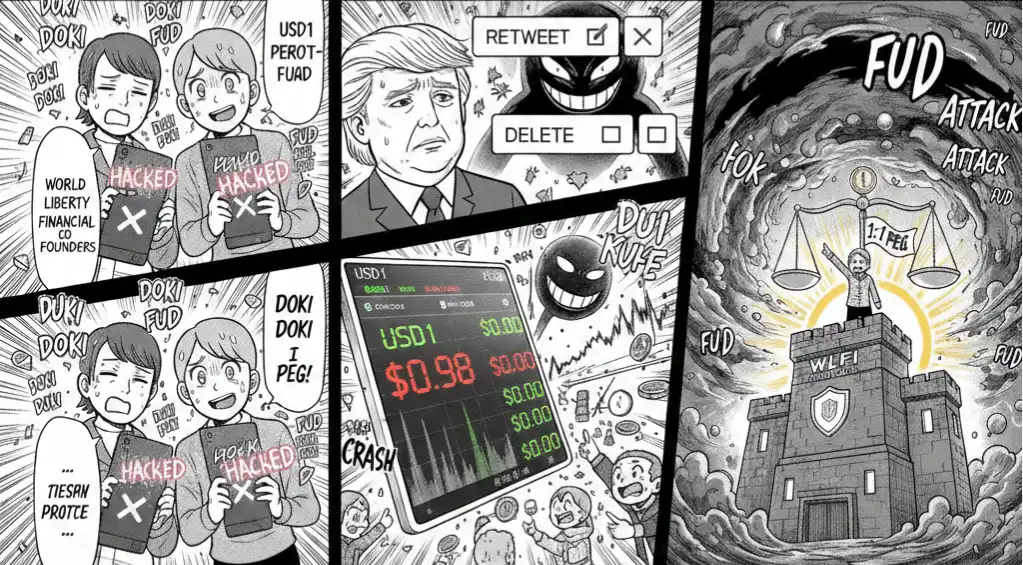
When 'Stability' Begins to Fluctuate: A Complete Review and Structural Analysis of the USD1 Depegging Incident

marsbitОпубликовано 2026-02-25Обновлено 2026-02-25

Введение

USD1, a stablecoin issued by World Liberty Financial (WLFI), experienced a brief depegging event on February 23, with its secondary market price dropping to around $0.98. WLFI attributed the incident to a "coordinated attack," claiming reserves and redemption mechanisms remained unaffected, and the price quickly recovered. The event raised questions about whether the depegging was a liquidity issue or a solvency crisis. Unlike TerraUSD's algorithmic collapse in 2022, USD1’s price dip appeared more related to temporary market liquidity stress rather than fundamental reserve failures. However, the incident highlighted that stablecoin stability relies not only on assets but also on market trust. USD1 operates under a centralized reserve model, where risks involve reserve transparency, asset liquidity, and market depth. In a low-liquidity, risk-averse market environment, even minor instability can trigger concerns about collateral devaluation, liquidations, and broader financial contraction. While the rapid price recovery suggests no systemic solvency issue, the event underscores how stablecoin depegging—even if temporary—can amplify market anxiety, reduce leverage, and increase funding costs. Trust, once questioned, takes time to restore, and credit repricing often precedes price changes in stressed markets.

Author: 137Labs

On February 23, a stablecoin named USD1 suddenly showed a significant discount in the secondary market.

On-chain quotes once fell to around 0.98 USDT, and social media quickly amplified the news.
The project team, World Liberty Financial (WLFI), subsequently stated publicly that this was a "coordinated attack" and emphasized that the reserve and redemption mechanisms were unaffected.

The price then recovered.

But the problem had already emerged——

When a "stablecoin" begins to trade at a discount, is it merely a liquidity friction, or a precursor to a crack in the credit structure?

I. Timeline: From the Wicking to the "Attack" Narrative

Based on reports from CoinDesk, The Block, Decrypt, WuBlockchain, PANews, ChainCatcher, and others, the sequence of events is roughly as follows:

1️⃣ Abnormal Volatility in the Secondary Market

  • USD1 quickly fell to around 0.98 in some trading pairs

  • The discount lasted for a short time

  • The price subsequently recovered

Unlike the brief depegging of USD Coin in 2023 due to banking risks, no clear systemic banking shock occurred this time.

2️⃣ WLFI's Official Response

WLFI stated externally:

  • This was an organized short attack coupled with a public opinion coordination attack

  • Reserve assets showed no abnormalities

  • Redemption function is normal

  • The 1:1 peg structure remains unchanged

This explanation was subsequently reported by Chinese media including WuBlockchain and ChainCatcher.

3️⃣ Social Media Amplification Effect

The event spread rapidly on platform X.

Some related tweets were deleted, fueling further market speculation.
In the current emotionally charged market environment, "deletion behavior" is often interpreted as a signal, not a random operation.

Thus, the question shifted from "Is the price depegged?" to:

  • Is there a reserve risk?

  • Is there a concentrated bank run?

  • Is there insufficient information disclosure?

II. The Nature of Depegging: A Liquidity Problem or a Solvency Problem?

Judging a stablecoin depegging event hinges on distinguishing between two completely different risk structures.

The first is a liquidity shock.
In this case, reserves are still sufficient, the redemption mechanism remains unimpeded, but due to insufficient trading depth, market maker withdrawal, or concentrated selling pressure, the secondary market experiences a brief imbalance. Once the arbitrage mechanism kicks in, the price usually recovers quickly.

The second is a solvency crisis.
If the reserve assets themselves are problematic, or if the assets suffer from maturity mismatches and cannot be liquidated immediately, then the depegging is no longer a trading-level fluctuation but a repricing of the balance sheet. In this case, the discount often widens persistently, accompanied by redemption delays or a collapse in trust.

Based on the information disclosed so far, USD1 is closer to the former.

It is completely different from the algorithmic death spiral of TerraUSD (UST) in 2022. UST's collapse stemmed from mechanism failure, while USD1's wicking更像 (more like) a liquidity tilt within a short period.

But even so, this event still holds significance.

Because the true anchor of a stablecoin is not just the reserve assets, but market trust.

Once trust is questioned, the price reacts ahead of the fundamentals.

III. The Credit Structure of Stablecoins: Where Exactly is Their "Stability"?

Stablecoins are essentially the "base money" of the crypto market.

Their credit support generally comes from three models:

  1. Algorithmic

  2. Collateralized

  3. Centrally Custodied Reserve-backed

USD1 belongs to a more centralized reserve structure.

The risk of this model lies not in the algorithm, but in:

  • Reserve Transparency

  • Asset Liquidity

  • Maturity Structure

  • Market Making Depth

Once the market suspects that reserves are discounted or face liquidation risks, the price often falls first.
This is highly similar to a "shadow bank run" in traditional finance—as soon as depositors start to doubt, the act of withdrawal itself amplifies the risk.

IV. Why Was the Market Reaction Particularly Sensitive This Time?

The fear index was already at an extreme low that day.

In an environment where liquidity was already tight:

  • Leverage levels decreased

  • Risk appetite weakened

  • The market became highly sensitive to uncertainty

Stablecoins are not just trading tools; they are the cornerstone of lending and liquidity.

Once a discount appears, the chain reaction may include:

  • Decrease in collateral ratios

  • Triggering of liquidations

  • Further compression of leverage

  • Capital outflow from the market

Therefore, even though the price recovered quickly, the psychological shock did not disappear simultaneously.

V. Is the "Attack" Narrative Valid?

WLFI attributed this volatility to a "coordinated attack".

Short attacks and public opinion resonance are not uncommon in the crypto market.
When trading depth is insufficient and market sentiment is fragile, prices are easily subject to amplified volatility.

But whether an attack can be sustained depends on one core factor:

Does the market believe the reserves are real, redeemable, and sustainable?

If the reserve structure is transparent and redemptions remain smooth, attacks often find it difficult to be effective in the long term;
If reserve disclosure is insufficient, panic is more easily self-reinforcing.

VI. The Differences Between USD1, USDC, USDT, and the True Meaning of This Depegging

Historically, USDC fell to $0.88 in 2023 due to banking risks; its problem stemmed from exposure to custodian bank risks and limitations on the pace of reserve liquidation.

Meanwhile, Tether has experienced minor depegging multiple times, usually during extreme panic phases or under concentrated withdrawal pressure, but the key to its eventual recovery lies in the continuous availability of the redemption mechanism and the verification of reserve redemption capability.

USD1 currently seems to be in the midst of a "trust stress test".

This event is closer to a liquidity shock than a solvency crisis.
The rapid price recovery indicates that a systemic bank run has not yet formed.

But what is truly worth paying attention to is not that single price of 0.98, but whether the market has begun to reassess the risk premium of "stability".

Stablecoins are the monetary base of the crypto market.

When the market questions their safety, the impact transmits outward along the credit chain:

  • Leverage decreases

  • Lending contracts

  • Collateral assets are repriced

  • Capital flows back to mainstream assets or exits the market

Even if the event itself is just short-term volatility, it will increase the cost of future financing and liquidity.

Depegging is never just a price problem; it is a credit pricing problem.

The price can recover quickly,
but trust takes time to repair.

USD1's depegging may not necessarily evolve into a systemic risk,
but it reminds the market——

During periods of liquidity contraction,
credit always changes before the price.

And once credit begins to be revalued,
the entire risk structure也随之 (also随之 -也随之) changes accordingly.

Связанные с этим вопросы

QWhat was the main event described in the article regarding the USD1 stablecoin?

AOn February 23rd, the USD1 stablecoin experienced a significant discount, with its price dropping to approximately 0.98 USDT on secondary markets.

QHow did the issuer, World Liberty Financial (WLFI), characterize the price drop of USD1?

AWLFI characterized the event as a 'coordinated attack,' stating that the reserve and redemption mechanisms were unaffected and the 1:1 peg structure remained intact.

QWhat is the fundamental difference between a liquidity shock and a solvency crisis for a stablecoin, as explained in the article?

AA liquidity shock involves sufficient reserves and a functioning redemption mechanism, with the price drop caused by temporary market imbalances like insufficient trading depth. A solvency crisis involves problems with the reserve assets themselves, where the de-pegging is a repricing of the balance sheet due to issues like asset quality or maturity mismatches.

QAccording to the article, what are the key risk factors for a centralized reserve-backed stablecoin like USD1?

AThe key risk factors are reserve transparency, asset liquidity, maturity structure, and market-making depth.

QWhat broader market implication does the article suggest from the USD1 de-pegging event, even if it was temporary?

AThe event suggests that market trust, the true anchor of a stablecoin, can be shaken. This can lead to a re-evaluation of risk premiums, resulting in decreased leverage, contracted lending, repricing of collateral assets, and potential capital outflows, thereby increasing future financing and liquidity costs.

Похожее

From Banning Doubao to Embracing Honor: Why Did WeChat Suddenly 'Change Its Face'?

The article explores the sudden shift in WeChat's strategy towards AI assistants from mobile phone manufacturers, transitioning from strict opposition to active collaboration. For over a year, WeChat fiercely resisted attempts by phone AI assistants (like ByteDance's Doubao in late 2025) to control its features via GUI automation ("simulated clicking"), citing security and data control concerns. This stance created a significant barrier for system-level AI integration. Now, Tencent has initiated A2A (Agent-to-Agent) partnerships with major phone brands like Honor, Xiaomi, OPPO, and vivo. This model allows a phone's system AI (e.g., Honor's YOYO) to parse a user's voice command and send a structured request directly to WeChat's own internal AI agent via secure APIs. WeChat then executes the action (e.g., sending a message) and returns the result. The article attributes Tencent's "change of face" to strategic pressure. While leading in social app usage, Tencent trails rivals like ByteDance and Alibaba in standalone AI app popularity. WeChat, with its vast mini-program ecosystem, is Tencent's key asset for an AI comeback. The upcoming WeChat AI agent aims to handle tasks like booking and payments within the app. However, phone system assistants remain the primary AI entry point for most users. The A2A collaboration allows Tencent to extend WeChat's AI reach to this crucial system layer while maintaining control over its core functions and data. For phone manufacturers, embracing A2A is a pragmatic move. The GUI route proved unviable due to WeChat's blocks. A2A offers a compliant path to integrate a vital service, enhancing their AI assistants' usefulness. It allows them to focus on developing their own AI ecosystems for other services while cooperating on WeChat access. The collaboration is framed as a mutual, strategic necessity: Tencent gains a distribution channel, and manufacturers gain a key functionality. The partnership relies on a "dual authorization" mechanism for security, requiring both user and app consent for each action. While questions about long-term data privacy practices remain, experts note A2A is more secure and compliant than GUI automation. Ultimately, this cooperation is seen as a tentative, calculated truce. Tencent's long-term goal is to make WeChat an AI-powered "service OS." Phone manufacturers aim to make their system AI the central user interface. Their paths may converge or clash in the future, but for now, the A2A deal represents the opening chapter in the battle for the AI-era user入口, driven by necessity and strategic calculus on both sides.

marsbit57 мин. назад

From Banning Doubao to Embracing Honor: Why Did WeChat Suddenly 'Change Its Face'?

marsbit57 мин. назад

On-Chain Figures on the Eve of Kickoff: 1.6 Billion Traded Before the World Cup Even Begins

"On-Chain Numbers on the Eve of the World Cup: $1.6 Billion Traded Before Kick-off" Analysis of on-chain markets before the 2026 FIFA World Cup reveals significant crypto integration into football. The most striking figure is the approximately **$1.6 billion** in total trading volume on the single "World Cup Winner" contract on the Polymarket prediction market platform, accumulated before a single match was played. This represents explosive growth for a sector whose annual volume surged from ~$16B in 2024 to ~$64B in 2025. The ecosystem is maturing beyond speculation. Key developments include: 1) **Infrastructure upgrades** like Polymarket's migration to native, regulated USDC stablecoin for settlements; 2) **Reliable data oracles**, such as Chainlink, being used to resolve real-world match outcomes on-chain; and 3) **Official recognition**, with FIFA appointing its first-ever "Prediction Markets" partner. Over 100 contracts now cover everything from the outright winner to individual match results and even non-sporting risks like venue relocation. This evolution marks a fundamental shift. While crypto firms are absent from FIFA's top-tier sponsor list, the technology has deeply penetrated the tournament's financial and predictive infrastructure through regulated stablecoin settlements, decentralized oracles, and new official partnership categories. The regulatory landscape remains complex and varies by jurisdiction, but on-chain markets for the World Cup are already a multi-billion-dollar reality.

marsbit1 ч. назад

On-Chain Figures on the Eve of Kickoff: 1.6 Billion Traded Before the World Cup Even Begins

marsbit1 ч. назад

From SpaceX's IPO to the Future of Crypto: Which Crypto Sectors Will Host the Trillion-Dollar Narrative?

From the SpaceX IPO, which targets a $750 billion raise at a $1.77 trillion valuation, we can extrapolate capital flow trends relevant to crypto. The focus shifts from speculative narratives to foundational infrastructure and real-world asset (RWA) integration. Key crypto sectors poised to benefit include: 1. **AI Infrastructure**: The narrative is moving from consumer-facing AI applications to underlying, scarce resources like compute power and decentralized GPU networks (e.g., TAO, RENDER, AKT, IO). These protocols are positioning as the essential "picks and shovels" providers for the AI economy. 2. **Real-World Assets (RWA)**: Beyond tokenized treasury bonds, RWA's future lies in on-chain equity and pre-IPO assets like SpaceX. This could democratize access to high-growth assets and reshape global capital flows, benefiting infrastructure projects like ONDO, LINK, and Plume that facilitate issuance, data, and liquidity. 3. **Core Financial Infrastructure**: Stablecoins, payment networks, and DePIN (Decentralized Physical Infrastructure Networks) are critical for settling the future on-chain economy. Their role expands from internal trading tools to foundational layers for global finance, AI systems, and real-world asset networks, leading to potential value reassessment. In summary, the next cycle may prioritize long-term infrastructure value—AI compute, asset tokenization networks, and settlement layers—over short-lived application hype, mirroring the broader market's shift towards funding the foundational systems of the future.

marsbit2 ч. назад

From SpaceX's IPO to the Future of Crypto: Which Crypto Sectors Will Host the Trillion-Dollar Narrative?

marsbit2 ч. назад

Торговля

Спот
Фьючерсы
活动图片