What NYSE’s ‘strategic’ 24/7 platform means for Ethereum and RWAs

ambcryptoОпубликовано 2026-03-25Обновлено 2026-03-25

Введение

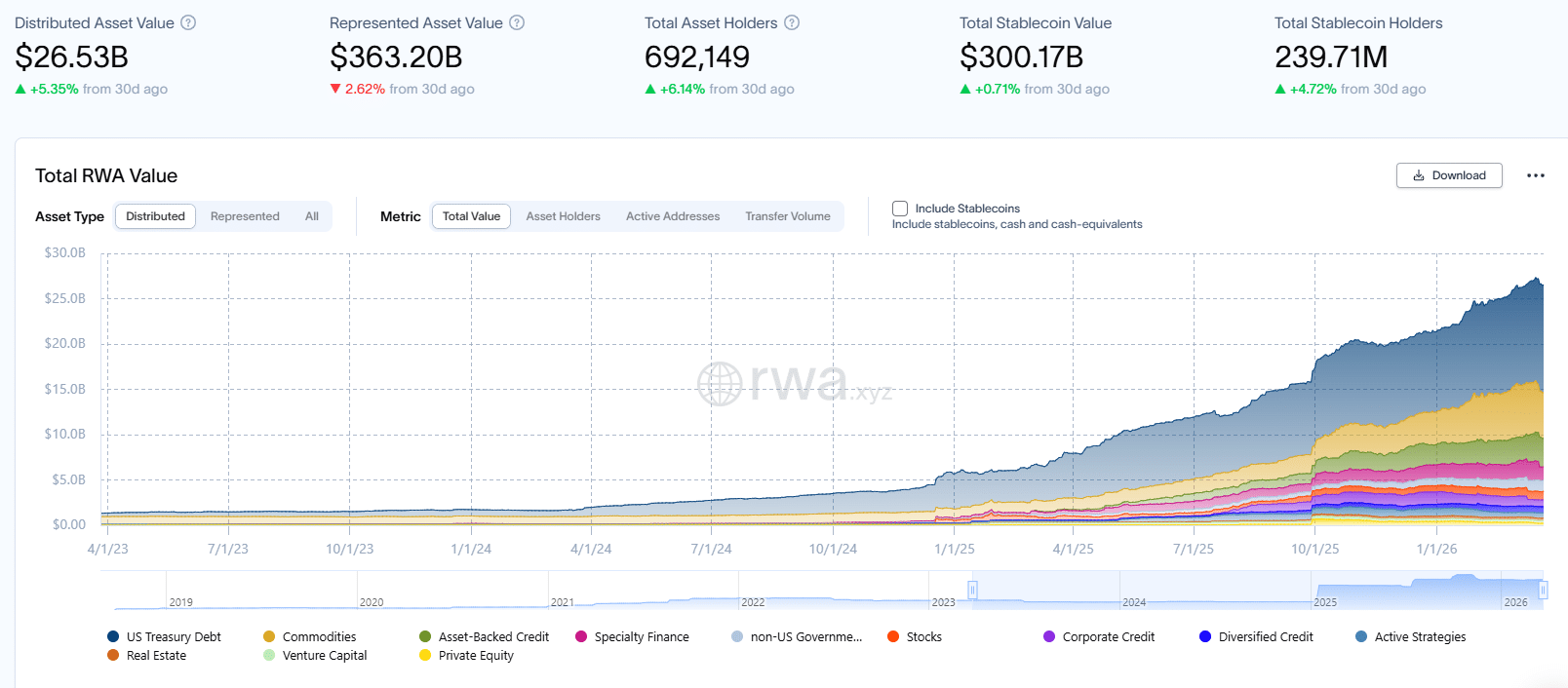
Tokenization is a key use case demonstrating stablecoin utility, with Ethereum currently dominating the real-world asset (RWA) market, accounting for 58% of its nearly $27 billion value. However, the New York Stock Exchange (NYSE) has partnered with Securitize to launch a 24/7 tokenized securities platform, potentially challenging Ethereum’s lead if scaled on alternative networks. Amid macroeconomic uncertainty, including high oil prices and inflationary pressures, capital is shifting toward tokenized assets like U.S. Treasuries, which surged 21% this month. Tokenized stocks also hit a $1 billion all-time high, up 20%, highlighting blockchain’s resilience and growing on-chain liquidity. NYSE’s move is seen as a strategic step to legitimize risk assets and capitalize on this momentum, signaling institutional-level confidence in RWAs and potentially reshaping the competitive landscape for Layer-1 networks.

Tokenization stands out as a primary use case that highlights the real utility of stablecoins.

For context, the real-world asset (RWA) segment represented nearly $27 billion in total value as of press time, with around 58% of that activity occurring on Ethereum [ETH]. Given its strong lead in both stablecoin supply and RWA adoption, Ethereum clearly serves as the core infrastructure layer driving this ecosystem.

However, a recent partnership involving the New York Stock Exchange (NYSE) could challenge this dominance.

According to reports, NYSE has partnered with Securitize to establish a 24/7 tokenized securities platform, potentially reducing Ethereum’s relative edge if such platforms scale on alternative networks.

Source: RWA.xyz

From a technical lens, the NYSE is the largest stock exchange globally, with over $25 trillion in listed market cap. That’s a huge capital base.

Consequently, even a small migration of this value onto tokenized rails could significantly reshape the competitive landscape across Layer-1 networks.

That said, beyond the structural shift, the timing of this partnership stands out.

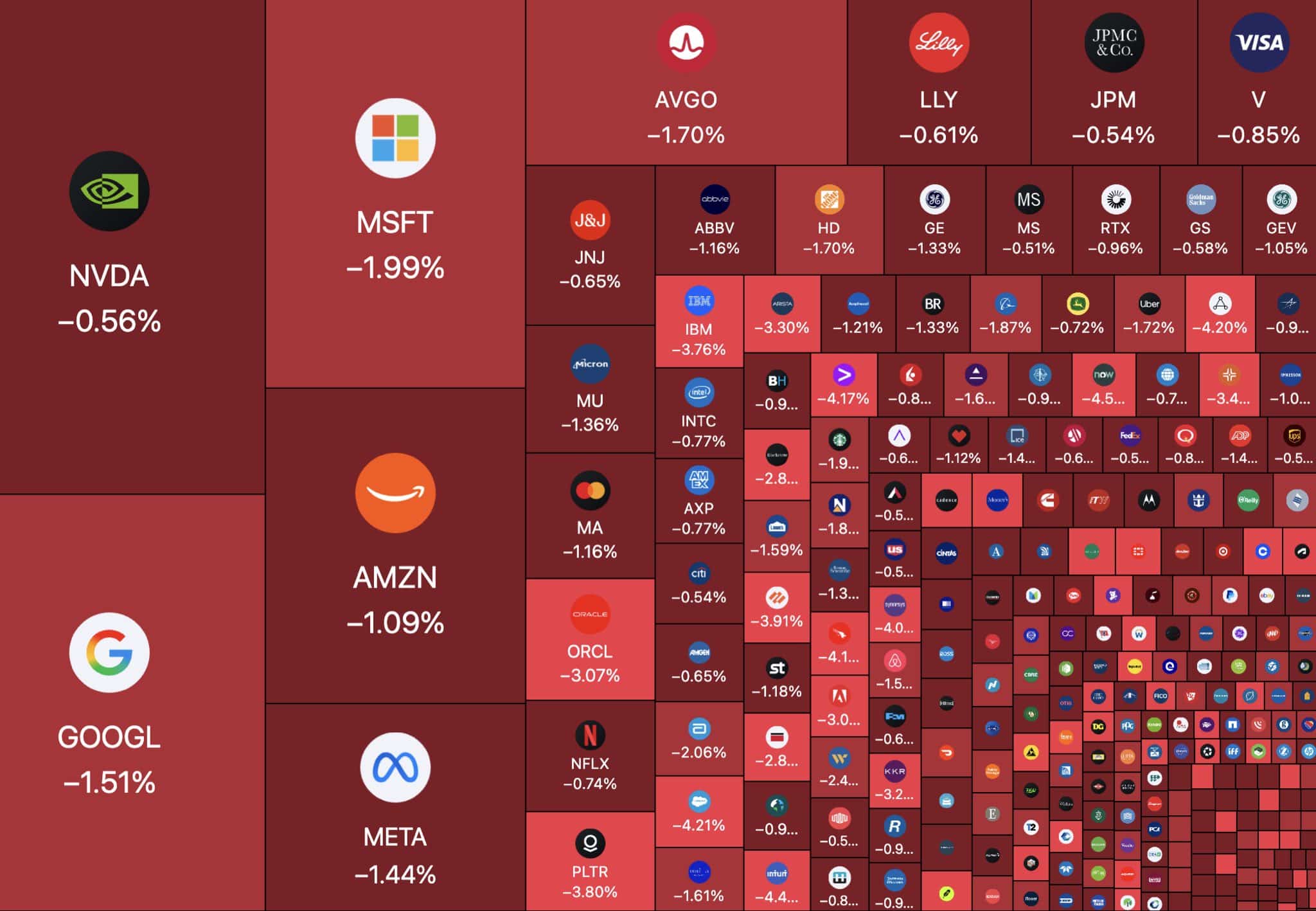
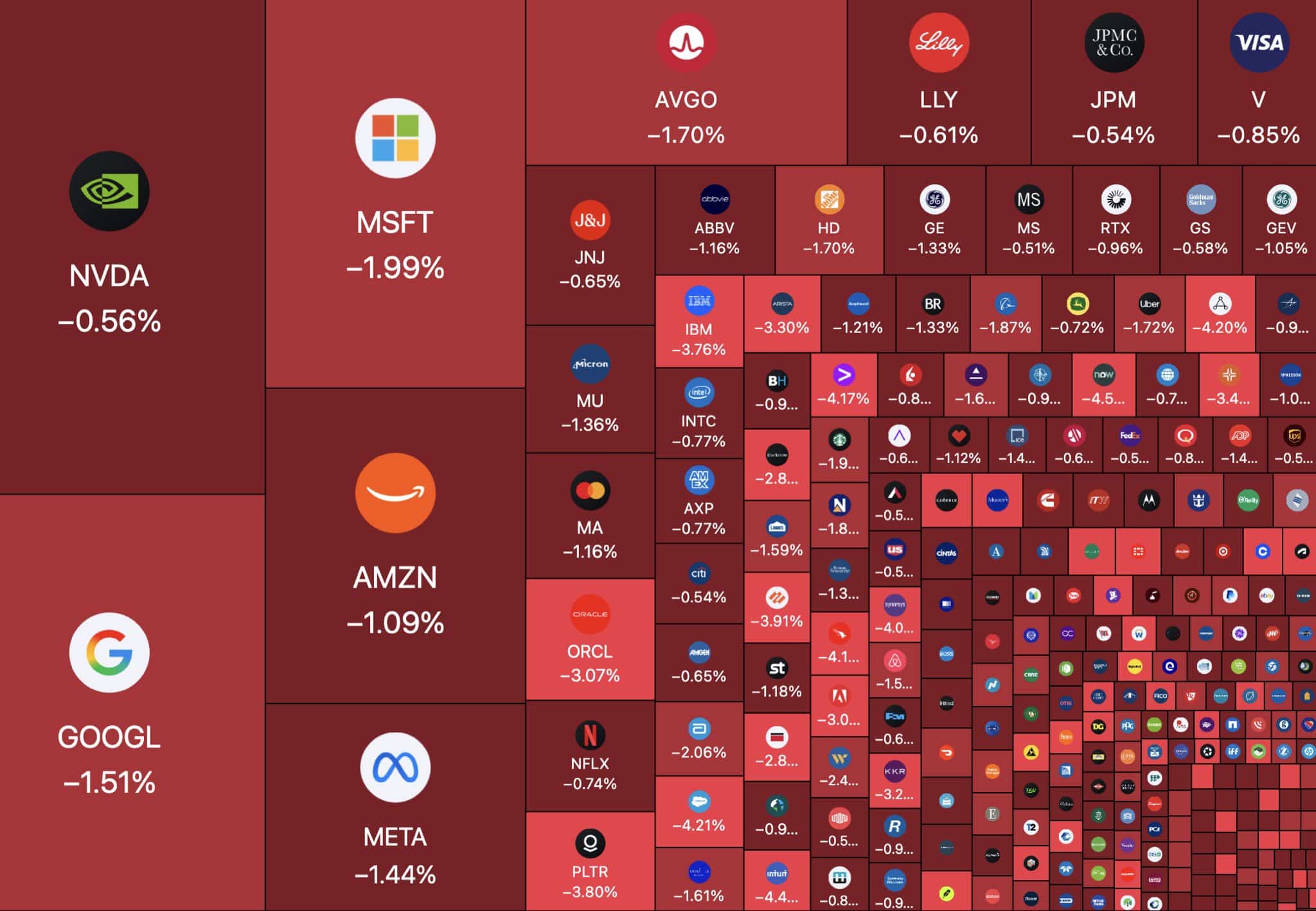
At the macro level, U.S. equities have been shedding significant capital over short timeframes amid ongoing macro uncertainty.

Source: X

Meanwhile, Bitcoin [BTC] and other risk assets have held up relatively better. Against this backdrop, is NYSE’s move into RWAs an early signal of “institutional-level validation” for risk assets?

NYSE takes a strategic step amid shifting macro dynamics

NYSE’s partnership looks like a strategic move in response to macro shifts.

Oil prices staying above $100/barrel have rattled global investor confidence. At the same time, inflationary pressures have kept the Federal Reserve on hold, effectively tightening monetary conditions.

As a result, capital has flowed into Treasuries, pushing yields to multi-month highs.

Interestingly, this trend is showing up in the tokenized sector too.

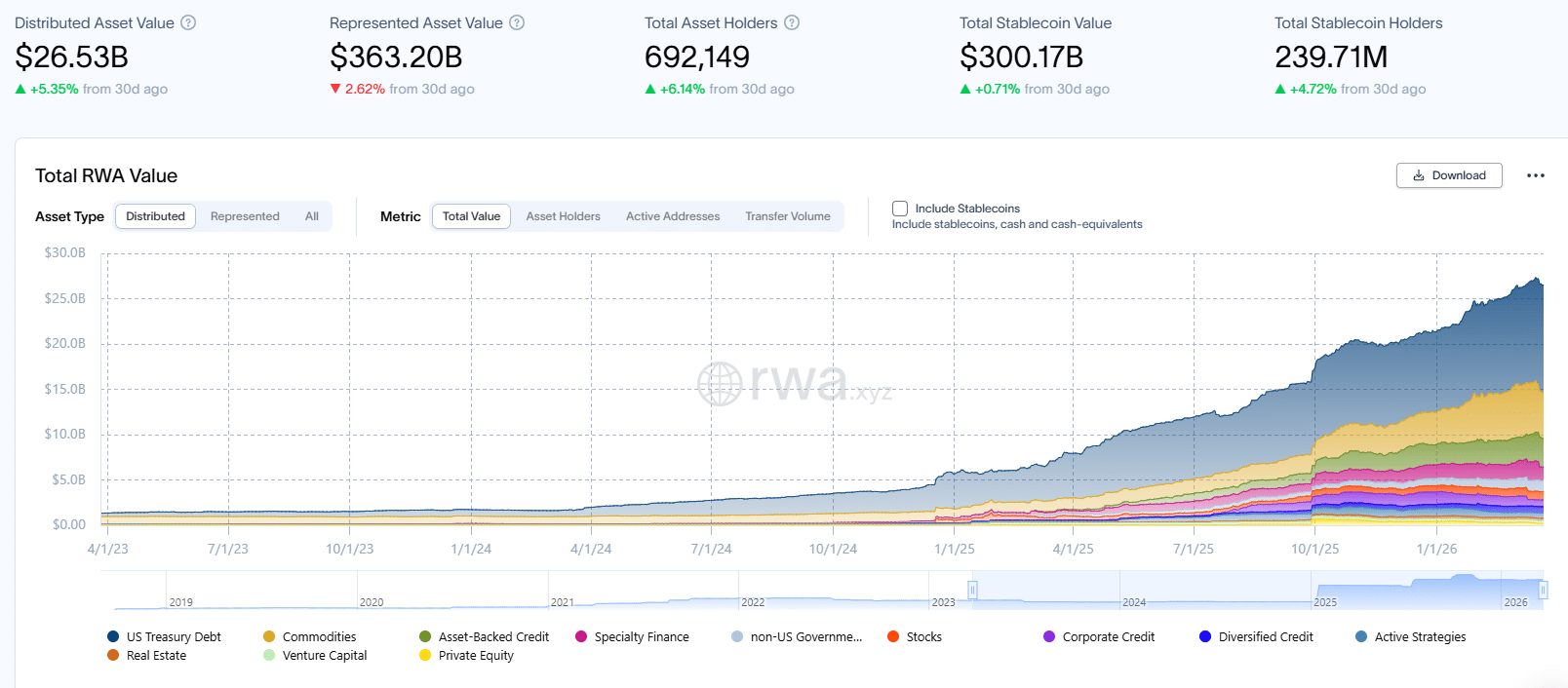
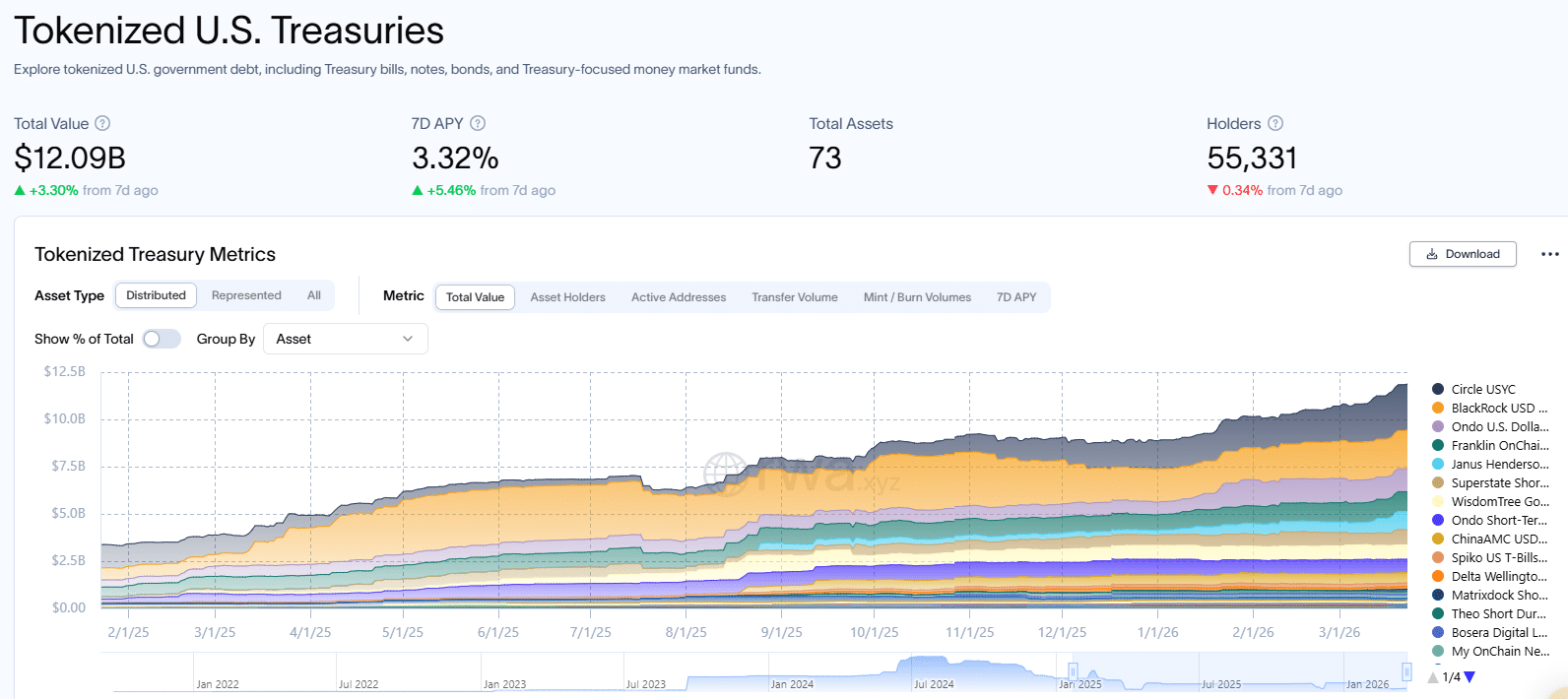
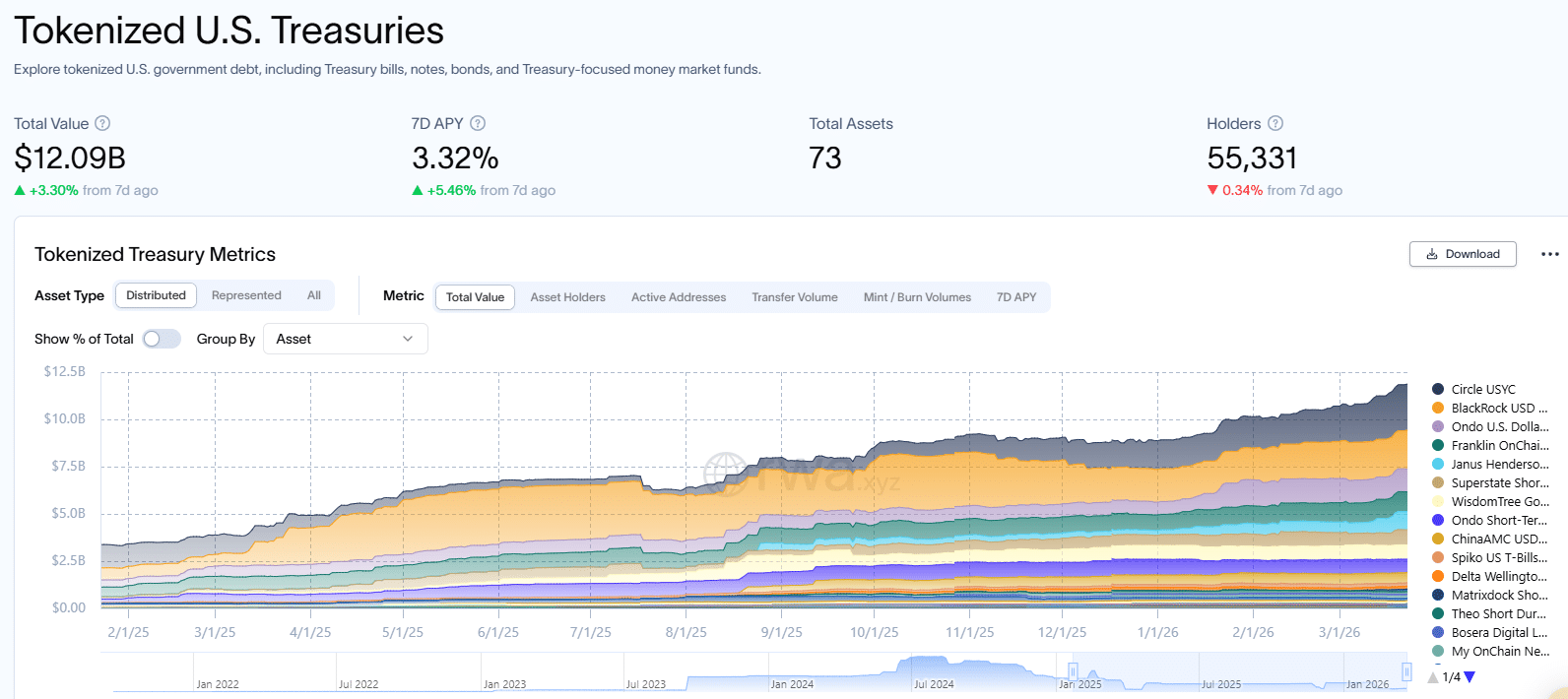
As the chart below shows, the U.S. tokenized Treasuries have jumped roughly 21% this month alone, now making up over 47% of total RWA asset value. In other words, as macro dynamics shift, the effect is clearly showing up in on-chain demand for tokenized assets.

Source: RWA.xyz

In this light, NYSE’s partnership with Securitize reflects a similar dynamic playing out.

As mentioned earlier, amid the FUD, U.S. equities have taken a hit, with sell-offs even prompting 2008-style crisis projections. By contrast, tokenized stocks have been among the top performers this month, rising 20% to reach a $1 billion all-time high.

In this context, NYSE’s move is clearly aimed at riding that momentum.

Put simply, while TradFi bears the brunt of macro uncertainty, capital is flowing into RWAs, showing that blockchain is proving its resilience beyond just offering 24/7 trading. Consequently, the partnership is more than a technical upgrade.

Instead, it’s a “strategic” step toward legitimizing risk assets, which form the backbone of on-chain liquidity for broader tokenization and stablecoin activity.


Final Summary

  • Ethereum dominates stablecoins and RWAs, but NYSE’s new 24/7 tokenized securities platform could shift the competitive landscape.
  • Macro pressures are driving capital into RWAs and tokenized assets, highlighting blockchain’s resilience and growing on-chain liquidity.

Связанные с этим вопросы

QWhat is the current market value of the real-world asset (RWA) segment and which blockchain dominates it?

AThe real-world asset (RWA) segment represents nearly $27 billion in total value, with around 58% of that activity occurring on Ethereum.

QWhat recent partnership could challenge Ethereum's dominance in the RWA and stablecoin ecosystem?

AThe New York Stock Exchange (NYSE) has partnered with Securitize to establish a 24/7 tokenized securities platform, which could challenge Ethereum's dominance if it scales on alternative networks.

QHow have U.S. tokenized Treasuries performed recently, and what does this indicate?

AU.S. tokenized Treasuries have jumped roughly 21% this month alone and now make up over 47% of total RWA asset value, indicating that macro economic shifts are driving capital into on-chain tokenized assets.

QWhat strategic move is NYSE making with its partnership, and why is it significant beyond just technical upgrades?

ANYSE's partnership is a strategic step toward legitimizing risk assets and riding the momentum of capital flowing into RWAs amid macro uncertainty. It's more than a technical upgrade as it validates blockchain's resilience and supports broader tokenization and stablecoin activity.

QHow have tokenized stocks performed compared to traditional U.S. equities recently?

AWhile traditional U.S. equities have faced sell-offs and taken a hit due to macro uncertainty, tokenized stocks have been among the top performers, rising 20% to reach a $1 billion all-time high.

Похожее

South Korean Stocks Plunge, Global Funds Liquidate: Has the Semiconductor Fundamentals Really Changed?

South Korean stocks experienced their sharpest decline of the year, with the KOSPI index plunging nearly 9% on Monday, triggering a market circuit breaker. Leading semiconductor firms Samsung Electronics and SK Hynix were heavily sold off, raising questions about whether the AI-driven bull market has reached an inflection point. This sell-off was largely triggered by a significant drop in the U.S. semiconductor sector late last week. Concurrently, NVIDIA CEO Jensen Huang visited Seoul over the weekend, meeting with top executives from SK Group, Samsung, LG, and NAVER. He announced a new multi-year partnership with SK Hynix to co-develop next-generation memory products for AI data centers. Huang emphasized that AI infrastructure build-out remains in its early stages, creating a stark contrast between market panic and ongoing, strengthened industry collaboration. The article argues that South Korea has become one of the most sensitive markets for global AI-related capital flows, functioning like a large AI memory ETF due to the heavy weighting of its chipmakers. The current market turmoil reflects a shift in investor focus: from simply betting on overall AI growth to scrutinizing which companies will actually capture the profits from that growth. This "profit pool reassessment" phase is causing high volatility based on supply chain news and earnings guidance. Ultimately, the direction of the Korean market will be determined by external factors—NVIDIA's orders, HBM supply-demand dynamics, and capital expenditures from cloud service providers—rather than domestic conditions. The disconnect between sharp price corrections and continued strong signals from the industry core leaves the market at a crossroads, awaiting clearer data on the durability of AI infrastructure demand.

marsbit27 мин. назад

South Korean Stocks Plunge, Global Funds Liquidate: Has the Semiconductor Fundamentals Really Changed?

marsbit27 мин. назад

Trump in Talks with AI Companies Over Profit Sharing, A Narrative Pressure of Industrial Revolution Scale Begins

In recent AI market discussions, a new dimension beyond growth and profits has emerged: the question of how the immense wealth potentially generated by AI should be shared with the wider public. Triggered by reports of White House officials discussing "voluntary equity transfers" with top AI firms, similar to models like Alaska's Permanent Fund, the conversation focuses on public wealth funds. OpenAI's own whitepaper proposes such funds, allowing households without direct tech stock ownership to benefit from AI gains. More radical proposals, like Bernie Sanders' call for high public equity stakes and board seats, represent an extreme end of the spectrum. Currently, these are early-stage policy probes, not enacted laws. OpenAI's initiative is seen as an attempt to secure "social license" for its future expansion, mitigating risks of public backlash, stricter regulation, or anti-trust actions as AI's economic impact grows. The core market implication is the introduction of a "policy discount" to AI valuations, particularly for private model companies like OpenAI, Anthropic, and xAI. Investors must now consider not just future earnings but also what portion might be allocated to public mechanisms. The impact varies greatly based on the mechanism. A small, voluntary transfer of non-voting economic rights (e.g., 5%) acts as a quantifiable long-term cost. Government acquisition of economic rights via warrants tied to support differs from direct equity with governance power. The most disruptive scenario would be forced high-percentage public ownership affecting control and innovation incentives. Key signals to watch include whether other AI companies follow suit, if the White House formalizes proposals, related disclosures in future IPO documents, and any market price reactions. For now, this represents a shift from pricing pure AI growth to pricing its potential distribution. A manageable, voluntary economic share is akin to an insurance cost for societal acceptance, while a forced shift toward control and governance would fundamentally alter valuation logic.

marsbit31 мин. назад

Trump in Talks with AI Companies Over Profit Sharing, A Narrative Pressure of Industrial Revolution Scale Begins

marsbit31 мин. назад

From Record Highs to a Two-Week Low: Why Did AI Concept Stocks Suddenly Pull Back?

From Record Highs to Two-Week Lows: Why Did AI Stocks Suddenly Pull Back? U.S. stock indices, led by the tech-heavy Nasdaq 100, fell sharply to two-week lows. This marked a reversal from earlier in the week when AI infrastructure and semiconductor stocks had propelled major indices to record highs. Investors are rotating out of these previously high-flying tech sectors into other areas. The sell-off was driven by profit-taking and concerns that the AI rally had become overextended, exacerbated by chipmaker Broadcom's sales outlook falling short of lofty market expectations. The decline accelerated following a stronger-than-expected U.S. May nonfarm payrolls report, which showed 172,000 jobs added versus an estimated 88,000. This data sparked a jump in bond yields, with the 10-year Treasury yield rising to 4.553%, as it reinforced market speculation that the Federal Reserve's next move could be a rate hike rather than a cut. Globally, equities also declined, with European and Asian markets falling. Within the U.S. market, chip and AI-related stocks like Super Micro Computer and Arm Holdings led the losses, dropping over 7%. Cryptocurrency-linked stocks and mining shares also fell sharply amid drops in Bitcoin and commodity prices. While the overall Q1 earnings season remained solid, with 83% of S&P 500 companies beating estimates, the weakness was concentrated in tech. Excluding the tech sector, Q1 earnings growth was around 3%, the weakest in two years.

marsbit32 мин. назад

From Record Highs to a Two-Week Low: Why Did AI Concept Stocks Suddenly Pull Back?

marsbit32 мин. назад

JP Morgan Mid-Year Research Report Analysis: The AI Supercycle is Not Over, Reduce Cash Holdings + Allocate to Real Assets

JP Morgan's 2026 Mid-Year Outlook argues the AI supercycle is far from over, despite market pessimism. The report advises clients to reduce cash holdings, increase allocations to real assets as an inflation hedge, and focus on emerging markets. Key conclusions include: 1. **AI Supercycle Intact**: Hyperscalers' 2026 capex forecasts exceed $650B, with AI contributing to GDP growth. However, their financial profile is shifting toward heavy investment, compressing free cash flow. 2. **SaaS Disruption**: Traditional software companies are being negatively impacted by AI, with significant stock declines and pressure in credit markets. 3. **Persistent Inflation**: Core inflation is structurally higher post-pandemic. Holding excess cash and bonds leads to real wealth erosion. Recommendations include commodities, infrastructure, real estate, and gold. 4. **Geopolitical Shocks & Opportunities**: The Hormuz Strait blockade caused a major oil shock, but JP Morgan views the subsequent equity market pullback as a buying opportunity. "Fragmentation" is creating pockets of value, notably in resource-rich Latin America, AI-supply-chain-linked East Asia, and deeply discounted Chinese equities, where a policy shift could trigger a re-rating. 5. **Regional Views**: The firm is cautious on Europe due to high energy costs and lower innovation investment, preferring US and select EM exposures. In short, JP Morgan sees market volatility as an entry point but recommends a portfolio pivot: favor AI infrastructure, real assets, and EM, while avoiding excess cash, vulnerable software firms, and traditional 60/40 stock-bond allocations.

marsbit57 мин. назад

JP Morgan Mid-Year Research Report Analysis: The AI Supercycle is Not Over, Reduce Cash Holdings + Allocate to Real Assets

marsbit57 мин. назад

Торговля

Спот
Фьючерсы

Популярные статьи

Как купить S

Добро пожаловать на HTX.com! Мы сделали приобретение Sonic (S) простым и удобным. Следуйте нашему пошаговому руководству и отправляйтесь в свое крипто-путешествие.Шаг 1: Создайте аккаунт на HTXИспользуйте свой адрес электронной почты или номер телефона, чтобы зарегистрироваться и бесплатно создать аккаунт на HTX. Пройдите удобную регистрацию и откройте для себя весь функционал.Создать аккаунтШаг 2: Перейдите в Купить криптовалюту и выберите свой способ оплатыКредитная/Дебетовая Карта: Используйте свою карту Visa или Mastercard для мгновенной покупки Sonic (S).Баланс: Используйте средства с баланса вашего аккаунта HTX для простой торговли.Третьи Лица: Мы добавили популярные способы оплаты, такие как Google Pay и Apple Pay, для повышения удобства.P2P: Торгуйте напрямую с другими пользователями на HTX.Внебиржевая Торговля (OTC): Мы предлагаем индивидуальные услуги и конкурентоспособные обменные курсы для трейдеров.Шаг 3: Хранение Sonic (S)После приобретения вами Sonic (S) храните их в своем аккаунте на HTX. В качестве альтернативы вы можете отправить их куда-либо с помощью перевода в блокчейне или использовать для торговли с другими криптовалютами.Шаг 4: Торговля Sonic (S)С легкостью торгуйте Sonic (S) на спотовом рынке HTX. Просто зайдите в свой аккаунт, выберите торговую пару, совершайте сделки и следите за ними в режиме реального времени. Мы предлагаем удобный интерфейс как для начинающих, так и для опытных трейдеров.

1.4k просмотров всегоОпубликовано 2025.01.15Обновлено 2026.06.02

Как купить S

Sonic: Обновления под руководством Андре Кронье – новая звезда Layer-1 на фоне спада рынка

Он решает проблемы масштабируемости, совместимости между блокчейнами и стимулов для разработчиков с помощью технологических инноваций.

2.3k просмотров всегоОпубликовано 2025.04.09Обновлено 2025.04.09

Sonic: Обновления под руководством Андре Кронье – новая звезда Layer-1 на фоне спада рынка

HTX Learn: Пройдите обучение по "Sonic" и разделите 1000 USDT

HTX Learn — ваш проводник в мир перспективных проектов, и мы запускаем специальное мероприятие "Учитесь и Зарабатывайте", посвящённое этим проектам. Наше новое направление .

1.8k просмотров всегоОпубликовано 2025.04.10Обновлено 2025.04.10

HTX Learn: Пройдите обучение по "Sonic" и разделите 1000 USDT

Обсуждения

Добро пожаловать в Сообщество HTX. Здесь вы сможете быть в курсе последних новостей о развитии платформы и получить доступ к профессиональной аналитической информации о рынке. Мнения пользователей о цене на S (S) представлены ниже.

活动图片