What Does the Top AI Influencer Karpathy Seek by Joining Anthropic?

marsbitОпубликовано 2026-05-21Обновлено 2026-05-21

Введение

AI pioneer Andrej Karpathy, a founding member of OpenAI, has joined AI safety-focused company Anthropic to lead a new team focused on pre-training research. His role will specifically involve using Anthropic's Claude model to accelerate exploration in pre-training, the foundational stage of large language model development. Karpathy's move is seen as a significant signal in the AI industry, combining his deep technical credibility with substantial public influence. It follows a period of momentum for Anthropic, which recently surpassed OpenAI in enterprise adoption rates and has expanded its offerings to smaller businesses. The move also highlights a continuing trend of talent migration from OpenAI to Anthropic, often linked to differing priorities on commercialization versus research depth and safety. By placing Karpathy on pre-training, Anthropic is making a long-term bet on fundamental AI advancements, exploring the meta-idea of using current AI to help build the next generation of models.

Author|桦林舞王

Editor| Jingyu

If someone had told me a few years ago that one of the co-founders of OpenAI would go to Anthropic to help a competitor with pre-training research, I probably would have thought they were describing a plot from a sci-fi novel.

But this is something that really happened today.

Andrej Karpathy, a name that hardly needs introduction in the AI community. Main lecturer of Stanford's CS231n course, the most popular science communicator in the field of deep learning, OpenAI co-founder, former head of Tesla's Autopilot team. A single tweet from him can make a technical direction skyrocket in popularity; a video he uploads to YouTube explaining Transformers easily gets millions of views.

And it is this very person who announced today that he is joining Anthropic.
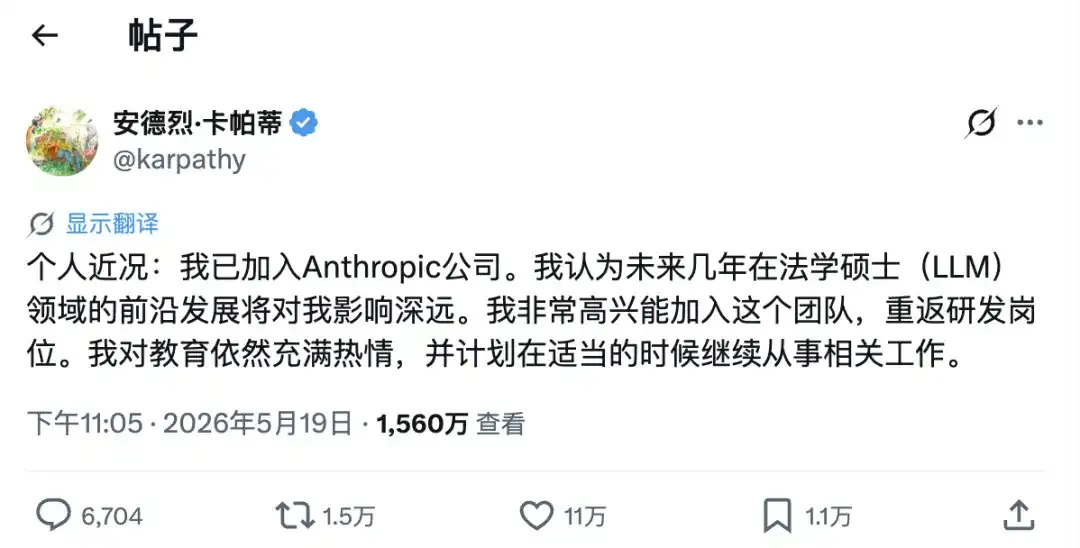
Karpathy's official announcement on X|Image Source: X

Karpathy's role at Anthropic will focus on pre-training research, leading a new team whose core mission is to use Claude to accelerate exploration in pre-training directions.

Pre-training is the foundation of large model capabilities. Whoever makes a breakthrough at this level holds the initiative in the competition for the next few years. Placing Karpathy here makes Anthropic's intent abundantly clear.

But if we only understand this event as "a talented person changing jobs," we are severely underestimating its significance.

Karpathy embodies something extremely rare in the AI community—a dual overlay of technical credibility and mass influence. He is not just a researcher who can write great code and publish papers; he is the kind of person whom other top researchers willingly follow.

There's a saying in the industry: the addition of a prestigious researcher often prompts a group of people to reassess their career choices. Karpathy's arrival could be the signal flare for an impending wave of talent influx at Anthropic.

Even more intriguing is his motivation. In 2015, he was one of the co-founders of OpenAI, witnessing firsthand the company's entire transformation from its non-profit idealistic beginnings. He later went to Tesla, then briefly returned to OpenAI, before leaving again to start his own venture.

This choice of Anthropic carries a certain degree of "statement".

01 Anthropic on a Winning Streak

Viewing Karpathy's joining in isolation misses an important context: Anthropic has recently been in a state of uncommon upward momentum.

Two weeks ago, data from the Ramp AI Index quietly went viral among tech media circles.

The data showed that Anthropic's enterprise adoption rate rose by 3.8 percentage points in April to 34.4%, while OpenAI's fell by 2.9 percentage points during the same period, dropping to 32.3%. This marks the first time in history that Anthropic has surpassed OpenAI in enterprise adoption rate. Though the gap isn't yet wide, the directional significance is strong.

In the same week, Anthropic launched a version of Claude for small businesses, integrating tools like QuickBooks, PayPal, HubSpot, Canva, and DocuSign that small and medium-sized enterprises rely on daily, embedding AI capabilities directly into these users' workflows. This is a clear signal of moving down-market; Anthropic is no longer just targeting large enterprise clients, it's moving into a broader market.

Just the day before that, Anthropic announced a partnership with the Gates Foundation, committing $200 million in funding, Claude usage credits, and technical support over four years for global health, education, and economic development, among other areas. The financial amount of this collaboration isn't the most eye-catching, but its narrative value is high. A company originally focused on "AI safety" is increasingly solidifying its identity around "responsible AI."

At the moment when financing valuations are nearing the trillion-dollar mark and enterprise adoption has just completed an overtake, Karpathy's joining is the highlight at the end of all this.

Fortune magazine's headline put it bluntly: "Anthropic Can't Seem to Stop Winning."

02 Why Not Return to OpenAI?

Where there are winners, there are inevitably those feeling the pressure.

Karpathy is not the first person to leave the OpenAI system for Anthropic.

Anthropic's founding team itself—Dario Amodei, Daniela Amodei, and a group of core researchers at the time—were a collective that left OpenAI to found the company in 2021. To some extent, from its very first day, Anthropic was the product of an internal divergence in philosophy at OpenAI.

In the years since, as OpenAI has moved faster and faster on commercialization and productization—accelerating releases, chasing revenue, increasingly aligning with Microsoft—some researchers who place greater value on "pure research" or "safety first" have begun voting with their feet.

Karpathy's choice of Anthropic comes at a sensitive time. OpenAI has been quite intensive in its external narrative recently, with the GPT series, the o series, Sora, and Operator all advancing simultaneously. The internal pace is so fast that some in the industry privately describe it as "running three marathons at once." Amid such rapid expansion, how to retain those who truly care about research depth and not just valuation is a difficult puzzle to solve.

Of course, OpenAI still possesses immense talent density and resource scale; a single departure won't shake its foundation. But if such movement becomes a trend, what truly warrants attention is the shift in industry expectations it signals.

A tech analyst put it bluntly: "AI development is no longer just a technical race; it's a war of intellectual leadership. The movement of an influential researcher can reshape the entire industry's research priorities."

Karpathy's own influence in the deep learning community perfectly fits this assessment. His Stanford lectures and YouTube videos are introductory material for many researchers now working in top AI labs. Where he goes carries a certain endorsement of "this direction is worth betting on."

03 Pre-training: Fighting for the Future

Returning to the specific focus of Karpathy's joining Anthropic—pre-training.

Over the past two years, the industry's attention has heavily concentrated on relatively "application-layer adjacent" directions like inference, multimodal capabilities, agents, and RAG. Breakthroughs in foundational model capabilities are seen by some as having entered a stage of "fine-tuning and optimization" rather than fundamental leaps.

Anthropic clearly doesn't see it that way. Tasking Karpathy with specifically forming a team to explore "using Claude to accelerate pre-training research" is a bet on a more foundational, longer-cycle, but potentially higher-reward direction.

There's an interesting logic hidden here: using existing large models to assist in the pre-training of the next generation of large models is an "AI helping AI evolve" approach. This path is still very new, without a mature roadmap, but if it can be made to work, it could mean nonlinear improvements in training efficiency and capability boundaries.

Entrusting this to Karpathy is a bold bet by Anthropic on a technical direction.

The talent war in the AI industry has reached an intensity today that can no longer be described as simply poaching a few engineers. It's more like a battle for "narrative control." Whoever attracts the people who can define research directions is sending a signal to the entire industry: we are the future protagonists of this game.

Karpathy's choice is perhaps just such a signal.

Связанные с этим вопросы

QWhat is the core mission of Karpathy's new team at Anthropic, and why is it strategically important?

AAndrej Karpathy's new team at Anthropic will focus on pre-training research, specifically on using Claude to accelerate exploration in pre-training. This is strategically important because pre-training forms the foundational capabilities of large language models. A breakthrough at this fundamental level could provide a significant competitive edge in the future AI landscape, as it could lead to non-linear improvements in model efficiency and capability.

QAccording to the article, what makes Andrej Karpathy's move to Anthropic particularly significant beyond just a job change?

AKarpathy's move is significant due to his unique combination of technical credibility and broad public influence. He is not only a top researcher but also a highly respected educator and communicator in the AI community. His choice signals to other top talent that Anthropic is a serious contender for defining future research priorities, potentially triggering a wave of further talent inflow to the company. It also carries an element of "statement," given his history as an OpenAI co-founder.

QWhat recent key business milestone did Anthropic achieve according to the Ramp AI Index data mentioned in the article?

AAccording to the Ramp AI Index data cited in the article, Anthropic achieved a key milestone in April: its enterprise adoption rate rose to 34.4%, surpassing OpenAI's rate of 32.3%. This marked the first time Anthropic has surpassed OpenAI in enterprise adoption, indicating a strong and growing competitive position in the business market.

QHow does the article contrast the recent trajectories of Anthropic and OpenAI?

AThe article contrasts the two companies' trajectories by describing Anthropic as being on a clear upward trend, "seemingly unable to stop winning," with rising enterprise adoption, product expansion for small businesses, and high-profile partnerships. In contrast, it portrays OpenAI as under pressure, with a fast-paced, multi-front expansion (GPT, o-series, Sora, Operator) that some perceive as potentially straining its ability to retain researchers deeply focused on fundamental research or safety, leading to talent outflow like Karpathy's.

QWhat is the novel technical approach Karpathy's team is expected to explore at Anthropic, and what is its potential implication?

AKarpathy's team is expected to explore the idea of using the existing Claude model to accelerate the pre-training research for the next generation of models. This represents an "AI helping AI to evolve" approach. If successful, this novel method could lead to non-linear improvements in training efficiency and the ultimate capability boundaries of future models, offering a potentially transformative advantage in foundational model development.

Похожее

Will the Next Crypto Bull Run Start with On-Chain Trading of SpaceX?

This article presents a scenario-based forecast for the crypto industry from 2026 to 2029, arguing that the next major cycle will be driven not by technological narratives but by legal access to real-world assets. The author predicts that by mid-2026, pre-IPO perpetual contracts for top private companies like SpaceX, OpenAI, and Anthropic on platforms like Hyperliquid will become the primary gateway for accessing quality assets, as most crypto-native tokens fail to capture real value. The much-hyped AI x Crypto intersection largely fails except for prediction markets, which thrive on betting on AI model supremacy. By 2027, public blockchain foundations are forced to choose between catering to retail speculation or building compliant infrastructure for institutions, with many opting for the latter. Growth in stablecoins and tokenized private credit/equity hits a "triple ceiling" due to regulatory and political uncertainty rather than market demand. The pivotal shift is forecast for 2028. A major liquidation event in pre-IPO perpetuals exposes the structural flaw of synthetic markets lacking a real underlying asset anchor. In response, regulatory changes finally allow the public solicitation of private securities resales to verified accredited investors. This creates a legitimate secondary market for real company equity, which then becomes the core asset class of the new bull market, relegating synthetic perps to a niche role. By 2029, the industry becomes "boring" but foundational. Tokens without claims on real cash flows or assets cease trading. Stablecoin growth is steady but politically capped. Crypto infrastructure fades from view as it gets absorbed into traditional finance backends. The article's central thesis is that the key bottleneck for crypto's next phase is legal and regulatory channels for real asset ownership, not technology.

marsbit23 мин. назад

Will the Next Crypto Bull Run Start with On-Chain Trading of SpaceX?

marsbit23 мин. назад

The Value Distribution of Stablecoins

**Summary: The Value Distribution of Stablecoins** The article argues that stablecoins are evolving from mere trading tools into broader channels for dollar access. It divides the stablecoin ecosystem into four layers to analyze how value is distributed: 1. **Issuance Layer:** Mints stablecoins, holds reserve assets, and captures the spread between reserve yield and user costs (e.g., Tether, Circle). This layer currently earns the largest profit margin. 2. **Infrastructure Layer:** Connects stablecoins to the traditional financial system, handling fiat on/off-ramps, banking integration, compliance (KYC/AML), and asset management (e.g., Bridge, BVNK). This is the "unglamorous" but critical work, building the essential bridges between crypto and real-world finance. 3. **Acquiring/Distribution Layer:** Integrates stablecoins into merchant systems, manages payment flows, and provides enterprise financial software (e.g., Stripe, Coinbase). They act as the access point for businesses. 4. **Application Layer:** The end-users and businesses that ultimately use stablecoins for payments, settlements, or as a store of value. They benefit from convenience but have little pricing power. The core thesis is that while the issuance layer currently dominates profits, the often-overlooked **infrastructure layer holds significant long-term potential**. The real challenge and barrier to mass adoption is not the on-chain transfer of stablecoins (which is simple), but the complex "last mile" integration into existing business workflows, banking systems, and regulatory frameworks across different countries. Companies in this layer are currently in a "land grab" phase, investing heavily to build networks, secure bank partnerships, and establish compliance pathways. While their position is currently pressured by the profitable issuers above and distribution platforms below, the article suggests that if stablecoins become a default financial rail for businesses, the infrastructure providers who have done the hard work of integration will ultimately gain strong pricing power and become entrenched, essential players.

marsbit7 ч. назад

The Value Distribution of Stablecoins

marsbit7 ч. назад

The Value Distribution of Stablecoins

The Value Distribution of Stablecoins The article argues that stablecoins are evolving from a mere trading tool into a broad "dollar channel." It analyzes the industry's value chain through four layers: 1. **Issuance Layer (e.g., Tether, Circle):** The top layer that mints stablecoins, holds reserve assets, and captures the thickest interest rate spread. 2. **Infrastructure Layer (e.g., Bridge, BVNK):** Connects stablecoins to the traditional financial system, handling critical but complex "dirty work" like fiat on/off-ramps, banking integration, compliance (KYC/AML), and cross-border settlement. 3. **Acquiring/Distribution Layer (e.g., Stripe, Coinbase):** Embeds stablecoins into merchant systems, manages payment flows, and integrates with enterprise software. 4. **Application Layer:** End-users and businesses that ultimately use stablecoins for payments, settlement, or storing value. The author posits that while the issuance layer currently captures the most profit, the most overlooked and potentially critical layer is infrastructure. The core challenge for stablecoin adoption isn't the on-chain transfer (which is simple), but bridging the gap between blockchain and the real-world financial system. This involves solving practical problems for businesses: fiat conversion, reconciliation, tax handling, and user onboarding. Infrastructure companies are currently in a difficult "land-grab" phase—building networks, securing banking relationships, and achieving compliance country-by-country. They face pressure from both the profitable issuance layer above and distribution platforms below. However, the author suggests this layer is building a crucial moat. Once stablecoins become a default business rail, the infrastructure players who have done the hard work of integration may gain significant, durable value and pricing power.

链捕手7 ч. назад

The Value Distribution of Stablecoins

链捕手7 ч. назад

Торговля

Спот
Фьючерсы

Популярные статьи

Неделя обучения по популярным токенам (2): 2026 может стать годом приложений реального времени, сектор AI продолжает оставаться в тренде

2025 год — год институциональных инвесторов, в будущем он будет доминировать в приложениях реального времени.

1.8k просмотров всегоОпубликовано 2025.12.16Обновлено 2025.12.16

Неделя обучения по популярным токенам (2): 2026 может стать годом приложений реального времени, сектор AI продолжает оставаться в тренде

Обсуждения

Добро пожаловать в Сообщество HTX. Здесь вы сможете быть в курсе последних новостей о развитии платформы и получить доступ к профессиональной аналитической информации о рынке. Мнения пользователей о цене на AI (AI) представлены ниже.

活动图片