Written by: Tiger Research
Compiled by: AididiaoJP, Foresight News
FOMO (Fear Of Missing Out) is sweeping the crypto industry. From exchanges to security companies, various institutions are launching AI-powered services. This article explores the reasons why companies are choosing to make this move at the current juncture.
Key Points
- Crypto businesses spanning exchanges, security, payments, research, and other fields are simultaneously launching AI-related services.
- Unlike previous cycles, the current leaders are established top-tier companies like Coinbase and Binance, which already have mature profit models. AI has evolved from a conceptual hype to an operational necessity.
- The motivations for adopting AI vary by industry: exchanges aim to reduce user churn; security firms focus on addressing audit blind spots; payment infrastructure targets the emerging agent economy.
- There is a gap between feature launch and practical application. FOMO around AI and competitive pressure are driving companies to accelerate their deployment faster than actual demand warrants.
- Both genuine demand and competitive anxiety are driving this wave. The core question is how to distinguish applications that create real value from those that are merely superficial rebranding.
Crypto Companies Are Launching AI Services
Artificial intelligence is currently the most watched field in the global market. General-purpose tools like ChatGPT and Claude have integrated into daily life, while platforms like OpenClaw have further lowered the technical barrier to building agents.
Although the crypto industry was slightly slower to react in this wave, it is now accelerating the integration of AI capabilities across various verticals.
What specific AI services are these companies offering? And what are their motivations for entering this field?
How Crypto Companies Are Applying AI
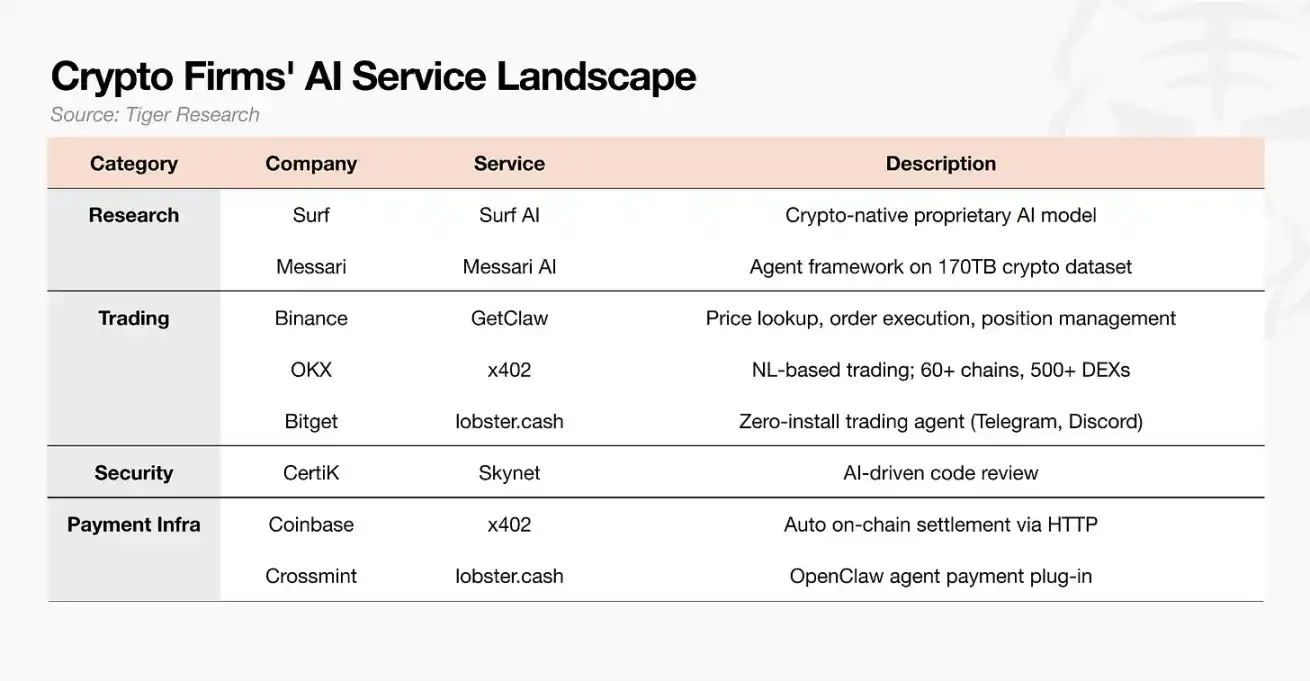
Research Field
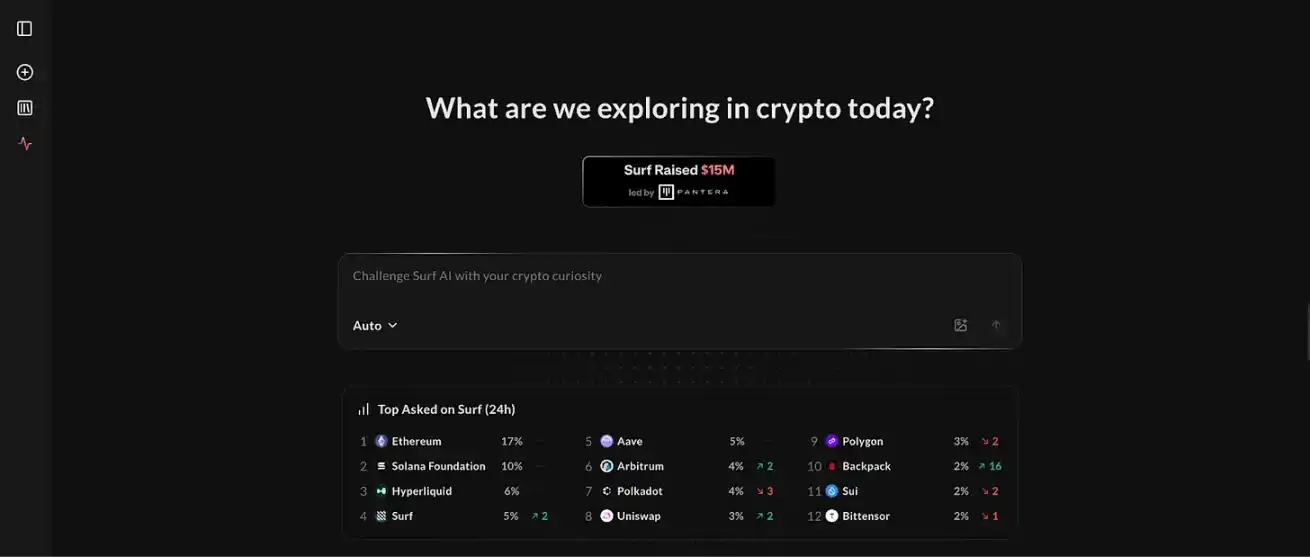
Source: Surf AI
Crypto research has structural problems: on-chain data, market sentiment, and key metrics are scattered across different platforms, making verification difficult. General-purpose AI often gives inaccurate answers when dealing with crypto-related questions.
In response to this situation, projects like Surf have launched dedicated AI research tools for the crypto field, integrating disparate data sources. Among all AI application scenarios in crypto, research tools have the lowest barrier to entry for ordinary users, requiring no programming or trading experience to use.
Trading Field

Source: Bitget
Exchanges are at the forefront of AI applications.
Different exchanges have varying approaches. Some directly provide users with proprietary trading data; others allow users to give instructions to AI agents in natural language, enabling the agent to complete analysis and execution in one step.
Exchanges have offered API services for years. The current change is the addition of an interaction layer: through interfaces like MCP and AI Skills, non-developers can also use AI agents to call exchange functions. Tools once limited to developers are now operable via natural language.
This change aligns with the evolution of the user base. An increasing number of users without programming backgrounds are using AI agents to build automated trading strategies. Users only need to describe their strategy idea, and the agent can complete the algorithm setup and operation.
For exchanges, this trend is both an opportunity and a challenge. As the AI-driven user base grows, their loyalty to a single platform decreases because agents can flexibly execute trades across different exchanges. The core motivation for exchanges to actively deploy AI is to quickly attract users and increase their activity on the platform.
Unlike information query applications, trading involves real asset management, requiring higher judgment and accountability mechanisms. However, as the barrier to use gradually decreases, this field is also opening up to ordinary users.
Security and Auditing Field
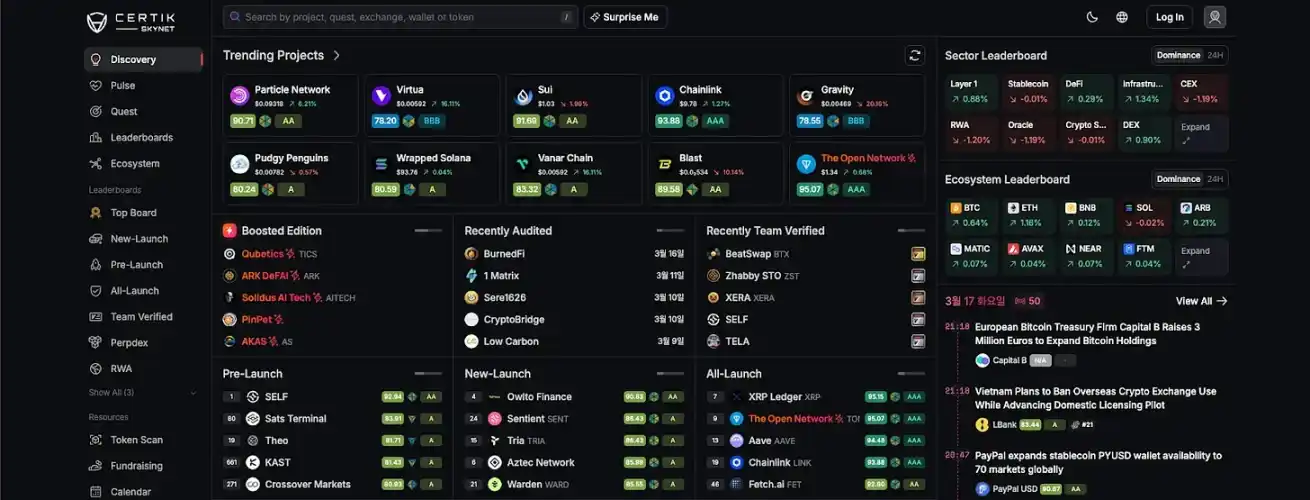
Source: Certik
Smart contract auditing traditionally relies on manual line-by-line code review, a slow and costly process where audit quality varies depending on the executor. Currently, AI is being introduced into the workflow: AI first scans the code, followed by targeted in-depth review by auditors. This enhances efficiency and coverage without replacing auditors.
CertiK is a representative company in this field. The company has previously faced skepticism due to security incidents occurring after some audits. However, many such incidents happened outside the audit scope—audits only cover the code at a specific point in time and do not include continuous monitoring.
CertiK has addressed this shortcoming with AI. It introduces real-time monitoring after the audit is completed and displays it on a public panel. Since the extended monitoring capability is AI-driven and doesn't require significant manpower, it benefits both CertiK and its audit clients.
In the security field, the application of AI is not intended to颠覆 existing services but to expand the boundaries of manual work: improving the accuracy of the audit process and弥补 the monitoring blind spots in the post-audit phase. For blockchain security companies, AI is not a new business direction but a tool to solve pain points in existing business.
Payment Infrastructure Field
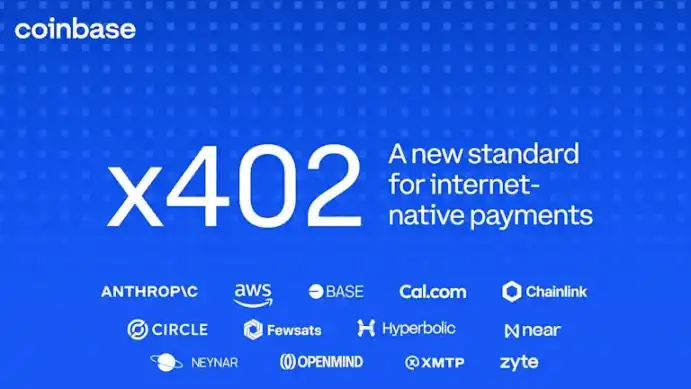
Source: Coinbase
If AI agents are to participate in economic activities, they must have accessible payment channels, such as paying for APIs, purchasing data, or buying services from other agents. For agents, the most suitable payment method is an on-chain wallet paired with stablecoins.
Currently, there are two main models. The first is a universal protocol that embeds payment functionality into HTTP requests, allowing agents to complete on-chain settlements simultaneously when calling paid APIs. The second is payment plugins for agents, where agents only execute payments within the permissions and limits preset by humans.
Payment infrastructure is the field most closely associated with stablecoins. However, since the payment subject is an AI agent rather than a natural person, there is no fully mature operational model yet.

Source: Circle
Circle, the issuer of the stablecoin USDC, is also attracting market attention. The company has released a proposal to connect its Gateway payment infrastructure with the x402 protocol and has invited developers and researchers to participate in review and co-building.
This field is not yet mature, but the market has already started pricing in related expectations. One of the key drivers behind Circle's stock price rise is the narrative around AI agent payments. Compared to the aforementioned fields, payment infrastructure will take longer to materialize but has already established itself as one of the most important macro themes in the current market.
Why Crypto Companies Are Entering the AI Field Now
When ChatGPT was launched in November 2022, neither AI nor the crypto industry were mature. AI models showed some capability but were not yet reliable for completing tasks; the crypto industry was mired in a severe trust crisis due to the FTX collapse.
Since then, AI technology has made significant progress. Over the past year, the capabilities of major models have greatly improved, and their practicality has significantly increased. In contrast, the crypto industry spent much of the same period in a phase of "borrowing" AI concepts, manifested in AI-themed meme coins, AI agents lacking practical functions, and marketing-oriented rhetoric. Decentralized AI infrastructure projects continued to emerge, but their product quality showed a clear gap compared to similar native AI services.
Currently, the gap is widening further. In the AI field, the maturity of infrastructure like MCP (allowing agents to directly call external tools) and OpenClaw (enabling no-code agent building) is turning the agent era from concept into reality. Crypto companies are only now beginning to substantively follow up.
The key to this round of change lies in the different actors. The leaders are no longer emerging projects using AI concepts for branding, but established top-tier companies with stable revenue models—Coinbase, Binance, Bitget, etc. These companies have no incentive to use AI services as a marketing gimmick. The core factor driving their actions is not current profit, but anxiety about falling behind industry development, i.e., FOMO.
Source: FORTUNE
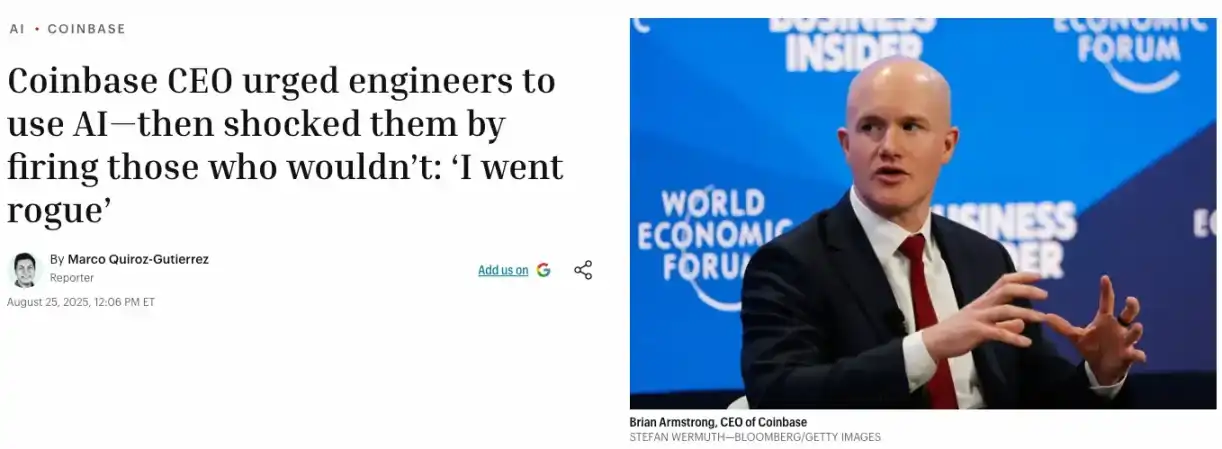
This sense of urgency is evident in the actions of Coinbase CEO Brian Armstrong. He demanded that all engineers complete training on AI coding tools within a week and threatened dismissal for those who failed to meet the standard.
However, maintaining prudent judgment is also necessary. Taking trading automation as an example, AI agents can perform price queries and strategy suggestions, but how many users are actually willing to hand over funds to an agent for live trading? Has the x402 protocol entered the practical application stage?
Overall, the crypto industry's deployment of AI is not about chasing short-term trends. As the contours of the AI era become clearer, companies are stepping up their efforts to consolidate their industry position. There is still a gap between feature launch and practical application, but the identity of the actors itself is highly indicative.
One might compare the AI industry to a pool being filled with water. Many early entrants were just pretending to swim. The current entrants are seasoned players with deep积累. How high the water level will rise, and whether the pool will expand into an ocean, remains uncertain. But one thing is clear: the crypto industry will not be marginalized in this wave.