Western Union launches USDPT on Solana: March rally for SOL?

ambcryptoОпубликовано 2026-03-05Обновлено 2026-03-05

Введение

Western Union has launched a new stablecoin, USDPT, on the Solana blockchain, signaling strong institutional confidence in the network’s capabilities. This partnership enhances Western Union’s position in the stablecoin market by enabling efficient cross-border transactions. The development comes amid growing stablecoin ecosystem on Solana, with Grayscale reporting a record $650 billion in stablecoin volume in February—even as SOL’s price declined. Increased stablecoin activity, including Circle minting $1 billion USDC on Solana, points to strong underlying liquidity and on-chain demand. This liquidity surge may position Solana for a potential rally in March, especially if market sentiment remains positive. The network’s deepening capital flows and institutional backing strengthen its long-term fundamentals despite regulatory and competitive pressures.

No doubt, over the years, stablecoins have bridged TradFi and DeFi by enabling banks to process payments faster and at lower cost, directly improving efficiency and the overall user experience.

In this context, the critical factor is the Layer-1 network chosen to facilitate this bridge. Notably, Solana [SOL] appears to be strategically positioning itself to capitalize on this opportunity through another key partnership.

Western Union, a global financial services company, has launched USDPT, a new stablecoin on Solana, clearly signaling its confidence in the network’s capability to deliver stablecoin services to users.

At a macro level, the partnership structurally strengthens Western Union’s competitive position in the expanding stablecoin market, as leveraging blockchain infrastructure enables seamless cross-border transactions.

The more consequential question, however, is what this development means for Solana. As stablecoin regulations tighten and competition among Layer-1 networks intensifies, does this partnership reinforce confidence in its long-term fundamentals?

Considering how a recent report by Grayscale highlighted Solana’s growing stablecoin market, USDPT’s launch could not have come at a better time, positioning the network at the forefront of a potential March rally.

Stablecoin surge fuels renewed bullish case for Solana

High liquidity directly drives a network’s long-term growth.

The reasoning is simple. The more liquid a chain is, the easier it becomes to move capital across different sectors like NFTs, RWAs, and staking. This naturally increases on-chain activity and overall network strength.

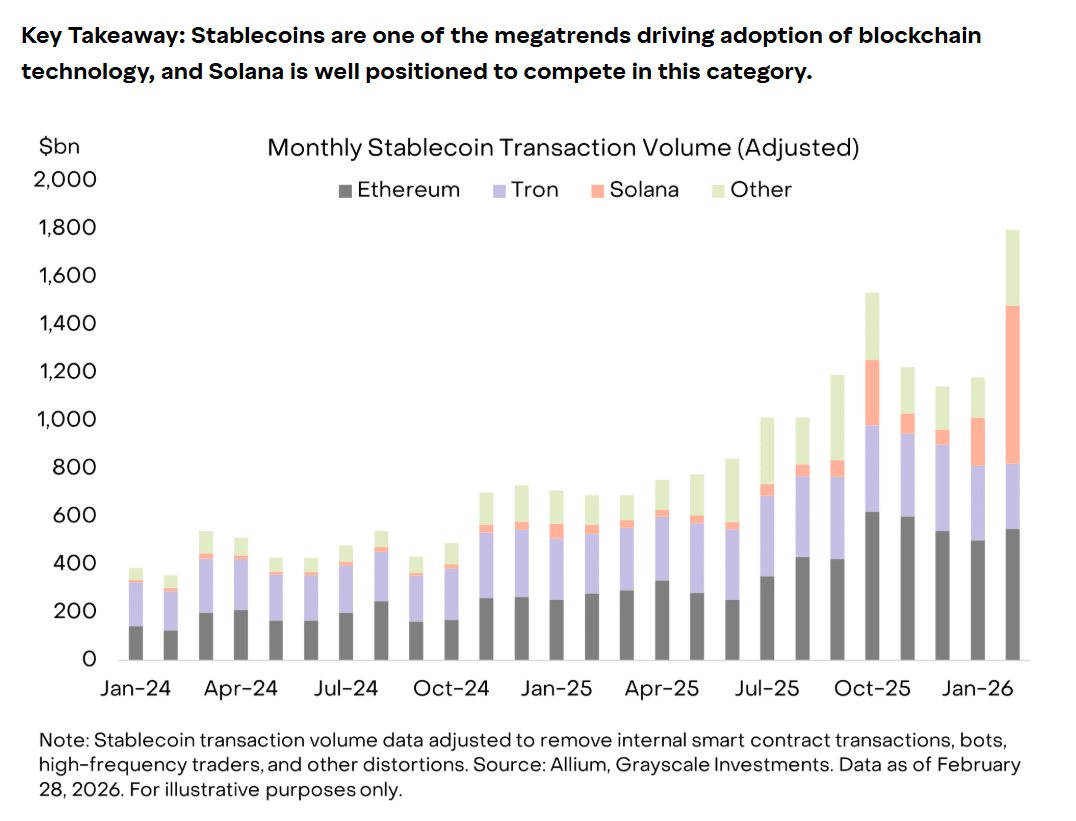
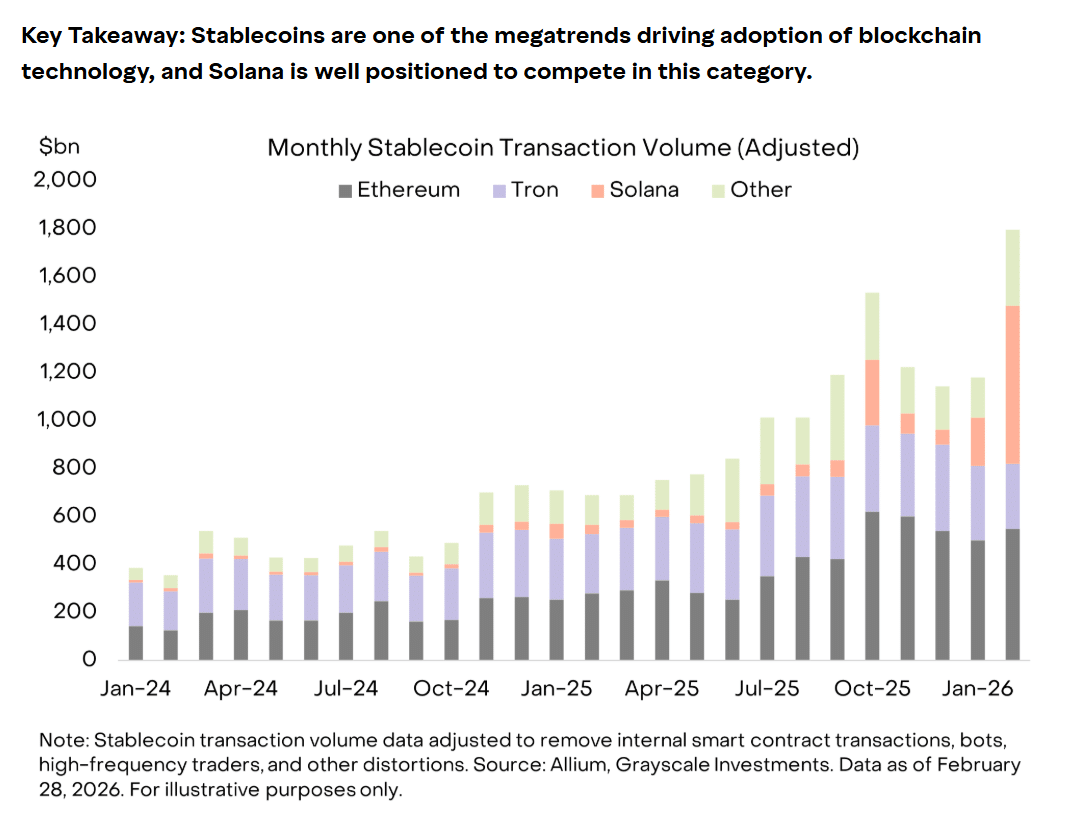
Grayscale’s statement that February was a record month for stablecoins on Solana carries weight in this context. The report noted that stablecoin volume on Solana hit an all‐time high of $650 billion.

Source: Grayscale

Notably, this expansion occurred while SOL saw its weakest monthly run of the year, closing February down 19.98%. This divergence suggests that underlying transactional activity persisted despite price weakness.

Within this context, Circle minting $1 billion in USDC on Solana following the Middle East conflict carries structural importance. Elevated stablecoin issuance during a risk-off phase increases on-chain liquidity depth.

When you add the USDPT launch to the mix, the added liquidity boosts Solana’s capital flows. With Grayscale highlighting strong underlying demand, the setup points to a potential liquidity‐driven repricing.

In this context, SOL’s breakout above $90 may only mark the beginning. With deeper stablecoin liquidity and steady on‐chain activity, Solana appears well‐positioned to lead in March if risk‐on sentiment persists.


Final Summary

  • Solana is seeing stronger liquidity and institutional backing, with moves from Western Union and Circle boosting on-chain activity.
  • Record stablecoin volume, highlighted by Grayscale, shows solid demand, which could support further upside if market sentiment improves.

Связанные с этим вопросы

QWhat is the significance of Western Union launching USDPT on Solana?

AWestern Union's launch of the USDPT stablecoin on Solana signals strong institutional confidence in the network's capability to handle stablecoin services, strengthens its competitive position in cross-border transactions, and adds significant capital flow and liquidity to the Solana ecosystem.

QHow did Solana's stablecoin volume perform in February according to Grayscale?

AGrayscale reported that February was a record month for stablecoins on Solana, with stablecoin volume hitting an all-time high of $650 billion, indicating robust underlying demand despite SOL's price decline of 19.98% that month.

QWhy is the partnership with Western Union and Circle's USDC minting important for Solana?

AThe partnership with Western Union and Circle's minting of $1 billion USDC on Solana during a risk-off phase structurally enhances on-chain liquidity depth, boosts capital flows, and positions Solana at the forefront of potential growth, reinforcing long-term fundamentals.

QWhat does high liquidity mean for a blockchain network like Solana?

AHigh liquidity on a blockchain network like Solana facilitates easier movement of capital across various sectors such as NFTs, RWAs, and staking, which increases on-chain activity, strengthens the network, and supports long-term growth and potential price repricing.

QHow might Solana's position in the stablecoin market affect its performance in March?

AWith record stablecoin volumes, increased liquidity from new partnerships and USDC minting, and strong underlying demand, Solana is well-positioned to lead a potential March rally if risk-on sentiment persists, possibly extending its breakout above $90.

Похожее

The Cost of an 11.5% Annualized Return: Will MicroStrategy's STRC Face a Moment of Reckoning?

This article analyzes the potential risks associated with MicroStrategy's (MSTR) use of structured financial products like STRC to leverage its BTC exposure. While these tools have enabled impressive returns (e.g., 11.5% annualized) and fueled significant capital inflows ($13.5B outstanding), they also create substantial annual dividend obligations (~$400M). The author argues that this structure, while effective in a bull market, could become a liability if BTC price stagnates or declines. The core risk is a potential negative feedback loop: the growing dividend burden from continued STRC issuance may eventually outweigh the benefits of increased BTC holdings. To meet these obligations, MicroStrategy might need to use new issuance proceeds for dividends instead of buying more BTC, which could disappoint equity investors. If the market capitalization (mNAV) falls below the value of its BTC holdings, the company could be forced to sell BTC instead of issuing new shares, potentially triggering a panic. The author estimates a potential inflection point in 6 months, where annual dividend costs reach $3-4B. At that stage, CEO Michael Saylor might face a difficult choice: sell BTC to meet obligations or sacrifice the credibility of the preferred shares by halting dividends. The article concludes that this financial engineering, while powerful, could ultimately "backfire" on MicroStrategy if market conditions turn.

marsbit1 ч. назад

The Cost of an 11.5% Annualized Return: Will MicroStrategy's STRC Face a Moment of Reckoning?

marsbit1 ч. назад

Торговля

Спот
Фьючерсы

Популярные статьи

Обсуждения

Добро пожаловать в Сообщество HTX. Здесь вы сможете быть в курсе последних новостей о развитии платформы и получить доступ к профессиональной аналитической информации о рынке. Мнения пользователей о цене на SOL (SOL) представлены ниже.

活动图片