Web3 Fund Global Expansion Guide: Deconstructing the Compliance Frameworks of Six Major Global Crypto Funds

marsbitОпубликовано 2026-03-20Обновлено 2026-03-20

Введение

A Guide to Web3 Fund Structures: Analyzing Six Major Global Crypto Fund Compliance Frameworks As crypto assets evolve from simple trading to professional asset management, Web3 projects, quantitative teams, and high-net-worth individuals increasingly adopt fund structures. The choice of legal framework is a foundational decision impacting risk isolation, tax treatment, and long-term compliance. This article analyzes six major fund structures suited for different strategies and investor profiles: - **Cayman SPC**: An umbrella company structure allowing multiple segregated portfolios under one entity. Ideal for multi-strategy teams seeking risk isolation and rapid product iteration. - **Cayman ELP**: A limited partnership form common in VC/PE, offering flexible profit distribution, tax transparency, and investor privacy. - **BVI Approved Fund**: A low-cost, fast-setup solution for early-stage teams managing under $100M, with simplified compliance and up to 20 investors. - **Singapore VCC**: An onshore structure with regulatory credibility, umbrella fund options, and potential tax exemptions (13O/13U), suitable for family offices and teams establishing a local presence. - **Hong Kong LPF**: A localized limited partnership offering convenience for Asian-based operations, banking, and legal services, with potential profit tax exemption. - **Hong Kong OFC**: An open-ended corporate structure ideal for liquid strategies, ETFs, or public offerings, supported by government subsidie...

Original Authors: Zhang Qianwen, Cheng Chuying

Introduction

As crypto assets evolve from simple trading activities to professional asset management, an increasing number of Web3 project teams, quantitative teams, and high-net-worth individuals are adopting fund structures to manage crypto assets. In this process, the choice of a fund's legal structure is no longer a matter of formality; it is a fundamental decision directly impacting risk isolation, tax treatment, and long-term compliant operations.

From a regulatory practice perspective, differences in fund establishment systems, regulatory requirements, and tax arrangements across various jurisdictions determine the investment strategies and fundraising targets they are suited for. Whether it's multi-strategy quantitative trading, primary market investments, or family office asset allocation, there is no "optimal structure," only a "suitable structure" that matches the business model.

This article deconstructs six major global crypto fund structures, analyzing their core mechanisms and applicable scenarios to provide reference for managers' compliance planning.

Cayman SPC: The "Umbrella Company" Suitable for Multi-Strategy Operations

The SPC (Segregated Portfolio Company) is a corporate form in the Cayman Islands. Its key feature is the ability to establish multiple, legally independent investment portfolios (SPs) under a single legal entity.

  • Core Mechanism: Risk Segregation

The assets and liabilities of each SP are legally separate. For example, if Strategy A loses money, its creditors can only claim against A's assets and cannot touch the funds of Strategy B. This is crucial in the highly volatile crypto market, effectively preventing one strategy's "meltdown" from dragging down the entire operation.

  • Applicable Scenarios:

When a manager simultaneously runs both high-risk and low-risk strategies, an SPC ensures that accounts are kept separate and do not interfere with each other. Additionally, launching a new product simply involves creating a new sub-fund under the existing SPC, eliminating the need to register a new company. This offers low cost and high speed, making it suitable for teams looking to quickly incubate new strategies.

Cayman ELP: The "Partnership Structure" Suitable for Primary Market Investments

Unlike the corporate structure of an SPC, the ELP (Exempted Limited Partnership) is a partnership structure established under the Exempted Limited Partnership Law. It does not have independent legal personality but is a contractual relationship between a General Partner (GP) and Limited Partners (LPs). ELPs are widely used in venture capital (VC) and private equity (PE).

  • Core Mechanism: Clear Division of Roles

The GP (General Partner) is responsible for managing the money and making investments, bearing unlimited liability (in practice, a limited company is often used as the GP to isolate risk). The LP (Limited Partner) provides capital, does not participate in management, and their liability is limited to their contribution.

  • Applicable Scenarios:

Primary market investments involve complex profit distribution. The Partnership Agreement allows for flexible terms on how and when profits are shared. Furthermore, ELPs are tax-transparent, meaning the fund itself does not pay tax, and the list of LPs does not need to be publicly disclosed, balancing tax efficiency and privacy protection.

BVI Approved Fund: The "Entry-Level Compliance Solution" for Small Teams

For smaller, early-stage teams, the BVI (British Virgin Islands) Approved Fund offers a compliant option with low barriers to entry and controllable costs.

  • Core Mechanism: Filing-Based, Simplified Regulation

Establishment is fast, typically approved within two to three days of submitting materials. It is not mandatory to hire an auditor or a local custodian, significantly reducing operational costs.

  • Applicable Scenarios

Suitable for teams with assets under management below $10 million who are still in the strategy validation phase. It allows for establishing a compliant entity at a lower cost to build a track record. The investor cap is 20 persons, and the asset size cap is $100 million, making it suitable for fundraising within a familiar circle or community.

Singapore VCC: The "Onshore Fund Structure" Balancing Compliance and Practicality

The VCC (Variable Capital Company) is a fund vehicle introduced by Singapore that retains the flexibility of offshore funds while having the regulatory backing of the Monetary Authority of Singapore (MAS).

  • Core Mechanism: Umbrella Structure + Tax Incentives

The VCC also supports the establishment of multiple sub-funds with asset segregation. Most importantly, it can apply for the 13O/13U tax exemption scheme, where qualifying investment income is tax-exempt, and dividends are not subject to withholding tax.

  • Applicable Scenarios

Suitable for teams looking to set up an office in Singapore, obtain work visas, or establish a family office. It offers an internationally recognized compliant identity while protecting investor privacy (the shareholder register is not public), making it attractive to capital seeking long-term stability.

Hong Kong LPF: The "Cross-Border Fund Channel" Connecting Asian Markets

The LPF (Limited Partnership Fund) is a localized fund structure launched by Hong Kong, modeled on the Cayman ELP. It is registered and managed in Hong Kong and governed by Hong Kong law.

  • Core Mechanism: Localized Limited Partnership

Structurally similar to the Cayman ELP, but all legal matters and bank communication are handled locally in Hong Kong, with no time zone or language barriers.

  • Applicable Scenarios

If the team is primarily based in Asia, the LPF offers convenience in lawyer liaison, bank account opening, and daily maintenance. Coupled with Hong Kong's Unified Fund Exemption (UFE) regime, qualifying funds can enjoy profits tax exemption, offering a friendly tax environment.

Hong Kong OFC: The "Open-Ended Fund Structure" Suitable for Public Offerings or ETF Issuance

The OFC (Open-ended Fund Company) is a corporate-type open-ended fund with independent legal personality, allowing flexibility in handling investor subscriptions and redemptions.

  • Core Mechanism: Variable Capital, Flexible Structure

An OFC can increase or decrease shares based on subscription and redemption demands, bypassing the restrictions of capital reduction in traditional companies. It can be used for private placements or apply for public offerings (requires SFC authorization).

  • Applicable Scenarios:

To encourage OFC development, the Hong Kong government offers a subsidy covering up to 70% of the establishment costs (capped at HKD 1 million per company), effectively reducing startup costs. Additionally, the OFC is currently one of the mainstream structures in Hong Kong for issuing virtual asset ETFs and fundraising from the public, making it suitable for highly liquid trading strategies.

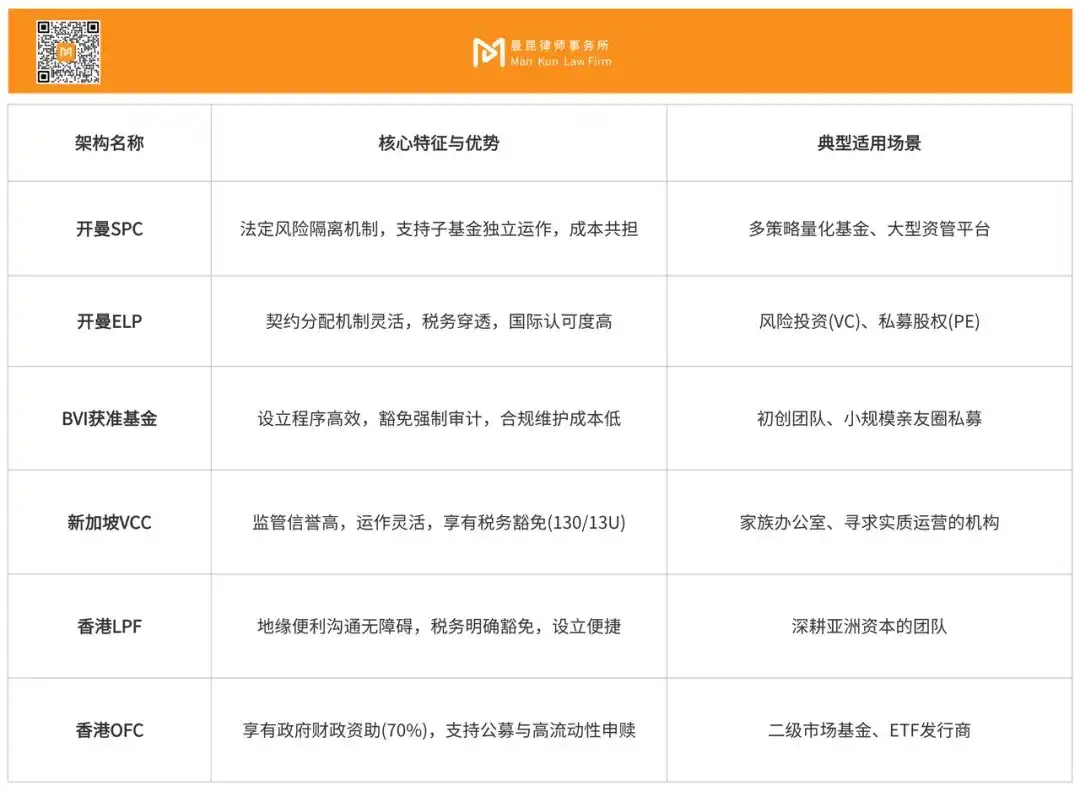
Overview of Core Characteristics of the Six Structures

Based on the above analysis, the legal characteristics and applicable scenarios of the six mainstream fund structures are summarized below:
Conclusion

In the field of crypto assets, the question regarding fund structures is never "whether to establish one," but rather "when to establish it and in what form." Different legal structures correspond not only to how taxes are paid and how regulations are applied but also to how risks are borne, how investors participate, and how the future operational model will succeed.

The fund structures introduced in this article are neither good nor bad in themselves; the key is whether they match your business model, investment strategy, and target investors. For managers who are already operating or plan to operate crypto assets in a fund format, thinking through and finalizing the structure early is itself an important form of risk control.


Связанные с этим вопросы

QWhat is the main advantage of using a Cayman Islands SPC structure for a crypto fund?

AThe main advantage is its ability to provide risk isolation through multiple segregated portfolios (SPs) within a single legal entity, ensuring that the assets and debts of one strategy do not affect others.

QWhich fund structure is most suitable for early-stage teams with smaller assets under management (AUM) and why?

AThe BVI Approved Fund is most suitable because it has a low compliance threshold, fast setup (approved in 2-3 days), reduced operational costs (no mandatory auditor or local custodian), and is designed for teams with AUM below $100 million and up to 20 investors.

QHow does the Singapore VCC structure benefit teams looking to establish a presence in Singapore?

AThe Singapore VCC offers regulatory backing from the Monetary Authority of Singapore (MAS), allows for multiple sub-funds with asset segregation, and provides tax exemptions (e.g., under 13O/13U schemes) on qualifying investment income, making it attractive for setting up offices, obtaining work visas, or establishing family offices.

QWhat makes the Hong LPF a convenient option for teams primarily based in Asia?

AThe Hong Kong LPF is convenient because all legal matters, banking communication, and daily maintenance are handled locally in Hong Kong, eliminating language and time zone barriers, and it benefits from tax exemptions under the Unified Fund Exemption (UFE) regime.

QWhich fund structure is ideal for issuing public offerings or virtual asset ETFs, and what support does it receive?

AThe Hong Kong OFC (Open-ended Fund Company) is ideal for public offerings or ETF issuance due to its flexible capital structure that allows for share redemptions and subscriptions. It also receives government support, including up to 70% subsidy on setup costs (capped at HKD 1 million per company).

Похожее

Свет слабеет: что происходит с криптовалютными венчурными фондами?

**Крипто-венчурные фонды на перепутье: от нишевых игроков к интеграции** Когда-то узкоспециализированные крипто-фонды, такие как Paradigm, были первопроходцами, обладавшими уникальными знаниями и готовыми брать на себя высокие риски нового рынка. Однако сегодня, как показывает пример Paradigm, собравшего 1,2 млрд долларов для инвестиций в ИИ и робототехнику, эти границы размываются. История повторяется по модели Карлоты Перес: по мере взросления технологии (крипто переходит от «фазы установления» к «фазе внедрения») исчезает информационное преимущество специалистов. Традиционные финансовые гиганты, такие как BlackRock или Visa, теперь понимают блокчейн и приходят в отрасль, но им нужны не технические детали, а регуляторные и банковские связи. Это привело к «эффекту гантели» на рынке венчурного капитала. Гигантские универсальные фонды (a16z, Sequoia) и небольшие нишевые игроки выживают, в то время как фонды среднего размера, составляющие большинство крипто-специалистов, оказываются в «зоне смерти». Их размера недостаточно для конкуренции за крупные раунды с гигантами, а доходности только от крипто-стартапов может не хватить для выполнения обязательств перед инвесторами (LP). Поэтому они вынуждены диверсифицироваться, как Framework Ventures, или полностью менять фокус. Даже оставшиеся «чистыми» крипто-фонды, такие как Dragonfly или a16z, сужают свою стратегию до блокчейн-инфраструктуры для финансов (стейблкоины, рынки предсказаний), области, которая также интересует крупные универсальные фонды. Это создает проблемы для крипто-стартапов: им приходится конкурировать за внимание инвесторов с модными ИИ-проектами, а также они теряют поддержку в финансировании важной, но неприбыльной на ранних этапах инфраструктуры, которую раньше строили специализированные фонды. В будущем термин «крипто-инвестор» может устареть, как когда-то «интернет-инвестор». Крипто станет базовой инфраструктурой, а не отдельным классом активов. Рынок будет разделен: крупные универсальные фонды будут финансировать зрелые проекты, а небольшие специализированные фонды — поддерживать нишевые инновации. При этом появляется новая тенденция: такие проекты, как Hyperliquid, успешно запускаются вообще без венчурного капитала, через сообщество. Эра, когда крипто зависело от специализированных VC, подходит к концу, открывая путь новой, более интегрированной и самостоятельной модели роста.

Foresight News15 мин. назад

Свет слабеет: что происходит с криптовалютными венчурными фондами?

Foresight News15 мин. назад

Когда консенсус формируется всё быстрее, во что ставят молодые инвесторы?

Статья «Когда консенсус ускоряется, на что делают ставки молодые инвесторы?» (издание Huxiu) анализирует новые тенденции в технологических инвестициях на фоне быстрого развития ИИ, робототехники, коммерческой космонавтики и квантовых вычислений. Молодые инвесторы смещают фокус от простого преследования технологических трендов к пониманию реальных путей интеграции технологий в промышленность. Выделяются четыре ключевых направления: 1. **ИИ переходит в физический мир:** Инвестиции смещаются от облачных моделей к периферийным устройствам, роботам (включая воплощённый интеллект) и интеллектуальному оборудованию. Акцент делается не на демонстрационных возможностях, а на надёжности, стоимости развёртывания и реальной окупаемости. 2. **Конкурентное преимущество смещается к «интеллектуальной маховичной модели»:** Вместо вопроса «чей ИИ-модель мощнее» важен вопрос, какая компания может встроить возможности модели в рабочие процессы, создав цикл обратной связи «данные — обучение — улучшение продукта». Это создаёт долгосрочный барьер, как показывают примеры компаний Zhipu AI и Kling AI. 3. **Новые базовые технологии для преодоления дефицита данных:** По мере исчерпания общедоступных данных качественного обучения растёт интерес к таким подходам, как обучение с подкреплением и самоиграющие модели. Научные базовые модели (например, для биологии, химии) рассматриваются как перспективное, но сложное направление для генерации новых высококачественных данных. 4. **Терпеливый капитал для глубоких технологий:** В таких сферах, как коммерческая космонавтика и квантовые вычисления, где циклы разработки и валидации длительны, инвесторы должны рано оценивать фундаментальный потенциал, инженерные компетенции команд и готовность сопровождать проекты в долгосрочной перспективе, даже при неопределённости технических путей. Общий вывод: современный технологический инвестор должен глубже понимать язык технологий, оценивать не только финансовые модели, но и инженерные, и коммерческие траектории, и делать выбор в условиях, когда консенсус ещё не сформирован.

marsbit42 мин. назад

Когда консенсус формируется всё быстрее, во что ставят молодые инвесторы?

marsbit42 мин. назад

Высвобождение ликвидности на $100 млн? Новая политика Pump.fun тестирует «технику пампов» за 5 минут

**Pump.fun запускает режим BOOST: использует "мертвую ликвидность" для 5-минутного "фейерверка"** 21 июля платформа для запуска мем-токенов Pump.fun представила режим BOOST, ставший новым стандартом для эмиссии. Его цель — решить проблему "мертвой ликвидности". Раньше при переходе токена с bonding curve в пул ликвидности около 20% средств навсегда блокировались в LP, даже если токен обесценивался. По оценкам платформы, это приводило к ежегодным потерям ликвидности свыше $100 млн. Суть BOOST: вместо блокировки эти 20% средств (примерно 17.6 SOL или $2516 USDC) используются для скупки самого токена в течение первых 5 минут после его миграции на PumpSwap. Покупка осуществляется по методу TWAP (средневзвешенная по времени цена), а все выкупленные токены немедленно сжигаются. Это создает кратковременный покупательский спрос и сокращает предложение. Новый режим не меняет процесс торговли на bonding curve или порог миграции. Он активируется автоматически для всех токенов, мигрирующих после указанной даты. Ранее выпущенные токены и токены, запущенные через Mayhem, не подпадают под его действие. Логика Pump.fun, вероятно, в следующем: если новые мем-токены после запуска покажут кратковременный всплеск ("фейерверк"), это повысит вовлеченность трейдеров и объемы торгов на платформе. Устойчивый доход от комиссий — основа для будущего выкупа и поддержки собственного токена PUMP. Однако некоторые трейдеры выражают опасения: искусственный спрос в первые 5 минут может облегчить запуск низкокачественных проектов, а после окончания скупки токен может столкнуться с резкими продажами и высоким проскальзыванием, что усилит волатильность.

Foresight News53 мин. назад

Высвобождение ликвидности на $100 млн? Новая политика Pump.fun тестирует «технику пампов» за 5 минут

Foresight News53 мин. назад

Япония хочет купить рост с помощью ИИ. Поверит ли ей рынок облигаций?

Японское правительство представило новый курс экономической и фискальной политики («Основные принципы 2026»), сместив акцент с достижения профицита первичного баланса на стабилизацию и снижение соотношения госдолга к ВВП. Ключевым элементом стратегии стали масштабные инвестиции в стратегические области, такие как ИИ, полупроводники, оборона и энергетика, с целью стимулирования долгосрочного роста и повышения производительности. Однако рынок облигаций отреагировал на эти планы с осторожностью. Инвесторы опасаются, что ослабление прежнего фискального правила (первичный баланс) без четких новых механизмов контроля может привести к фискальной экспансии. Это вызвало рост доходности 10-летних японских гособлигаций и волатильность йены. Успех новой стратегии зависит от способности Японии обеспечить, чтобы номинальный экономический рост устойчиво превышал долгосрочные процентные ставки. Рынки будут оценивать не сам факт инвестиций в ИИ, а их реальную отдачу в виде роста производительности, налоговых поступлений и соблюдения дисциплины при выпуске новых облигаций.

marsbit1 ч. назад

Япония хочет купить рост с помощью ИИ. Поверит ли ей рынок облигаций?

marsbit1 ч. назад

Неправомерно пострадавшие A-акции: Устойчивость, ожидания и основание

В июле глобальные технологические акции столкнулись с коррекцией, начавшейся с распродаж в Южной Корее и затронувшей рынки США, Японии и Китая (A-shares). Однако китайский рынок продемонстрировал устойчивость благодаря нескольким факторам. Во-первых, базовые показатели технологического сектора Китая остаются прочными. Такие подотрасли, как оптические модули и оптическое волокно, показывают высокий рост прибыли (например, New Eastsoft, Changfei Optical Fiber). В отличие от южнокорейского рынка, сильно зависящего от полупроводников памяти, китайский технологический сектор диверсифицирован (компьютеры, связь, электроника) и опирается как на глобальные цепочки поставок (например, для NVIDIA), так и на политику импортозамещения. Во-вторых, государственные институты («команда страны») активно поддерживают рынок, выделив сотни миллиардов юаней на выкуп акций и ETF через такие компании, как China Reform Holdings и China Chengtong. Этот шаг направлен на стабилизацию ликвидности и формирование позитивных ожиданий, сигнализируя о возможном достижении локального дна. В-третьих, другие ключевые секторы A-shares демонстрируют внутренний потенциал для восстановления: * **Потребительский сектор:** CPI стабильно превышает 1%, указывая на улучшение маржи. Ключевые игроки, такие как Kweichow Moutai, повышают цены, а розничные продажи алкоголя растут. * **Сырьевой сектор (например, алюминий):** Высокая рентабельность, сохраняющийся дефицит предложения и низкие оценки создают потенциал для роста. * **Финансовый сектор:** Банки предлагают высокие дивиденды, а брокеры и страховщики выигрывают от оживления на рынке капитала. Таким образом, текущая коррекция в основном вызвана внешними факторами, а не ухудшением фундаментальных показателей. При поддержке государства и наличии внутренних драйверов роста в нескольких секторах рынок A-shares обладает значительной устойчивостью для возвращения к стабильности.

marsbit1 ч. назад

Неправомерно пострадавшие A-акции: Устойчивость, ожидания и основание

marsbit1 ч. назад

Торговля

Спот
活动图片




