Wang Tao's First Large Model Brings Meta Back to the Table

marsbitОпубликовано 2026-04-09Обновлено 2026-04-09

Введение

Meta has unveiled Muse Spark, the first model from its new Muse series, marking a significant step in its AI strategy under the leadership of Alexandr (Wang) since his appointment ten months ago. Designed to be compact and fast, Spark is a natively multimodal reasoning model that integrates visual information into its core architecture, enabling advanced capabilities like visual chain-of-thought reasoning. It excels in areas such as medical reasoning, visual and chart understanding, and scientific reasoning, though it lags in coding and long-form tasks compared to rivals like GPT-5.4 and Gemini 3.1 Pro. The model will power Meta AI across platforms like WhatsApp, Instagram, and Facebook, with private API access for select partners. The release follows Meta’s shift from its earlier Llama series and significant internal investment, including a restructured AI stack and expanded infrastructure. Spark’s introduction spurred a 6.5% rise in Meta’s stock, reflecting market optimism. Meta plans to develop larger models in the Muse series, potentially adopting a hybrid open/closed-source approach moving forward.

By | Alphabet AI

It has been about ten months since Wang Tao (Alexandr Wang) joined Meta. The world is about to move from one summer to another, and Meta's "Avocado" is finally ripe.

On April 8 local time, Meta officially announced the release of Spark, the first model in the Muse series. This is also the first dish served by Meta after recruiting Wang Tao and establishing the "Meta Superintelligence Labs (MSL)".

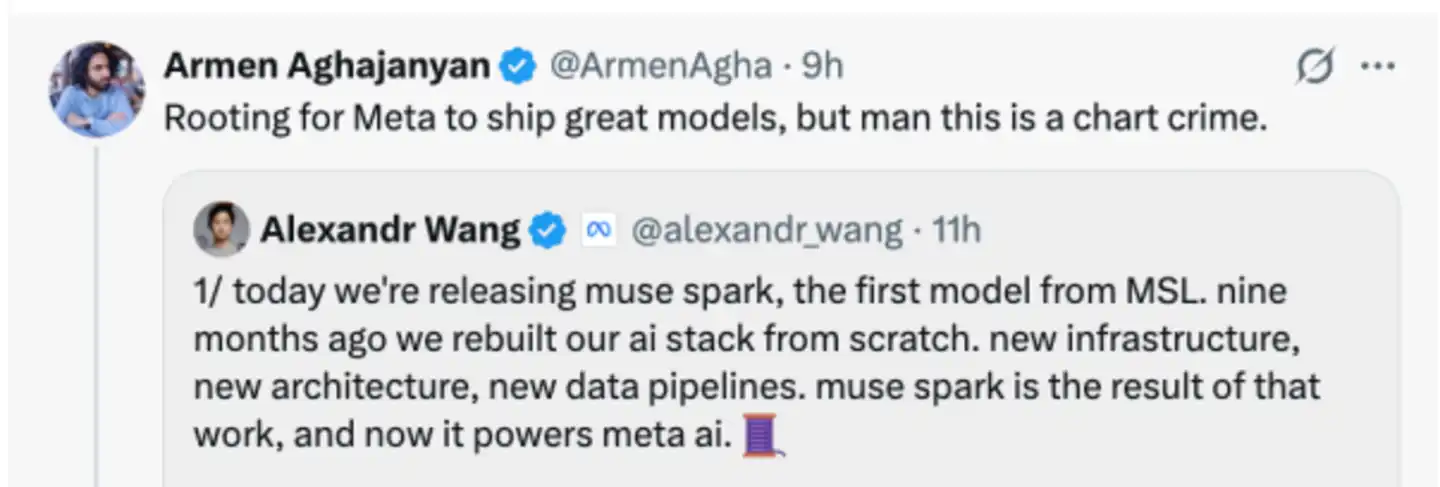
Wang Tao posted several messages on X to introduce the new model, stating: "Nine months ago, we rebuilt the AI technology stack from scratch, including new infrastructure, architecture, and data pipelines. Muse Spark is the result of this work."

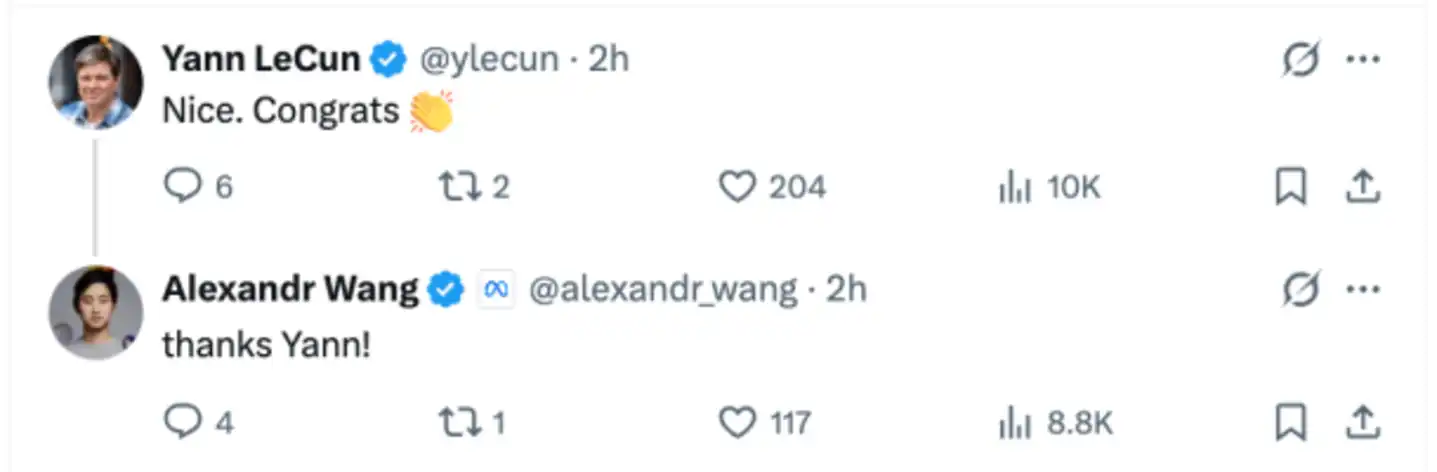
Even Yann LeCun, Meta's former chief scientist who was rumored to have disagreements with Wang Tao, came to congratulate him, creating a harmonious atmosphere.

Meta emphasized that Spark was designed to be "small and fast." Leading with such a model instead of "holding back for a big move" to release a crushing model shows that Meta knows time is of the essence.

This move seems to have worked, as Meta's stock price rose by about 9% that day.

01 New Model Muse Spark

First, let's take a look at what model Meta has released.

The new model is called Muse Spark, with Muse being the name of the model series. The name is quite interesting: Muse refers to the "Muses," and Spark means "spark."

Meta stated that Muse Spark is Meta's most powerful model to date. It currently powers Meta AI applications and websites and will be rolled out to WhatsApp, Instagram, Facebook, Messenger, and AI glasses in the coming weeks. Meta will also offer a private preview of the model via API to select partners.

Clearly, Meta wants to fully leverage its platform advantages, explicitly stating that Muse Spark is specifically built for Meta's products.

It will provide smarter and faster support for Meta AI and unlock new features over time, such as referencing recommended content and information shared by users on Instagram, Facebook, and Threads.

"We are moving toward the goal of personal superintelligence: creating an intelligent assistant that can help anyone, anytime, with the things they care about most."

Muse Spark is designed to be small and fast yet capable of handling complex problems in science, mathematics, and health. Its core is a natively multimodal reasoning model.

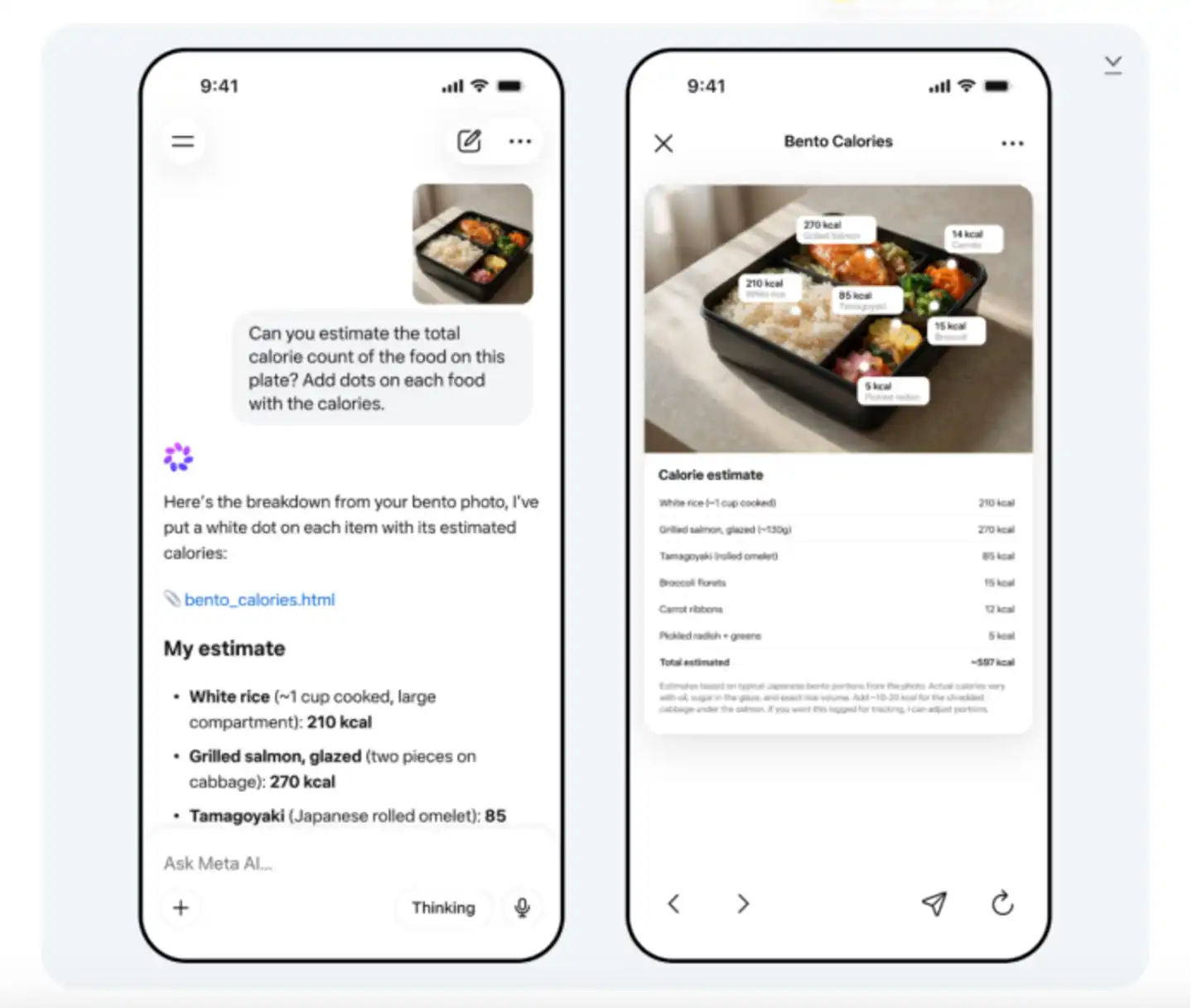
Unlike previous versions that "stitched" vision and text together, Muse Spark was rebuilt from the ground up, integrating visual information into its internal logic. This architectural shift enables a "visual chain of thought," allowing the model to annotate dynamic environments—for example, identifying components of a complex coffee machine or correcting a user's yoga posture through side-by-side video analysis.

However, the most important technical leap is the new "Contemplating" mode.

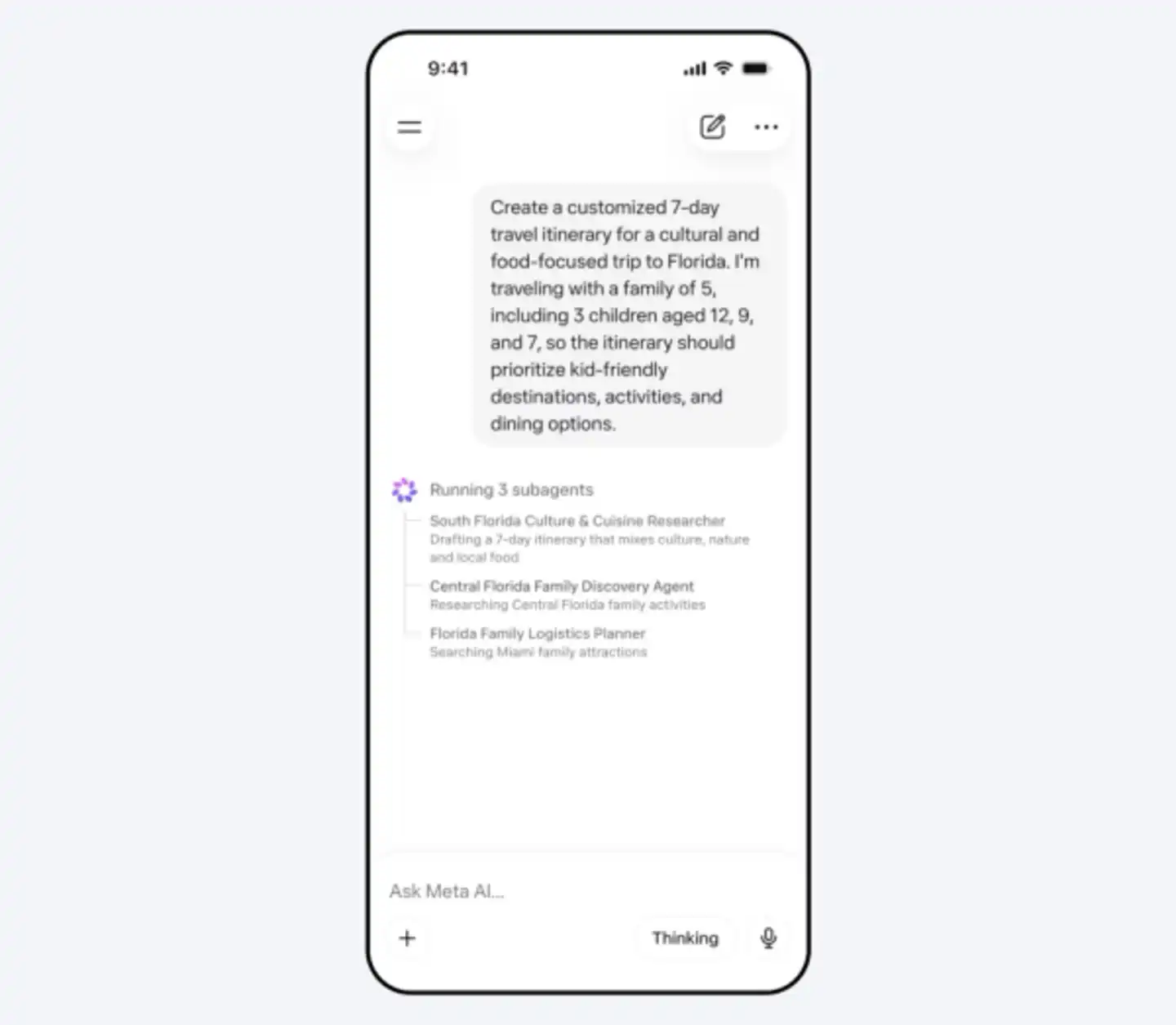
Meta claims that this feature coordinates multiple sub-agents for parallel reasoning, enabling Meta to compete with extreme reasoning models like Google's Gemini Deep Think and OpenAI's GPT-5.4 Pro.

In terms of single-model test results:

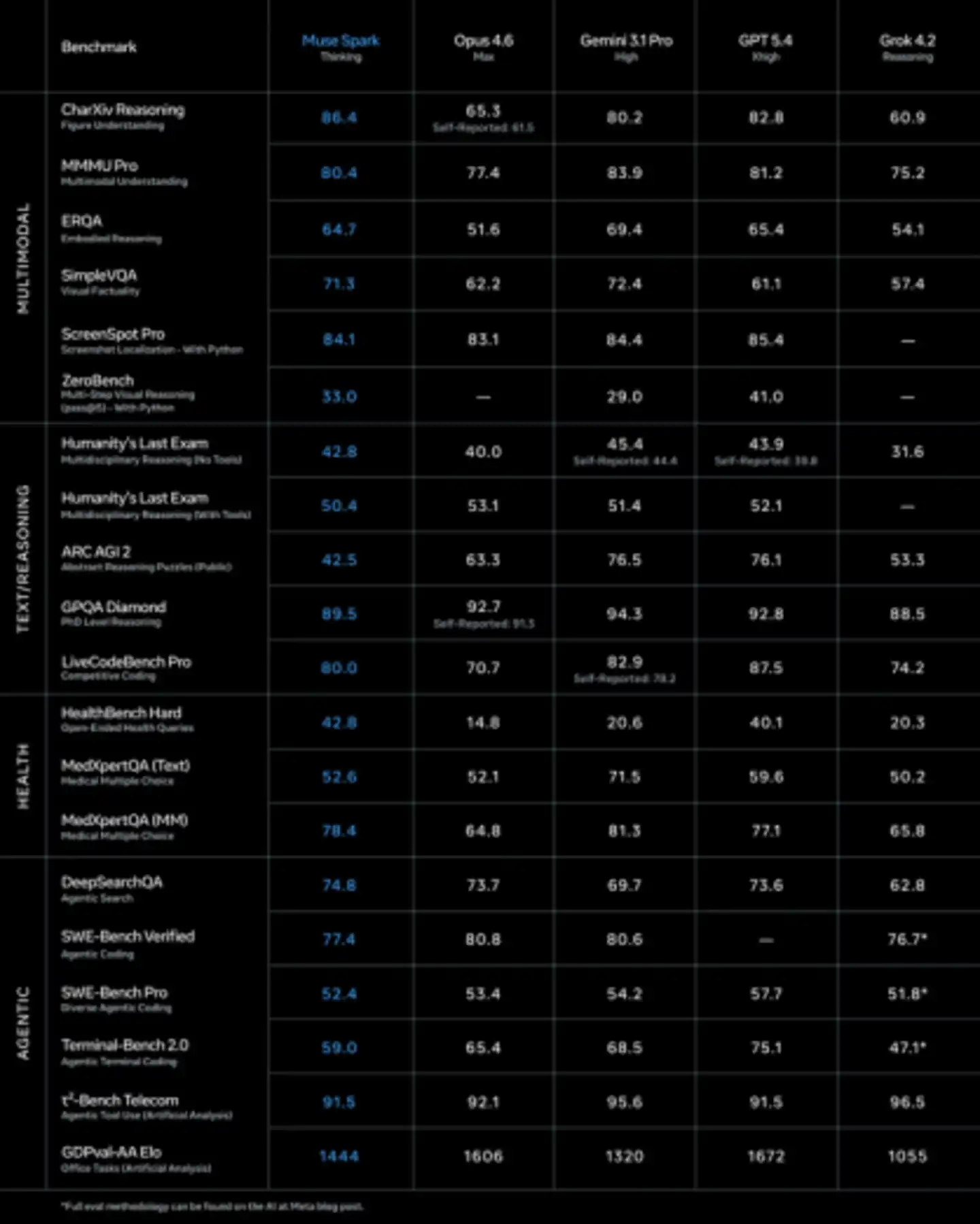
. PhD-level scientific reasoning (GPQA Diamond): Muse Spark achieved an accuracy of 89.5%, which is quite strong but still slightly behind Gemini 3.1 Pro (94.3%), GPT-5.4 (92.8%), and Claude Opus 4.6 (92.7%).

. Chart and visual understanding (CharXiv Reasoning, in Contemplating mode): Scored 86.4, significantly outperforming competitors in this multimodal visual reasoning task—surpassing Gemini 3.1 Pro (80.2), GPT-5.4 (82.8), and Claude Opus 4.6 (65.3). Visual understanding and chart reasoning are among Muse Spark's standout strengths.

. Hard medical reasoning (HealthBench Hard): Scored 42.8%, significantly leading all major competitors, including GPT-5.4 (40.1%), Gemini 3.1 Pro (20.6%), and Claude Opus 4.6 (14.8%). Meta stated that this is thanks to targeted training in collaboration with over 1,000 doctors. Medical-related capabilities are one of its highlights.

. Software engineering and coding (SWE-Bench Verified): Scored 77.4%, behind Claude Opus 4.6 (80.8%) and Gemini 3.1 Pro (80.6%). Meta itself admitted that there is still a gap in long-term, multi-step autonomous tasks (agentic tasks) and complex coding workflows, requiring continued investment.

. Multimodal multidisciplinary understanding (MMMU Pro): Scored approximately 80.4–80.5%, second only to Gemini 3.1 Pro (83.9%), ranking second in visual multimodal tasks.

Overall, Muse Spark excels in visual multimodal reasoning, medical fields, and efficient reasoning, making it particularly suitable for Meta's own social, content, and health ecosystems. However, it still has room for improvement in pure coding and long-chain autonomous tasks.

02 The "Avocado" Delayed Multiple Times

An interesting side note occurred on X.

As Meta's current AI leader, Wang Tao (Alexandr Wang) posted several messages on X promoting the new model.

At this point, someone pointed out that the benchmark chart provided was too misleading, "almost criminal." In this chart, Muse Spark's scores were placed in the first column and all highlighted in a prominent color. At first glance, it seemed to be leading across the board, but upon closer inspection, some scores were actually lower.

Playing tricks with charts is not new; OpenAI has been criticized for this multiple times before.

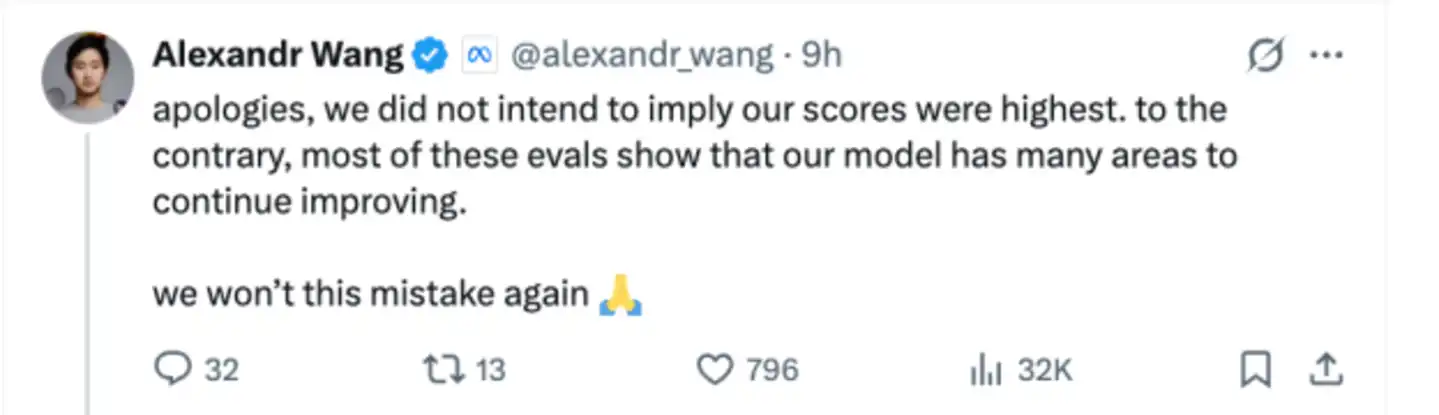
Interestingly, Wang Tao chose to immediately "apologize" in response to the criticism:

"Sorry, we did not mean to imply that our scores are the highest. On the contrary, most evaluation results show that our model still has much room for improvement. We will not make the same mistake again."

It is not hard to see that Meta does not intend for Muse Spark to achieve complete dominance but rather to return to the competition in AI.

From various signs, the Muse series is likely the project internally code-named "Avocado."

Avocado has been delayed for too long, and Meta has now adopted a "small first, then big" strategy. Meta emphasized in its official blog post that Spark focuses on being fast and small, and this is just the beginning:

"Our models are developing as expected. Muse Spark is an early data point in our development journey, and we are working on larger-scale models."

This is different from the AI industry's (especially the top players') habit of "making a splash" or "shocking," but Meta really doesn't have time to take it slow.

Early last year, after Meta released the Llama 4 series, the model's performance did not meet expectations (especially the insufficient performance of the Behemoth large model), and further open-source development of the Llama series was paused.

By last summer, Meta invested $14.3 billion in Scale AI (acquiring a 49% stake) and directly recruited Scale AI founder and CEO, 28-year-old Wang Tao (Alexandr Wang), as Chief AI Officer, formally establishing the Meta Superintelligence Labs (MSL).

At the same time, Meta engaged in疯狂挖角 (frenzy recruitment), recruiting dozens of top researchers from OpenAI, Google, and other companies with high salaries, some offers reaching millions to hundreds of millions of dollars.

In terms of costs, Meta's full-year AI-related capital expenditure in 2025 reached $72.22 billion; the financial guidance in January 2026 indicated that this number would significantly increase to $115–135 billion, almost doubling, mainly for MSL's model training and data center expansion.

Over the past ten months, Meta, as well as Zuckerberg and Meta's AI head Wang Tao, have been under tremendous pressure. People were eager to see what dish would be served after Wang Tao joined and Meta重组 (reorganized).

At least from the market's initial feedback, Meta's strategy of abandoning "holding back for a big move" and instead serving a small dish first is working. Meta's stock price surged nearly 9% that day, marking the largest single-day gain since January this year. As of the close, Meta rose 6.5%.

A noteworthy piece of information is that the outside world一直认为 (has always believed) that "Avocado" would completely转向闭源 (shift to closed-source), but Meta did not close the door this time. In the future, Meta may adopt a hybrid strategy of open-source and closed-source并行 (parallel), keeping flagship models and exclusive technologies internal while maintaining the open-source availability of fresh models to the broad developer community.

Meta has finally served "Avocado" on the table, but this is far from the end. For Wang Tao and Zuckerberg, Muse Spark is more like a starting gun. The future unfolds depends on whether the promise of "getting stronger and stronger" can be fulfilled.

Связанные с этим вопросы

QWhat is the name of the first model in the Muse series released by Meta, and what is its key design philosophy?

AThe first model in the Muse series is called Muse Spark. Its key design philosophy is to be 'small and fast'.

QWhich specific areas does the Muse Spark model excel in, according to the benchmark results mentioned in the article?

AAccording to the benchmarks, Muse Spark excels in visual and multimodal reasoning (e.g., CharXiv Reasoning), medical hard reasoning (HealthBench Hard), and efficient inference.

QHow did the market react to the announcement of the Muse Spark model?

AThe market reacted positively. Meta's stock price rose by as much as 9% during the day and closed up 6.5%, marking its largest single-day gain since January of that year.

QWho is Alexandr Wang, and what role does he play at Meta in relation to this new model?

AAlexandr Wang is the Chief AI Officer at Meta. He leads the Meta Superintelligence Labs (MSL) and was instrumental in the development of the Muse Spark model, which is the first major release since he joined the company.

QWhat was the internal code name for the Muse project, and what strategy did Meta adopt for its release?

AThe internal code name for the project was 'Avocado'. Meta adopted a 'small first, then large' strategy, releasing the smaller, faster Muse Spark first instead of waiting to release a much larger model.

Похожее

Vitalik: Building Index-Tracking Assets Based on Options Rather Than Debt

Vitalik Buterin proposes constructing index-tracking assets using synthetic options rather than debt-based mechanisms. The core problem is enabling exposure to a price index (T, e.g., USD/ETH) in a trust-minimized environment where only ETH is a trustless asset, relying solely on a decentralized oracle. Traditional approaches, like algorithmic stablecoins, use debt positions and require real-time, binding oracles for liquidations, which are difficult to secure. This article suggests a paradigm shift: eliminating liquidation and using options as the fundamental building block, requiring only a "slow" oracle. The design defines two synthetic assets, P and N, with parameters for the index T, a strike price S, and an expiry M. At any time, 1 ETH can be split to create a (P, N) pair or merged back. At expiry M, the oracle determines T's value x. P receives min(1, S/x) ETH, and N receives max(0, 1 - S/x) ETH. This structure inherently avoids insolvency risk (P+N=1) and can share an oracle with prediction markets. To gain stable exposure to T (e.g., USD), a user would hold deeply "in-the-money" P options (with S significantly below the current price) and periodically "roll" them to lower strikes as the price approaches the current strike, rebalancing their portfolio. This transfers the decision of *when* to act from a protocol-enforced liquidation (requiring a real-time oracle) to the user or an automated wrapper. Users can manage MEV risk and oracle dependency by choosing their rebalancing timing and data sources. A key trade-off is accepting some quadratic drift (deviation from perfect peg), estimated at 1-4% annualized volatility. Buterin argues this cost is reasonable compared to fiat currency volatility or equilibrium shifts in other stablecoins. The success of this model depends heavily on designing low-slippage market mechanisms for the rebalancing process, leveraging users' low time preference to execute trades patiently.

marsbit41 мин. назад

Vitalik: Building Index-Tracking Assets Based on Options Rather Than Debt

marsbit41 мин. назад

"Water Scarcity": The Hidden Fatal Flaw of AI Infrastructure

“Water Scarcity: The Hidden Vulnerability of AI Infrastructure” In June 2026, SpaceX revised its IPO prospectus to highlight a core resource constraint alongside power and processors: water. This move signals a pivotal shift where water scarcity has transformed from an operational cost to a major, uncontrollable investment risk, directly threatening AI data center expansion. The scale of the problem is immense. U.S. data centers consumed an estimated 17 billion gallons of water for direct cooling in 2023, with indirect water use for power generation exceeding 211 billion gallons. Giants like Google alone use billions of gallons annually, with single sites consuming volumes equivalent to a medium-sized city. This water is largely “consumptive,” evaporated into the atmosphere and lost. This massive demand is colliding with scarcity. Tech companies are building “water tigers” in arid regions, sparking community protests in places like Mexico and Arizona, where data centers can legally use millions of gallons daily—enough for tens of thousands of residents. These conflicts are not about illegality, but about a mismatch between historic water allocation frameworks and new, colossal demand. The consequences are real. Community opposition, largely centered on water, has reportedly stalled or canceled $64 billion in U.S. data center projects over two years. Simultaneously, investors are pressuring companies for greater water footprint transparency, viewing it as a financial risk, not just an ESG metric. Technological solutions like air or liquid cooling involve trade-offs between water and electricity use, with final choices dictated by local constraints. The irony is stark: while industry leaders envision AI as a utility “like water,” its physical infrastructure is straining real-world water supplies. The race for AI supremacy may ultimately be governed not by the fastest chip, but by the slowest water meter.

marsbit1 ч. назад

"Water Scarcity": The Hidden Fatal Flaw of AI Infrastructure

marsbit1 ч. назад

Global Card Issuance Enters a Compliance-Driven Era: WasabiCard is Building the Next-Generation Payment Infrastructure

Global card issuance is entering a compliance-driven era, with WasabiCard building next-generation payment infrastructure. The platform asserts that as stablecoins increasingly enter cross-border payments, corporate settlements, and global commerce, the industry is shifting focus from "availability" and "growth-driven" models to long-term, compliant operation under global frameworks. Competition will center on sustainable compliance and global infrastructure capabilities. Stablecoins are evolving from on-chain assets into key payment tools in global business, with card issuance acting as critical infrastructure connecting digital assets to traditional payment networks like Visa and Mastercard. This expansion has revealed structural issues, including cross-regional issuance, BIN resource management, and insufficient AML and risk controls. In response, the industry is moving away from reliance on "grey efficiency" towards prioritizing compliance, risk management, and long-term operational stability. WasabiCard outlines its strategy: collaborating with licensed principals and local partners for localized operations, building robust KYC/AML systems, strictly separating commercial and consumer BIN usage, and enhancing global issuance, payment, and cross-border fund flow infrastructure. The goal is to build stable, scalable payment infrastructure amid evolving global regulations, shifting industry competition from scale to infrastructure capability. As stablecoins integrate further with global commerce, payment infrastructure will become a fundamental, embedded component of internet business. WasabiCard will continue to develop capabilities in global card issuance, stablecoin payments, cross-border fund flows, and API-driven financial workflows.

marsbit1 ч. назад

Global Card Issuance Enters a Compliance-Driven Era: WasabiCard is Building the Next-Generation Payment Infrastructure

marsbit1 ч. назад

Торговля

Спот
Фьючерсы

Популярные статьи

Как купить S

Добро пожаловать на HTX.com! Мы сделали приобретение Sonic (S) простым и удобным. Следуйте нашему пошаговому руководству и отправляйтесь в свое крипто-путешествие.Шаг 1: Создайте аккаунт на HTXИспользуйте свой адрес электронной почты или номер телефона, чтобы зарегистрироваться и бесплатно создать аккаунт на HTX. Пройдите удобную регистрацию и откройте для себя весь функционал.Создать аккаунтШаг 2: Перейдите в Купить криптовалюту и выберите свой способ оплатыКредитная/Дебетовая Карта: Используйте свою карту Visa или Mastercard для мгновенной покупки Sonic (S).Баланс: Используйте средства с баланса вашего аккаунта HTX для простой торговли.Третьи Лица: Мы добавили популярные способы оплаты, такие как Google Pay и Apple Pay, для повышения удобства.P2P: Торгуйте напрямую с другими пользователями на HTX.Внебиржевая Торговля (OTC): Мы предлагаем индивидуальные услуги и конкурентоспособные обменные курсы для трейдеров.Шаг 3: Хранение Sonic (S)После приобретения вами Sonic (S) храните их в своем аккаунте на HTX. В качестве альтернативы вы можете отправить их куда-либо с помощью перевода в блокчейне или использовать для торговли с другими криптовалютами.Шаг 4: Торговля Sonic (S)С легкостью торгуйте Sonic (S) на спотовом рынке HTX. Просто зайдите в свой аккаунт, выберите торговую пару, совершайте сделки и следите за ними в режиме реального времени. Мы предлагаем удобный интерфейс как для начинающих, так и для опытных трейдеров.

1.4k просмотров всегоОпубликовано 2025.01.15Обновлено 2026.06.02

Как купить S

Sonic: Обновления под руководством Андре Кронье – новая звезда Layer-1 на фоне спада рынка

Он решает проблемы масштабируемости, совместимости между блокчейнами и стимулов для разработчиков с помощью технологических инноваций.

2.3k просмотров всегоОпубликовано 2025.04.09Обновлено 2025.04.09

Sonic: Обновления под руководством Андре Кронье – новая звезда Layer-1 на фоне спада рынка

HTX Learn: Пройдите обучение по "Sonic" и разделите 1000 USDT

HTX Learn — ваш проводник в мир перспективных проектов, и мы запускаем специальное мероприятие "Учитесь и Зарабатывайте", посвящённое этим проектам. Наше новое направление .

1.8k просмотров всегоОпубликовано 2025.04.10Обновлено 2025.04.10

HTX Learn: Пройдите обучение по "Sonic" и разделите 1000 USDT

Обсуждения

Добро пожаловать в Сообщество HTX. Здесь вы сможете быть в курсе последних новостей о развитии платформы и получить доступ к профессиональной аналитической информации о рынке. Мнения пользователей о цене на S (S) представлены ниже.

活动图片