Wall Street Capital Enters ARC, Circle Sparks a System-Level Competition for Stablecoins

marsbitОпубликовано 2026-05-13Обновлено 2026-05-13

Введение

Wall Street Capital Enters the ARC Arena as Circle Launches a System-Level Battle for Stablecoin Dominance On May 11, Circle successfully raised $222 million in a pre-sale funding round for its new blockchain and native token, ARC, giving the network a fully diluted valuation of $3 billion. The investor lineup, featuring Wall Street giants like BlackRock and Intercontinental Exchange alongside top-tier venture capital firms such as a16z and ARK Invest, signaled a collective strategic bet on future financial infrastructure. This move marks Circle's significant evolution from a stablecoin issuer (notably USDC) to a designer of financial systems. While USDC operates on external blockchains like Ethereum, making Circle dependent on their performance, ARC aims to create a dedicated infrastructure for the circulation, payment, and clearing of stablecoins. This would integrate currency issuance and circulation into one system, potentially shifting Circle's business model from asset management to infrastructure provision. The convergence of traditional finance and crypto-native capital in this funding round underscores a broader industry shift: stablecoins are transitioning from being mere trading tools to becoming core components of financial infrastructure. By controlling both the issuance (via USDC) and the流通 pathway (via ARC), Circle could establish a closed-loop system from issuance to settlement. If successful, this infrastructure could optimize costs, lower barriers for in...

Author: Winnie, CryptoPulse Labs

On May 11, Circle successfully raised $222 million in a pre-sale funding round for its new blockchain and native token ARC. Following the completion of the funding, the fully diluted valuation of the ARC network reached $3 billion.

While this figure itself is not staggering, what truly captured market attention was the investor lineup behind it. From the world's top venture capital firm a16z to Wall Street giants like BlackRock and Intercontinental Exchange, and further to crypto and tech capital like ARK Invest and General Catalyst, the consortium nearly covers key institutions across the global financial system.

This makes ARC more than just a blockchain project funding event; it resembles a collective bet on the future financial infrastructure. It also marks a new stage where the stablecoin industry is shifting from product competition to system competition.

I. Circle's Transformation: From Stablecoin Issuer to Financial System Architect

Looking back at Circle's development path, its core identity has long been very clear: it is a stablecoin issuing company, with USDC as its flagship product.
The logic of USDC is not complicated. Its core is to establish a credible digital dollar, providing a relatively stable medium of exchange in the crypto market through transparent reserves, a compliant structure, and a USD peg mechanism.

At this stage, Circle functioned more like an on-chain bank, responsible for issuing, custody, and maintaining user trust in the digital dollar.

However, the problem lies in the fact that this model is inherently dependent. Although USDC is important, it operates on external public chains like Ethereum and Solana. The performance, cost, and congestion of these chains directly impact the user experience of USDC. In other words, Circle controls the issuance of money but not the system through which it circulates.

The emergence of ARC is precisely a response to this structural problem.

From its design logic, ARC is not intended to become another general-purpose public chain, but rather a highly verticalized on-chain infrastructure. Its core objective is to specifically serve the circulation, payment, and settlement system for stablecoins.

In other words, if USDC is the digital dollar, then ARC aims to build the financial highway on which that digital dollar runs. In this system, a stablecoin is no longer just an asset flowing on a chain. It is integrated into a unified settlement network, forming a complete closed loop from issuance to transfer to settlement.

The key significance of this design is that, for the first time, Circle is attempting to integrate currency issuance and currency circulation within the same system, thereby breaking free from dependence on external public chains. At a deeper level, this transformation is essentially a restructuring of the business model.

In the past, Circle relied primarily on interest income from reserve assets, essentially operating as an asset management-style stablecoin company. If ARC successfully operates, it will have the opportunity to shift towards an infrastructure fee model, similar to a payment network or settlement system provider.

This suggests that Circle's role may evolve from issuing dollars to defining how dollars flow in the digital world. The significance of this change is not merely a product upgrade but a leap from the application layer to the protocol layer.

II. Top Investors Gather: A Mutual Embrace of Traditional Finance and Crypto Capital

The primary reason this funding round for ARC garnered widespread attention is not the amount raised, but the signal conveyed by the investor structure itself.

Leading this round is the renowned venture capital firm Andreessen Horowitz (a16z). Its $75 million investment not only provides financial support but, more importantly, confirms ARC's positioning as Web3 infrastructure.

In a16z's investment logic, ARC is clearly not an ordinary application project but appears more like a component of the future internet financial system.

However, what truly shocked the market was the collective entry of traditional financial institutions. Traditional financial giants, including BlackRock, Intercontinental Exchange (parent company of the NYSE), Apollo Funds, Standard Chartered Ventures, SBI Group, and Janus Henderson Investors, participated in various forms.

The commonality among these institutions is very clear: they essentially control or are deeply involved in the global flow of funds and settlement systems.

Simultaneously, crypto-native capital also participated, including institutions like ARK Invest, General Catalyst, Haun Ventures, and Bullish. This structure is quite rare because it signifies that two financial systems, long separate in the past, are reaching a consensus around a single infrastructure project.

If the logic of crypto investment over the past decade has been to find high-growth assets, then this round of funding for ARC is more like searching for the gateway to the future financial system.

Venture capital is betting on technological evolution, Wall Street is betting on settlement efficiency, crypto capital is betting on ecosystem dominance, and Circle happens to stand at the intersection of these three forces.

This kind of simultaneous betting by multiple parties is uncommon in financial history. It resembles more of a system-level alignment in advance: the future of finance may no longer be a fragmented system but may gradually converge towards a unified on-chain settlement layer.

III. From Trading Tool to Financial Infrastructure Reconstruction: Stablecoins Enter a New Era of Infrastructure

ARC's current fully diluted valuation of $3 billion, viewed in isolation, is just a funding figure. But placed within the industry structure, it actually represents a deeper shift: stablecoins are evolving from trading tools into the core layer of financial infrastructure.

In the past, discussions about blockchain focused more on public chain performance, DeFi ecosystems, or exchange liquidity. However, as stablecoins gradually become the unit of account for the on-chain economy, the entire competitive logic is changing.
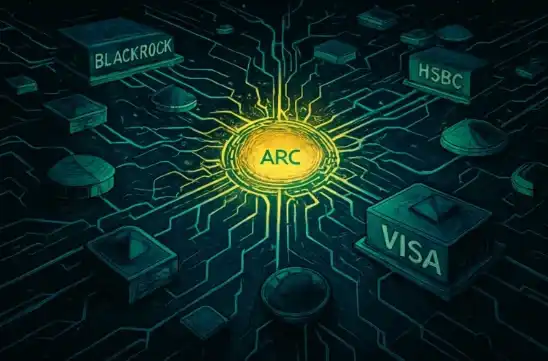
Whoever controls the circulation path of stablecoins holds the key gateway to on-chain finance.

Against this backdrop, Circle's strategy becomes very clear. First, solve the trust problem with USDC; then, solve the circulation problem with ARC; finally, form a complete closed-loop system from issuance to settlement.

If this structure is established, then Circle will no longer be just a stablecoin company but may evolve into an infrastructure operator for the on-chain financial system.

In terms of industry impact, this model could bring about changes at three levels. First, cost structure optimization: cross-chain transfers and settlement of stablecoins will be processed within a unified system, significantly reducing transaction costs and friction. Second, lower barriers for institutional access: banks, funds, and payment companies can directly connect to a unified on-chain system without needing to adapt to multi-chain ecosystems. Third, a strengthening trend of financial standardization: on-chain finance may gradually form foundational standards similar to internet protocol layers, and ARC has the opportunity to become one of the core participants.

More importantly, once such infrastructure is proven successful, its impact will no longer be confined to the crypto industry but may gradually touch the core links of traditional finance, especially cross-border payment and settlement systems.

The existing SWIFT system has operated for decades. If the on-chain stablecoin system establishes advantages in efficiency and cost, then the reconstruction of financial infrastructure is no longer a theoretical question but a matter of time.

Conclusion

The $222 million funding event for ARC is, in essence, not just a simple project funding story but a staged signal of financial system evolution.

When capital from different systems like BlackRock, Intercontinental Exchange, and ARK Invest simultaneously bets on the same chain, it indicates that the market has already begun to acknowledge a trend: stablecoins are no longer just trading tools but are becoming one of the candidate standards for global financial infrastructure.

What's truly worth watching is not how high ARC's valuation can go, but whether it will become one of the default paths for future global capital flow. And if this trend holds true, then today's $222 million may be just a small step in the prologue of the entire financial system's reconstruction.


Связанные с этим вопросы

QWhat is the key strategic shift that Circle's launch of the ARC network represents, according to the article?

AThe launch of ARC represents Circle's strategic shift from being solely a stablecoin issuer (of USDC) to becoming a financial system designer. It marks a transition from an application layer company dependent on external public chains to a protocol layer infrastructure provider, aiming to integrate currency issuance and circulation into one unified, closed-loop system.

QWhy does the article consider the ARC funding round significant beyond the $222 million amount raised?

AThe significance lies in the composition of the investor consortium. It includes a rare convergence of top traditional financial giants (like BlackRock, Intercontinental Exchange), elite venture capital (a16z), and major crypto-native funds (ARK Invest, General Catalyst). This signals a collective bet by key players from different financial spheres on a shared future financial infrastructure, indicating a system-level alignment.

QHow does the ARC network aim to change the fundamental business model of Circle, as described in the article?

AARC aims to shift Circle's business model from reliance on interest income from reserve assets (an asset management model) to an infrastructure fee model. By controlling the dedicated network for stablecoin flow and settlement, Circle could become a payment network or clearing system provider, generating revenue from infrastructure usage.

QWhat are the three potential industry-wide impacts the article suggests ARC's model could bring about?

A1. Cost structure optimization: Lowering transaction costs and friction by unifying cross-chain transfers and settlements within one system. 2. Lowering institutional access barriers: Banks and payment companies could directly connect to a single on-chain system instead of adapting to multiple chains. 3. Strengthening financial standardization: Potentially establishing core foundational standards for on-chain finance, similar to internet protocols, with ARC as a key participant.

QWhat broader historical financial system does the article suggest ARC and stablecoins could potentially challenge or impact in the long term?

AThe article suggests that if successful and efficient, the on-chain stablecoin system, with infrastructures like ARC, could potentially challenge or impact the core of traditional cross-border payment and settlement systems, specifically referencing the decades-old SWIFT (Society for Worldwide Interbank Financial Telecommunication) system.

Похожее

Outpoll Review: A Prediction Market Platform Built for Active Traders

Outpoll Review: A Prediction Market Platform Built for Active Traders In recent years, prediction markets have grown from a niche sector to a mainstream arena, attracting billions in trading volume and institutional capital. However, the user experience and tools for traders have not kept pace. Outpoll, a new global prediction market platform, aims to fill this gap by providing enhanced trading infrastructure for active and professional traders. Built on standard prediction market principles, Outpoll allows users to trade on the outcome of specific events. It uses fully collateralized contracts with USDC settlement, charges a competitive 0.1% fee per trade, and provides clear settlement rules upfront to minimize disputes. A key focus for Outpoll is its professional-grade trading tools. The platform supports limit and market orders, as well as take-profit and stop-loss orders for open positions—features uncommon in prediction markets. For automated trading, Outpoll offers comprehensive REST and WebSocket APIs, enabling portfolio management, price arbitrage, and integration with existing tools. The platform also features a creator-led market model, where approved experts and community leaders can create and manage markets for niche topics under platform supervision. Its integrated interface combines news feeds directly with trading functions, allowing users to monitor events and manage positions seamlessly. Outpoll launched with a native Android app (available on Google Play) and plans an iOS version later this year. In summary, Outpoll distinguishes itself with trader-focused tools, practical APIs, transparent and collateralized markets, integrated news, and an expanding creator program. For active traders, its advanced order types and API access alone make it a platform worth watching. Outpoll is now globally accessible via outpoll.com and Google Play.

marsbit7 мин. назад

Outpoll Review: A Prediction Market Platform Built for Active Traders

marsbit7 мин. назад

Bitwise: Crypto Becomes a Contrarian Investment, Three Logics to Understand the Current Market

**Summary** Matt Hougan, Bitwise's CIO, analyzes the current crypto market through three key lenses, arguing it has shifted from a momentum-driven to a contrarian investment. **1) Crypto Becomes a Contrarian Play:** The market is weak, with major assets like Bitcoin and Ethereum down significantly. Capital has moved to hot sectors like AI, leaving crypto as an "unloved" asset class. This transforms crypto investing from trend-following to a test of patience and fundamental analysis. Investors now favor projects with solid fundamentals (e.g., Hyperliquid) over speculative ones. **2) Regulatory Overhang:** The uncertain fate of the U.S. CLARITY Act, a major crypto regulatory framework, is a key headwind. With its passage in 2024 seen as far from guaranteed (estimates range from 30-55%), institutional capital remains on the sidelines, choosing less risky alternatives like AI stocks. The market needs clarity—whether the bill passes or fails—more than any specific outcome to move decisively. **3) Capital Rotates to New Fundamentals:** This cycle differs from past bear markets where money fled to Bitcoin. Now, capital seeks smaller assets with strong use cases. While major cryptos fell in May 2024, tokens like Hyperliquid (+72%), Zcash (+50%), and XLM (+44%) rallied on their specific fundamentals. This rotation confirms the new contrarian, fundamentals-driven logic and signals the bear market may be in its later stages. **Conclusion:** Short-term pressure persists due to regulatory uncertainty and competition from AI narratives. Investing in crypto now requires a contrarian mindset—acting against the crowd and focusing on fundamental value. Patience and targeting high-quality projects based on their merits are essential for capturing long-term gains.

marsbit49 мин. назад

Bitwise: Crypto Becomes a Contrarian Investment, Three Logics to Understand the Current Market

marsbit49 мин. назад

ChatGPT Might Be Disappearing Soon

OpenAI announced at its "Intelligence at Work" event that its coding assistant, Codex, will be fully integrated into the ChatGPT app within weeks. This move marks a strategic shift from a conversational AI (Chat) towards a unified "agentic" platform capable of execution. Codex, originally launched to compete with Anthropic's Claude Code, has grown rapidly to 5 million weekly active users, with 20% being non-developers like analysts and designers. Its enterprise revenue now constitutes 40% of OpenAI's total. The integration is the first step in creating a super-app combining ChatGPT (interface), Codex (execution engine), and the Atlas browser (web access). OpenAI also unveiled new Codex features: specialized Agent plugins for six professional roles, an "Annotations" tool for direct document editing, and a "Sites" function to turn work into shareable web apps. Internally, this reflects a power shift; the Codex team now leads core product strategy. While the ChatGPT brand remains for its vast user base, the platform's future is focused on autonomous agents that perform tasks, not just chat. The article notes that competition with Claude Code pushed OpenAI's development, with Codex competing on cost-effectiveness and accessibility rather than raw coding quality. It concludes that the essence of "ChatGPT" is evolving from a chatbot into an AI agent platform, with the name potentially becoming a legacy symbol of its original function.

marsbit1 ч. назад

ChatGPT Might Be Disappearing Soon

marsbit1 ч. назад

WWDC26 Ultimate Preview: The All-New Siri is the Main Course, iOS 27 is Another Year of Refinements

Apple has confirmed WWDC26 will begin on June 8, with the keynote at 10 AM PT (1 AM Beijing Time, June 9). This year's focus is expected to shift significantly from routine OS updates to Apple's progress in AI, particularly a major overhaul of Siri. Reports indicate the highlight will be a new Siri, reportedly powered by Google's Gemini technology. This upgraded assistant is expected to appear as a lightweight bubble from the Dynamic Island and be accessible via a unified "Search or Ask" system-wide entry point. It aims to deeply integrate with iOS 27, iPadOS 27, and macOS 27, accessing personal data like messages, photos, and documents, with a potential standalone Siri app also in development. For iOS 27, leaks suggest incremental improvements rather than major redesigns. Key updates may include a redesigned, more customizable Camera app, enhanced photo editing tools within the Photos app, and potential early system optimizations for a future foldable iPhone. The update is also rumored to prioritize bug fixes, stability, and performance optimization. iPadOS 27 is anticipated to focus on improving productivity features like window management, file systems, and external display support to better utilize the iPad's hardware. macOS 27 is seen as a core platform for Apple Intelligence, likely receiving an optimized Siri, new AI features, and continued refinement of the "Liquid Glass" design language. Notably, macOS 27 may finally drop support for Intel-based Macs. The overarching theme for WWDC26 is whether Apple can effectively integrate AI across its ecosystem. The success of the new Siri and Apple Intelligence will be judged on their ability to move beyond standalone features and become a cohesive, context-aware system layer that understands user workflows across iPhone, iPad, Mac, and other devices, while maintaining Apple's emphasis on privacy and stability. The conference represents Apple's critical attempt to catch up and redefine the AI assistant experience after a perceived slow start in the generative AI era.

marsbit1 ч. назад

WWDC26 Ultimate Preview: The All-New Siri is the Main Course, iOS 27 is Another Year of Refinements

marsbit1 ч. назад

Торговля

Спот
Фьючерсы
活动图片