Vitalik Buterin Argues Ethereum’s Biggest Use Case Is Data Availability

bitcoinistОпубликовано 2026-03-13Обновлено 2026-03-13

Введение

Vitalik Buterin argues that Ethereum's primary value is not smart contracts or payments, but its role as a censorship-resistant "public bulletin board" for data availability. This foundational layer is critical for cryptographic systems like secure voting and version control. Buterin highlights scaling solutions like PeerDAS, which significantly boost data capacity, positioning Ethereum as key infrastructure for a broader, privacy-preserving internet. While payments and smart contracts remain important, they are secondary, often serving anti-spam or security functions. He concludes that Ethereum is best understood as "global shared memory" and that current low fees and improved tooling make this vision more achievable than ever.

Ethereum co-founder Vitalik Buterin says the network’s clearest value proposition may not be smart contracts or payments, but something more foundational: acting as a censorship-resistant public data layer. In a post reflecting on conversations at Real World Crypto and related events, Buterin argued that stepping outside “blockchain baggage” makes ETH’s core utility easier to see.

“I was recently at Real World Crypto (that’s crypto as in cryptography) and the associated side events, and one thing that struck me was that it was a clarifying experience in terms of understanding what blockchains are for,” Buterin wrote. “We blockchain people (myself included) often have a tendency to start off from the perspective that we are Ethereum, and therefore we need to go around and find use cases for Ethereum.”

Ethereum’s Core Value Starts With A ‘Public Bulletin Board’

His point was less about defending Ethereum as a brand than re-evaluating it as infrastructure. “For a moment, let us forget that we are ‘the Ethereum community’. Rather, we are maintainers of the Ethereum tool,” he wrote, asking where the network adds value when viewed with “zero attachment to Ethereum specifically.”

The first answer, he said, is “not what you think.” It is “not smart contracts, it’s not even payments,” but what cryptographers call a “public bulletin board”, a publicly readable and writable place to post data blobs. That matters because a range of cryptographic systems, including secure online voting, software and website version control, and certificate revocation, depend on exactly that kind of shared infrastructure.

“This does not require any computation functionality,” Buterin wrote. “In fact, it does not directly require money, though it does indirectly require money, because if you want permissionless anti-spam it has to be economic. The only thing it fundamentally requires is data availability.”

That framing leads directly to Ethereum’s recent scaling work. Buterin highlighted PeerDAS, which he said increased Ethereum’s data availability capacity by 2.3x, with a roadmap to push that another 10x to 100x higher. In his telling, that makes Ethereum increasingly relevant not just for onchain finance, but for a broader class of open, privacy-preserving internet infrastructure.

Payments still matter, but as a secondary layer in the stack. Buterin argued that many systems need value transfer not primarily for commerce, but for anti-spam, sybil resistance, and machine-to-machine coordination. He pointed to Ethereum plus ZK payment channels as a strong design for permissionless APIs, and said ETH can serve as a “natural backstop” for applications that want to resist fake-account abuse without relying on phone numbers or other centralized identity rails.

Smart contracts come after that. Here, Buterin described them as useful for security deposits, for implementing constructs like ZK payment channels, and for managing pointers to “digital objects” tied to socially recognized external entities. Technically, he said, most non-ETH use cases could be handled by treating the chain as a bulletin board and using ZK-SNARKs for computation off-chain. In practice, though, standardizing that model is difficult, and shared execution remains the more interoperable route.

The broader claim is that Ethereum works best when understood as “global shared memory” inside a decentralized software stack. Buterin suggested adoption may still lag that reality because many builders are operating with outdated assumptions from 2020 to 2022, when fees were far higher and scaling looked less mature. Today, he argued, fees are “extremely low,” the roadmap is stronger, and tooling to shield users from fee volatility has improved.

At press time, ETH traded at 2,110.
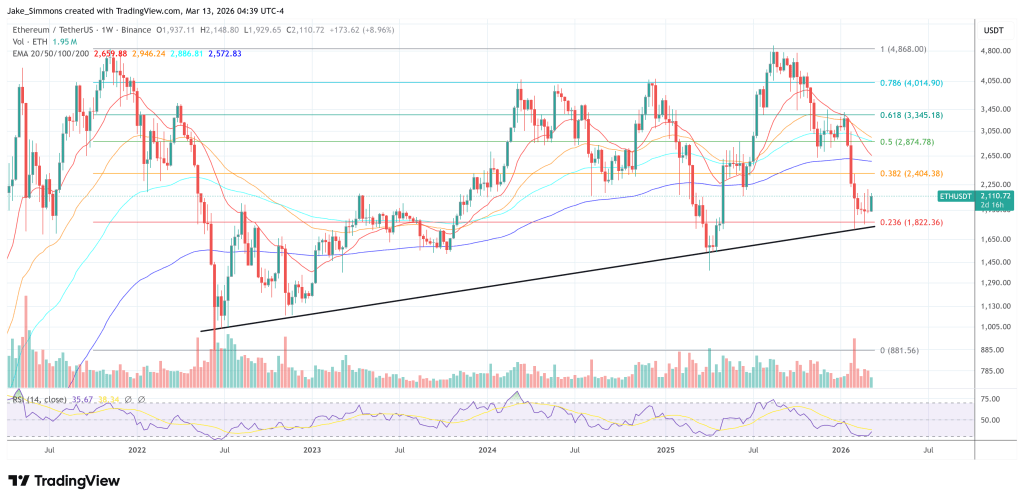
ETH must break the 0.382 Fib, 1-week chart | Source: ETHUSDT on TradingView.com

Связанные с этим вопросы

QWhat does Vitalik Buterin argue is Ethereum's clearest value proposition according to the article?

AVitalik Buterin argues that Ethereum's clearest value proposition is not smart contracts or payments, but acting as a censorship-resistant public data layer, which cryptographers call a 'public bulletin board'.

QWhat specific Ethereum scaling solution did Buterin highlight, and by how much did it increase data availability capacity?

AButerin highlighted PeerDAS, which he said increased Ethereum's data availability capacity by 2.3x, with a roadmap to push that another 10x to 100x higher.

QAccording to Buterin, what is the primary purpose of value transfer (payments) in many systems built on Ethereum?

AButerin argued that many systems need value transfer not primarily for commerce, but for anti-spam, sybil resistance, and machine-to-machine coordination.

QHow does Buterin describe the role of smart contracts in the context of Ethereum's primary use case?

AButerin described smart contracts as useful for security deposits, implementing constructs like ZK payment channels, and managing pointers to 'digital objects', but positioned them as coming after the core data availability function.

QWhat reason does Buterin suggest for why adoption of Ethereum's current capabilities might be lagging?

AButerin suggested adoption may lag because many builders are operating with outdated assumptions from 2020 to 2022, when fees were far higher and scaling looked less mature, despite current low fees and a stronger roadmap.

Похожее

a16z: AI's 'Amnesia', Can Continuous Learning Cure It?

The article "a16z: AI's 'Amnesia' – Can Continual Learning Cure It?" explores the limitations of current large language models (LLMs), which, like the protagonist in the film *Memento*, are trapped in a perpetual present—unable to form new memories after training. While methods like in-context learning (ICL), retrieval-augmented generation (RAG), and external scaffolding (e.g., chat history, prompts) provide temporary solutions, they fail to enable true internalization of new knowledge. The authors argue that compression—the core of learning during training—is halted at deployment, preventing models from generalizing, discovering novel solutions (e.g., mathematical proofs), or handling adversarial scenarios. The piece introduces *continual learning* as a critical research direction to address this, categorizing approaches into three paths: 1. **Context**: Scaling external memory via longer context windows, multi-agent systems, and smarter retrieval. 2. **Modules**: Using pluggable adapters or external memory layers for specialization without full retraining. 3. **Weights**: Enabling parameter updates through sparse training, test-time training, meta-learning, distillation, and reinforcement learning from feedback. Challenges include catastrophic forgetting, safety risks, and auditability, but overcoming these could unlock models that learn iteratively from experience. The conclusion emphasizes that while context-based methods are effective, true breakthroughs require models to compress new information into weights post-deployment, moving from mere retrieval to genuine learning.

marsbit48 мин. назад

a16z: AI's 'Amnesia', Can Continuous Learning Cure It?

marsbit48 мин. назад

Can a Hair Dryer Earn $34,000? Deciphering the Reflexivity Paradox in Prediction Markets

An individual manipulated a weather sensor at Paris Charles de Gaulle Airport with a portable heat source, causing a Polymarket weather market to settle at 22°C and earning $34,000. This incident highlights a fundamental issue in prediction markets: when a market aims to reflect reality, it also incentivizes participants to influence that reality. Prediction markets operate on two layers: platform rules (what outcome counts as a win) and data sources (what actually happened). While most focus on rules, the real vulnerability lies in the data source. If reality is recorded through a specific source, influencing that source directly affects market settlement. The article categorizes markets by their vulnerability: 1. **Single-point physical data sources** (e.g., weather stations): Easily manipulated through physical interference. 2. **Insider information markets** (e.g., MrBeast video details): Insiders like team members use non-public information to trade. Kalshi fined a剪辑师 $20,000 for insider trading. 3. **Actor-manipulated markets** (e.g., Andrew Tate’s tweet counts): The subject of the market can control the outcome. Evidence suggests Tate’sociated accounts coordinated to profit. 4. **Individual-action markets** (e.g., WNBA disruptions): A single person can execute an event to profit from their pre-placed bets. Kalshi and Polymarket handle these issues differently. Kalshi enforces strict KYC, publicly penalizes insider trading, and reports to regulators. Polymarket, with its anonymous wallet-based system, has historically been more permissive, arguing that insider information improves market accuracy. However, it cooperated with authorities in the "Van Dyke case," where a user traded on classified government information. The core paradox is reflexivity: prediction markets are designed to discover truth, but their financial incentives can distort reality. The more valuable a prediction becomes, the more likely participants are to influence the event itself. The market ceases to be a mirror of reality and instead shapes it.

marsbit1 ч. назад

Can a Hair Dryer Earn $34,000? Deciphering the Reflexivity Paradox in Prediction Markets

marsbit1 ч. назад

Торговля

Спот
Фьючерсы

Популярные статьи

Как купить S

Добро пожаловать на HTX.com! Мы сделали приобретение Sonic (S) простым и удобным. Следуйте нашему пошаговому руководству и отправляйтесь в свое крипто-путешествие.Шаг 1: Создайте аккаунт на HTXИспользуйте свой адрес электронной почты или номер телефона, чтобы зарегистрироваться и бесплатно создать аккаунт на HTX. Пройдите удобную регистрацию и откройте для себя весь функционал.Создать аккаунтШаг 2: Перейдите в Купить криптовалюту и выберите свой способ оплатыКредитная/Дебетовая Карта: Используйте свою карту Visa или Mastercard для мгновенной покупки Sonic (S).Баланс: Используйте средства с баланса вашего аккаунта HTX для простой торговли.Третьи Лица: Мы добавили популярные способы оплаты, такие как Google Pay и Apple Pay, для повышения удобства.P2P: Торгуйте напрямую с другими пользователями на HTX.Внебиржевая Торговля (OTC): Мы предлагаем индивидуальные услуги и конкурентоспособные обменные курсы для трейдеров.Шаг 3: Хранение Sonic (S)После приобретения вами Sonic (S) храните их в своем аккаунте на HTX. В качестве альтернативы вы можете отправить их куда-либо с помощью перевода в блокчейне или использовать для торговли с другими криптовалютами.Шаг 4: Торговля Sonic (S)С легкостью торгуйте Sonic (S) на спотовом рынке HTX. Просто зайдите в свой аккаунт, выберите торговую пару, совершайте сделки и следите за ними в режиме реального времени. Мы предлагаем удобный интерфейс как для начинающих, так и для опытных трейдеров.

1.2k просмотров всегоОпубликовано 2025.01.15Обновлено 2025.03.21

Как купить S

Sonic: Обновления под руководством Андре Кронье – новая звезда Layer-1 на фоне спада рынка

Он решает проблемы масштабируемости, совместимости между блокчейнами и стимулов для разработчиков с помощью технологических инноваций.

2.2k просмотров всегоОпубликовано 2025.04.09Обновлено 2025.04.09

Sonic: Обновления под руководством Андре Кронье – новая звезда Layer-1 на фоне спада рынка

HTX Learn: Пройдите обучение по "Sonic" и разделите 1000 USDT

HTX Learn — ваш проводник в мир перспективных проектов, и мы запускаем специальное мероприятие "Учитесь и Зарабатывайте", посвящённое этим проектам. Наше новое направление .

1.8k просмотров всегоОпубликовано 2025.04.10Обновлено 2025.04.10

HTX Learn: Пройдите обучение по "Sonic" и разделите 1000 USDT

Обсуждения

Добро пожаловать в Сообщество HTX. Здесь вы сможете быть в курсе последних новостей о развитии платформы и получить доступ к профессиональной аналитической информации о рынке. Мнения пользователей о цене на S (S) представлены ниже.

活动图片