US Treasury Secretary Urges Congress To Pass Crypto Market Structure Bill This Spring

bitcoinistОпубликовано 2026-02-14Обновлено 2026-02-14

Введение

US Treasury Secretary Scott Bessent has urged Congress to pass the stalled crypto market structure bill, the CLARITY Act, this spring to provide market reassurance amid recent volatility. He noted that some industry opposition has contributed to instability and emphasized the importance of bipartisan cooperation to advance the legislation. Bessent warned that the opportunity could diminish if Democrats gain control of the House in November. Patrick Witt of the Crypto Council also discussed the bill's progress, highlighting that the Senate Agriculture Committee portion has passed, but the Banking Committee's section remains pending. He called for compromise to address issues like stablecoin regulations without derailing the broader bill, which includes key measures on regulatory clarity and developer protections.

The US Secretary of the Treasury has called for the passage of the long-awaited crypto market structure bill this spring to provide reassurance to the industry amid recent market volatility.

Bessent Calls For Crypto Market Structure Bill

On Friday, Treasury Secretary Scott Bessent urged the US lawmakers to pass the stalled crypto market structure bill soon, highlighting the importance of getting the legislation on President Donald Trump’s desk before the end of the spring legislative window.

In a CNBC interview, Bessent affirmed that part of the recent market volatility was “self-induced” due to the reaction of some industry participants to the bill. He affirmed that some digital assets firms have been blocking it, which hasn’t been “good for the overall crypto community.”

Notably, the long-awaited CLARITY Act has been stalled for nearly a month after the Senate Banking Committee published its bill draft. The legislation was heavily criticized by crypto industry leaders, who slammed multiple of its policies, including key restrictions for stablecoin issuers.

The Treasury Secretary considers that passing the bill would “give great comfort” to the market at a time of significant volatility. Moreover, he pointed out that there’s a bipartisan working group trying to advance the legislation, with democrats “that want to work with republicans on getting a market structure bill.”

However, Bessent noted that the chances of getting a deal done could fall apart if Democrats take control of the House of Representatives in November, highlighting the Biden administration’s crackdown on the industry.

“There’s a lot of innovation that goes on adjacent to crypto, the blockchain, and DeFi. So, I think it’s important to get this clarity bill done as soon as possible and on the president’s desk this spring,” he concluded.

‘More Work To Be Done’

Similarly, Patrick Witt, executive director of the US President’s Council of Advisors for Digital Assets, discussed the progress on the crypto market structure bill on Friday.

Speaking with Yahoo Finance, Witt stated, “We are working hard to address the issues that were raised that led to the postponement of that markup and hopefully get that back on the book soon.”

He highlighted that lawmakers were able to pass the Senate Agriculture Committee’s half of the CLARITY Act, which handles the Commodity Futures Trading Commission (CFTC)’s portion of the bill.

The Crypto Council’s executive director outlined that once the Senate Banking Committee’s portion of the bill is passed, the two pieces of legislation will need to be reconciled before a final vote on the Senate floor. “So, more work to be done, but we are a step closer with the passage of the Ag portion of this a couple of weeks ago,” he said.

Discussing who must bend to advance the bill, Witt affirmed that both sides would have to compromise. “It’s unfortunate that this has become such a big issue, because ultimately, this is not the stablecoin bill that was the GENIUS Act,” he said.

“What we’ve encouraged both sides to do is find a middle ground. Let’s use a scalpel heel here to address this narrow issue of idle yield (...). But let’s not take a chainsaw out of this; let’s not let this derail the bill. There is so much goodness in this bill, no matter what your perspective is,” Witt continued.

He listed some of the “excellent measures” proposed in the bill, including the clear line between the SEC and the CFTC, regulatory jurisdiction, and developer protections, which he considers to be “critical to future-proof this industry from a future Gary Gensler or, God forbid, a Secretary of the Treasury Elizabeth Warren.”

Lastly, he shared that the White House might host another meeting between the banking and crypto industry to discuss the payment of stablecoin rewards.

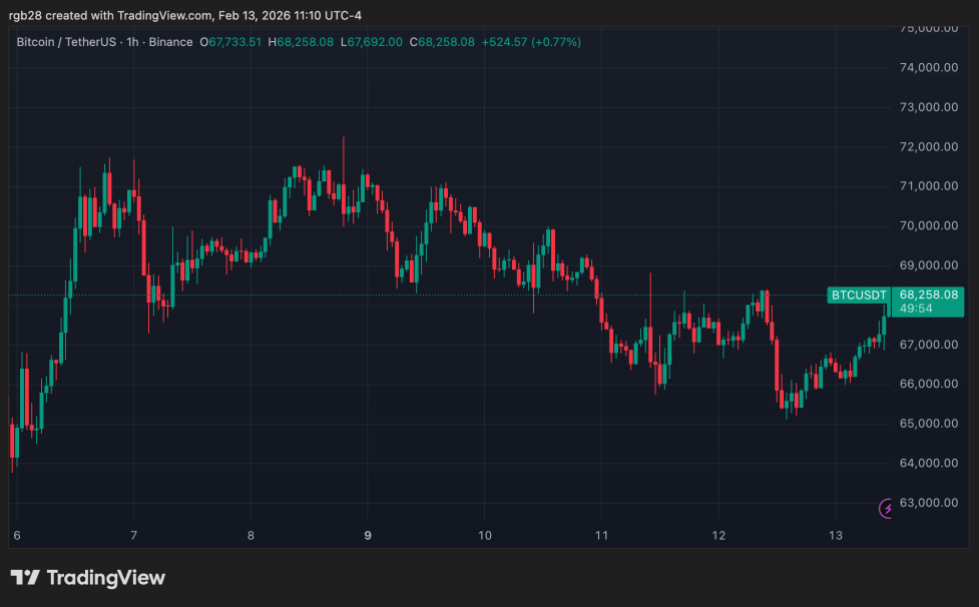
Bitcoin (BTC) trades at $68,258 in the one-week chart. Source: BTCUSDT on TradingView

Связанные с этим вопросы

QWho is urging Congress to pass the crypto market structure bill and when?

AUS Treasury Secretary Scott Bessent is urging Congress to pass the crypto market structure bill this spring.

QWhat is the name of the specific bill that has been stalled in the Senate?

AThe specific bill is called the CLARITY Act.

QAccording to the Treasury Secretary, why is it important to pass the bill quickly?

AHe believes passing the bill would 'give great comfort' to the market during a time of significant volatility and provide regulatory clarity for the industry.

QWhat potential political event could cause the chances of a deal to 'fall apart'?

AThe chances of a deal could fall apart if Democrats take control of the House of Representatives in November.

QWhich two committees' bills need to be reconciled before a final Senate vote?

AThe bills from the Senate Banking Committee and the Senate Agriculture Committee need to be reconciled.

Похожее

From Gas Limit to 'Keyed Nonces', How to Understand the Next Step in Ethereum Scalability?

Ethereum’s scalability efforts are shifting toward a user-centric approach—focusing not only on higher TPS, but on translating technical upgrades into lower costs, smoother operations, and better wallet experiences. Two recent developments highlight this direction: - **Raising the Gas Limit to 200 million**: Following the Fusaka upgrade that increased it to 60 million, a consensus has formed around a potential future increase to 200 million. This would boost Ethereum’s execution capacity, but it is planned alongside other upgrades—such as ePBS, Block-Level Access Lists (BAL), and EIP-8037—to manage state growth and keep node operation viable for average participants. - **Keyed Nonces (EIP-8250)**: This proposal aims to improve how transactions are queued. Instead of a single linear nonce per account, it introduces multiple independent nonce domains. This prevents different types of transactions—such as private payments, session keys, or batch operations—from blocking each other. Vitalik Buterin views this as a foundational step toward better privacy support and more flexible state scalability. Together, these upgrades are part of a broader move to push complexity from wallets, DApps, and relays back into the protocol layer. For everyday users, this means future Ethereum interactions could become less congested, more intuitive, and safer—especially as core improvements in account abstraction, cross-L2 interoperability, and node decentralization continue to progress. Ultimately, Ethereum is evolving to handle not just more transactions, but more varied and complex on-chain use cases while preserving its decentralized foundation.

marsbit5 мин. назад

From Gas Limit to 'Keyed Nonces', How to Understand the Next Step in Ethereum Scalability?

marsbit5 мин. назад

Leaving OpenAI, How Much Has Their Net Worth Increased?

Former OpenAI employees have collectively accrued near-trillion dollar valuations through ventures and investments, charting AI's future. The article highlights two main paths: founding high-value companies like Anthropic and Perplexity, or applying insider insights as investors. Leopold Aschenbrenner exemplifies the investor path. After being fired from OpenAI, he leveraged firsthand knowledge of AI's massive energy demands to make hugely successful public market bets on nuclear and fuel cell companies, practicing "cross-industry cognitive arbitrage." Other alumni, like the Zero Shot VC fund founders, use their technical foresight for early-stage investing. Their key advantage lies not just in picking winners, but in knowing which technical approaches are likely dead ends—a "veto list" derived from internal OpenAI experience. Angel investing within the network, as seen with Mira Murati and Sam Altman, operates on deep, pre-existing understanding of a founder's capabilities, reducing due diligence to near zero. This creates an ecosystem bound by a shared belief in AGI's imminent arrival, differing from networks like the "PayPal Mafia" which were built on shared past struggles. The shift of these builders to investors signals a profound conviction: their situational awareness of the AI landscape is now so clear that deploying capital based on that judgment is more efficient than building themselves. They are allocating bets on the future they helped shape from the inside.

marsbit16 мин. назад

Leaving OpenAI, How Much Has Their Net Worth Increased?

marsbit16 мин. назад

Countdown to the AI Bull Market? Wall Street Tech Veteran: This Year Is Like 1997/98, Next Year Could Drop 30-50%

"AI Bull Market Countdown? Wall Street Veteran: This Year Feels Like 1997/98, Next Year Could Drop 30-50%" In an interview, veteran tech analyst Dan Niles draws parallels between the current AI boom and the 1997-98 period of the internet boom, suggesting the bull run isn't over yet. The core new driver is identified as "Agentic AI," which performs multi-step tasks and consumes vastly more computing power than conversational AI. This shift is expected to boost demand for cloud infrastructure and benefit CPU makers like Intel and AMD, potentially pressuring GPU leader Nvidia. However, Niles warns of significant short-term overbought conditions in semiconductors. His central warning is for a potential major market correction of 30-50% starting in early 2027. Drivers include a slowdown from high growth comparables, the outsized capital demands of companies like OpenAI, and a wave of massive tech IPOs sucking liquidity from the market. A J.P. Morgan survey of 56 global investors aligns with this view, finding that 54% expect a >30% U.S. stock correction by 2027. Among mega-cap tech, Niles favors Google due to its full-stack AI capabilities and cash flow, expresses concern about Meta's user growth, and sees potential for Apple's AI Siri and foldable iPhone. Niles advises investors to be nimble, hold significant cash, and closely monitor the conflicting signals from equities, oil prices, and bond yields, which he believes cannot all be correct simultaneously.

marsbit49 мин. назад

Countdown to the AI Bull Market? Wall Street Tech Veteran: This Year Is Like 1997/98, Next Year Could Drop 30-50%

marsbit49 мин. назад

Торговля

Спот
Фьючерсы
活动图片