Trump Tariffs Fuel Bitcoin’s Risk-Off Correction: Exchange Netflows Hint At Short-Term Selling

bitcoinistОпубликовано 2026-01-22Обновлено 2026-01-22

Введение

Bitcoin declined below $90,000 amid rising U.S.-EU trade tensions and renewed tariff threats from the Trump administration, increasing macroeconomic uncertainty. According to XWIN Research Japan, tariffs have consistently pressured Bitcoin downward by affecting corporate margins, supply chains, and inflation expectations. Rather than acting as a safe-haven asset, Bitcoin has behaved like a risk-sensitive investment, moving in sync with equities during risk-off periods. Exchange netflow data shows brief spikes in selling activity, suggesting short-term profit-taking rather than sustained selling pressure. The current environment continues to tie Bitcoin’s performance to macro conditions, with tariffs acting as a key downside risk factor.

Bitcoin slipped below the $90,000 level as global markets reacted to rising macroeconomic tension between the United States and the European Union. Investors are closely watching the latest trade headlines, as renewed tariff threats increase uncertainty around global growth, corporate earnings, and inflation dynamics. When friction between major economies escalates, risk appetite typically fades, and crypto tends to feel the impact fast as traders reduce exposure and cut leverage.

According to an analysis by XWIN Research Japan, Bitcoin’s recent weakness fits a broader pattern that has been developing since 2025. The report argues that the Trump administration’s renewed tariff push has acted as a consistent downside pressure for BTC, mainly because tariffs influence multiple pillars of the macro environment at once. Higher tariffs can squeeze company margins, disrupt supply chains, and push inflation expectations higher, which complicates the outlook for interest rates and monetary policy.

In this environment, Bitcoin has continued to behave more like a macro-sensitive risk asset than a defensive hedge. Instead of attracting safe-haven flows, BTC has often moved in sync with equities during trade-driven risk-off waves. As a result, even brief bursts of bullish momentum have struggled to hold when economic uncertainty rises and capital rotates into safer positioning.

Tariff Risk Keeps Bitcoin Tied to Macro Conditions

The XWIN Research Japan report explains that several Bitcoin pullbacks between 2025 and 2026 aligned with periods of rising economic uncertainty driven by tariff hikes and trade frictions. During these episodes, BTC declined alongside equities, reinforcing that the market still treats Bitcoin as a macro-sensitive risk asset rather than a defensive hedge. Instead of decoupling during stress, Bitcoin often reacts like a high-beta instrument when traders rush to reduce volatility in their portfolios.

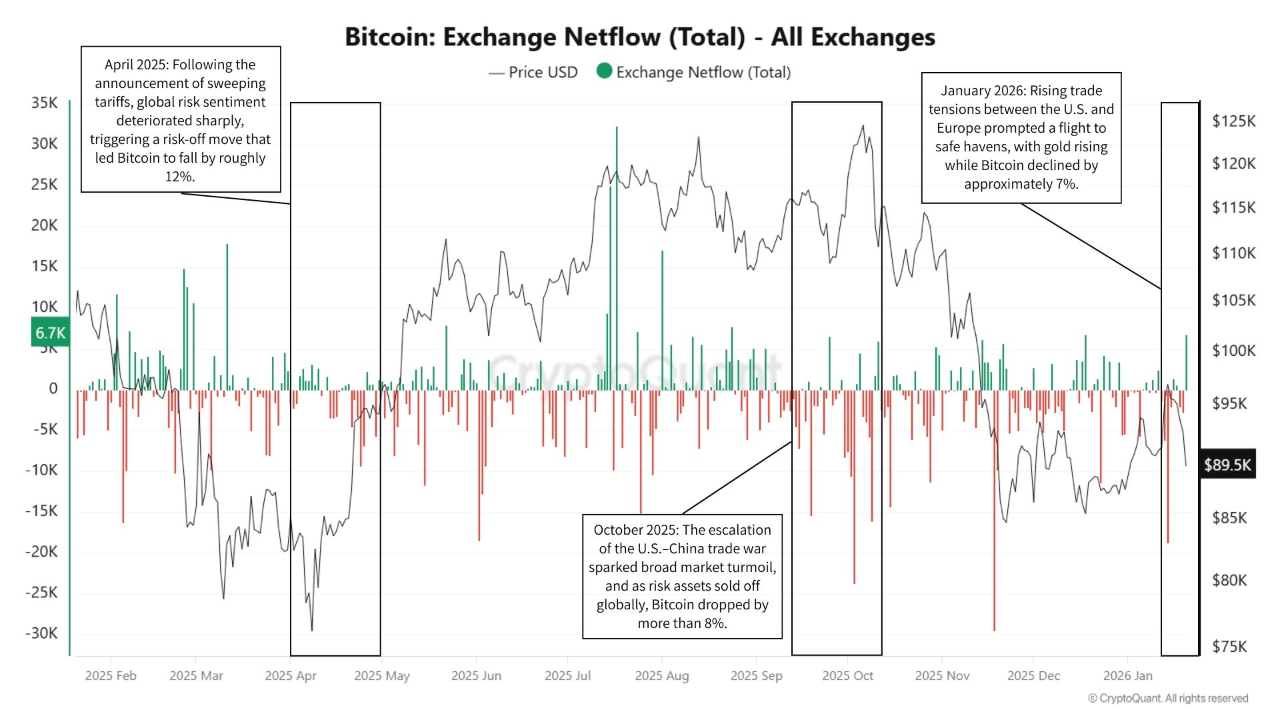
Bitcoin Exchange Netflow | Source: CryptoQuant

Economic risk tends to hit Bitcoin quickly because investor behavior adjusts fast. As uncertainty around growth and interest rates increases, capital typically shifts toward short-term protection. In that process, Bitcoin is frequently viewed as a liquid asset that can be sold temporarily to lower portfolio risk, rather than a long-term store of value that benefits from risk-off flows. This dynamic can amplify downside moves even when long-term fundamentals remain intact.

Exchange Netflow provides a supplementary layer of evidence. During correction phases, brief spikes in exchange inflows often appear, consistent with tactical repositioning and short-term profit protection. However, these inflows have not persisted, suggesting the absence of sustained structural selling pressure.

For now, the base scenario remains that tariff-driven economic risk is weighing on Bitcoin. If exchange inflows become sustained and supply-demand conditions weaken further, that assessment would need to be reassessed.

Связанные с этим вопросы

QWhat is the main reason for Bitcoin's recent decline below $90,000 according to the article?

ABitcoin's recent decline is attributed to rising macroeconomic tension between the United States and the European Union, particularly due to the Trump administration's renewed tariff threats, which increase uncertainty around global growth, corporate earnings, and inflation dynamics.

QHow does the XWIN Research Japan report describe Bitcoin's behavior in response to economic uncertainty?

AThe report states that Bitcoin behaves more like a macro-sensitive risk asset than a defensive hedge, often moving in sync with equities during trade-driven risk-off waves and reacting like a high-beta instrument when traders reduce portfolio volatility.

QWhat role do tariffs play in affecting Bitcoin's price according to the analysis?

ATariffs act as a consistent downside pressure for Bitcoin by squeezing company margins, disrupting supply chains, pushing inflation expectations higher, and complicating the outlook for interest rates and monetary policy.

QWhat does the Exchange Netflow data indicate about Bitcoin selling pressure during corrections?

AExchange Netflow data shows brief spikes in exchange inflows during correction phases, indicating tactical repositioning and short-term profit protection, but these inflows have not persisted, suggesting no sustained structural selling pressure.

QUnder what condition would the assessment of tariff-driven economic pressure on Bitcoin need to be reassessed?

AThe assessment would need to be reassessed if exchange inflows become sustained and supply-demand conditions weaken further.

Похожее

Торговля

Спот
Фьючерсы

Популярные статьи

Как купить S

Добро пожаловать на HTX.com! Мы сделали приобретение Sonic (S) простым и удобным. Следуйте нашему пошаговому руководству и отправляйтесь в свое крипто-путешествие.Шаг 1: Создайте аккаунт на HTXИспользуйте свой адрес электронной почты или номер телефона, чтобы зарегистрироваться и бесплатно создать аккаунт на HTX. Пройдите удобную регистрацию и откройте для себя весь функционал.Создать аккаунтШаг 2: Перейдите в Купить криптовалюту и выберите свой способ оплатыКредитная/Дебетовая Карта: Используйте свою карту Visa или Mastercard для мгновенной покупки Sonic (S).Баланс: Используйте средства с баланса вашего аккаунта HTX для простой торговли.Третьи Лица: Мы добавили популярные способы оплаты, такие как Google Pay и Apple Pay, для повышения удобства.P2P: Торгуйте напрямую с другими пользователями на HTX.Внебиржевая Торговля (OTC): Мы предлагаем индивидуальные услуги и конкурентоспособные обменные курсы для трейдеров.Шаг 3: Хранение Sonic (S)После приобретения вами Sonic (S) храните их в своем аккаунте на HTX. В качестве альтернативы вы можете отправить их куда-либо с помощью перевода в блокчейне или использовать для торговли с другими криптовалютами.Шаг 4: Торговля Sonic (S)С легкостью торгуйте Sonic (S) на спотовом рынке HTX. Просто зайдите в свой аккаунт, выберите торговую пару, совершайте сделки и следите за ними в режиме реального времени. Мы предлагаем удобный интерфейс как для начинающих, так и для опытных трейдеров.

1.1k просмотров всегоОпубликовано 2025.01.15Обновлено 2025.03.21

Как купить S

Sonic: Обновления под руководством Андре Кронье – новая звезда Layer-1 на фоне спада рынка

Он решает проблемы масштабируемости, совместимости между блокчейнами и стимулов для разработчиков с помощью технологических инноваций.

2.2k просмотров всегоОпубликовано 2025.04.09Обновлено 2025.04.09

Sonic: Обновления под руководством Андре Кронье – новая звезда Layer-1 на фоне спада рынка

HTX Learn: Пройдите обучение по "Sonic" и разделите 1000 USDT

HTX Learn — ваш проводник в мир перспективных проектов, и мы запускаем специальное мероприятие "Учитесь и Зарабатывайте", посвящённое этим проектам. Наше новое направление .

1.8k просмотров всегоОпубликовано 2025.04.10Обновлено 2025.04.10

HTX Learn: Пройдите обучение по "Sonic" и разделите 1000 USDT

Обсуждения

Добро пожаловать в Сообщество HTX. Здесь вы сможете быть в курсе последних новостей о развитии платформы и получить доступ к профессиональной аналитической информации о рынке. Мнения пользователей о цене на S (S) представлены ниже.

活动图片