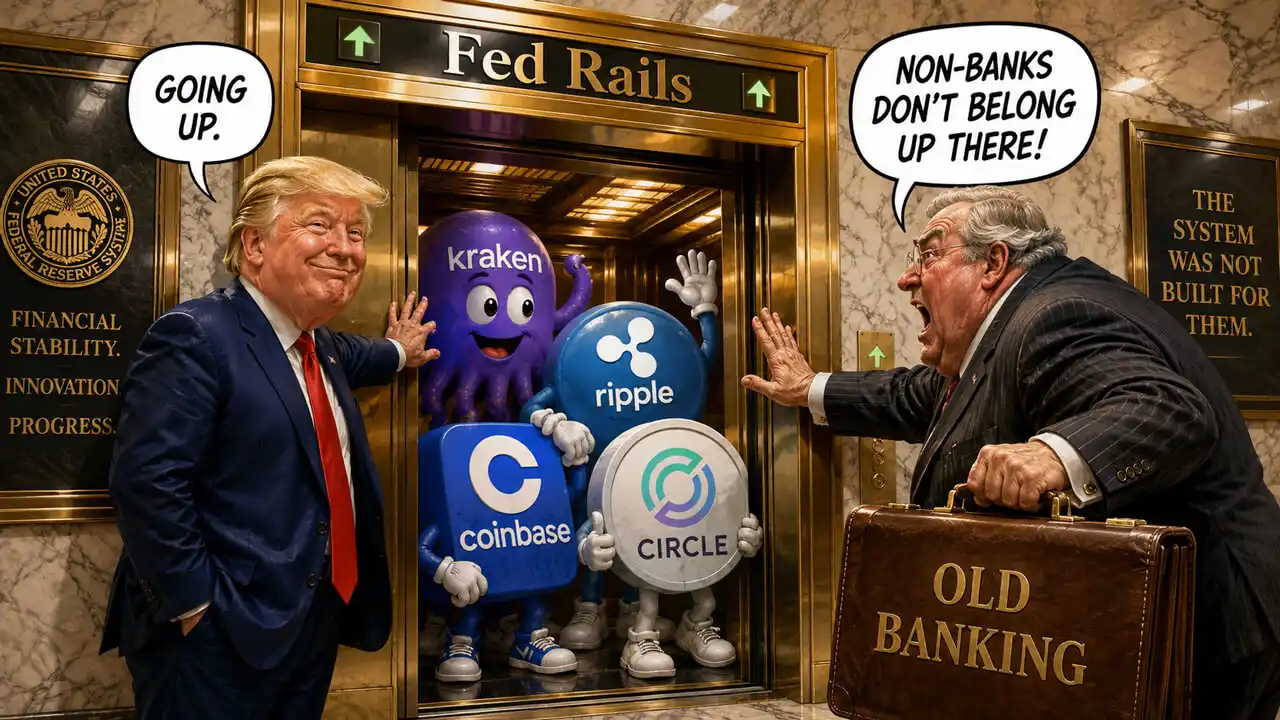
Trump Signs Executive Order, Kraken, Coinbase and Others May Gain Access to Fed Payment Channels

marsbitОпубликовано 2026-05-21Обновлено 2026-05-21

Введение

President Trump has signed an executive order, "Incorporating Financial Technology Innovation into the Regulatory Framework," pressuring the Federal Reserve to reassess its rules on granting non-bank financial companies—including crypto and fintech firms—access to its payment systems, specifically master accounts that connect to the Fedwire settlement system. Currently, such accounts are primarily reserved for depository institutions. The order mandates a review to determine if broader access is permissible and to establish an application process. This move, supported by figures like Senator Cynthia Lummis, aims to reduce barriers to innovation and lower public payment costs by fostering fairer competition. It does not grant immediate access but could pave the way for companies like Kraken, Coinbase, Ripple, and Circle to reduce reliance on intermediary banks, lowering costs and speeding up settlements. A key precedent is the Kansas City Fed granting Kraken's parent company a restricted master account in March, offering limited payment services without interest or credit privileges. This model is seen as a potential template for allowing controlled access while mitigating systemic risk. Other firms like Anchorage, Paxos, and BitGo, which hold specialized banking charters, are also well-positioned to apply. The banking industry, represented by the American Bankers Association, opposes easing access, arguing any institution handling bank-like payments must meet the same stri...

Written by: Oluwapelumi Adejumo

Compiled by: Luffy, Foresight News

U.S. President Trump has formally pressured the Federal Reserve to re-evaluate the highly controversial access rules within the U.S. financial sector, escalating the industry battle over whether crypto firms and fintech companies can directly connect to the central bank's payment systems.

On May 19, Trump signed an executive order directing the Federal Reserve to assess its policies regarding granting payment account access to nonbank financial companies, including those engaged in digital assets, blockchain services, and other fintech businesses.

Titled "Modernizing the Regulatory Framework to Facilitate Financial Innovation," the order requires major federal regulatory agencies to review existing rules and eliminate redundant regulatory provisions that hinder financial innovation.

This order does not immediately grant crypto firms direct access to Federal Reserve payment channels. However, it explicitly authorizes the Federal Reserve to examine whether existing laws permit broader access and, if so, to clarify the application process.

The outcome of this review is crucial, as it will directly determine whether companies like Kraken, Ripple, Coinbase, Circle, Anchorage, Wise, Paxos, and BitGo can reduce their reliance on intermediary banks and move closer to core U.S. dollar wholesale clearing financial infrastructure.

Policy Shift for Fed Master Account Access

The core focus of this executive order is the Federal Reserve master account. Institutions holding such an account gain direct access to the full suite of Federal Reserve payment services, including the interbank large-dollar U.S. funds transfer system, Fedwire.

Under current Fed rules, such accounts are, in principle, only open to depository banking institutions. Consequently, many crypto firms have had to pursue special-purpose banking charters or national trust bank charters in their quest for direct connection eligibility.

Trump's order now requires the Federal Reserve to comprehensively review the access rules for central bank payment accounts, while also clarifying whether the 12 regional Federal Reserve Banks have the statutory authority to independently approve or reject institution account applications.

In March of this year, the Federal Reserve Bank of Kansas City took the lead by approving a restricted master account for Kraken's parent company, Payward, setting the industry's first precedent and making this issue of access increasingly urgent.

In addition, the order instructs regulators to conduct a comprehensive review of barriers to the development of the fintech industry, covering charter licensing rules, third-party risk management guidance, and policies restricting cross-border collaboration between banks and tech companies.

U.S. Senator Cynthia Lummis stated that this new policy corrects the long-standing restricted access situation for the fintech industry. Traditional legacy financial institutions have monopolized core payment channel resources, while emerging tech companies have long been excluded. This order aims to create a level playing field, stimulate industry vitality, and reduce payment costs for the public.

Coinbase Chief Legal Officer Paul Grewal also expressed support for the move. He argued that current payment access rules and third-party risk control guidelines are outdated, favoring traditional financial giants and suppressing innovation, and that regulatory rules urgently need renewal.

This echoes a common demand within the crypto industry: access to the central bank's core payment network has become a competitive barrier. Firms unable to connect directly must rely on bank intermediaries, which not only increases operational costs and slows settlement efficiency but also imposes the additional operational risks of their partner banks.

Kraken Provides a Feasible Model for Crypto Companies

Kraken has provided a practical example for the industry to expand access. In March, the Kansas City Fed granted a master account to its financial entity, Kraken Financial, allowing access to the core U.S. dollar large-value clearing payment channels. This enables the platform to handle institutional user deposits and withdrawals more efficiently, particularly facilitating rapid transfers of large funds between the trading platform, custodians, and partner banks.

However, this account comes with clear limitations: it does not offer the full range of financial services available to regular insured banks, does not earn interest on reserve balances, and cannot access Federal Reserve credit facilities.

This restricted design can reduce central bank systemic risk while allowing crypto firms moderate access to mainstream payment infrastructure. It is likely to become a universal template promoted by regulators in the future—granting firms U.S. dollar transfer and clearing permissions while strictly prohibiting access to high-sensitivity financial privileges like overdraft lending, reserve interest, and emergency liquidity assistance.

Custodia Bank CEO Caitlin Long welcomed the new policy. Her institution has sought access to the Federal Reserve system for years but was rejected in 2023, with the Fed ruling that its crypto-focused business model did not meet statutory access requirements, highlighting the extreme difficulty licensed crypto institutions previously faced in gaining full access.

The implementation of Kraken's restricted account has fundamentally shifted the regulatory stance. Regulators no longer have only the options of "full access" or "complete rejection." Through a tiered permission model, they can gradually guide crypto firms into the mainstream payment system while firmly maintaining risk control bottom lines.

Ripple, Coinbase, and Circle are Prepared for the Next Phase

Ripple, Coinbase, and Circle are among the most direct beneficiaries of this policy relaxation. Ripple has already applied for a Federal Reserve master account and actively supports implementing a lightweight restricted account mechanism that allows non-bank institutions to conveniently use basic payment services without touching the Fed's core financial privileges.

Once successfully implemented, this would significantly boost its RLUSD stablecoin business, enabling efficient reserve fund transfers and user redemption operations. For stablecoin issuers, the efficiency of reserve clearing and fund redemption stability directly determine market confidence. Direct or restricted access to a Federal Reserve account would greatly reduce reliance on bank intermediaries, allowing more flexible U.S. dollar liquidity management during periods of concentrated redemptions or market volatility.

Coinbase and Circle, through their USDC stablecoin businesses and own payment ecosystems, also have strong needs for access. Both institutions have established federal trust bank structures, which not only further integrate them into the federal unified regulatory system but also pave the way for applying for Federal Reserve payment accounts.

Meanwhile, other companies are also waiting in line. Anchorage Digital is already a federally chartered crypto bank; Paxos, BitGo, and Fidelity Digital Assets have successively obtained national trust bank-related approvals from the Office of the Comptroller of the Currency. While such qualifications do not directly translate into Federal Reserve payment account access, they significantly narrow the gap between these firms and compliance standards.

Industry demands are clear: crypto exchanges seek fast fiat currency settlement, stablecoin issuers want autonomous control over reserve funds, asset custodians aim to optimize institutional client fund flow efficiency, and payment companies are eager to reduce heavy reliance on cross-border clearing banks.

Galaxy Digital Head of Research Alex Thorn stated bluntly that it is not only deposit-taking and lending banking institutions that are qualified to conduct wire transfer business; this is a threshold set by modern regulation, not an immutable rule of the financial industry. With multiple forces now competing, traditional banks are actually fighting to maintain their monopoly in the payments industry. The prevailing industry view is that payment channel access eligibility should be determined based on a firm's business attributes, compliance and regulatory rigor, and risk management capabilities, rather than rigidly adhering to traditional banking business models.

Traditional Banks Warn: Access Must Meet Bank-Level Standards

Facing calls for industry openness, the American Bankers Association has clearly expressed opposition. The association believes that any institution conducting bank-like business must be subject to the same stringent regulatory standards and consumer protection rules as traditional banks.

ABA President and CEO Rob Nichols stated publicly: "Without full industry-wide high-standard regulation, the entire financial system and ordinary consumers will face direct risks. Regarding this White House financial innovation executive order, we urge regulatory agencies to uphold the bottom line of safety and soundness of the financial system while promoting innovation, and not to lower access thresholds."

This is the core concern of the banking industry. Direct access to the Federal Reserve payment system is not merely a business privilege; it comes with a suite of high-intensity regulations, including deposit insurance systems, capital adequacy assessments, liquidity controls, and regular business reviews. From the banks' perspective, allowing crypto firms with lightweight licenses and limited business scopes, which lack equivalent compliance obligations and risk management capabilities, to connect to the core payment network could easily sow the seeds of systemic risk.

The Fedwire system is the core hub for global U.S. dollar clearing. Any cyber-attacks, operational failures, compliance breaches, or liquidity crises at an接入 institution could cause settlement disruptions with impacts far beyond the firm's own business scope. Simultaneously, banks invest heavily in compliance areas such as anti-money laundering, customer fund monitoring, and suspicious transaction reporting. Regulators also need to confirm that crypto firms possess equivalent compliance capabilities before allowing them to engage in diverse businesses like trading, asset custody, stablecoin issuance, and payments.

Liquidity diversion is another key concern for banks. If stablecoin issuers and fintech firms can efficiently hold and transfer funds through the Federal Reserve system, they will likely divert existing funds from the traditional banking system.

The restricted account rules proposed by the Fed, by removing benefits like interest and credit, somewhat alleviate this concern, but the banking industry will not readily acquiesce to this shift in the industry landscape.

Although specialized restricted accounts can avoid most risks through permission demarcation, they also raise new regulatory questions: At what point does the level of payment business access granted to a non-bank institution make its operations equivalent to those of a formal bank? This will become a core point of contention for regulators in defining future access boundaries.

Связанные с этим вопросы

QWhat was the main objective of the executive order signed by former President Trump regarding financial innovation and cryptocurrency companies?

AThe executive order aimed to pressure the Federal Reserve to reassess its policies on granting payment account access to non-bank financial companies, including those in digital assets, blockchain, and fintech. It required federal regulators to review existing rules to eliminate redundant regulations hindering financial innovation and to clarify whether broader access to the Federal Reserve's payment systems is legally permissible for such companies.

QHow does the Federal Reserve's Master Account benefit financial institutions, and what was the previous limitation for crypto companies?

AA Federal Reserve Master Account allows institutions direct access to the Fed's full suite of payment services, including the Fedwire system for large-scale dollar transfers between banks. Previously, such accounts were typically restricted to depository banking institutions, forcing crypto companies to seek special-purpose banking charters or national trust bank licenses to qualify for direct access.

QWhat precedent did the Federal Reserve Bank of Kansas City set for crypto companies in March, and what were the limitations of this account?

AIn March, the Federal Reserve Bank of Kansas City approved a restricted master account for Payward, Inc., the parent company of Kraken. This account, granted to its special-purpose depository institution Kraken Financial, allowed direct access to core dollar payment channels but with key limitations: it did not grant full banking services, did not pay interest on reserves, and did not provide access to Federal Reserve credit facilities.

QWhy are companies like Ripple, Coinbase, and Circle particularly interested in gaining access to Federal Reserve payment channels?

ACompanies like Ripple, Coinbase, and Circle are keen to access Federal Reserve payment channels to reduce reliance on intermediary banks. This would lower operational costs, speed up settlement times, and mitigate risks associated with partner banks. For stablecoin issuers like Circle (USDC) and Ripple (RLUSD), direct access would enhance the efficiency of managing reserve funds and processing redemptions, which is crucial for maintaining market confidence, especially during periods of high volatility or concentrated withdrawals.

QWhat are the primary concerns raised by traditional banks, as represented by the American Bankers Association, regarding expanding access to the Federal Reserve's payment systems?

ATraditional banks, through the American Bankers Association, argue that any institution performing bank-like activities must be subject to the same stringent regulatory standards as traditional banks, including robust consumer protection rules, capital requirements, liquidity management, and anti-money laundering compliance. They warn that allowing crypto firms with lighter regulatory burdens to connect to core payment networks like Fedwire could introduce systemic risks, such as operational failures or compliance gaps, and potentially drain liquidity from the traditional banking system.

Похожее

GitHub, Transfixed by AI

On the night of February 9th, GitHub suffered a major outage caused by a simple configuration change—reducing a cache refresh interval from 12 to 2 hours—that triggered a cascade of failures. This was not an isolated event, but part of a broader pattern. In early 2026, GitHub experienced at least 8 major incidents, failing to meet its promised 99.9% availability. These outages stemmed from structural issues: explosive growth in load, tight service coupling, and insufficient protection against abnormal traffic. This unprecedented load is driven by AI Agents. In 2025, GitHub handled ~1 billion commits. By 2026, weekly commits reached 275 million, projecting to ~14 billion for the year—a 14x increase. AI tools like Claude Code now contribute 4.5% of all public repository commits, with weekly submissions surging 25x in just three months. AI-generated pull requests jumped from 4 million to 17 million per month in half a year. Unlike human developers, AI Agents work continuously, generating commits at a scale that overwhelms infrastructure designed for human rhythms. The surge also shattered GitHub's business model. Copilot's flat-rate pricing, based on assisting human developers, became unsustainable as Agentic AI sessions consumed resources worth hundreds of dollars for a few dollars in fees. In response, GitHub imposed usage limits and, by June 1st, shifted to a pay-per-use "AI Credits" system. Facing this new reality, GitHub realized a 10x scaling plan was insufficient. It announced a need to *redesign* its architecture for 30x current scale—decoupling services, adding fault isolation, and improving change management to prevent cascading failures. Other platforms like Stripe and AWS are facing similar challenges with AI Agents. Fundamentally, GitHub is transitioning from a human collaboration platform to an "exhaust pipe" for automated AI workflows. Its detailed post-mortem reports aim to maintain trust during this turbulent rebuild. The February outage was not just a technical glitch, but a signal of the software industry's entry into a new, AI-driven era.

marsbit13 мин. назад

GitHub, Transfixed by AI

marsbit13 мин. назад

Both Suffer Massive Losses Exceeding $90 Billion, Which Is in Greater Peril: Strategy or Bitmine?

Facing massive paper losses exceeding $90 billion each amidst a sharp market downturn, "Digital Asset Treasury" (DAT) giants Strategy and Bitmine find themselves in a precarious position, but with different underlying risks. Strategy, heavily invested in Bitcoin (BTC), faces significant financial strain. Its strategy relies heavily on debt, including convertible notes and preferred stock (STRC) requiring substantial dividend payments. With its cash reserves dwindling and BTC offering no staking yield for cash flow, Strategy's high leverage makes it vulnerable. A continued price decline could force asset sales to meet obligations, potentially creating a negative feedback loop. Its market value has already fallen sharply. In contrast, Bitmine, an Ethereum (ETH) holder, appears on firmer financial ground. It primarily funds its purchases through equity offerings (like ATM programs), avoiding debt pressure. It also generates income by staking a large portion of its ETH holdings. While not immune to market drops and shareholder dilution concerns, Bitmine maintains more flexibility, recently announcing a new preferred share offering to raise further capital. The core divergence lies in their financing: Bitmine uses equity (investor money), while Strategy uses debt (borrowed money). Consequently, Bitmine currently faces less immediate liquidity pressure than Strategy, which must navigate the dual challenge of servicing debt/dividends and a declining core asset (BTC) price.

marsbit20 мин. назад

Both Suffer Massive Losses Exceeding $90 Billion, Which Is in Greater Peril: Strategy or Bitmine?

marsbit20 мин. назад

Where the AI Bubble Really Is: Which Layer of Players Are Naked

AI Bubble: Where It Really Is and Who's Swimming Naked This analysis dissects the AI industry not as a single entity but as a five-layer pyramid, arguing that bubbles are concentrated in specific tiers, not uniformly distributed. **Key Distinction from the 2000 Dot-com Bubble:** Unlike 2000, where companies had stock prices before revenue, today's leading AI players have massive, contract-backed revenue driving their valuations. Core infrastructure demand is real, with every GPU running at full capacity for paying customers. **The Five-Layer Pyramid & Bubble Assessment:** * **L0 (Fab/Manufacturing) & Top L4 (Leading AI Apps): NO BUBBLE.** Companies like TSMC, NVIDIA, major cloud providers (Microsoft, Google, Meta, Amazon), and top AI labs have real revenues and orders. Supply is tightly constrained by TSMC's disciplined capacity control and physical limits like power/land for data centers, preventing a supply glut. * **L1 (Memory): BATTLEGROUND.** Sky-high HBM margins could signal a new structural cycle or a classic "boom before bust." The oligopoly of three major players may enforce supply discipline, making this a high-stakes bet. * **L2 (Interconnect/Optical Modules): BUBBLE TERRITORY.** Companies like Lumentum and AAOI have seen stock surges (4-10x) far outpacing revenue growth. This hardware segment has lower physical barriers to expansion than fabs, allowing speculation. It mirrors the 2000 bubble's epicenter—optics. * **L3 (Infrastructure/"GPU Landlords"): VULNERABLE.** GPU leasing companies profit from the current compute shortage but own no long-term moat. Their business model relies on a temporary bottleneck that will ease as big tech expands and new tech (e.g., potential space-based data centers) emerges. * **L4 Long Tail (VC-backed Startups): STRONG BUBBLE SIGNALS.** VC funding concentration in AI is twice that of the 1999 peak. Many startups with little revenue use the valuation logic of successful giants to justify their own, creating high risk of a "valuation crunch" when funding dries up. **Critical Risks to Monitor:** 1. **GPU Depreciation & Accounting:** Companies extending the assumed useful life of GPUs artificially boost profits. The true economic life depends on future generational leaps from NVIDIA. 2. **"GPU Credit" & Off-Balance-Sheet Leverage:** Emerging structures where shell companies borrow to buy GPUs and lease them out (with chipmakers sometimes investing) move debt off major balance sheets. This echoes the "vendor financing" of 2000 and the securitization risks of 2008, though currently small-scale. 3. **TSMC Abandoning Caution:** If the primary supply bottleneck (TSMC's conservative capacity planning) breaks, runaway supply could trigger a bust. 4. **Algorithmic Efficiency Breakthrough:** A major leap in software efficiency could drastically reduce the need for raw compute hardware, undermining the investment thesis. **Conclusion:** The AI boom is expensive and has frothy areas, but its core is underpinned by real demand and physical supply constraints. The bubble risk is layered: most present in optical components, GPU leasing, and the long-tail startup ecosystem, while the foundational chip manufacturing and leading application layers remain relatively solid—for now.

marsbit32 мин. назад

Where the AI Bubble Really Is: Which Layer of Players Are Naked

marsbit32 мин. назад

Торговля

Спот
Фьючерсы

Популярные статьи

Как купить ORDER

Добро пожаловать на HTX.com! Мы сделали приобретение Orderly (ORDER) простым и удобным. Следуйте нашему пошаговому руководству и отправляйтесь в свое крипто-путешествие.Шаг 1: Создайте аккаунт на HTXИспользуйте свой адрес электронной почты или номер телефона, чтобы зарегистрироваться и бесплатно создать аккаунт на HTX. Пройдите удобную регистрацию и откройте для себя весь функционал.Создать аккаунтШаг 2: Перейдите в Купить криптовалюту и выберите свой способ оплатыКредитная/Дебетовая Карта: Используйте свою карту Visa или Mastercard для мгновенной покупки Orderly (ORDER).Баланс: Используйте средства с баланса вашего аккаунта HTX для простой торговли.Третьи Лица: Мы добавили популярные способы оплаты, такие как Google Pay и Apple Pay, для повышения удобства.P2P: Торгуйте напрямую с другими пользователями на HTX.Внебиржевая Торговля (OTC): Мы предлагаем индивидуальные услуги и конкурентоспособные обменные курсы для трейдеров.Шаг 3: Хранение Orderly (ORDER)После приобретения вами Orderly (ORDER) храните их в своем аккаунте на HTX. В качестве альтернативы вы можете отправить их куда-либо с помощью перевода в блокчейне или использовать для торговли с другими криптовалютами.Шаг 4: Торговля Orderly (ORDER)С легкостью торгуйте Orderly (ORDER) на спотовом рынке HTX. Просто зайдите в свой аккаунт, выберите торговую пару, совершайте сделки и следите за ними в режиме реального времени. Мы предлагаем удобный интерфейс как для начинающих, так и для опытных трейдеров.

544 просмотров всегоОпубликовано 2024.08.25Обновлено 2026.06.02

Как купить ORDER

Обсуждения

Добро пожаловать в Сообщество HTX. Здесь вы сможете быть в курсе последних новостей о развитии платформы и получить доступ к профессиональной аналитической информации о рынке. Мнения пользователей о цене на ORDER (ORDER) представлены ниже.

活动图片