TRM Labs Hits Unicorn Status With $1B Valuation as $MAXI Explodes

bitcoinistОпубликовано 2026-02-04Обновлено 2026-02-04

Введение

Blockchain intelligence firm TRM Labs has achieved unicorn status with a $1 billion valuation, signaling a maturation in crypto's "sanitization phase." This development, backed by major institutions like JPMorgan, Visa, and Citi, indicates traditional finance is investing heavily in blockchain compliance infrastructure. Historically, improved compliance leads to increased institutional capital flow, reducing systemic risk and encouraging a rotation into high-beta, speculative assets. Capital is already shifting towards high-volatility opportunities, exemplified by the presale success of Maxi Doge ($MAXI), which has raised $4.5 million. The project leverages a 'leverage culture' narrative, targeting traders with gamified experiences, holder-only trading competitions, and a treasury fund. Built on Ethereum, it offers staking rewards and aims to capitalize on the returning appetite for risk. On-chain activity suggests whale accumulation at the current presale price of $0.0002785, indicating smart money bet on its asymmetric risk-reward potential ahead of a public listing.

Trusted Editorial content, reviewed by leading industry experts and seasoned editors. Ad Disclosure

Quick Facts:

  • ➡️ TRM Labs achieving a $1B valuation signals institutional readiness to enter the crypto market, reducing systemic risk perception.
  • ➡️ Improved compliance infrastructure historically correlates with increased capital flows into risk-on assets and high-beta tokens.
  • ➡️ Maxi Doge ($MAXI) has raised over $4.48 million, capitalizing on this risk rotation with a ‘leverage culture’ narrative.
  • ➡️Smart money accumulation often precedes retail FOMO, suggesting whales are positioning for the next volatility cycle.

Blockchain intelligence firm TRM Labs has officially cemented its status as a ‘unicorn.’

The firm reached a $1 billion valuation following its latest funding round, but the number matters less than the signal. It proves the “sanitization phase” of crypto is maturing.

With heavy hitters like JPMorgan, Visa, and Citi already on the cap table, this valuation spike confirms one thing: traditional finance (TradFi) is paying big money to police the blockchain.

To the average retail trader, forensic firms sound like a buzzkill. More oversight, less Wild West. But history suggests a different outcome (and it’s bullish). When compliance infrastructure solidifies, institutional capital finally feels safe enough to enter.

And when the ‘adults’ enter the room with safety rails, liquidity cascades downstream. Lower systemic risk doesn’t kill volatility; it encourages a rotation into high-beta assets.

Call it the barbell effect. Massive capital flows into boring compliance infrastructure on one end, and high-octane speculative assets on the other. As regulatory fears fade, traders return to the charts hungry. We’re already seeing it happen, capital isn’t just parking in Bitcoin anymore; it’s hunting for volatility.

That rotation is clear in the presale sector, where liquidity is flowing toward projects embracing the aggressive ‘up-only’ culture. This is where Maxi Doge ($MAXI) comes in.

Buy $MAXI here.

Maxi Doge Capitalizes on the Return of ‘Leverage Culture’

While TRM Labs builds the police station, traders are heading back to the casino. Maxi Doge ($MAXI) is catching that wave.

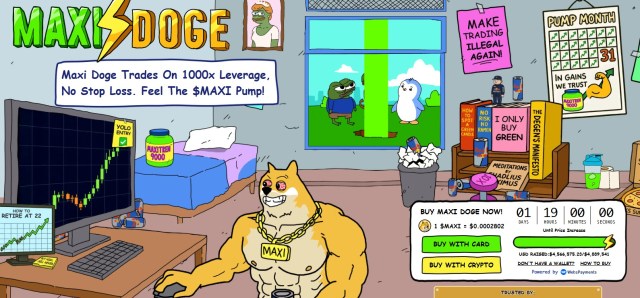
The project diverges from the standard ‘cute animal’ formula by targeting a specific vibe: the gym-bro trader obsessed with leverage, gains, and ‘never skipping leg day.’ It frames the bull market as a physical grind, appealing to the grit needed to survive volatility.

The market response has been loud. According to official presale data, Maxi Doge has raised exactly $4.5M, signaling real demand for a narrative that mixes meme virality with trading utility. The project introduces holder-only trading competitions and a ‘Maxi Fund’ treasury to sustain liquidity, a structure attempting to fix the fragmentation typical in low-cap assets.
By gamifying the experience, $MAXI positions itself less as a token and more as a derivative of retail conviction.

For traders tired of low-volatility chop, the appeal lies in the project’s unapologetic focus on ‘pump’ mechanics. The tokenomics include a dynamic staking APY from a 5% allocation pool, giving traders yield while they wait for price action.

At the current presale price of $0.0002785, early buyers are effectively betting that the ‘meme supercycle’ will outperform the sanitized infrastructure plays.

Explore the $MAXI ecosystem.

Whale Wallets Signal Accumulation in Pre-Market Rounds

Smart money often moves first. On-chain activity around Maxi Doge ($MAXI) suggests high-net-worth players are positioning before the public listing.

Typically, whales wait for deep liquidity on DEXs to minimize slippage. Jumping in this early suggests a conviction that the $0.0002785 entry price offers an asymmetric risk-reward ratio compared to legacy memes. If TRM Labs represents the institutional ceiling, these whales are betting $MAXI is the retail floor.

Plus, the project’s technical foundation on Ethereum (ERC-20) ensures compatibility for future DeFi integrations. While the ‘Leverage King’ branding is funny, the underlying structure allows for serious capital deployment.

With daily automatic smart contract distribution for stakers, the protocol incentivizes holding through the volatility, a mechanism designed to counteract the ‘jeet’ (rapid selling) behavior that plagues lesser coins.

Buy your $MAXI here.

This article is for informational purposes only and does not constitute financial advice. Cryptocurrencies, particularly presale tokens, are high-risk assets. Always perform your own due diligence.

Editorial Process for bitcoinist is centered on delivering thoroughly researched, accurate, and unbiased content. We uphold strict sourcing standards, and each page undergoes diligent review by our team of top technology experts and seasoned editors. This process ensures the integrity, relevance, and value of our content for our readers.

patrubogdan

Follow

Full Profile

Related Posts

Quale criptovaluta comprare oggi in base alle condizioni di mercato: Il superciclo dei Layer 2 su Bitcoin

El mercado de las criptomonedas a la baja hoy: ¿qué está pasando?

B. Riley Cuts Price Targets Across Digital Asset Treasury Companies as LiquidChain Momentum Builds

Bitcoin in fase di stallo: i movimenti delle balene e il caso Bitcoin Hyper

Meilleure prévente crypto : où le capital se positionne avant le marché

XRP actualité : le marché réagit aux derniers signaux autour de Ripple et à l’émergence de nouveaux acteurs

Связанные с этим вопросы

QWhat valuation did TRM Labs achieve in its latest funding round and what does this signify for the crypto market?

ATRM Labs achieved a $1 billion valuation, signifying that traditional finance (TradFi) institutions are heavily investing in blockchain compliance infrastructure. This signals a maturing 'sanitization phase' of crypto, reducing systemic risk perception and encouraging institutional capital to enter the market.

QHow does the article link improved compliance infrastructure to capital flows?

AThe article states that improved compliance infrastructure, as evidenced by TRM Labs' funding, historically correlates with increased capital flows into risk-on assets and high-beta tokens. It creates a 'barbell effect' where capital moves into both compliance tools and high-volatility speculative assets.

QWhat is the name of the meme token mentioned and how much has it raised in its presale?

AThe meme token mentioned is Maxi Doge ($MAXI). It has raised over $4.48 million (approximately $4.5M) in its presale.

QWhat specific market culture is Maxi Doge ($MAXI) attempting to capitalize on?

AMaxi Doge ($MAXI) is capitalizing on the return of 'leverage culture,' targeting a 'gym-bro trader' vibe obsessed with gains and volatility. It frames the bull market as a physical grind and embraces an aggressive 'up-only' narrative.

QWhat on-chain activity suggests 'smart money' or whales are interested in Maxi Doge ($MAXI)?

AOn-chain activity shows whale wallets are participating in the pre-market presale rounds. This early accumulation by high-net-worth players, who typically wait for deeper liquidity, suggests a conviction that the current price offers an asymmetric risk-reward ratio ahead of a public listing.

Похожее

Apple Also Has to Pay Rent Now

Apple Pays Rent Too: The Two-Way Flow of "Traffic Tax" and "AI Capability Rent" Between Tech Giants For over two decades, Google has paid Apple an estimated $20 billion annually to remain the default search engine on Safari, a "traffic tax" for a critical user entry point. However, in 2026, the direction of this cash flow partially reversed. Apple agreed to pay Google roughly $1 billion per year to license its Gemini AI models, as Apple's own models reportedly struggled with complex tasks. This creates a unique dynamic: Apple acts as the "landlord" in the established search ecosystem, collecting rent from Google for access. Simultaneously, in the emerging AI arena, Apple becomes the "tenant," paying Google for access to cutting-edge AI capabilities it cannot currently match internally. While Apple claims its new models are "distilled" from Gemini outputs and contain "not a drop" of Google's original code, core dependencies remain. Its knowledge base is refined using Gemini's outputs, and its most powerful cloud model runs on Google's infrastructure. Apple has structured the deal as non-exclusive, allowing it to theoretically switch AI suppliers—a hedge against over-reliance. The future hinges on whether advanced AI models become a commodity (cheap and abundant) or remain a concentrated, scarce resource (expensive and controlled by few). Apple is betting on the former, leveraging its massive device ecosystem to be a powerful, choosy customer. If the latter proves true, its bargaining power could erode. This power dynamic is extending to developers. Apple, Google, and WeChat are all pushing for apps to expose their core functions as standardized "actions" or "intents" that their respective AI assistants (Siri, Gemini, WeChat AI) can directly call. The new scarce resource is no longer just app store visibility, but "being selected by the AI." The currency of "rent" has changed from a 30% revenue share to ceding control over how users interact with an app's functions.

marsbit7 мин. назад

Apple Also Has to Pay Rent Now

marsbit7 мин. назад

Missed the SpaceX IPO? WEEX's "First Trade Protection" Lets You Experience US Stock Trading Risk-Free.

With the excitement around SpaceX's recent public listing reigniting interest in the US stock market, Chinese investors face significant challenges accessing compliant and convenient trading channels following regulatory actions against major online brokers. This article explores the available options, highlighting their risks and limitations. Traditional paths for US stock investments remain problematic. Qualified Domestic Institutional Investor (QDII) and Listed Open-Ended Fund (LOF) products, while compliant, suffer from high fees, significant purchase premiums, and a very limited selection of assets. Small, unregulated offshore brokers pose substantial risks, including potential insolvency. While secure, VIP accounts at banks in Hong Kong or Singapore require high minimum deposits (often 1-2 million RMB) and in-person visits, placing them out of reach for most retail investors. The article positions cryptocurrency exchanges, specifically their TradFi (traditional finance on-chain) offerings, as a compelling alternative. Platforms like WEEX are noted for providing access to a wide range of US stocks and ETFs, including SpaceX (SPCXON), through tokenized assets. This method offers advantages such as a single account for both crypto and traditional assets, USDT-based settlement avoiding fiat complexities, flexible leverage, and robust risk management. To attract users, WEEX is promoting a "First Trade Guarantee" campaign. Running from June 15 to July 8 (UTC+8), it features a $30,000 prize pool. Users who trade $500 worth of US stock contracts can qualify for a guarantee on their first eligible trade: 100% loss coverage up to $30 or a 20% bonus on profits up to $30. The campaign is presented as a low-risk opportunity for both crypto natives and traditional investors to experience US stock trading.

marsbit8 мин. назад

Missed the SpaceX IPO? WEEX's "First Trade Protection" Lets You Experience US Stock Trading Risk-Free.

marsbit8 мин. назад

How Difficult is Chip Making? A Division Error Costs 475 Million Dollars

How Hard Is It to Make a Chip? A Division Error Cost $475 Million Chip expert Shi Kan, a researcher at the Chinese Academy of Sciences and a popular tech creator, explains the immense challenges of chip development. Chips are foundational to modern technology, but their creation is extraordinarily difficult. The journey from sand to a functional chip involves complex design and manufacturing, but a critical bottleneck is verification—ensuring the design works flawlessly before costly production. A single, undetected bug can have catastrophic consequences, as illustrated by the infamous 1994 Intel Pentium FDIV bug. A flaw in the floating-point division unit forced a recall costing $475 million. Unlike software, chips cannot be easily patched after manufacture, making "first-time success" paramount. However, industry surveys show only 24% of chip projects achieve this; over three-quarters require at least one costly re-spin due to design flaws. Verification has thus become the dominant phase, consuming up to 70% of the design cycle. The core challenge is a "verification impossible triangle" between high performance, good debuggability, and low cost. Exhaustively verifying a modern CPU core could take 15,000 years with software simulation, or 30 years with advanced hardware emulation—timeframes utterly impractical for development. Despite being essential, verification is often seen as unglamorous "dirty work," receiving less academic attention than fields like AI. Shi and his team are tackling this by developing an agile verification research framework called ENCORE, based on FPGA technology, to improve verification efficiency and debug capability. Beyond research, Shi engages in public science communication through long-form video content, aiming to demystify chip technology, AI, and computer science. He argues for the value of pursuing "hard and long-term" endeavors, whether in the meticulous world of chip verification or in creating substantive educational content, believing such sustained effort is likely the right path forward.

marsbit18 мин. назад

How Difficult is Chip Making? A Division Error Costs 475 Million Dollars

marsbit18 мин. назад

Claude to Mandate "Face-Scan ID Verification", No ID No Service Starting July?

Anthropic, the creator of Claude AI, has sent privacy policy update emails to users, signaling a significant shift. The key change, effective July 8, is the potential requirement for consumer-level users (Free, Pro, Max plans) to verify their age or identity. This verification would be conducted through the third-party service Persona, involving uploading a government-issued photo ID and taking a live selfie for comparison. Anthropic states this data is for security purposes only, will not be used for model training, and is processed by Persona, not stored on its own servers. The update also clarifies data handling for Claude's new capabilities: when performing multi-step tasks or connecting to third-party apps, user data may flow between Anthropic and those external services. Additionally, more information may be collected from users who participate in Anthropic research. This move is seen as a major step towards establishing accountability as AI agents become more powerful and autonomous, capable of executing complex, real-world tasks. It follows previous enforcement actions, like the banning of the "Fable 5" account, and indicates a broader industry trend toward stricter user identification and safety measures. The verification is expected to apply in specific scenarios, particularly as users engage Claude in more complex agentic workflows.

链捕手30 мин. назад

Claude to Mandate "Face-Scan ID Verification", No ID No Service Starting July?

链捕手30 мин. назад

Blockchain Has Finally Started to Sail into the Mainstream After 18 Years

Blockchain Finds Its True Path After 18 Years: Becoming the Financial Backbone for AI Agents and Autonomy This analysis explores a pivotal shift in the blockchain and crypto investment landscape, driven by the dominance of AI. Major venture capital firms, including Variant, Paradigm, Haun Ventures, and YZi Labs, are moving beyond pure "crypto" investment theses. They are expanding their focus to AI, robotics, and frontier tech, signaling that blockchain is no longer seen as a standalone sector but as an underlying infrastructure layer. The core argument is that blockchain's killer application may not be user-facing apps, but rather providing the economic rails for the coming wave of AI agents, autonomous robots, and automated systems. Key capabilities like self-custody wallets, programmable stablecoins for micropayments, on-chain identity, and verifiable smart contracts are positioned as essential for a future where machines conduct economic activity. The recent $1.4 billion investment by Tether (via its venture arm) in German robotics company NEURA Robotics exemplifies this, aiming to embed Tether's wallet tools directly into robots for autonomous transactions. While many "AI + Crypto" projects remain superficial, the article concludes that true value lies where crypto is a necessary component—enabling machine-to-machine payments, agent autonomy, verifiable data provenance, and open financial settlement for the AI era. For crypto venture capital, this convergence with AI represents both an adaptation to shifting capital flows and a potential path to unlocking the large-scale, non-speculative utility the industry has long sought.

marsbit39 мин. назад

Blockchain Has Finally Started to Sail into the Mainstream After 18 Years

marsbit39 мин. назад

Торговля

Спот
Фьючерсы
活动图片