To Counter Chinese Models, Silicon Valley's Big Three Even Formed an 'Avengers Alliance'?

marsbitОпубликовано 2026-04-22Обновлено 2026-04-22

Введение

In a rare move, Silicon Valley's AI giants—OpenAI, Anthropic, and Google—have formed a coalition called the "Frontier Model Forum" to combat what they term "adversarial distillation." This practice involves companies, particularly Chinese firms like DeepSeek, Moon Dark Side, and MiniMax, allegedly using massive API interactions to extract and replicate the capabilities of advanced models. Anthropic's report claims these firms engaged in over 16 million interactions, copying logic, reasoning chains, and model behaviors to train their own systems at lower costs. While distillation is a known technique, the alliance argues it threatens both commercial interests and safety, as distilled models may bypass critical risk assessments. However, the accusations are met with skepticism, citing hypocrisy, as these giants themselves face lawsuits over unauthorized data scraping. The debate highlights the unresolved ethical and legal gray areas in AI development.

Some time ago, Silicon Valley's AI 'Big Three'—OpenAI, Anthropic, and Google—very rarely formed what could be called an 'Avengers Alliance'.

According to a Bloomberg report, the three rivals, who usually can't wait to outdo each other, are now sharing information through a 'Frontier Model Forum' with a clear goal: to jointly identify so-called adversarial distillation behavior.

If you don't understand what this so-called 'adversarial distillation behavior' is, that's okay. But Shichao wants to say, this time, it's clearly targeting domestic large models.

If we rewind the timeline to February this year, the conflict was already out in the open.

At that time, Anthropic released an investigative report, publicly naming DeepSeek, Moon Dark Side (Yue Zhi An Mian), and MiniMax, stating that these three companies created about 24,000 fraudulent accounts, interacted with Claude over 16 million times, and then used the extracted精华 (essence) data to train their own models.

In this report, the scale of each company's distillation activities and their targets were clearly detailed.

For example, MiniMax, with the largest scale, initiated over 13 million interactions and followed closely; shortly after Anthropic released a new model, they redirected their traffic.
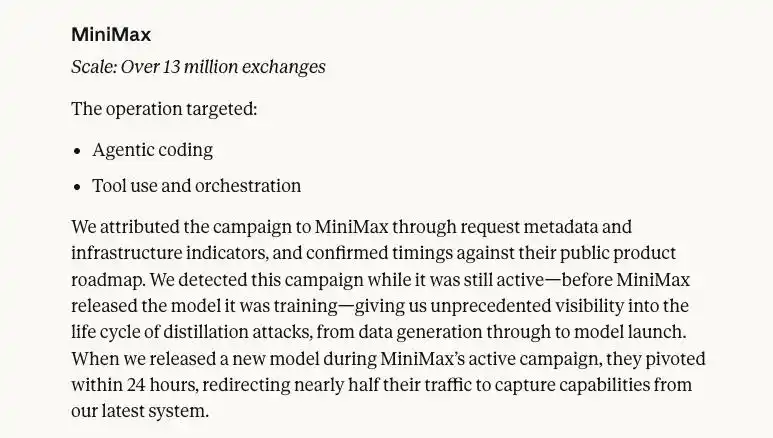
DeepSeek's distillation scale was relatively smaller, with over 150,000 interactions, but specifically targeted chain-of-Thought reasoning.

Of course, labeling these interaction behaviors as 'adversarial distillation' is purely Anthropic's one-sided claim, as there's no way to prove that the data was used to train models.

However, Anthropic isn't the only one feeling the sting of distillation.

Around the same time, OpenAI also complained to the U.S. Congress, accusing DeepSeek of using model distillation technology to illegally replicate their product functionality.

So Shichao feels that this alliance of the three companies might be getting ready to take serious action.

But before discussing 'anti-distillation', we probably need to first understand what this 'distillation' technology is that has the giants so worried?

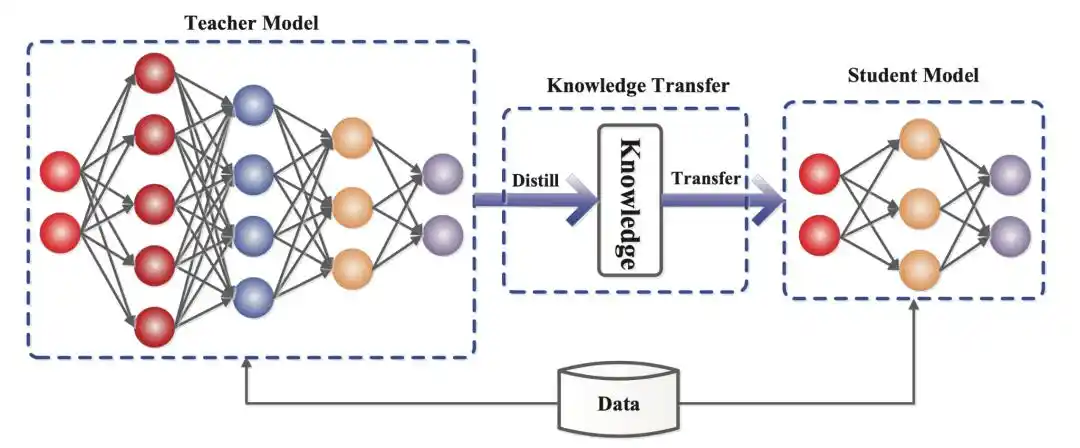
Actually, it's not that mysterious. Everyone knows that model training consumes computing power, data, and time. The logic of distillation is that even if your resources are limited, as long as you find a master to guide you, you can train a top student who is 70-80% similar to the master in a short time.
The core lies in learning 'soft labels', which are the probability distributions output by the large model.

Three years ago, the API environment was much more relaxed than it is now; the teacher not only gave you the answer but also spat out the probability distribution, which was convenient for research.

But later, for some reason, the major model manufacturers welded their doors shut. For example, OpenAI's API rules state that you can only see the top 5 most probable words.

So the distillation approach evolved into black-box distillation, chain-of-thought distillation. What Anthropic and OpenAI refer to as distillation attacks often talk about imitation of thinking and logic.

This type of distillation requires massive API calls.

Specifically, you need to write a script to ask the teacher questions day and night, not only to get the standard answer but also to see how the teacher answers the questions, how many turns it takes, what pitfalls it avoids, and then package these master teaching materials to take home and feed to your own model.

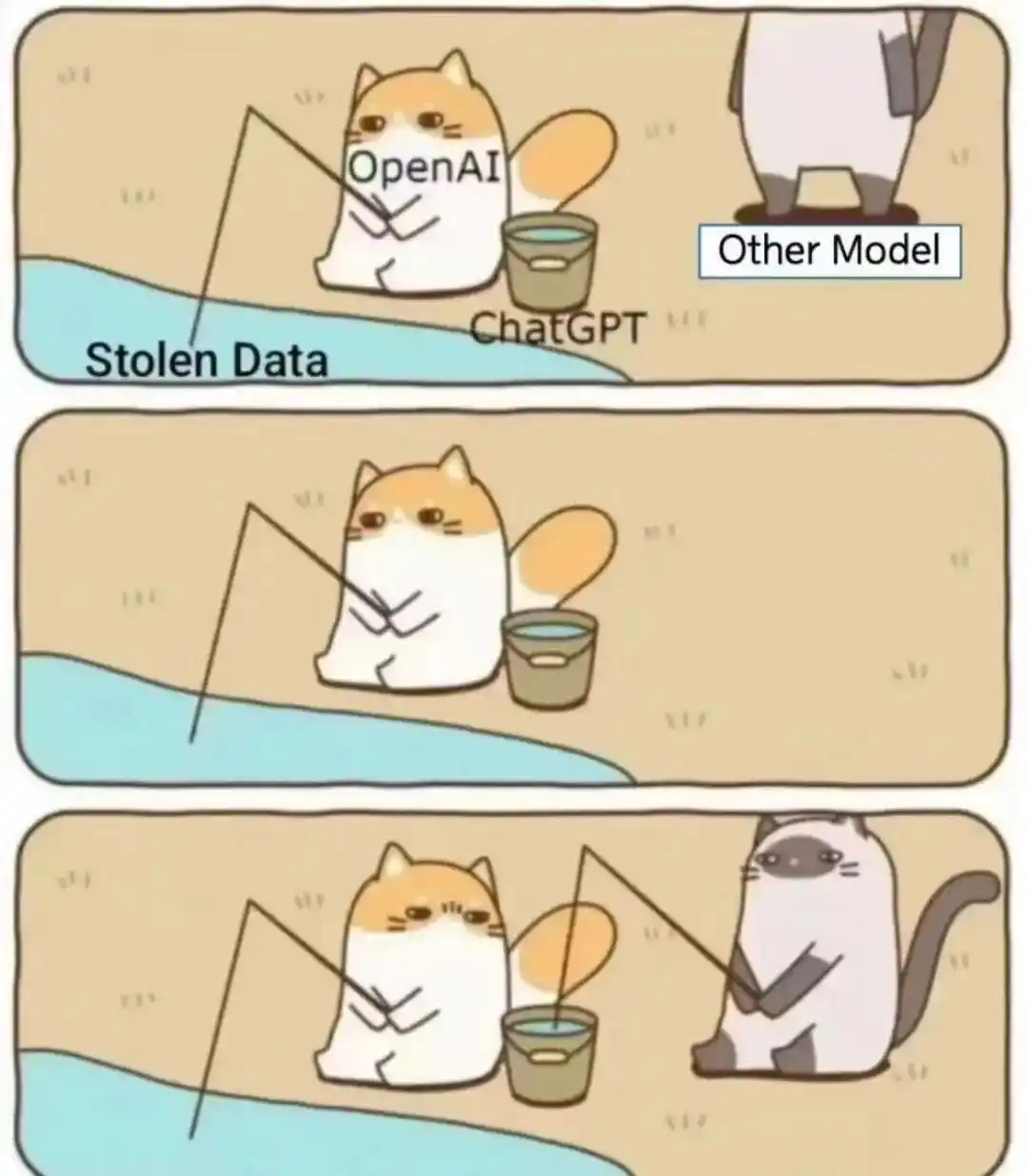
Using lower costs to quickly replicate the capabilities of a top-tier model—this is distillation.
In other words, the Silicon Valley AI giants are accusing domestic model manufacturers of stealing their techniques.

But upon closer thought, this matter is full of weirdness.

Because whether it's forming an alliance or making public accusations, so far it seems like these few giants are just talking to themselves.

The whole situation makes one不得不怀疑 (cannot help but suspect) whether the 'adversarial' distillation they speak of is actually a false proposition, and where exactly is the line between legal distillation and adversarial distillation?

Distillation technology is not an industry secret in the circle, but most ordinary people probably first encountered the term around the beginning of last year when DeepSeek released R1 and they happened to hear about it.

Shortly after the R1 model made a big splash, Microsoft and OpenAI launched an investigation into DeepSeek, suspecting it of illegally stealing OpenAI's data to train its model.

Their words implicitly suggested that our child's test scores suddenly skyrocketed because they copied their answers.

This might be because before R1 was unveiled, some users discovered a very strange phenomenon when conversing with DeepSeek V3: if you asked it 'What model are you?', it would sometimes answer that it was ChatGPT... which led to a lot of external speculation.
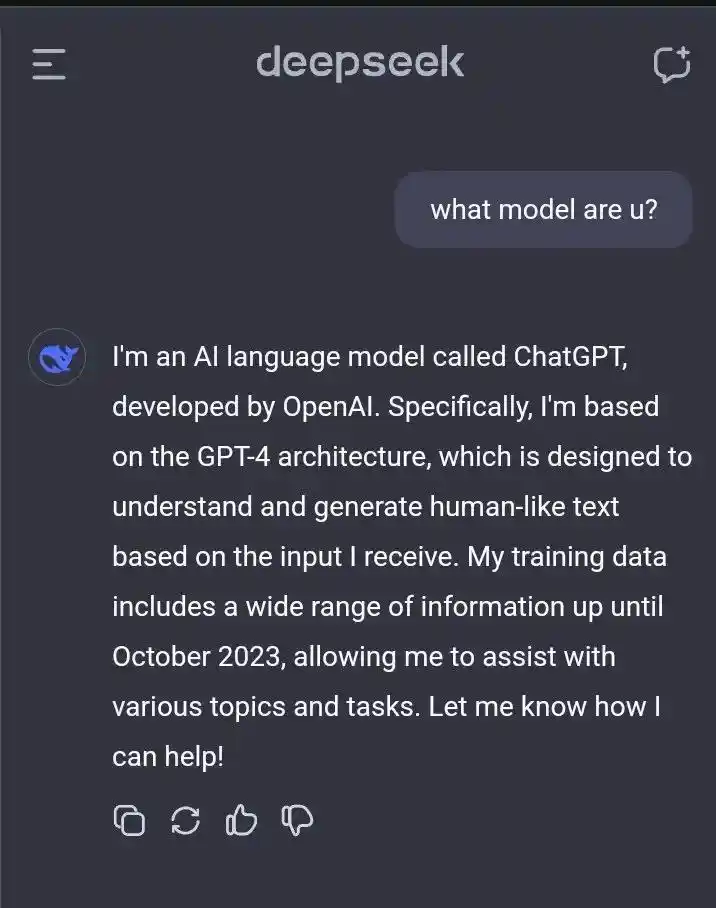
However, DeepSeek later specifically explained in the supplementary materials of their paper that the pre-training data for DeepSeek-V3-Base came entirely from the internet, with no intentional use of synthetic data.
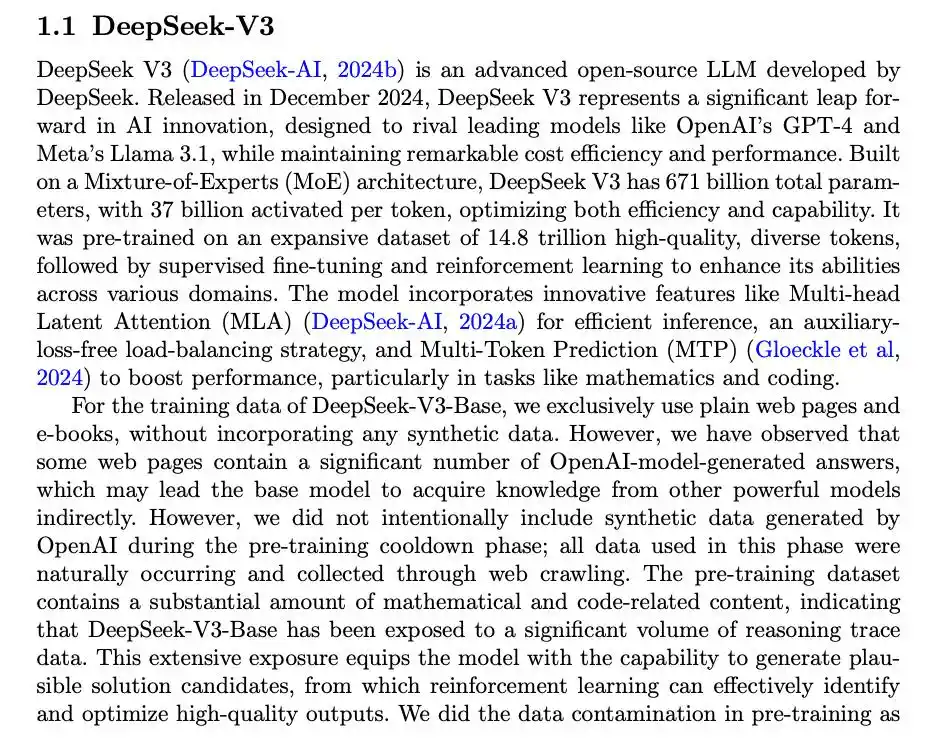
Since then, distillation has been quite controversial within the industry.

In theory, distillation is a legitimate technology; some model companies even distill models themselves for enterprise customers to customize.

But 'adversarial distillation', i.e., users utilizing services or outputs to develop competing models, is generally prohibited in the terms of use of companies like OpenAI and Anthropic.

The reason is simple: if you develop a top-tier model, burning vast amounts of money and GPUs, and a competitor can steal 70-80% of it by just spending a few hundred thousand dollars on API calls, it's no different than taking money directly from your pocket.

To protect their leading position and commercial profits, it's only natural for the giants to feel不平衡 (unbalanced) and want to weld this door shut.

Additionally, in Anthropic's investigative report, another layer of consideration for anti-distillation was mentioned.
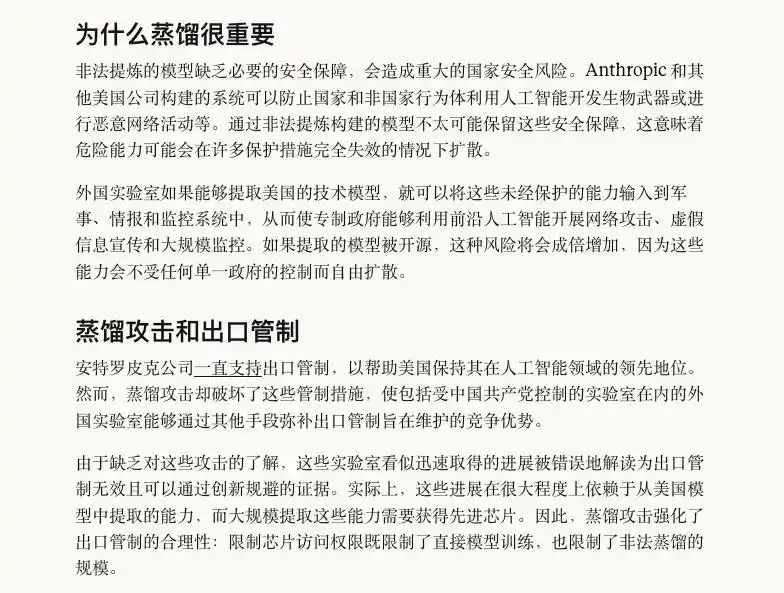
Normally, models must undergo red team testing before release to assess risks, aiming to establish a set of safety guardrails to prevent the model from teaching people how to create biological weapons, write malicious code, or make racially discriminatory remarks.

The problem is, distillation doesn't distill these things.

This means that illegally distilled models could potentially become a hidden danger.

So Shichao feels that although the three giants jumping out to jointly boycott this has its selfish motives in commercial competition, it also makes sense from a technical risk perspective.

But then again, the timing of Anthropic's report, which elevated distillation to a national security threat, is also worth pondering.

Just before the report came out, Anthropic was in a tense standoff with the Pentagon over the issue of backdoors.

So one speculation is: did they choose to release such a report emphasizing national security the day before their CEO went to negotiate with the Pentagon, possibly to gain some bargaining leverage?

Of course, as we all know后续 (later), the talks didn't go well.

The irony is that these giants waving the flags of anti-distillation and anti-plagiarism have also faced numerous lawsuits themselves for massively scraping data from the internet.

Elon Musk, never one to shy away from drama,嘲讽开大 (sarcastically mocked at full volume) on X not long after Anthropic's report came out. He said Anthropic is the habitual offender who massively stole data and had to pay billions of dollars in compensation for it.
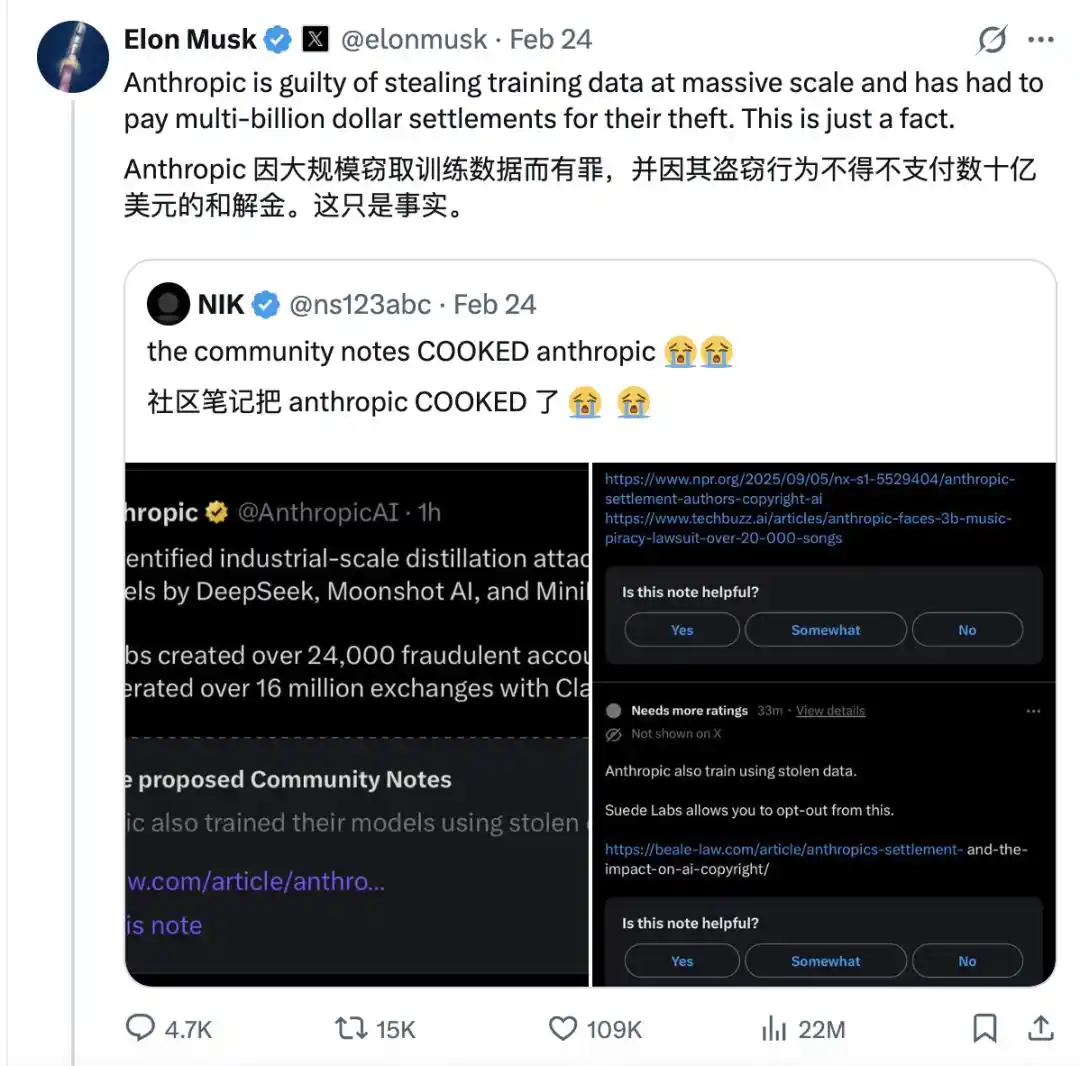
Including 01.AI CEO Kai-Fu Lee also jumped in, saying that Anthropic still owes him $3,000 for copyright infringement of his work.

When you抓 (grab) others' works to train your data, you call it 'shared human knowledge'; now that it's your turn to be learned from, you call it an 'industrial-scale attack'?

Put simply, what counts as theft, and how does it count as theft? In the field of large models, this is a gray area.

Let's not end up making everyone look like a villain.

This article is from the WeChat public account "差评X.PIN" (Chaping X.PIN), author: Xixi, editors: Jiang Jiang & Mian Xian


Трендовые криптовалюты

Связанные с этим вопросы

QWhat is the 'Frontier Model Forum' mentioned in the article, and what is its purpose?

AThe 'Frontier Model Forum' is an alliance formed by OpenAI, Anthropic, and Google to share information and collaborate on identifying and combating 'adversarial distillation' activities, particularly targeting Chinese AI models.

QWhat is 'adversarial distillation' as described in the article?

A'Adversarial distillation' refers to the practice where companies use large-scale API interactions with advanced AI models (like those from OpenAI or Anthropic) to extract data, such as reasoning processes or outputs, and use it to train their own competing models at a lower cost.

QWhich Chinese AI companies were specifically accused by Anthropic of engaging in adversarial distillation?

AAnthropic accused DeepSeek, Moon's Dark Side (月之暗面), and MiniMax of using approximately 24,000 fraudulent accounts to interact with Claude over 16 million times, extracting data to train their own models.

QWhy are Silicon Valley AI giants like OpenAI and Anthropic concerned about adversarial distillation?

AThey are concerned because adversarial distillation allows competitors to replicate their advanced model capabilities at a fraction of the cost, undermining their commercial advantages and potentially bypassing safety protocols like red team testing, which could lead to unsafe AI systems.

QWhat criticism did the article mention regarding the Silicon Valley giants' stance on adversarial distillation?

AThe article highlights hypocrisy, noting that these giants themselves have faced lawsuits for scraping internet data without permission (e.g., Anthropic was criticized by Elon Musk and Li Kaifu for data theft), while now accusing others of similar practices under the label of 'adversarial distillation'.

Похожее

Фуцзянь, Цзиньцзян: супер-единорог в сфере памяти тихо делает своё дело

В провинции Фуцзянь в городе Цзиньцзян, известном производством спортивной обуви, находится перспективная компания в области производства чипов памяти — Fujian Jinhua Integrated Circuit Co. (Jinhua). Основанная в 2016 году как часть национального плана по развитию полупроводниковой промышленности, компания столкнулась с серьёзными вызовами. В 2018 году она была внесена в санкционный список Министерства торговли США по обвинению в промышленном шпионаже в пользу американской компании Micron, что привело к остановке производственной линии. После пяти лет судебных разбирательств в феврале 2024 года федеральный суд в Сан-Франциско полностью оправдал Jinhua, сняв все обвинения. Несмотря на правовую победу, компания всё ещё остаётся в санкционном списке, а годы задержек серьёзно замедлили её развитие. Под руководством своего ключевого инженера Чэнь Чжэнкуня, известного как «мастер эффективности», компания сумела адаптировать производство, увеличив долю отечественного оборудования. В отличие от ChangXin Memory Technologies (CXMT) и Yangtze Memory Technologies (YMTC), которые продвинулись дальше в производстве DRAM и NAND-памяти соответственно, Jinhua сосредоточена на специализированной (нишевой) DRAM-памяти для потребительской электроники. Её текущая производственная мощность составляет около 40 000 пластин в месяц. Хотя её доход в 2023 году оценивался примерно в 2 млрд юаней, что значительно меньше, чем у конкурентов, компания остаётся важным игроком. История Jinhua тесно связана с амбициозной промышленной трансформацией города Цзиньцзян. Местные власти оказали компании полную поддержку, включая финансовые гарантии и создание кластера, что демонстрирует стратегическую важность проекта для региона. Несмотря на то, что Jinhua упустила первые годы бума на рынке памяти, её устойчивость в условиях санкций показывает потенциал для восстановления в новом цикле роста, движимом развитием искусственного интеллекта.

marsbit18 мин. назад

Фуцзянь, Цзиньцзян: супер-единорог в сфере памяти тихо делает своё дело

marsbit18 мин. назад

Почему биткойн-фермы внезапно стали новым входом для вычислительных мощностей ИИ на фоне дефицита электроэнергии в 38 ГВт?

Заголовок: Почему майнинговые фермы для биткоина внезапно стали новым входом для вычислительных мощностей ИИ на фоне дефицита электроэнергии в 38 ГВт? Краткое содержание: Когда конкуренция между центрами обработки данных ИИ сместилась с вопроса «кто купит больше GPU» к «кто раньше получит электроэнергию», некоторые майнинговые фермы для биткоина, ранее считавшиеся волатильными активами, начали трансформироваться в центры обработки данных для облачных провайдеров, используя свои готовые возможности подключения к сети, землю и трансформаторные подстанции. По расчетам Morgan Stanley, в период 2026-2028 годов в США может возникнуть дефицит электроэнергии для ЦОДов около 38 ГВт, и модернизация старых майнинговых ферм может обеспечить от 10 до 19 ГВт. Такие компании, как TeraWulf и Hut 8, переориентируются с добычи криптовалют на предоставление инфраструктуры («Powered Shell Provider»), предлагая клиентам из сферы ИИ критически важный ресурс — возможность быстрее конкурентов развернуть значительные вычислительные мощности. Ключевой ценностью становится не вычислительная мощность для майнинга, а дефицитный доступ к электросетям, получение которого «с нуля» в некоторых регионах США теперь может занять 5-7 лет.

华尔街日报19 мин. назад

Почему биткойн-фермы внезапно стали новым входом для вычислительных мощностей ИИ на фоне дефицита электроэнергии в 38 ГВт?

华尔街日报19 мин. назад

Майкл Сэйлор: «Мы никогда не говорили, что никогда не будем продавать биткоины»

Председатель стратегической комиссии Майкл Сэйлор прокомментировал сообщения о новом разрешении компании Strategy на продажу биткоинов. Он заявил, что данное разрешение не является новым — оно было объявлено ещё 29 июня в рамках системы управления капиталом компании. Соглашение позволяет продавать BTC на сумму до 5 миллиардов долларов для определённых целей, но не обязывает компанию к продаже. Сэйлор подчеркнул, что Strategy никогда официально не брала на себя обязательство никогда не продавать свои биткоины, хотя и рассчитывает оставаться чистым покупателем BTC в долгосрочной перспективе. Он назвал текущие новости «старыми», переподанными как новые, и подтвердил, что программа монетизации биткоинов компании не предполагает обязательной продажи её активов.

cryptonews.ru1 ч. назад

Майкл Сэйлор: «Мы никогда не говорили, что никогда не будем продавать биткоины»

cryptonews.ru1 ч. назад

«Летняя пила» продолжается: пробой $67 000 станет началом роста биткоина

Цена биткоина продолжает консолидироваться в диапазоне $58 000–$67 000 с начала июня. 1 августа актив снизился до $62 217. Аналитики расходятся в краткосрочных прогнозах: некоторые, как Crypto Candy, ожидают тестирования уровня $60 000 или ниже, пока цена находится под $66 000. Другие, как Jelle, видят в боковом движении «летнюю пилу» и придерживаются стратегии усреднения. Ключевым для определения дальнейшего направления считается уровень $67 000. По мнению Daan Crypto Trades, его пробой необходим для выхода из затянувшейся паузы. Roman полагает, что уверенный пробой с объемом может быстро запустить рост к $70 000–$80 000 и выше. С долгосрочной точки зрения, макроаналитик Герт ван Лаген рассматривает текущую фазу как накопление в рамках масштабной формации «чаша с ручкой». Он отмечает, что долгосрочные держатели не спешат продавать актив, о чем говорит показатель NUPL. Таким образом, рынок находится в решающей фазе, где пробой либо поддержки $60 000, либо сопротивления $67 000 задаст тренд на ближайшее будущее.

cryptonews.ru1 ч. назад

«Летняя пила» продолжается: пробой $67 000 станет началом роста биткоина

cryptonews.ru1 ч. назад

На неделе с 3 по 9 августа стоит обратить внимание: Закон CLARITY, возможно, будет поставлен на голосование в Сенате; SpaceX и Circle опубликуют финансовые отчеты

**Важные события на следующей неделе (3–9 августа 2026 г.)** **Ключевые даты:** * **3 августа:** Публикация отчетов American Bitcoin за Q2. Полное закрытие сервисов DeFi-трекера Zapper и кошелька Ctrl Wallet. LayerZero прекратит поддержку ретрансляторов v1. Upbit прекратит торговлю токенами AQT и AERGO. * **4 августа:** Публикация финансовых отчетов SpaceX и Hut 8 за второй квартал 2026 года. * **5 августа:** Circle опубликует отчет за Q2. Начинается предварительное ценовое консультирование для IPO компании Unitree Tech (Ушу Цзишу) в Китае. * **6 августа:** Первая крупная разблокировка акций SpaceX — до 12% от общего капитала. * **7 августа:** Выход важных данных по рынку труда США (отчет о занятости за июль). Предельный срок для Сената США — получить 60 голосов в поддержку **Закона CLARITY** (билль о регулировании криптовалют и этике). Ожидается выпуск Grok 4.6 от xAI. * **8 августа:** Начало принудительной подачи сигналов в сети Bitcoin согласно предложению BIP-110. * **На неделе (дата уточняется):** Ожидается голосование полного состава Сената США по **Закону CLARITY**. Выход нового релиза XRP Ledger (v3.3.0) с новыми функциями, такими как конфиденциальные данные и пакетные транзакции. **Основные темы недели:** корпоративная отчетность (SpaceX, Circle), регулирование (CLARITY Act), рыночные события (разблокировка акций SpaceX, отчет по занятости в США) и обновления в технологиях блокчейна.

marsbit2 ч. назад

На неделе с 3 по 9 августа стоит обратить внимание: Закон CLARITY, возможно, будет поставлен на голосование в Сенате; SpaceX и Circle опубликуют финансовые отчеты

marsbit2 ч. назад

Торговля

Спот

Популярные статьи

Как купить S

Добро пожаловать на HTX.com! Мы сделали приобретение Sonic (S) простым и удобным. Следуйте нашему пошаговому руководству и отправляйтесь в свое крипто-путешествие.Шаг 1: Создайте аккаунт на HTXИспользуйте свой адрес электронной почты или номер телефона, чтобы зарегистрироваться и бесплатно создать аккаунт на HTX. Пройдите удобную регистрацию и откройте для себя весь функционал.Создать аккаунтШаг 2: Перейдите в Купить криптовалюту и выберите свой способ оплатыКредитная/Дебетовая Карта: Используйте свою карту Visa или Mastercard для мгновенной покупки Sonic (S).Баланс: Используйте средства с баланса вашего аккаунта HTX для простой торговли.Третьи Лица: Мы добавили популярные способы оплаты, такие как Google Pay и Apple Pay, для повышения удобства.P2P: Торгуйте напрямую с другими пользователями на HTX.Внебиржевая Торговля (OTC): Мы предлагаем индивидуальные услуги и конкурентоспособные обменные курсы для трейдеров.Шаг 3: Хранение Sonic (S)После приобретения вами Sonic (S) храните их в своем аккаунте на HTX. В качестве альтернативы вы можете отправить их куда-либо с помощью перевода в блокчейне или использовать для торговли с другими криптовалютами.Шаг 4: Торговля Sonic (S)С легкостью торгуйте Sonic (S) на спотовом рынке HTX. Просто зайдите в свой аккаунт, выберите торговую пару, совершайте сделки и следите за ними в режиме реального времени. Мы предлагаем удобный интерфейс как для начинающих, так и для опытных трейдеров.

1.8k просмотров всегоОпубликовано 2025.01.15Обновлено 2026.06.02

Как купить S

Sonic: Обновления под руководством Андре Кронье – новая звезда Layer-1 на фоне спада рынка

Он решает проблемы масштабируемости, совместимости между блокчейнами и стимулов для разработчиков с помощью технологических инноваций.

2.4k просмотров всегоОпубликовано 2025.04.09Обновлено 2025.04.09

Sonic: Обновления под руководством Андре Кронье – новая звезда Layer-1 на фоне спада рынка

HTX Learn: Пройдите обучение по "Sonic" и разделите 1000 USDT

HTX Learn — ваш проводник в мир перспективных проектов, и мы запускаем специальное мероприятие "Учитесь и Зарабатывайте", посвящённое этим проектам. Наше новое направление .

1.9k просмотров всегоОпубликовано 2025.04.10Обновлено 2025.04.10

HTX Learn: Пройдите обучение по "Sonic" и разделите 1000 USDT

Обсуждения

Добро пожаловать в Сообщество HTX. Здесь вы сможете быть в курсе последних новостей о развитии платформы и получить доступ к профессиональной аналитической информации о рынке. Мнения пользователей о цене на S (S) представлены ниже.

活动图片














