This report is written by Tiger Research, February 2026. Following the airstrike incident in Iran, the price of gold rose, while the price of Bitcoin plummeted. Can we still believe Bitcoin is 'digital gold'? We will explore the conditions Bitcoin must meet to become the 'next gold'.
Key Takeaways
- In every geopolitical crisis, the price of gold rises, and the price of Bitcoin falls. After six tests, the 'digital gold' narrative has never been confirmed by data.
- Countries hoard gold but exclude Bitcoin from their reserves. For investors, Bitcoin exhibits asymmetry: it falls with stocks but does not rise with them. Three structural asymmetries prevent Bitcoin from gaining safe-haven status: derivative excess (market structure), dominance of leveraged traders (participant composition), and lack of a behavioral track record (behavioral accumulation).
- Bitcoin is not a safe-haven asset, but it is a 'useful asset in a crisis,' functioning effectively when borders are closed or banks fail.
- If these three asymmetries diminish, Bitcoin may no longer be a replica of gold but could become a全新的全新的 (brand new) 'next-generation gold.' Generational shift and the widespread application of algorithms are key factors that could accelerate this process.
1. Is Bitcoin Really 'Digital Gold'?
On February 28, 2026, the US and Israel launched airstrikes against Iran. Immediately after the operation was announced, the price of gold rose. In contrast, the price of Bitcoin plummeted to $63,000 that day before recovering within 24 hours.
The same event, yet completely opposite reactions.
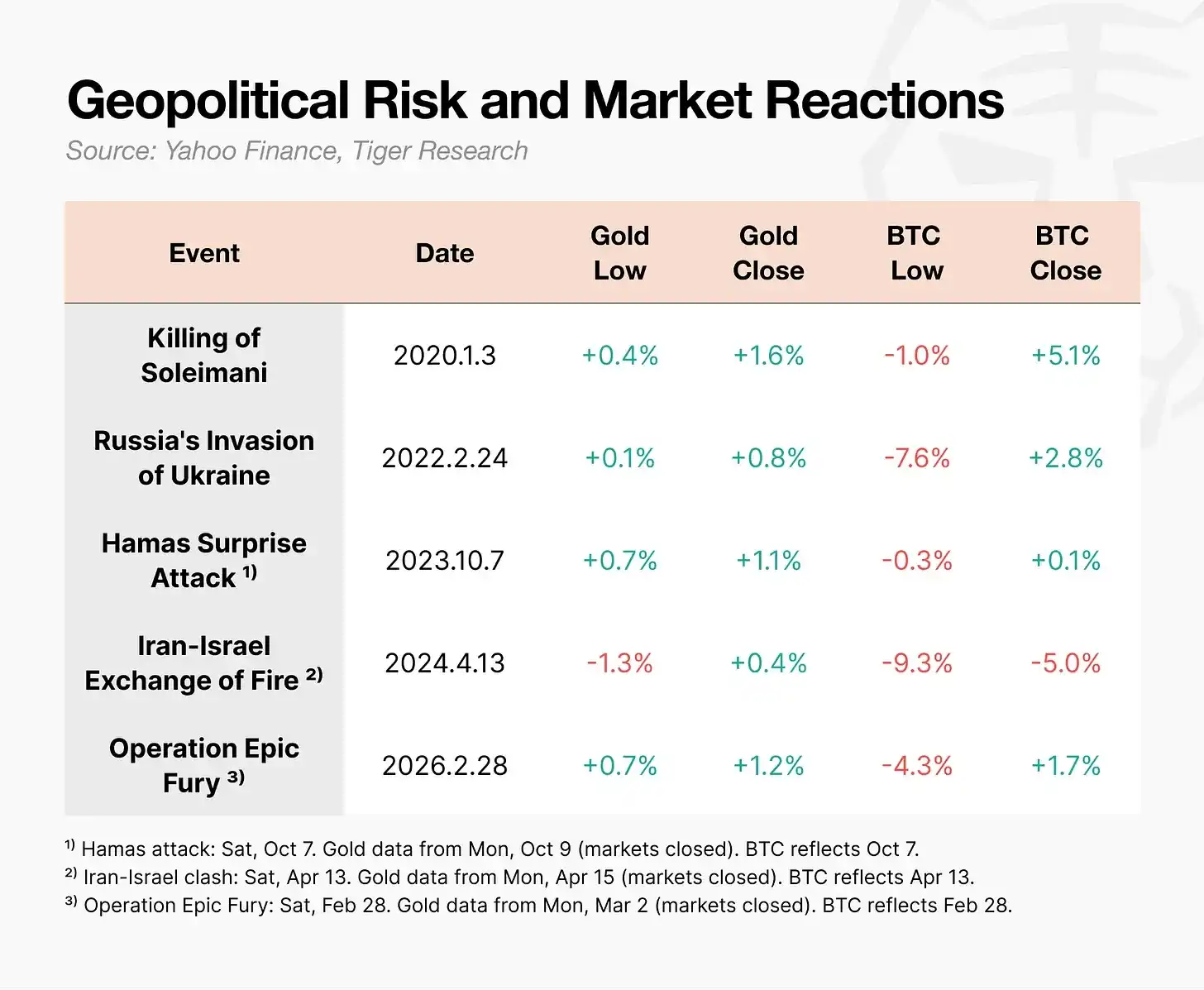
During geopolitical shocks like war, Bitcoin's movement differs from gold's.
Bitcoin often recovers quickly after an initial drop, but the chain reaction triggered by forced liquidations of leveraged traders exacerbates the decline. During the Iran-Israel conflict, Bitcoin's intraday drop reached 9.3%; during the Ukraine war, it fell by 7.6%. This stands in stark contrast to gold, which rose during the same periods.
Bitcoin is often the first asset to fall at the onset of a crisis. Can we really still call it 'digital gold'?
2. Bitcoin is Not 'Digital Gold' for Nations or Investors.
Bitcoin was not originally designed to be 'digital gold.' The title of Satoshi Nakamoto's 2008 whitepaper was 'Bitcoin: A Peer-to-Peer Electronic Cash System.' Its starting point was as a transfer mechanism, not a store of value.
The concept of 'digital gold' as we know it today gained popularity during the period of zero interest rates and quantitative easing in 2020. As fears of currency devaluation peaked, Bitcoin attracted attention as a store of value. However, in practice, neither nations nor investors treat Bitcoin as 'digital gold.'
2.1. Sovereign Nations: Hoard Gold, But Not Bitcoin
Data from the World Gold Council shows that central banks have never stopped buying gold year after year. However, no major central bank includes Bitcoin in its full reserve assets.
Some might counter that the US formally established a 'Strategic Bitcoin Reserve' via executive order in March 2025. The text of the order even noted that 'Bitcoin is often referred to as 'digital gold.'' But the details tell a different story. The reserve is limited to assets seized through criminal and civil forfeiture proceedings. The government is not purchasing new Bitcoin but merely holding seized Bitcoin instead of selling it.
Notably, as the attractiveness of US Treasury bonds declines, Europe and China are actively buying gold, but Bitcoin has not yet made their list of alternatives.
2.2 Investors: Falls Together, Doesn't Rise Together
The second half of 2025 was crucial. The Nasdaq hit a record high, while Bitcoin plummeted over 30% from its October high of $125,000. These two assets began to decouple.
But the real issue is not the decoupling itself, but the direction. Bitcoin falls when stocks fall but does not rise when stocks rise. For investors, this is the worst combination. There is no point in holding an asset that bears downside risk but misses upside gains. Bitcoin is far from a safe haven; even as a risk asset, its appeal is questionable.
3. Why Bitcoin Has Failed to Become 'Digital Gold'
A safe-haven asset is not merely one whose price rises. Academically, it refers to an asset whose correlation with other assets drops to zero or even turns negative during extreme economic downturns. The key question is whether its reaction in a crisis is predictable. Measured by this standard, the gap between gold and Bitcoin is evident.
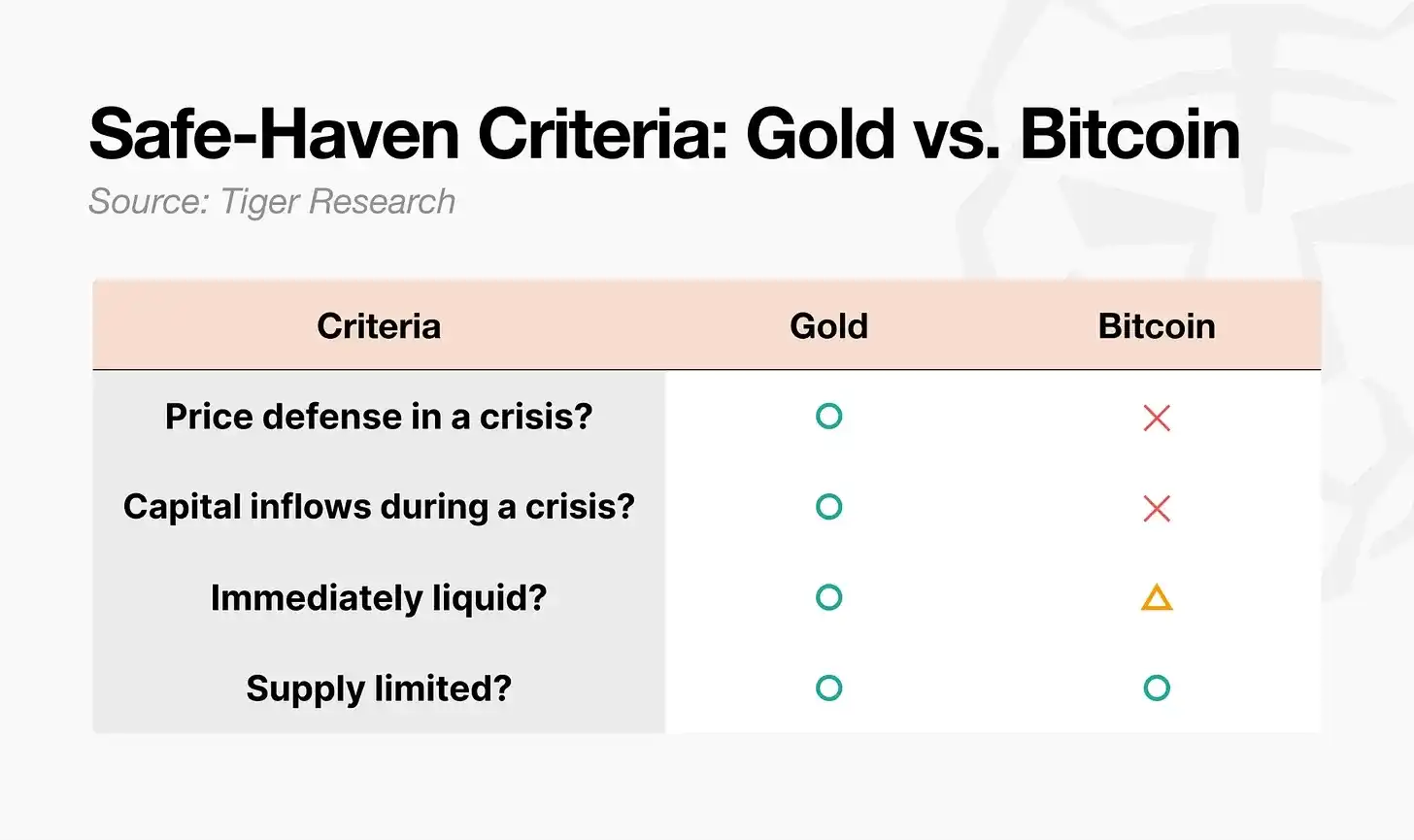
Gold meets all four requirements. Bitcoin clearly meets only one: fixed supply. Liquidity is conditional. The other two requirements are not met. Three structural asymmetries can explain this gap.
- Market Structure Asymmetry: Physical demand for gold supports a price floor, and its futures have lower leverage. Bitcoin's derivative trading volume is about 6.5 times its spot trading volume, and its market trades 24/7, making it often the first asset sold off when a crisis hits.
- Participant Asymmetry: The buyers during gold crises are patient capital, such as central banks, pension funds, and sovereign wealth funds. The main participants in the Bitcoin market are leveraged traders and hedge funds—capital that is the first to flee when a crisis erupts.
- Behavioral Accumulation Asymmetry: The behavioral pattern of 'buying gold in a crisis' has repeated for decades, eventually becoming a fixed pattern. Bitcoin needs time to earn the same trust.
4. Not Safe, But Proven Useful
In terms of safety, it's hard to call Bitcoin 'digital gold.' But its role in crises is undeniable.
After the outbreak of the Russia-Ukraine war in 2022, the Ukrainian central bank immediately restricted electronic transfers and limited ATM withdrawals. Bank branches closed, and people couldn't even access their deposits. Some refugees crossed the border carrying USB drives with Bitcoin seed phrases. Reports indicate that upon arrival in Poland, they exchanged Bitcoin for local currency via Bitcoin ATMs or P2P transactions to cover living expenses.
The UN Refugee Agency went further, distributing the stablecoin USDC to displaced persons and running a program allowing them to exchange it for local currency at MoneyGram outlets. During the 2026 'Operation Epic Fury,' outflows from Iran's largest crypto exchange, Nobitex, surged 700% immediately after the airstrikes.
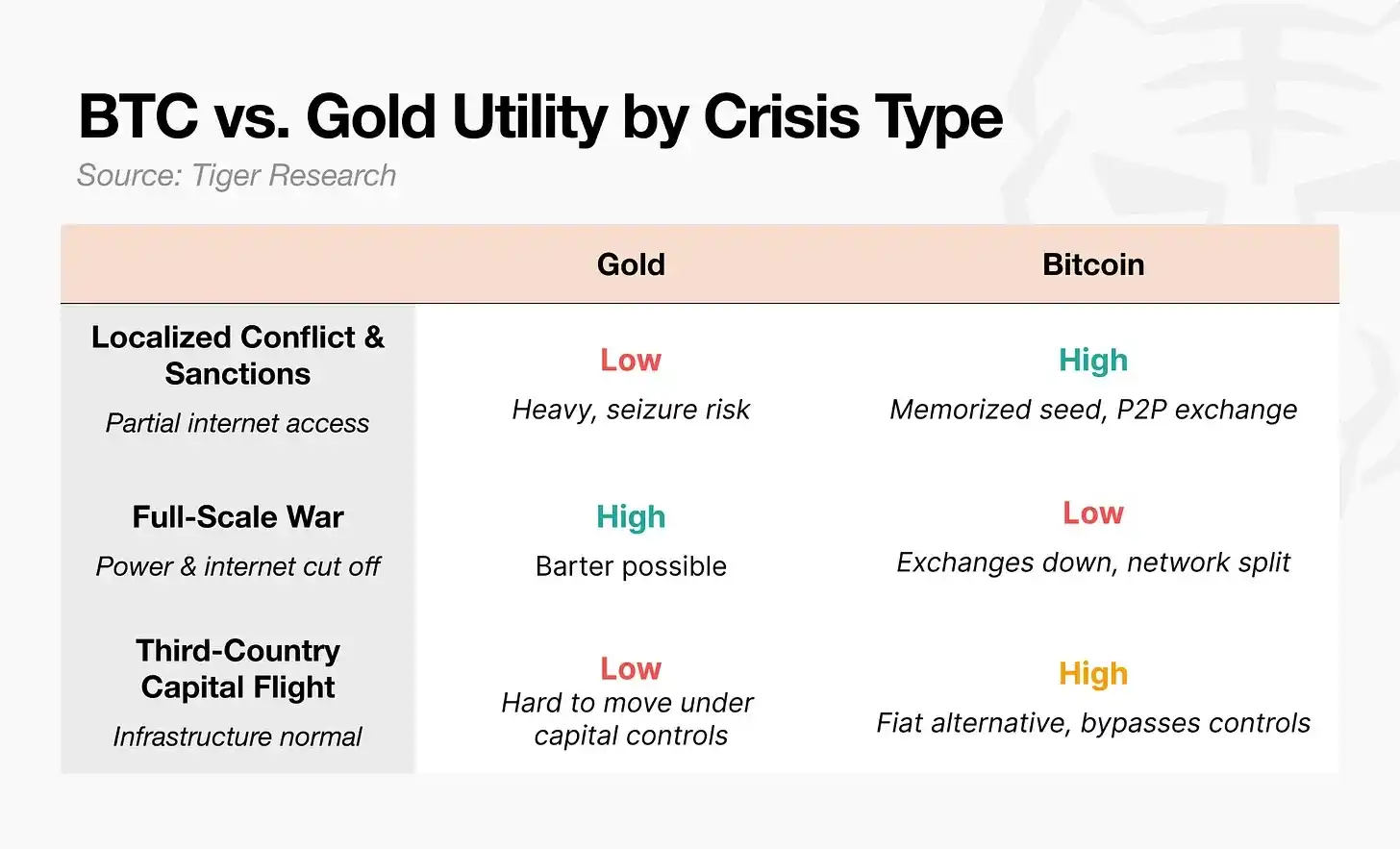
These cases show people turn to Bitcoin not because it is a safe-haven asset, but because it functions when the financial system fails.
In finance, a 'safe-haven asset' refers to one whose price remains stable during a crisis. This is different from an asset that can be used during a crisis. Bitcoin clearly provides functional value for transfer and remittance in wartime, but it cannot guarantee its own price. What constitutes a safe-haven asset is not utility, but the predictability of price behavior. Bitcoin has the former but cannot guarantee the latter.
5. Bitcoin's 'Next-Generation Gold' Scenario
In every crisis, Bitcoin's movement is the opposite of gold's. Neither nations nor investors see it as 'digital gold.' Yet, its utility in regions with closed borders and shuttered banks is undeniable. Given this potential, the path to 'next-generation gold' opens if these three asymmetries diminish.
5.1 Market Structure Shift
Derivative trading volume being 6.5 times spot volume triggers chain sell-offs in every crisis. Recently, futures open interest has declined, and price discovery mechanisms show signs of shifting towards spot and ETFs. But the real test is whether leverage will be rebuilt in the next bull market.
5.2. Participant Shift
After the approval of spot ETFs in 2024, institutional capital flooded in, and Bitcoin became a mainstream financial asset. But this created a paradox: the more institutional investors include Bitcoin in their portfolios, the more likely it is to be sold off alongside stocks during risk-off sentiment. Bitcoin's accessibility increased, but its independent price volatility disappeared. This is the financialization paradox.
Gold ETFs have also become mainstream, yet in crises, gold moves opposite to stocks because 'buying in a crisis' is a pattern formed over half a century. To break this paradox, the participant composition must shift from leveraged traders to patient capital.
There is an often-overlooked variable: generational shift. When Generation Z begins to inherit and manage real wealth, gold might remain their parents' safe haven. This generation's first investment account was not a securities account but a crypto exchange. For a generation whose first接触 (contact with) asset was Bitcoin, they might instinctively choose Bitcoin over gold in a crisis. This participant shift might not begin with institutional decisions but with generational behavioral change.
5.3 Behavioral Accumulation Shift
After the Nixon Shock, the 'buy gold in a crisis' pattern took about 50 years to form. Does Bitcoin need the same time? Not necessarily. This US-Iran conflict was the sixth test, and the result was the same again: an intraday plunge, then a rebound. As this pattern continues, belief grows that 'it will fall, but it always recovers.'
A more important variable is algorithms. A significant portion of Bitcoin trading volume today comes from AI agents and algorithmic trading. If a 'buy Bitcoin in a crisis' strategy is embedded in these algorithms, this pattern could form without the accumulation of human behavior. In this case, trust is built in code before it is built in people.
Bitcoin is not 'digital gold' today. But if market structure, participant composition, and behavioral accumulation patterns shift based on its proven utility, it has the potential to become 'next-generation gold.' It is not a replica of gold, but the birth of a全新 category.







