Thin Profit Business? No, DeFi Lending Protocols Are the Underestimated 'King of Value'

marsbitОпубликовано 2025-12-25Обновлено 2025-12-25

Введение

In the DeFi lending ecosystem, protocols like Aave and SparkLend capture more value than downstream vaults and even upstream asset issuers, challenging the notion that distribution is king. Despite perceptions of thin margins, lending protocols generate higher revenues than the vaults built on top of them. For example, Ether.fi’s vault pays Aave $4.5M in annual interest fees while earning only $1.07M in platform fees. Similarly, Fluid and Mellow vaults contribute significantly more value to lending protocols than they capture themselves. Even compared to asset issuers like Lido, lending protocols often yield greater economic benefits due to their central role in the credit stack. The true moat of lending protocols lies in their position as the highest value-capture layer in the on-chain credit value chain.

Original Title: Why the defi lending moat is bigger than you think

Original Author: Silvio, Crypto Researcher

Original Compilation: Ding Dang, Odaily Planet Daily

As the market share of Vaults and Curators continues to grow in the DeFi world, the market has begun to question: Are lending protocols being squeezed for profit margins? Is lending no longer a good business?

But if we shift our perspective back to the entire on-chain credit value chain, the conclusion is quite the opposite. Lending protocols still occupy the most solid moat in this value chain. We can quantify this with data.

On Aave and SparkLend, the interest fees that Vaults pay to lending protocols actually exceed the revenue generated by the Vaults themselves. This fact directly challenges the mainstream narrative that "distribution is king."

At least in the lending space, distribution is not king.

Simply put: Aave not only earns more than the various Vaults built on top of it, but also more than the asset issuers used for lending, such as Lido and Ether.fi.

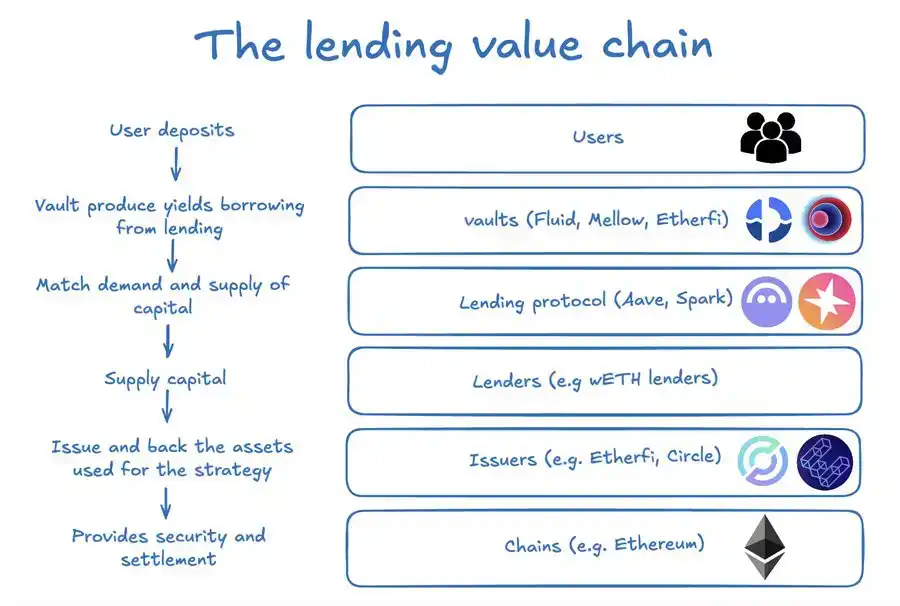
To understand why, we need to deconstruct the complete value chain of DeFi lending and re-examine the value capture capabilities of each role by following the flow of funds and fees.

Deconstructing the Lending Value Chain

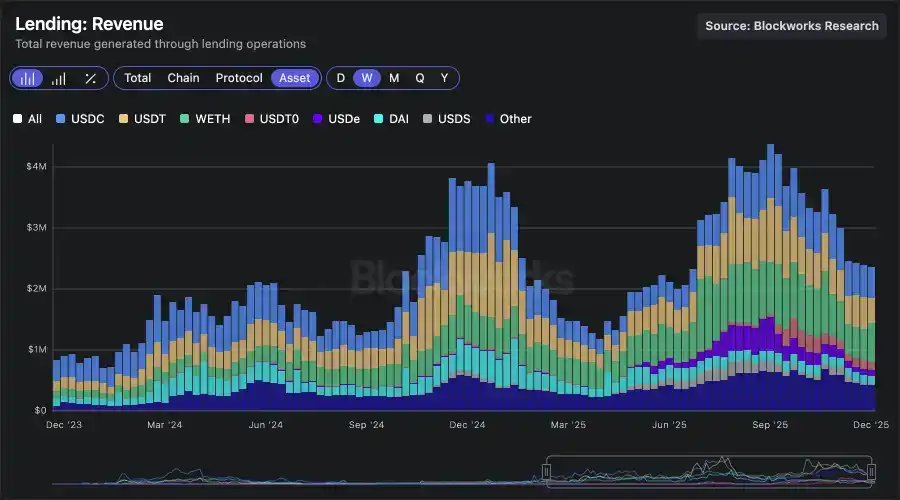
The annualized revenue scale of the entire lending market has exceeded $100 million. This value is not generated by a single link but is co-created by a complex stack: the underlying settlement blockchain, asset issuers, capital lenders, the lending protocol itself, and the Vaults responsible for distribution and strategy execution.

As mentioned in previous articles, a large number of use cases in the current lending market originate from basis trading and liquidity mining opportunities, and we have deconstructed the main strategy logic.

So, who is actually "demanding" the capital in the lending market?

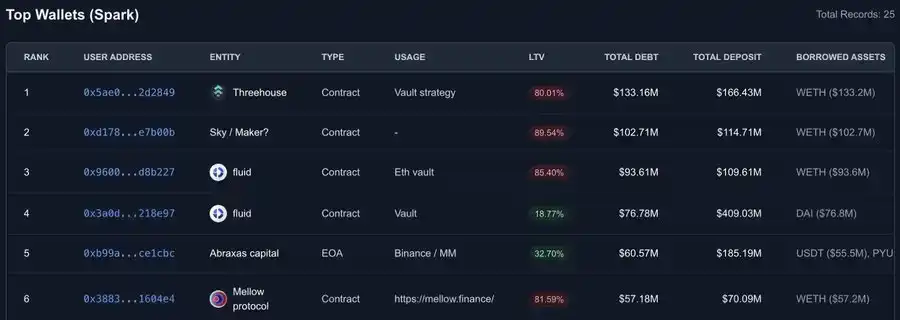
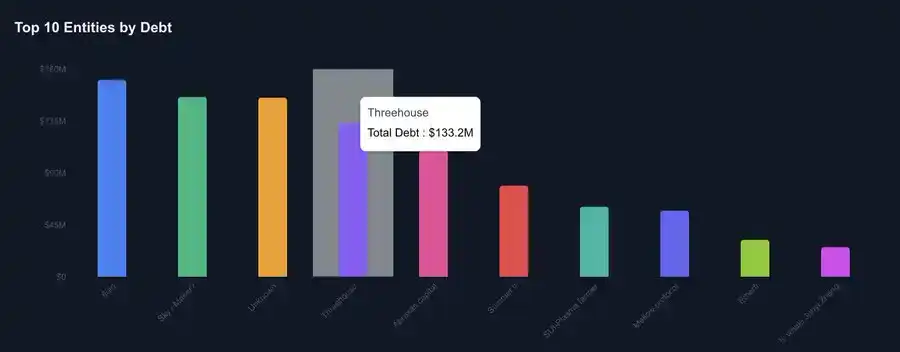
I analyzed the top 50 wallet addresses on Aave and SparkLend and labeled the main borrowers.

1. The largest borrowers are various Vaults and strategy platforms like Fluid, Treehouse, Mellow, Ether.fi, Lido (which are also asset issuers). They control the distribution capability to end-users, helping users obtain higher yields without having to manage complex loops and risks themselves.

2. There are also large institutional capital providers, such as Abraxas Capital, which deploy external capital into similar strategies. Their economic model is essentially very close to that of Vaults.

But Vaults are not the whole story. At least the following participants are involved in this chain:

· Users: Deposit assets, hoping to obtain additional yields through Vaults or strategy managers.

· Lending Protocols: Provide infrastructure and liquidity matching, generating protocol revenue by charging interest to the borrowing side and taking a certain percentage.

· Lenders: Capital providers, who can be either ordinary users or other Vaults.

· Asset Issuers: Most on-chain lending assets have underlying supported assets that themselves generate yield, part of which is captured by the issuer.

· Blockchain Network: The underlying "rail" where all activities occur.

Lending Protocols Earn More Than Downstream Vaults

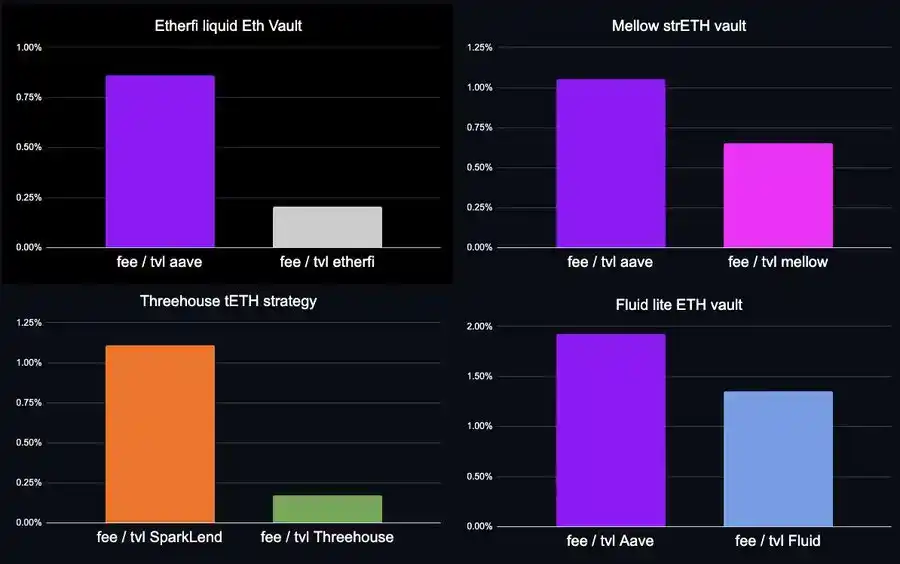
Take Ether.fi's ETH liquid staking Vault as an example. It is the second-largest borrower on Aave, with an outstanding loan size of approximately $1.5 billion. The strategy itself is very typical:

· Deposit weETH (approx. +2.9%)

· Borrow wETH (approx. –2%)

· The Vault charges a 0.5% platform management fee on TVL.

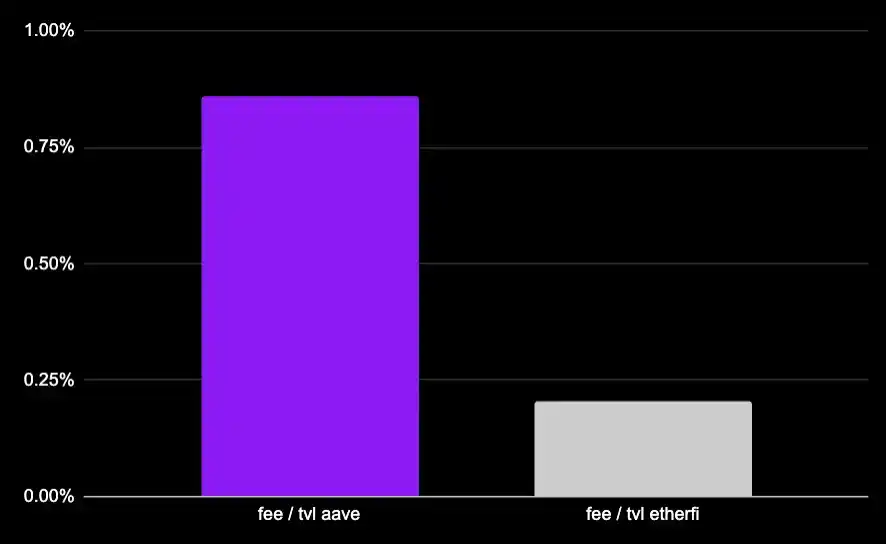
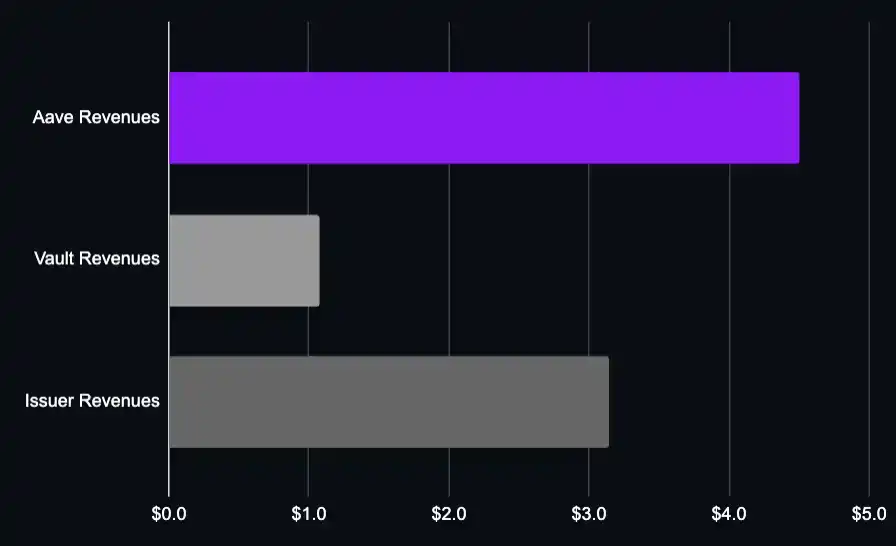
Out of Ether.fi's total TVL, approximately $215 million is the net liquidity actually deployed on Aave. This portion of TVL brings in about $1.07 million in platform fee revenue annually for the Vault.

However, at the same time, this strategy pays about $4.5 million in interest fees to Aave annually (calculation: $1.5 billion borrowed × 2% borrowing APY × 15% reserve factor).

Even for one of the largest and most successful loop strategies in DeFi, the value captured by the lending protocol is several times that of the Vault.

Of course, Ether.fi is also the issuer of weETH, and this Vault itself directly creates demand for weETH.

But even considering the Vault strategy yield + asset issuer yield together, the economic value created by the lending layer (Aave) is still higher.

In other words, the lending protocol is the link that creates the largest incremental value in the entire stack.

We can perform the same analysis on other commonly used Vaults:

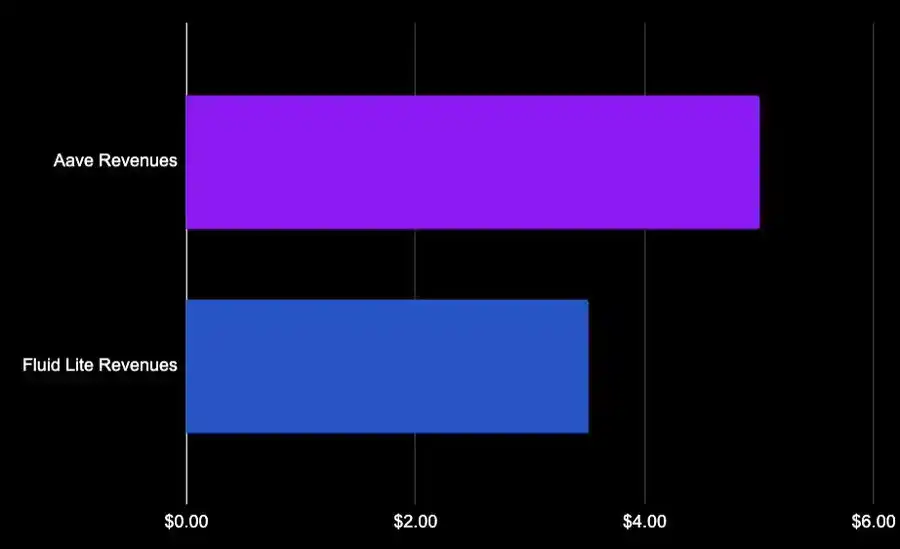
Fluid Lite ETH: 20% performance fee + 0.05% exit fee, no platform management fee. Borrows $1.7 billion wETH from Aave, pays about $33 million in interest, of which about $5 million goes to Aave. Fluid's revenue is close to $4 million.

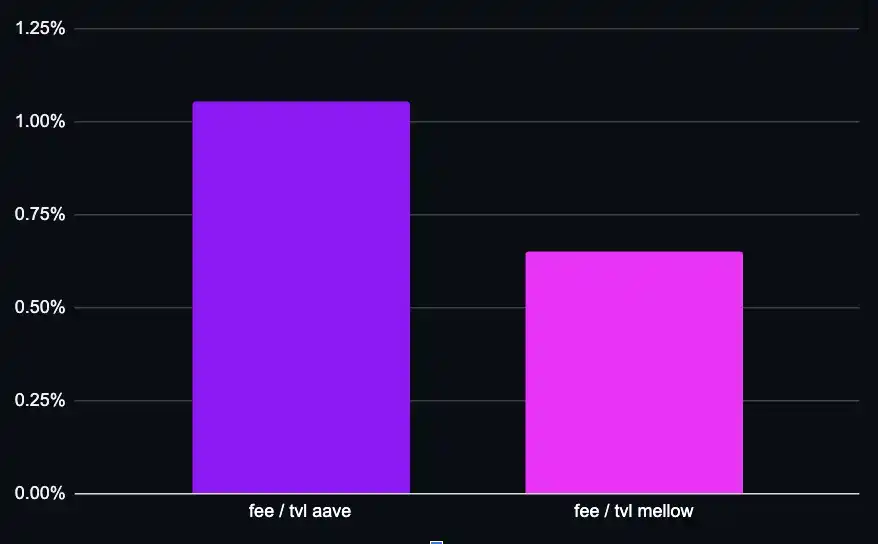
Mellow Protocol strETH charges a 10% performance fee, with a borrowing size of $165 million and a TVL of only about $37 million. Once again, we see that in terms of TVL, the value captured by Aave exceeds that of the Vault itself.

Let's look at another example. On SparkLend, the second-largest lending protocol on Ethereum, Treehouse is one of the important participants, running an ETH loop strategy:

· TVL approx. $34 million

· Borrows $133 million

· Charges a performance fee only on marginal yields above 2.6%

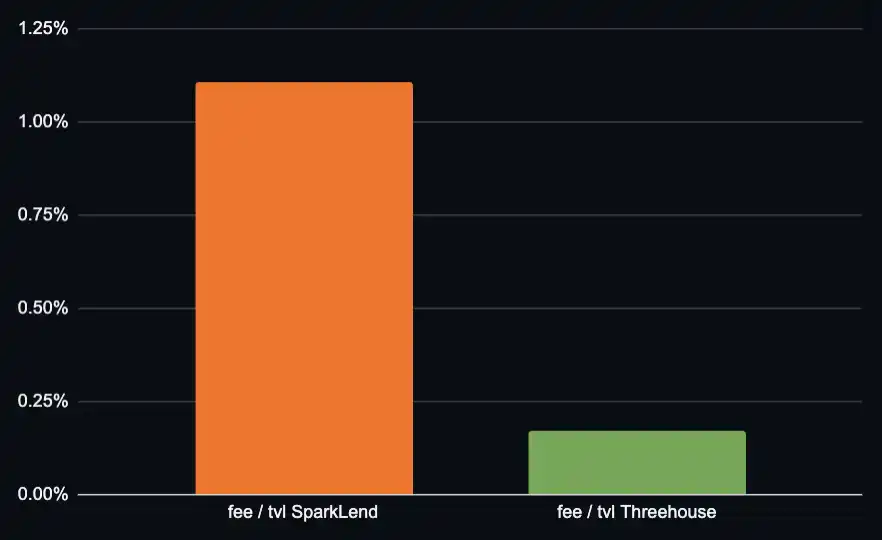
SparkLend, as a lending protocol, has higher value capture capability in terms of TVL than the Vault.

The pricing structure of Vaults greatly affects their own capturable value; but for lending protocols, their revenue depends more on the nominal borrowing size, which is relatively stable.

Even shifting to USD-denominated strategies, although the leverage is lower, the higher interest rates often offset this impact. I don't believe the conclusion would fundamentally change.

In relatively closed markets, more value might flow to curators, such as Stakehouse Prime Vault (26% performance fee, with incentives provided by Morpho). But this is not the end state of Morpho's pricing mechanism, and curators themselves are also engaging in distribution collaborations with other platforms.

Lending Protocol vs. Asset Issuer

So the question arises: Is it better to be Aave or Lido?

This question is more complex than comparing Vaults because staking assets not only generate yield themselves but also indirectly create stablecoin interest income for the protocol through the lending market. We can only make approximate estimates.

Lido has approximately $4.42 billion in assets in Ethereum core markets supporting lending positions, with annualized performance fee revenue of about $11 million.

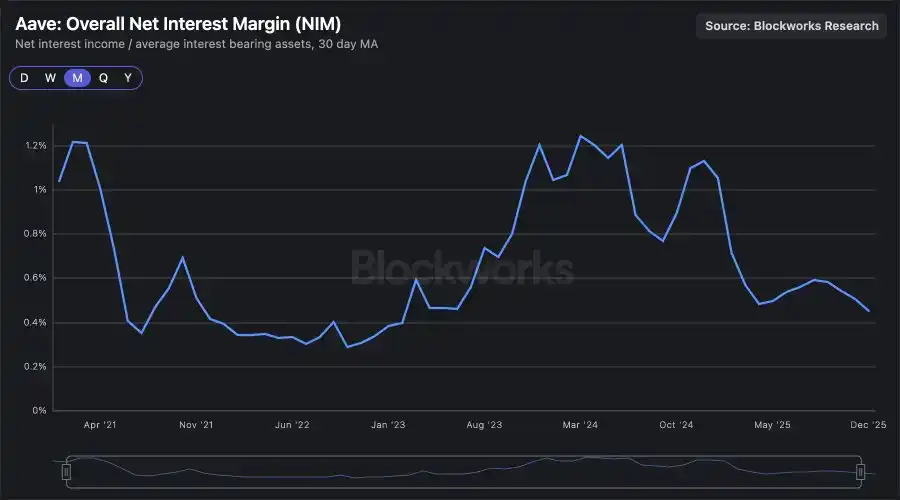
These positions roughly equally support ETH and stablecoin lending. At the current net interest margin (NIM) of about 0.4%, the corresponding lending yield is about $17 million, which is already significantly higher than Lido's direct revenue (and this is at a historically low NIM level).

The True Moat of Lending Protocols

If we only compare using the deposit profit model of traditional finance, DeFi lending protocols seem to be a low-margin industry. But this comparison ignores where the real moat lies.

In the on-chain credit system, lending protocols capture more value than the downstream distribution layer and, overall, more than the upstream asset issuers.

Viewed in isolation, lending seems like a thin-profit business; but placed within the complete credit stack, it is the layer with the strongest value capture capability relative to all other participants—Vaults, issuers, distribution channels.

Связанные с этим вопросы

QAccording to the article, which layer in the DeFi lending stack captures the most value?

AThe lending protocol layer (e.g., Aave, SparkLend) captures the most value in the DeFi lending stack, exceeding the value captured by downstream vaults/curators and even upstream asset issuers.

QWhat data point is used to challenge the 'distribution is king' narrative in DeFi lending?

AThe data point is that vaults pay more in interest fees to lending protocols (like Aave and SparkLend) than the vaults themselves generate in revenue from their users.

QWho are the primary borrowers on major lending protocols like Aave and SparkLend?

AThe primary borrowers are vaults and strategy platforms (e.g., Ether.fi, Lido, Fluid, Mellow) and large institutional capital providers (e.g., Abraxas Capital) that deploy capital into yield-generating strategies.

QIn the Ether.fi vault example, how much does the vault pay to Aave annually compared to its own fee income?

AThe Ether.fi vault pays approximately $4.5 million in annual interest fees to Aave, while it only generates about $1.07 million in platform fee revenue from its users.

QWhat is identified as the true moat (competitive advantage) of DeFi lending protocols?

AThe true moat is their position as the layer that captures the most economic value in the entire on-chain credit value chain, making them more valuable than the businesses built on top of them (vaults) or the asset issuers that supply them.

Похожее

Four Questions on the Zcash Orchard Vulnerability: Was It Exploited? Can Funds Be Recovered? Is the Supply Verifiable? And Are There Others?

Zcash Orchard Bug: Four Key Questions Answered A critical forgery vulnerability was discovered in Zcash's Orchard privacy pool, raising four major concerns for users. 1. **Was the Orchard bug exploited?** The likelihood is considered low. The bug was found proactively using advanced AI-assisted tools and was promptly patched, limiting any potential attack window. If exploitation had occurred, evidence would likely have surfaced by now. 2. **Can legitimate Orchard funds be recovered?** It is believed so, based on the assessment that the bug was not exploited. If forgery did happen, existing "turnstile" mechanisms could prevent full recovery of legitimate funds if forged coins were moved out first, though this scenario is deemed unlikely. Users can choose to move funds, but this carries risks like loss of privacy or new wallet/software issues. 3. **Can users verify Zcash's total supply?** Currently, no. The vulnerability's prior existence prevented independent verification of the shielded supply. The proposed "Ironwood" network upgrade will restore this ability by sealing the Orchard pool, allowing anyone running a node to verify that the circulating ZEC does not exceed the correct amount. 4. **Are there other forgery bugs?** Ongoing intensive audits by multiple teams, including AI-assisted analysis, have not found additional forgery vulnerabilities, increasing confidence that none remain. Further work and collaborations are planned to provide additional guarantees. In conclusion, while the team assesses that exploitation was unlikely and the supply is safe, the upcoming upgrade is critical to restore users' ability to independently verify Zcash's supply integrity, moving away from reliance on trust.

marsbit20 мин. назад

Four Questions on the Zcash Orchard Vulnerability: Was It Exploited? Can Funds Be Recovered? Is the Supply Verifiable? And Are There Others?

marsbit20 мин. назад

Four Questions on the Zcash Orchard Vulnerability: Was it Exploited? Can Funds Be Recovered? Is the Supply Verifiable? Are There Others?

**Summary: Zcash Orchard Vulnerability Analysis** A critical forgery vulnerability was recently discovered in Zcash's Orchard shielded pool, raising concerns about the coin's supply and user funds. The developers, led by Zcash Open Development Labs, acted swiftly to temporarily freeze the pool and deploy a fix. The article addresses four key questions: 1. **Was the vulnerability exploited?** While unknown, the developers believe it is unlikely for several reasons: the bug was difficult to find, using advanced AI tools; the fix was deployed quickly; and typical crypto exploits are fast, with no evidence of abnormal outflows. 2. **Can legitimate Orchard funds be recovered?** If the bug was not exploited, all funds are safe. If exploited, a mechanism limits total withdrawals from the pool to the amount legitimately entered, potentially blocking some legitimate funds. The developers deem this unlikely but advise cautious users to consider moving funds, noting the privacy and risk trade-offs of moving to transparent or Sapling pools. 3. **Can users verify Zcash's total supply?** Not currently. The vulnerability temporarily broke the ability for users to independently verify that no extra ZEC was created. 4. **Are there other forgery bugs?** Ongoing audits by multiple teams, including using advanced AI analysis, have so far found no others, increasing confidence. The proposed "Ironwood" network upgrade is the core solution. It will **seal** the Orchard pool, preventing new entries or internal circulation. This action, combined with the existing withdrawal mechanism, will restore the ability for any node operator to verify that Zcash's supply limit has not been violated, regardless of whether exploitation occurred in the past. The upgrade aims to restore the system's long-term credibility through user-verifiable supply integrity.

Odaily星球日报20 мин. назад

Four Questions on the Zcash Orchard Vulnerability: Was it Exploited? Can Funds Be Recovered? Is the Supply Verifiable? Are There Others?

Odaily星球日报20 мин. назад

An AI Version of the 'Subprime Crisis'? A Hidden Debt of $1.8 Trillion is Accumulating in the Shadows Amid the Frenzy

Amidst the AI infrastructure construction boom, a massive debt expansion is forming, with the most dangerous portion remaining off-balance sheets. Morgan Stanley research reveals approximately $1.8 trillion in off-balance-sheet exposures, including nearly $1 trillion in purchase commitments and over $800 billion in non-active lease contracts. These future cash outflows are not recorded as liabilities. The leverage of hyperscale cloud companies has surged from 0.9x to 1.8x in just two quarters. Private credit firms like Apollo and Blackstone are shifting leverage into the supply chain through complex, opaque SPV (Special Purpose Vehicle) financing structures. Global AI-related bond issuance has skyrocketed, with annual volume projected to exceed $570 billion. However, capital expenditure growth is outpacing revenue and free cash flow. Major cloud providers may see free cash flow approach zero or turn negative in 2026. A significant 'depreciation cliff' looms as vast amounts of current capital spending, recorded as 'construction in progress,' have yet to begin depreciating, artificially inflating current profit margins. Future depreciation could severely pressure earnings. The core risk is identified as a series of timing mismatches, not an immediate solvency crisis. Investment is racing ahead of monetization, leverage is being obscured, and accounting classifications hinder comparability. The entire financing structure faces a fundamental stress test if AI commercialization lags or enterprise clients shift to cheaper alternatives, potentially triggering chain reactions within the highly interconnected funding ecosystem.

marsbit32 мин. назад

An AI Version of the 'Subprime Crisis'? A Hidden Debt of $1.8 Trillion is Accumulating in the Shadows Amid the Frenzy

marsbit32 мин. назад

Торговля

Спот
Фьючерсы
活动图片