In 2026, the global AI computing power market has entered an extremely dynamic phase. On one hand, leading technology companies are consolidating GPU resources at an unprecedented pace. For example:
- xAI's Colossus supercomputing cluster has aggregated 550,000 NVIDIA GPUs and is progressing toward the publicly stated roadmap goal of 1 million GPUs;
- Project Stargate, initiated by OpenAI, Oracle, SoftBank, and others, has deployed over 450,000 NVIDIA GPUs in Texas, with a target total power of 1.2GW.

On the other hand, a large number of small and medium-sized AI startups and independent research teams are suffering from computing power shortages. AWS's H100 clusters experienced waiting periods of 8 to 12 months from 2023 to 2024, with cloud computing bills easily exceeding millions of dollars.
It is precisely in this context of severe supply shortage that the Decentralized Physical Infrastructure Networks (DePIN) track has rapidly emerged.
- As of the end of March 2026, the total market capitalization of the DePIN track is approximately $9.423 billion, with nearly 250 active projects tracked by CoinGecko.
- The sector reached a market cap high of about $19.2 billion in September 2025, achieving a year-on-year growth of approximately 270% compared to $5.2 billion in the same period of 2024.
- More crucially, according to on-chain data aggregated by DeFiLlama and Dune Analytics, the annualized protocol revenue of decentralized GPU computing protocols exceeded $200 million in early 2026.
We have to admit that this sector has crossed a massive threshold that other crypto narratives have never achieved—it is generating real revenue from non-crypto-native clients.
I. Industry Panorama: From Fervent Narrative to Revenue Realization
In 2026, the DePIN computing power industry began to have verifiable revenue data, rather than just a stack of market cap tables and token emission schedules. Over the past two years, the sector has formed a clear hierarchical structure. The operational status of major protocols is shown in the following table:
Table 1: Key Data Comparison of Mainstream Decentralized Computing Networks in 2026
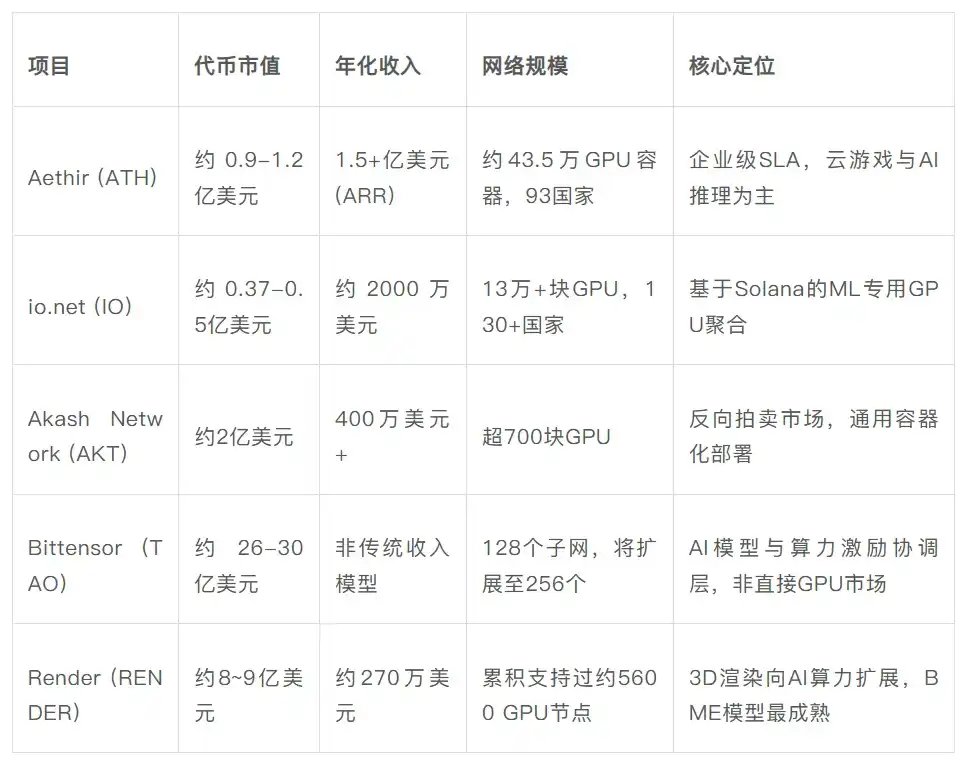
Data source: Official disclosures of each project, Messari quarterly reports, CoinMarketCap, CoinGecko / Coinbase. Data as of May 2026. Note: Bittensor does not have "protocol revenue" in the traditional sense—it is an AI model incentive coordination layer, rewarding participants via inflationary token issuance, with each subnet generating revenue independently.
As can be seen from the table above, these five protocols occupy different ecological positions.
- Aethir leads in enterprise-level revenue, with an annualized recurring revenue of approximately $150 million. It is currently the protocol with the largest revenue scale in the decentralized computing track, serving clients including game studios, AI inference providers, and model training teams.
- io.net focuses on orchestrating distributed ML computing clusters, covering over 130,000 GPU devices across more than 130 countries.
- Akash has formed genuine price competition through its reverse auction pricing mechanism. Its Q1 2026 computing power expenditure broke a historical high of over $5 million, and the AKT token has risen over 72% year-to-date.
- Bittensor is entirely different; it doesn't rent GPU hardware but incentivizes AI intelligence output itself, forming a decentralized machine intelligence market through 128 subnets.
- Render started with 3D rendering, having cumulatively rendered over 67 million frames, and is now expanding into general AI computing.
II. Capability Boundaries: What Decentralized GPU Networks Can and Cannot Do
Decentralized GPU networks have long been caught between two extreme narratives: one side claims costs are only one-tenth of AWS's and will soon disrupt cloud computing; the other side believes distributed GPUs cannot support real AI workloads at all. Both judgments are biased.
The key to understanding this sector lies in confronting the structural characteristics of consumer-grade GPUs.
On one hand, the computing power supply of decentralized networks largely comes from consumer-grade GPUs, which have limited VRAM capacity, and inter-node bandwidth relies on home broadband. This inherently makes them unsuitable for synchronous training of frontier large models—such tasks require thousands of high-end GPUs to be interconnected with extremely low latency, a scenario designed for hyperscale clouds.
On the other hand, for workloads with higher latency tolerance and cost sensitivity, the cost-effectiveness advantage of decentralized networks is quite evident: parallel molecular screening in AI drug discovery, batch rendering for text-to-image and text-to-video, and large-scale data preprocessing pipelines are typical matching scenarios.
Furthermore, the continuous expansion of open-source models and the technological evolution of lightweight inference are systematically expanding the serviceable market for decentralized networks. An increasing number of models can run efficiently on a single or a few consumer-grade GPUs. The barriers to inference and fine-tuning are decreasing, which happens to be the most competitive range for decentralized networks.
Chart 2: Matching Relationship between AI Workloads and Computing Power Infrastructure
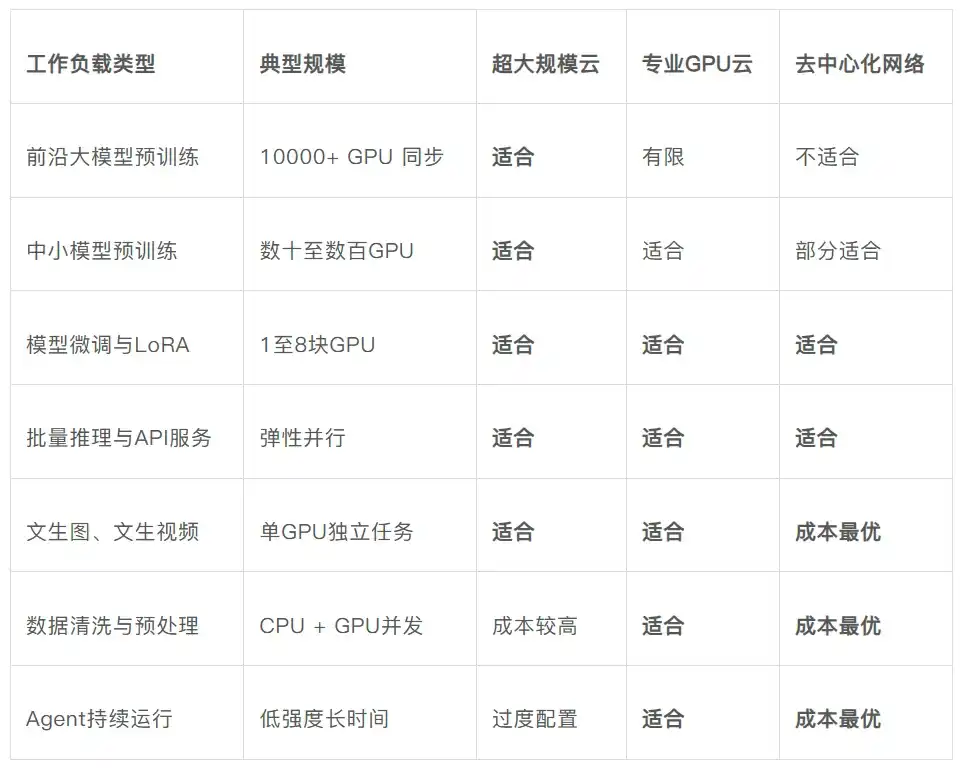
Data source: Compiled from Together AI's multi-node training report (January 2026), Dell LLM cluster network traffic technical documentation (December 2025), Cointelegraph industry analysis (January 2026).
Based on this, the real opportunity for decentralized GPUs concentrates on fragmented, distributed, and price-sensitive scenarios such as inference, fine-tuning, data preprocessing, and Agent continuous operation, rather than directly competing with hyperscale clouds in the frontier training market.
It is worth noting that from the perspective of current AI production environments, the proportion of training in total computing power consumption is now far lower than that of inference and Agent-like tasks, the latter being the main source of growth in computing power demand. This means that the market targeted by decentralized networks is not marginal in scale—it corresponds precisely to the largest and fastest-growing layer in the AI computing power demand structure.
III. Is the Price Advantage Real: Is It Really 60% Cheaper?
One reason decentralized computing power is highly sought after is the widely circulated claim of being "60% cheaper." This statement originates from a cost comparison between the two. The publicly listed price on the Akash Network website shows the hourly rental rate for an H100 GPU is approximately $1.33; after a price reduction of about 44% in June 2025, the per-GPU hourly rate for an AWS p5 instance (averaged across 8 cards) is about $3.93. This is the comparison most frequently cited in reports and the source of the claim "decentralized is over 60% cheaper."
Chart 3: H100 GPU Hourly Rental Price Comparison (Early 2026)
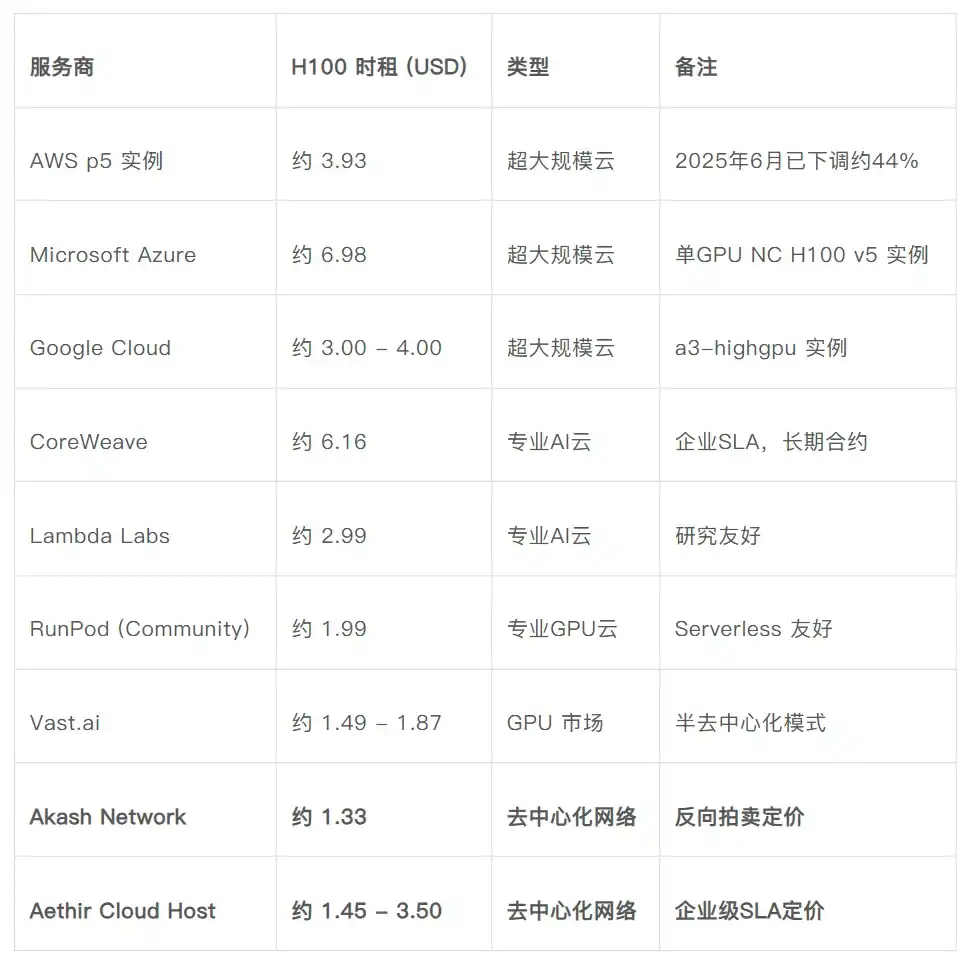
Data source: AWS, Azure, Google Cloud public pricing; Akash Network official website; Aethir official documentation; getdeploying.com (May 2026); IntuitionLabs' "H100 Rental Prices Compared" (May 2026); Silicon Data "H100 Price Spike" (January 2026).
The table above compares the price difference for H100 GPU rentals between centralized platforms and decentralized networks. The comparison leads to the following conclusions:
First, the price advantage of decentralized GPU networks over hyperscale clouds is real—approximately 60% lower compared to the AWS p5 average price, and can be as low as 75%~80% compared to single-GPU instances (AWS/Azure).
Second, compared to fully competitive professional GPU clouds (RunPod, Vast.ai), the price gap with decentralized GPU networks narrows to 15%~35%, and is basically flat in some scenarios.
Third, what truly constitutes differentiation are more structural attributes: no enterprise account required, no minimum usage commitment, on-demand start-stop, flexible geographical distribution of nodes, and no vendor lock-in—this is the real charm of decentralized GPUs.
However, one point that must be raised simultaneously is: Hidden costs cannot be ignored. The node stability of decentralized networks varies greatly. In production scenarios, redundant deployment or increased fault-tolerance mechanisms are needed. These additional costs erode the nominal price advantage to varying degrees. This is one of the main practical barriers facing large-scale enterprise adoption of decentralized GPUs in 2026.
IV. The Real Changes in the Sector in 2026
Based on existing data, the decentralized computing power sector is undergoing two observable deep-seated changes in 2026.
The first is the maturation of tokenomics. Early DePIN projects generally relied on inflationary token subsidies for hardware suppliers, a model with inherent flaws: falling token prices lead to shrinking supplier profits, supplier exits reduce network availability, which further depresses token prices, creating a vicious cycle. Between 2025 and 2026, leading projects have gradually shifted to new models that directly bind token mechanisms to real business volume.
Render Network's BME (Burn-Mint Equilibrium) model, established through RNP-001, requires creators to pay for rendering tasks at fiat prices. Payments are automatically converted to RENDER tokens and burned upon task completion. This mechanism has been operating for years.
io.net's original tokenomics relied on fixed emissions and price-sensitive supplier income, making it prone to a "death spiral." Its upcoming IDE (Incentive Dynamic Engine), slated for Q2 2026, will replace fixed emissions with a demand-driven model, stabilize supplier income pegged to the US dollar, and dynamically adjust token supply based on real-time revenue and token prices.
These two models differ in mechanism but share a common logic: linking token burning and minting to real computing power consumption and anchoring supplier income to the US dollar value. This is the first time decentralized infrastructure has a financial structural logic in token design comparable to traditional SaaS businesses.
The second is the gradual clarification of market entry paths. Early DePIN computing power networks almost exclusively served crypto-native teams, creating a natural market ceiling. Since 2025, several cases of traditional enterprises entering the decentralized computing power system through specific collaborations have emerged.

As early as December 2024, io.net joined the Dell Technologies Partner Program as an authorized partner and cloud service provider. The two sides will collaborate on marketing and demand development, enabling enterprise clients to integrate and deploy decentralized GPU computing power with Dell hardware. Prior to that, in April 2024, io.net established a partnership with the AI creative platform KREA, whose enterprise client list includes Nike, Apple, FC Barcelona, Publicis Group, and Meta. io.net provided KREA with NVIDIA A100-80GB GPU clusters at approximately one-third of the market average price.
Meanwhile, Aethir's over 150 paying enterprise clients are distributed across AI, Web3, and gaming sectors. Its Q3 2025 single-quarter revenue reached $39.8 million, with annualized revenue exceeding $147 million, covering scenarios such as AI inference, model training, and Agent platforms.
Regarding Akash, Venice.ai (a private, uncensored generative AI application) uses Akash GPUs to handle inference requests, and FLock.io (a federated learning platform) allows operators to deploy validator nodes on Akash. Both integrations were completed in 2024.
The common feature of the above cases is that non-crypto-native enterprises have begun to incorporate decentralized computing power into actual procurement and technical integration, moving beyond mere narrative levels. Although the number of cases is not vast, they represent a substantive breakthrough in market entry paths.
Chart 4: Key Metric Changes in the DePIN Computing Power Sector (2024 - 2026)
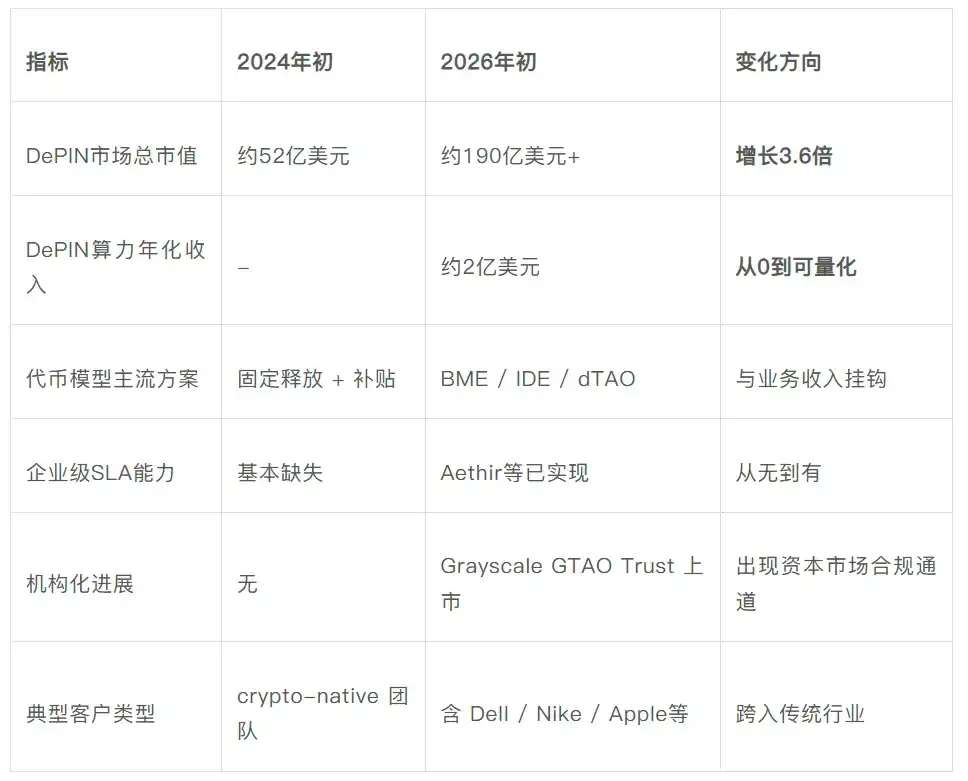
Data source: BlockEden "Decentralized GPU Networks 2026," "DePIN Revenue Inflection"; Yellow.com (May 2026); Messari project report series; CoinGecko "Top Bittensor Subnets" (April 2026).
However, it must also be admitted that: the decentralized computing power sector still faces significant unresolved core obstacles.
First, raw GPU quotes are indeed cheaper (offering discounts of 45-60%), but reliability variance often forces users to over-provision computing power, significantly eroding the nominal cost savings.
Second, enterprise adoption of decentralized computing power still faces difficulties, such as: orchestration challenges, difficulties in debugging distributed failures, and lack of enforceable SLA (Service Level Agreement) guarantees.
Third, the DePIN technology stack is highly fragmented—computing power, storage, verification, and data are scattered across different protocols. Developers must piece together multiple systems to complete production-level deployments, significantly increasing engineering costs.
An exception worth noting on the enterprise front is Aethir. Aethir maintains a 99.31% uptime across over 435,000 GPU containers, possesses enforceable enterprise-level SLAs, and is one of the few projects in the decentralized computing power sector currently capable of meeting enterprise contract-level service requirements.
Of course, the existence of these problems represents both current constraints and tangible gaps that project teams can concretely address.
V. Implications for Ecosystem Player Development Paths
For ecosystem players entering this sector in 2026, the aforementioned data points to several specific judgments:
First, avoid redundant construction of basic aggregation layers. io.net, Akash, and Aethir have already established GPU aggregation networks of considerable scale across different price points. New projects that merely enter as generic GPU aggregators, without significant differentiation—whether in geographic coverage, compliance qualifications, special hardware types, or vertical industry certifications—will find it difficult to establish sustainable advantages. Projects like Render (extending from rendering to AI computing) and Aethir (extending from cloud gaming to enterprise AI inference), which themselves have accumulated resources in specific scenarios, are more likely to gain initial users and differentiated pricing power than pure generic aggregation networks.
Second, tooling and middleware layers are more realistic entry points. Each of the aforementioned unresolved problems—reliability management, distributed debugging, SLA guarantees, cross-chain settlement, Agent-level computing power procurement, and reconciliation—corresponds to a tooling-type project that can stand independently.

- Gensyn's Verde is an early example. It is a verification protocol specifically designed for machine learning in decentralized environments. Its core is a lightweight dispute arbitration system capable of pinpointing the first step in the training computation graph where the trainer and verifier diverge. Thus, only that single operation needs to be recomputed, not the entire task, significantly reducing verification overhead.
- Other ideas include, for instance, what io.net proposed: utilizing the MCP protocol to enable AI Agents to directly procure and schedule computing resources without human KYC or enterprise accounts, thereby bypassing the onboarding barriers of traditional cloud services, which are unfriendly to autonomous Agents.
Building toolchains around these underlying protocols offers more clear-cut differentiation space than creating another GPU marketplace.
Third, opportunities at the vertical application layer are diverging. Specific scenarios such as AI biomedicine, AI image/video generation, AI Agent continuous operation, on-chain data analysis and backtesting, and privacy computing (combined with TEE) have different sensitivities to computing power cost, latency tolerance, and reliability requirements. Cases like the Templar subnet training the 72B-parameter Covenant model on Bittensor demonstrate that small-scale, task-specific training is feasible on decentralized networks; however, the subsequent team departure incident also indicates that the governance and team stability of vertical application projects are deeply tied to token market performance.
Fourth, tokenomics design has become a core barrier. Token models like BME and IDE, which are tied to real business volume, have become the de facto standard for the new generation of DePIN computing projects. The early path of releasing tokens first, attracting hardware to the network, and then promoting market cap to attract users has been proven unsustainable in the 2026 market environment. The token model design of new projects must answer from day one: where does the token demand side come from?
Fifth, a point needs to be added: the integration of decentralized GPU networks and the AI Agent economy has just begun in 2026. When the number of AI Agents experiences exponential growth in the next 12 to 18 months, the demand for decentralized computing power will no longer be an option for enterprise-level teams but the default entry point for non-human economic activities. This change is structurally compatible with decentralized computing power networks—the human KYC and enterprise account systems of traditional cloud services are unfriendly to Agents, while permissionless computing power markets can fill this gap.
VI. Observations from Go2Mars Research Institute
The state of decentralized GPU networks in 2026 is neither the "complete disruption of cloud computing" touted by proponents nor the "conceptual scam" claimed by skeptics. It has become a layer within the AI infrastructure stack with real revenue, clear capability boundaries, and is purchasable by enterprises—but its most suitable scenarios still concentrate in areas such as inference, fine-tuning, data preparation, and Agent continuous operation. The market for frontier foundational model training still belongs to hyperscale centralized clouds.
For ecosystem players, this means the opportunity window for the next 12 to 18 months is concentrated in three types of positions.
- The first category is the tooling layer around the Agent economy and AI inference, including infrastructure for computing power orchestration, behavior verification, metering and billing, SLA guarantees, and cross-chain settlement.
- The second category is the application layer tied to specific vertical industries, including cost-sensitive and latency-tolerant scenarios such as biomedicine, content generation, and on-chain data science.
- The third category is the deep integration of next-generation tokenomics and enterprise-level payment paths, requiring direct binding of token demand side with real business volume.
The research institute team has recently engaged in in-depth cooperation with multiple AI × Crypto project teams in areas such as track positioning, technology path selection, token model design, market entry strategies, and VC connections. If a project team believes they are better suited to enter one of the three aforementioned positions, please feel free to contact us for further research and incubation support.