The Ghost of X.com, Musk's 25-Year Revenge

marsbitОпубликовано 2026-01-14Обновлено 2026-01-14

Введение

Elon Musk's 25-year quest to reclaim his original vision for X.com culminated in the acquisition and transformation of Twitter. In 1999, Musk invested his entire $22 million fortune from the sale of Zip2 into X.com, an ambitious online financial platform. The venture merged with Confinity (later PayPal), but Musk was ousted in a board coup while on his honeymoon. The X.com brand was discarded, leaving a "fishbone" of regret in Musk. His 2022 acquisition of Twitter was not primarily about free speech but about复仇 (revenge) for that early betrayal. He systematically rebranded it as X and began a gradual transformation from a microblogging site into an all-in-one "everything app." This involved introducing long-form content, enhanced video, creator monetization, and, most crucially, laying the groundwork for financial services. The key development is the "Smart Cashtags" feature, allowing users to embed asset tickers (e.g., $TSLA) in posts that link to real-time data and, ultimately, enable direct trading. This creates a seamless loop from seeing information to making a financial decision to executing a trade, all within X. To build trust for this financial future, Musk took the unprecedented step of open-sourcing the platform's algorithm. The article frames this as Musk finally realizing his 1999 vision, an idea validated by the success of Chinese super-apps like WeChat. The timing is now perfect, with mature mobile payments, crypto adoption, and shifting regulations. Musk's ...

Author: Niusike, Deep Tide TechFlow

Some dreams never die, they just wait for the right time.

The Premature Baby of 1999

In March 1999, in Palo Alto, 27-year-old Elon Musk made a decision that seemed almost absurd at the time.

He bet all the $22 million he made from selling Zip2 on a website called X.com.

At that time, Silicon Valley was still the era of Yahoo and America Online (AOL), and the internet in people's eyes was equivalent to portal websites. Proposing the concept of "online banking" at this point was like selling rockets in the era of carriages. But Musk's ideal X.com was not just an online bank; he wanted to create an online financial operating system: allowing all financial services to be realized on one platform, including transfers, investments, loans, insurance, and even daily consumption.

Silicon Valley at the time thought this young man from South Africa was crazy.

It was the era of dial-up internet, accompanied by the screeching sound of modems, and it sometimes took half a minute to open a webpage. Asking users to transfer money on a 28.8K turtle-speed network? It sounded like a joke.

The ambition was terrifyingly big, but reality hit back harder.

A year later, X.com merged with Peter Thiel's Confinity (the predecessor of PayPal). It should have been a "genius alliance," but it turned into a Silicon Valley version of "Game of Thrones." Thiel's elite group from Stanford couldn't stand Musk's chaotic radicalism, thinking this engineer-turned-CEO was a dangerous madman.

In September 2000, the collapse came. Musk flew to Australia for his honeymoon. Just as his flight landed in Sydney, before he could even leave the airport, the board called: you're out.

Peter Thiel took over everything. A few months later, the sign "X.com" that Musk loved was taken down, and the company was renamed PayPal.

The foundation of the "financial empire" that Musk spent a year building was bulldozed by a group of investment bankers in Brioni custom suits, leaving only the simplest function: payment.

In 2002, eBay acquired PayPal, and Musk received $180 million. Financially, he won, but at that moment, he was like a child whose favorite toy had been taken away. A fishbone was deeply stuck in his heart.

For the next twenty years, he built the best electric cars, sent rockets into space, and vowed to die on Mars. But whenever someone mentioned PayPal, he couldn't hide his disappointment.

X.com was always his inner demon.

Bringing the "Sink" to Wall Street

On October 27, 2022, Musk walked into the Twitter headquarters building, holding a sink.
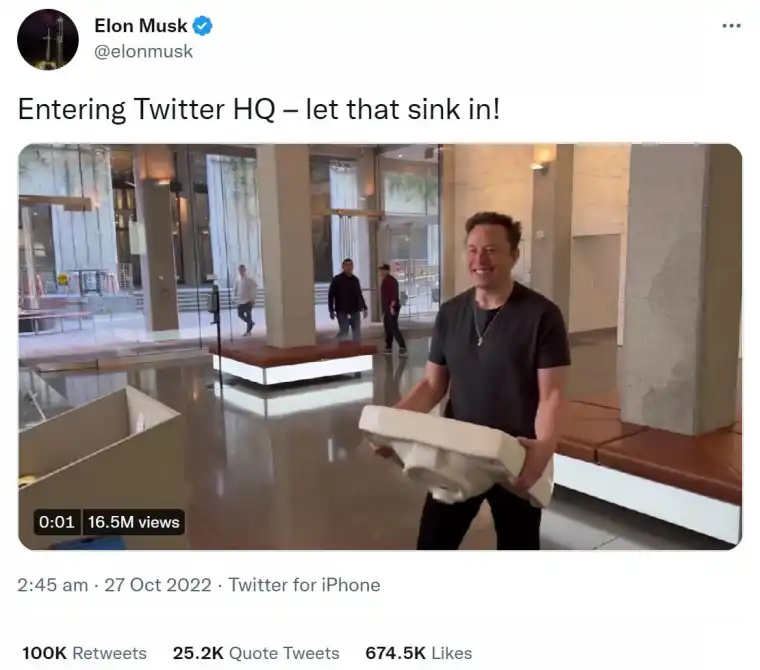
This detail was later wildly reported by the media, but the real signal was the sentence he wrote on Twitter: "Let that sink in."

A pun. Let the sink in, and let it all sink in.

The outside world thought he bought Twitter for free speech or to defend Trump. They were all wrong. Musk wanted revenge, revenge for that betrayal 25 years ago.

The first step was to change the name.

X. One letter, carrying all his anger and ambition. Those who mocked X.com for being too advanced back then would now witness its resurrection on this platform.

But Musk was smart. He knew he couldn't go all the way at once; turning Twitter directly into a bank would scare users away. So he chose a gradual transformation.

In early 2023, X was still mainly a lightweight social platform with a 140-character limit. Musk first adjusted the content strategy, encouraging more original content and real-time discussions. Then came paid subscriptions, getting users used to spending money on the platform.

By mid-year, the long-tweet feature was launched. Users could publish longer, more in-depth content, and the platform began to shift from a short-message square to an information center.

Next came a significant enhancement of video features. Musk wanted X to become a one-stop platform for information consumption, so users no longer needed to jump to YouTube or other video sites.

At the end of 2023, the creator revenue-sharing plan was officially launched. The platform began to have an economic ecosystem, and users could earn income through content creation. This was a crucial step; Musk was cultivating users' transaction habits.

Then came the big move in 2024.

Financial license applications, payment system construction... Musk no longer hid his intentions; he wanted to turn X into a financial platform.

In January 2026, X product lead Nikita Bier stated that the platform is developing the Smart Cashtags feature, allowing users to precisely point to specific assets or smart contracts when publishing ticker symbols.
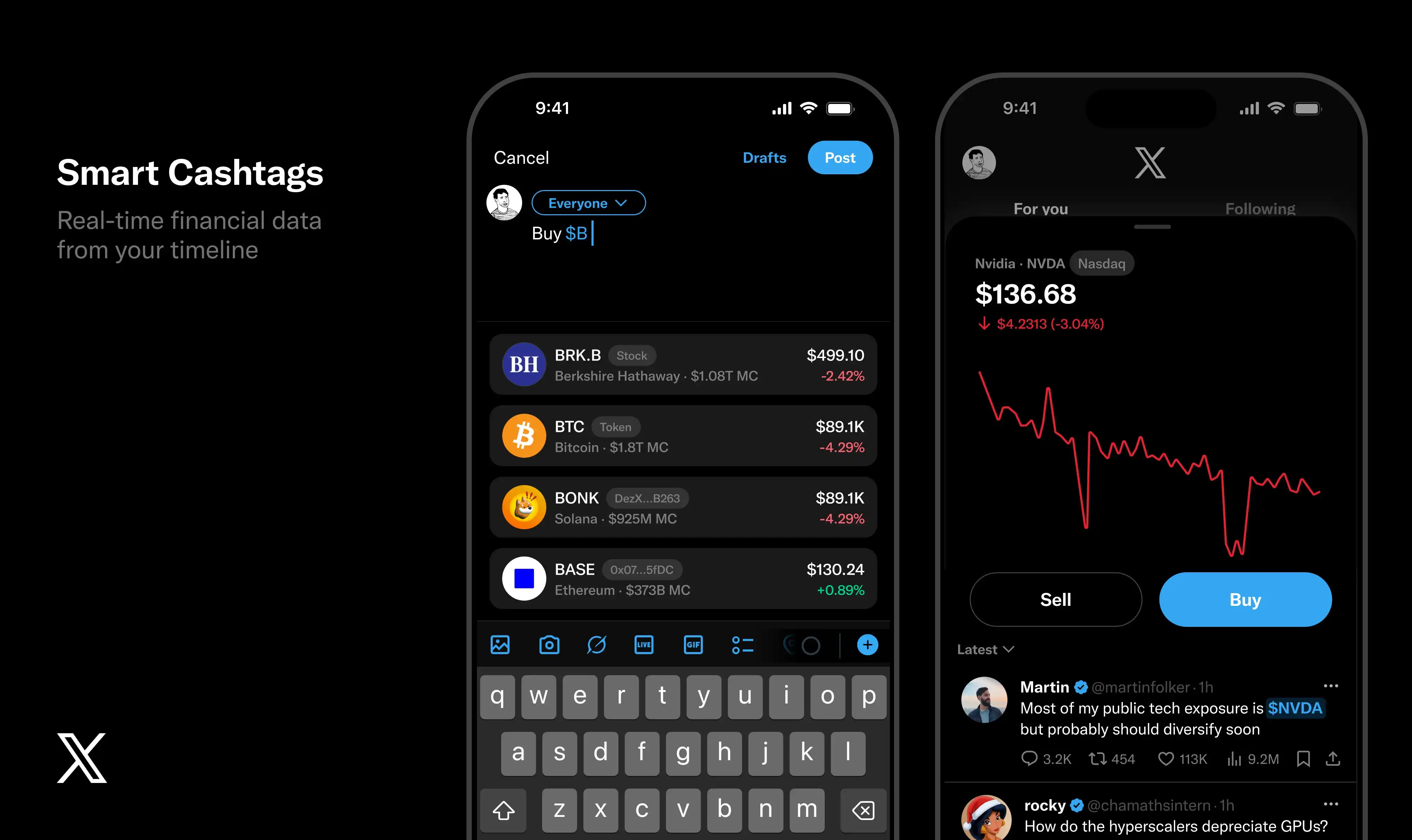
Users can embed tags like $TSLA in tweets to display stock prices in real-time. It seems like just an information display feature, but it's actually the final piece of the financialization puzzle.

Imagine: you see a tweet about NVIDIA's new chip on X, the stock price immediately rises 5%, and you directly click the $NVDA tag to place a buy order.

Social, information, and trading, all in one. This is the vision Musk wanted to realize with X.com back in the day.

From a town square to an information center, and then to a trading hall. Musk spent two years gradually guiding users to accept X's transformation.

To dispel users' doubts, Musk made an unprecedented decision: open-sourcing all algorithms.

On January 10, 2026, Musk announced on X that he would officially open-source X platform's latest content recommendation algorithm within a week, covering the recommendation of organic and ad content code, with updates every four weeks along with developer documentation.

The recommendation algorithms of platforms like Facebook, YouTube, and TikTok are black boxes; no one knows why they see certain content. When it comes to financial services, this lack of transparency becomes a fatal flaw.

Musk broke the black box with open source. Users can inspect the code, developers can audit security, and regulators can supervise compliance.

All to pave the way for financialization.

Belated Validation

X.com in 1999 died because it was "born at the wrong time." The internet back then was still in the dial-up era, with broadband penetration below 10%. Online payments required dozens of security verifications, and users were full of fear about putting money online.

More importantly, the regulatory environment was extremely strict. Banking regulators saw internet finance as a flood beast, and the government was also feeling its way. Musk's radical strategy seemed too risky in that conservative era.

But history proved his judgment right.

It's just that the validation came too late, and from an unexpected place: China.

In 2011, WeChat launched. Initially just a chat app, it quickly became the super app that Musk had envisioned back in the day. Chatting, payments, ride-hailing, food delivery, wealth management—it could do everything. Alipay also evolved from a simple third-party payment tool to a comprehensive financial platform.

Musk saw it and felt anxious.

In June 2022, at his first all-hands meeting with Twitter employees, he publicly stated: "In China, people basically live on WeChat because it's so useful and helpful in daily life. I think if we can achieve that with Twitter, or even just get close, it would be a huge success."

This sounded like praise for WeChat, but also regret for his own failure 25 years ago. The Chinese had achieved in ten years what he wanted to do in 1999.

Now it was his turn.

Mobile payments have rewritten global users' consumption habits, cryptocurrencies have gone from geek toys to pension fund investments. Blockchain technology has made decentralized finance a reality. Regulators have also begun to embrace innovation.

The U.S. Securities and Exchange Commission approved Bitcoin ETFs, the European Union launched a digital euro plan, and the People's Bank of China is piloting the digital yuan.

Musk waited 25 years for this moment.

With this background, when you look at Smart Cashtags, you'll understand that Musk's opponent was never Zuckerberg.

Meta controls social relationships, Google controls information indexing, and Apple controls hardware access. But so far, no tech giant has truly controlled the global "flow of funds."

This is X's endgame. Finance is the underlying protocol of the business world. Whoever controls the flow of funds holds the throat of the digital economy. This is more lethal than making a search engine or selling a phone.

Musk is reshaping an ultra-fast chain from "information" to "decision" to "action." Imagine: Musk tweets about a new Tesla technology. Within seconds, hundreds of thousands of people click the $TSLA tag. The algorithm predicts trends based on sentiment analysis, automatically pushes trading suggestions, and users place orders with one click. Influence is instantly converted into trading volume.

This is the financialization of social media. The traditional Wall Street model, with its analysts writing reports and brokers making calls, will seem clumsy and expensive in the face of algorithms.

Back to the initial question: why did Musk acquire Twitter?

The answer was already public. On October 5, 2022, Musk tweeted that acquiring Twitter accelerated the creation of the super app "X."

It's just that now, everyone finally understands this sentence.

Back to 1999, the ghost of X.com finally found the right time to resurrect. This time, no one can stop him. He is no longer the 27-year-old entrepreneur who had to kowtow to others, but the world's richest man with absolute authority.

Welcome to the X Universe

If we zoom out, beyond the rises and falls of Wall Street and the grudges of Silicon Valley, you'll discover an even more chilling pattern.

Musk's obsession with the letter "X" has long transcended the scope of a commercial brand, becoming an almost pathological totem worship.

Look at what he's done over the past twenty years: When he tried to send humans to Mars, he named the company SpaceX; when he wanted to build a flagship SUV to define Tesla's future, he insisted on calling it Model X despite opposition; when he left OpenAI to develop his own AI large model, he named it xAI.

He even named his most beloved son X Æ A-12, and in daily life, he only calls him "Little X."
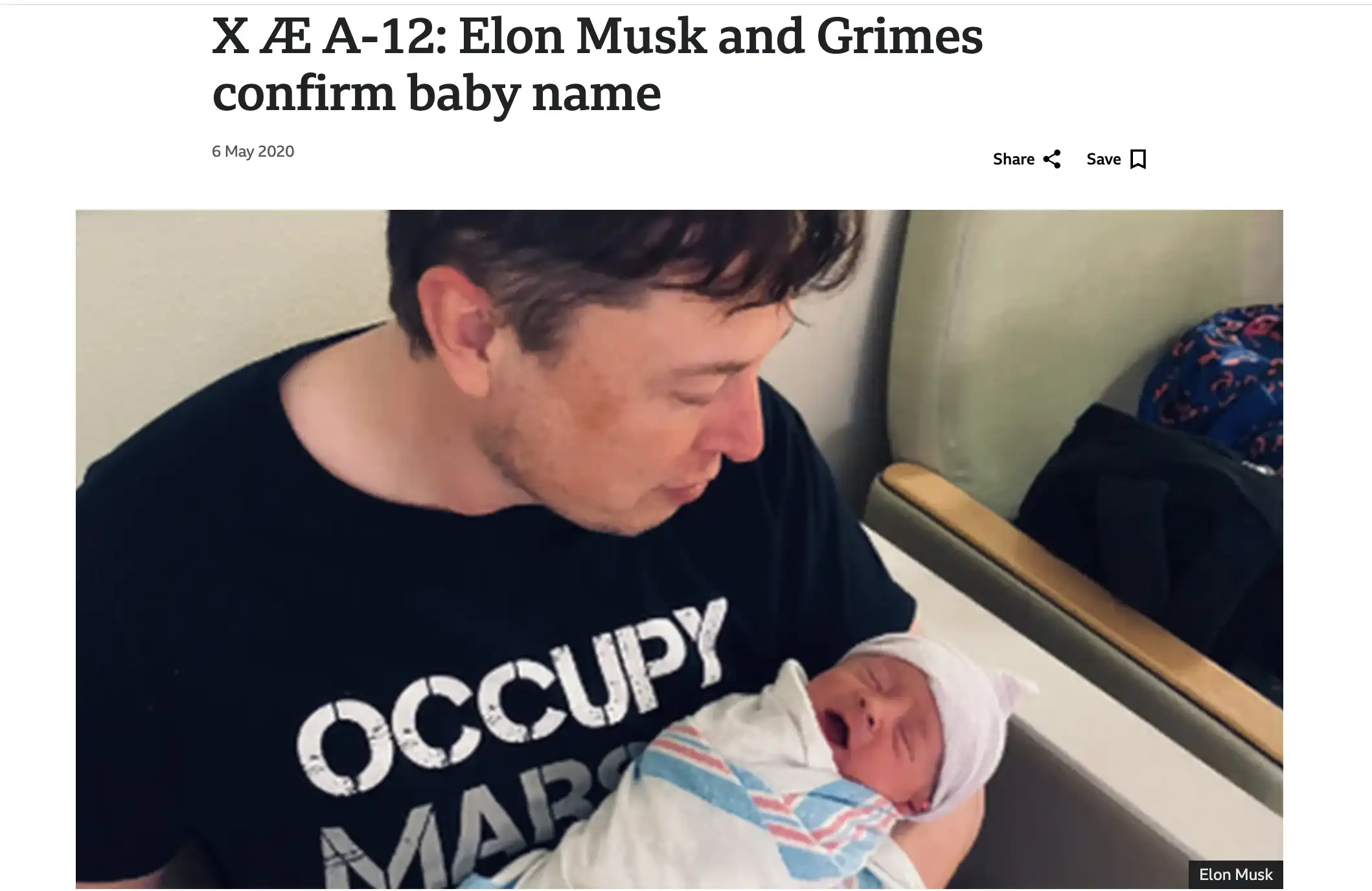
In mathematics, X represents the unknown, representing infinite possibilities. But in Musk's life story, X is the only constant.

Twenty-five years ago, that young man kicked out by the PayPal board lost his X. Twenty-five years later, the richest man who owns rockets, cars, AI, and the world's largest court of public opinion has finally picked up that puzzle piece.

Everything, everything, is to make X happen.

Welcome to Musk's X Universe.

Связанные с этим вопросы

QWhat was the original vision for X.com that Elon Musk had in 1999?

AElon Musk envisioned X.com not just as an online bank, but as a comprehensive online financial operating system where all financial services—transfers, investments, loans, insurance, and even daily consumption—could be conducted on a single platform.

QWhy was the original X.com considered a failure and what happened to Musk's departure?

AX.com was considered ahead of its time due to slow dial-up internet and conservative regulatory environments. It merged with Confinity (later PayPal), but internal conflicts led to Musk being ousted by the board while he was on his honeymoon in 2000. The company was later renamed PayPal.

QHow is Musk's acquisition and transformation of Twitter (now X) connected to his original X.com vision?

AMusk acquired Twitter to accelerate the creation of a super app 'X,' fulfilling his original 1999 vision. He is transforming the platform from a social network into an integrated information and financial hub, incorporating features like payments, smart cash tags, and open-source algorithms to enable seamless social and financial interactions.

QWhat role does the 'Smart Cashtags' feature play in X's financialization strategy?

ASmart Cashtags allow users to embed asset tickers (like $TSLA) in posts, displaying real-time prices and enabling direct trading. This feature bridges social content with financial action, turning X into a platform for instant information consumption and transaction execution.

QHow does Musk's obsession with the letter 'X' manifest across his ventures and personal life?

AMusk's obsession with 'X' is evident in his companies: SpaceX for space exploration, Model X for Tesla's SUV, and xAI for his artificial intelligence venture. He even named his son 'X Æ A-12,' commonly referred to as 'Little X.' The letter symbolizes infinite possibilities and is a constant theme in his ambitious projects.

Похожее

From Gas Limit to 'Keyed Nonces', How to Understand the Next Step in Ethereum Scalability?

Ethereum’s scalability efforts are shifting toward a user-centric approach—focusing not only on higher TPS, but on translating technical upgrades into lower costs, smoother operations, and better wallet experiences. Two recent developments highlight this direction: - **Raising the Gas Limit to 200 million**: Following the Fusaka upgrade that increased it to 60 million, a consensus has formed around a potential future increase to 200 million. This would boost Ethereum’s execution capacity, but it is planned alongside other upgrades—such as ePBS, Block-Level Access Lists (BAL), and EIP-8037—to manage state growth and keep node operation viable for average participants. - **Keyed Nonces (EIP-8250)**: This proposal aims to improve how transactions are queued. Instead of a single linear nonce per account, it introduces multiple independent nonce domains. This prevents different types of transactions—such as private payments, session keys, or batch operations—from blocking each other. Vitalik Buterin views this as a foundational step toward better privacy support and more flexible state scalability. Together, these upgrades are part of a broader move to push complexity from wallets, DApps, and relays back into the protocol layer. For everyday users, this means future Ethereum interactions could become less congested, more intuitive, and safer—especially as core improvements in account abstraction, cross-L2 interoperability, and node decentralization continue to progress. Ultimately, Ethereum is evolving to handle not just more transactions, but more varied and complex on-chain use cases while preserving its decentralized foundation.

marsbit4 мин. назад

From Gas Limit to 'Keyed Nonces', How to Understand the Next Step in Ethereum Scalability?

marsbit4 мин. назад

Leaving OpenAI, How Much Has Their Net Worth Increased?

Former OpenAI employees have collectively accrued near-trillion dollar valuations through ventures and investments, charting AI's future. The article highlights two main paths: founding high-value companies like Anthropic and Perplexity, or applying insider insights as investors. Leopold Aschenbrenner exemplifies the investor path. After being fired from OpenAI, he leveraged firsthand knowledge of AI's massive energy demands to make hugely successful public market bets on nuclear and fuel cell companies, practicing "cross-industry cognitive arbitrage." Other alumni, like the Zero Shot VC fund founders, use their technical foresight for early-stage investing. Their key advantage lies not just in picking winners, but in knowing which technical approaches are likely dead ends—a "veto list" derived from internal OpenAI experience. Angel investing within the network, as seen with Mira Murati and Sam Altman, operates on deep, pre-existing understanding of a founder's capabilities, reducing due diligence to near zero. This creates an ecosystem bound by a shared belief in AGI's imminent arrival, differing from networks like the "PayPal Mafia" which were built on shared past struggles. The shift of these builders to investors signals a profound conviction: their situational awareness of the AI landscape is now so clear that deploying capital based on that judgment is more efficient than building themselves. They are allocating bets on the future they helped shape from the inside.

marsbit15 мин. назад

Leaving OpenAI, How Much Has Their Net Worth Increased?

marsbit15 мин. назад

Countdown to the AI Bull Market? Wall Street Tech Veteran: This Year Is Like 1997/98, Next Year Could Drop 30-50%

"AI Bull Market Countdown? Wall Street Veteran: This Year Feels Like 1997/98, Next Year Could Drop 30-50%" In an interview, veteran tech analyst Dan Niles draws parallels between the current AI boom and the 1997-98 period of the internet boom, suggesting the bull run isn't over yet. The core new driver is identified as "Agentic AI," which performs multi-step tasks and consumes vastly more computing power than conversational AI. This shift is expected to boost demand for cloud infrastructure and benefit CPU makers like Intel and AMD, potentially pressuring GPU leader Nvidia. However, Niles warns of significant short-term overbought conditions in semiconductors. His central warning is for a potential major market correction of 30-50% starting in early 2027. Drivers include a slowdown from high growth comparables, the outsized capital demands of companies like OpenAI, and a wave of massive tech IPOs sucking liquidity from the market. A J.P. Morgan survey of 56 global investors aligns with this view, finding that 54% expect a >30% U.S. stock correction by 2027. Among mega-cap tech, Niles favors Google due to its full-stack AI capabilities and cash flow, expresses concern about Meta's user growth, and sees potential for Apple's AI Siri and foldable iPhone. Niles advises investors to be nimble, hold significant cash, and closely monitor the conflicting signals from equities, oil prices, and bond yields, which he believes cannot all be correct simultaneously.

marsbit48 мин. назад

Countdown to the AI Bull Market? Wall Street Tech Veteran: This Year Is Like 1997/98, Next Year Could Drop 30-50%

marsbit48 мин. назад

Торговля

Спот
Фьючерсы

Популярные статьи

Как купить S

Добро пожаловать на HTX.com! Мы сделали приобретение Sonic (S) простым и удобным. Следуйте нашему пошаговому руководству и отправляйтесь в свое крипто-путешествие.Шаг 1: Создайте аккаунт на HTXИспользуйте свой адрес электронной почты или номер телефона, чтобы зарегистрироваться и бесплатно создать аккаунт на HTX. Пройдите удобную регистрацию и откройте для себя весь функционал.Создать аккаунтШаг 2: Перейдите в Купить криптовалюту и выберите свой способ оплатыКредитная/Дебетовая Карта: Используйте свою карту Visa или Mastercard для мгновенной покупки Sonic (S).Баланс: Используйте средства с баланса вашего аккаунта HTX для простой торговли.Третьи Лица: Мы добавили популярные способы оплаты, такие как Google Pay и Apple Pay, для повышения удобства.P2P: Торгуйте напрямую с другими пользователями на HTX.Внебиржевая Торговля (OTC): Мы предлагаем индивидуальные услуги и конкурентоспособные обменные курсы для трейдеров.Шаг 3: Хранение Sonic (S)После приобретения вами Sonic (S) храните их в своем аккаунте на HTX. В качестве альтернативы вы можете отправить их куда-либо с помощью перевода в блокчейне или использовать для торговли с другими криптовалютами.Шаг 4: Торговля Sonic (S)С легкостью торгуйте Sonic (S) на спотовом рынке HTX. Просто зайдите в свой аккаунт, выберите торговую пару, совершайте сделки и следите за ними в режиме реального времени. Мы предлагаем удобный интерфейс как для начинающих, так и для опытных трейдеров.

1.3k просмотров всегоОпубликовано 2025.01.15Обновлено 2025.03.21

Как купить S

Sonic: Обновления под руководством Андре Кронье – новая звезда Layer-1 на фоне спада рынка

Он решает проблемы масштабируемости, совместимости между блокчейнами и стимулов для разработчиков с помощью технологических инноваций.

2.2k просмотров всегоОпубликовано 2025.04.09Обновлено 2025.04.09

Sonic: Обновления под руководством Андре Кронье – новая звезда Layer-1 на фоне спада рынка

HTX Learn: Пройдите обучение по "Sonic" и разделите 1000 USDT

HTX Learn — ваш проводник в мир перспективных проектов, и мы запускаем специальное мероприятие "Учитесь и Зарабатывайте", посвящённое этим проектам. Наше новое направление .

1.8k просмотров всегоОпубликовано 2025.04.10Обновлено 2025.04.10

HTX Learn: Пройдите обучение по "Sonic" и разделите 1000 USDT

Обсуждения

Добро пожаловать в Сообщество HTX. Здесь вы сможете быть в курсе последних новостей о развитии платформы и получить доступ к профессиональной аналитической информации о рынке. Мнения пользователей о цене на S (S) представлены ниже.

活动图片