The Ethereum Doomsday Scenario: Inside The Bank Of Italy’s Crisis Simulation

bitcoinistОпубликовано 2026-01-13Обновлено 2026-01-13

Введение

The Bank of Italy published a technical analysis exploring the potential consequences if Ethereum's value were to fall to zero and remain there. The paper frames this as a stress test on infrastructure, not just asset prices. It warns that if ETH loses its value, the economic incentive for validators—who are paid in ETH—would disappear. This could lead validators to exit the network, severely slowing or even stopping transaction settlement. The paper further cautions that other assets on the chain, such as tokenized securities or stablecoins, could become difficult to move or face security risks. While the scenario is not presented as likely, the analysis highlights how market risk can transform into infrastructure risk, especially since there is no formal mechanism to orderly shut down a permissionless blockchain.

The Bank of Italy ran a technical analysis that asks a stark question: What happens if Ethereum (ETH) falls to zero and stays there?

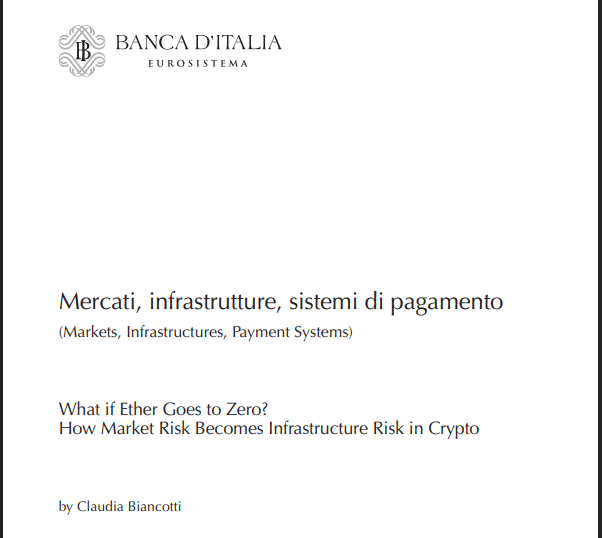
The recently released paper is authored by Claudia Biancotti for the Bank’s Markets, Infrastructures, Payment Systems series. It is listed as Number 74 and runs 11 pages.

Bank Of Italy Issues Technical Analysis

According to the Bank, permissionless blockchains like Ethereum act as settlement systems for a wide range of tokens and contracts. The institution treats the question as a stress test on infrastructure rather than only on asset prices.

The note warns that if a native token loses most of its market value and the drop remains persistent, the economic incentives that keep validators running could vanish. Validators might exit, the paper says, and that could make settlement slow or stop.

Source: Bank of Italy

What The Paper Found

Based on reports in the Bank’s paper, the chain of effects is simple and worrying. Validators are paid in ETH. If ETH has next to no value, that payment no longer motivates operators.

As a result, transaction settlement could slow dramatically or, in extreme cases, halt. The paper also highlights that other assets using the chain — for example, tokenized securities or fully backed stablecoins — could become hard to move or could face security problems if the network’s defenses weaken.

Ethereum: Context And Reaction

Italy’s broader regulators have recently stepped up their look at crypto risks. Reports show the Economy Ministry ordered a review of safeguards, and the Bank of Italy’s paper fits into that wider push to quantify risks tied to new payment systems.

Reuters and other outlets covered the regulator-level review in December and January as authorities pressed firms to meet emerging rules.

Potential System Risks

The authors do not claim the scenario is likely. Instead, the exercise is framed as a way to show how market risk can turn into infrastructure risk. The paper points out there is no formal mechanism to “shut down” a permissionless chain in an orderly way.

Any mitigation would rely on voluntary action by validators, major staking firms, or protocol changes proposed and adopted by the community. That uncertainty is the main policy concern.

The Bank of Italy’s note is a technical, measured look at a worst-case scenario. It uses concrete data to argue that a collapse in Ethereum market value would not only hit holders but could also impair the functioning of systems that now run on Ethereum.

Featured image from Gemini, chart from TradingView

Связанные с этим вопросы

QWhat is the main question explored in the Bank of Italy's technical analysis paper?

AThe paper explores the question of what would happen if Ethereum (ETH) were to fall to zero and stay there, treating it as a stress test on financial infrastructure.

QAccording to the paper, what is the primary risk if the value of ETH becomes nearly worthless?

AThe primary risk is that the economic incentives for validators would vanish, which could cause them to exit the network, leading to dramatically slowed or even halted transaction settlement.

QBeyond the native ETH asset, what other types of assets on the Ethereum chain could be affected in this doomsday scenario?

AOther assets like tokenized securities or fully backed stablecoins could become hard to move or could face security problems if the network's defenses weaken due to validator exit.

QHow does the Bank of Italy frame the likelihood of this 'Ethereum falling to zero' scenario actually happening?

AThe authors do not claim the scenario is likely. Instead, they frame the exercise as a way to show how market risk can transform into infrastructure risk.

QWhat is identified as the main policy concern stemming from this analysis?

AThe main policy concern is the uncertainty, as there is no formal mechanism to 'shut down' a permissionless blockchain in an orderly way, and any mitigation would rely on voluntary action from validators, staking firms, or the community.

Похожее

Gensyn AI: Don't Let AI Repeat the Mistakes of the Internet

In recent months, the rapid growth of the AI industry has attracted significant talent from the crypto sector. A persistent question among researchers intersecting both fields is whether blockchain can become a foundational part of AI infrastructure. While many previous AI and Crypto projects focused on application layers (like AI Agents, on-chain reasoning, data markets, and compute rentals), few achieved viable commercial models. Gensyn differentiates itself by targeting the most critical and expensive layer of AI: model training. Gensyn aims to organize globally distributed GPU resources into an open AI training network. Developers can submit training tasks, nodes provide computational power, and the network verifies results while distributing incentives. The core issue addressed is not decentralization for its own sake, but the increasing centralization of compute power among tech giants. In the era of large models, access to GPUs (like the H100) has become a decisive bottleneck, dictating the pace of AI development. Major AI companies are heavily dependent on large cloud providers for compute resources. Gensyn's approach is significant for several reasons: 1) It operates at the core infrastructure layer (model training), the most resource-intensive and technically demanding part of the AI value chain. 2) It proposes a more open, collaborative model for compute, potentially increasing resource utilization by dynamically pooling idle GPUs, similar to early cloud computing logic. 3) Its technical moat lies in solving complex challenges like verifying training results, ensuring node honesty, and maintaining reliability in a distributed environment—making it more of a deep-tech infrastructure company. 4) It targets a validated, high-growth market with genuine demand, rather than pursuing blockchain integration without purpose. Ultimately, the boundaries between Crypto and AI are blurring. AI requires global resource coordination, incentive mechanisms, and collaborative systems—areas where crypto-native solutions excel. Gensyn represents a step toward making advanced training capabilities more accessible and collaborative, moving beyond a niche controlled by a few giants. If successful, it could evolve into a fundamental piece of AI infrastructure, where the most enduring value in the AI era is often created.

marsbit12 ч. назад

Gensyn AI: Don't Let AI Repeat the Mistakes of the Internet

marsbit12 ч. назад

Why is China's AI Developing So Fast? The Answer Lies Inside the Labs

A US researcher's visit to China's top AI labs reveals distinct cultural and organizational factors driving China's rapid AI development. While talent, data, and compute are similar to the West, Chinese labs excel through a pragmatic, execution-focused culture: less emphasis on individual stardom and conceptual debate, and more on teamwork, engineering optimization, and mastering the full tech stack. A key advantage is the integration of young students and researchers who approach model-building with fresh perspectives and low ego, prioritizing collective progress over personal credit. This contrasts with the US culture of self-promotion and "star scientist" narratives. Chinese labs also exhibit a strong "build, don't buy" mentality, preferring to develop core capabilities—like data pipelines and environments—in-house rather than relying on external services. The ecosystem feels more collaborative than tribal, with mutual respect among labs. While government support exists, its scale is unclear, and technical decisions appear driven by labs, not state mandates. Chinese companies across sectors, from platforms to consumer tech, are building their own foundational models to control their tech destiny, reflecting a broader cultural drive for technological sovereignty. Demand for AI is emerging, with spending patterns potentially mirroring cloud infrastructure more than traditional SaaS. Despite challenges like a less mature data industry and GPU shortages, Chinese labs are propelled by vast talent, rapid iteration, and deep integration with the open-source community. The competition is evolving beyond a pure model race into a contest of organizational execution, developer ecosystems, and industrial pragmatism.

marsbit14 ч. назад

Why is China's AI Developing So Fast? The Answer Lies Inside the Labs

marsbit14 ч. назад

3 Years, 5 Times: The Rebirth of a Century-Old Glass Factory

Corning, a 175-year-old glass company, is experiencing a dramatic revival as a key player in AI infrastructure, driven by surging demand for high-performance optical fiber in data centers. AI data centers require vastly more fiber than traditional ones—5 to 10 times as much per rack—to handle high-speed data transmission between GPUs. This structural demand shift, coupled with supply constraints from the lengthy expansion cycle for fiber preforms, has created a significant supply-demand gap. Nvidia has invested in Corning, along with Lumentum and Coherent, in a $4.5 billion total commitment to secure the optical supply chain for AI. Corning's competitive edge lies in its expertise in producing ultra-low-loss, high-density, and bend-resistant specialty fiber, which is critical for 800G+ and future 1.6T data rates. Its deep involvement in co-packaged optics (CPO) with partners like Nvidia further solidifies its position. While not the largest fiber manufacturer globally, Corning's revenue from enterprise/data center clients now exceeds 40% of its optical communications sales, and it has secured multi-year supply agreements with major hyperscalers including Meta and Nvidia. Financially, Corning's optical communications revenue has surged, doubling from $1.3 billion in 2023 to over $3 billion in 2025. Its stock price has risen nearly 6-fold since late 2023. Key future catalysts include the rollout of Nvidia's CPO products and the scale of undisclosed customer agreements. However, risks include high current valuations and potential disruption from next-generation technologies like hollow-core fiber. The company's long-term bet on light over electricity, maintained even through the telecom bubble crash, is now being validated by the AI boom.

marsbit15 ч. назад

3 Years, 5 Times: The Rebirth of a Century-Old Glass Factory

marsbit15 ч. назад

Торговля

Спот
Фьючерсы

Популярные статьи

Как купить S

Добро пожаловать на HTX.com! Мы сделали приобретение Sonic (S) простым и удобным. Следуйте нашему пошаговому руководству и отправляйтесь в свое крипто-путешествие.Шаг 1: Создайте аккаунт на HTXИспользуйте свой адрес электронной почты или номер телефона, чтобы зарегистрироваться и бесплатно создать аккаунт на HTX. Пройдите удобную регистрацию и откройте для себя весь функционал.Создать аккаунтШаг 2: Перейдите в Купить криптовалюту и выберите свой способ оплатыКредитная/Дебетовая Карта: Используйте свою карту Visa или Mastercard для мгновенной покупки Sonic (S).Баланс: Используйте средства с баланса вашего аккаунта HTX для простой торговли.Третьи Лица: Мы добавили популярные способы оплаты, такие как Google Pay и Apple Pay, для повышения удобства.P2P: Торгуйте напрямую с другими пользователями на HTX.Внебиржевая Торговля (OTC): Мы предлагаем индивидуальные услуги и конкурентоспособные обменные курсы для трейдеров.Шаг 3: Хранение Sonic (S)После приобретения вами Sonic (S) храните их в своем аккаунте на HTX. В качестве альтернативы вы можете отправить их куда-либо с помощью перевода в блокчейне или использовать для торговли с другими криптовалютами.Шаг 4: Торговля Sonic (S)С легкостью торгуйте Sonic (S) на спотовом рынке HTX. Просто зайдите в свой аккаунт, выберите торговую пару, совершайте сделки и следите за ними в режиме реального времени. Мы предлагаем удобный интерфейс как для начинающих, так и для опытных трейдеров.

1.3k просмотров всегоОпубликовано 2025.01.15Обновлено 2025.03.21

Как купить S

Sonic: Обновления под руководством Андре Кронье – новая звезда Layer-1 на фоне спада рынка

Он решает проблемы масштабируемости, совместимости между блокчейнами и стимулов для разработчиков с помощью технологических инноваций.

2.2k просмотров всегоОпубликовано 2025.04.09Обновлено 2025.04.09

Sonic: Обновления под руководством Андре Кронье – новая звезда Layer-1 на фоне спада рынка

HTX Learn: Пройдите обучение по "Sonic" и разделите 1000 USDT

HTX Learn — ваш проводник в мир перспективных проектов, и мы запускаем специальное мероприятие "Учитесь и Зарабатывайте", посвящённое этим проектам. Наше новое направление .

1.8k просмотров всегоОпубликовано 2025.04.10Обновлено 2025.04.10

HTX Learn: Пройдите обучение по "Sonic" и разделите 1000 USDT

Обсуждения

Добро пожаловать в Сообщество HTX. Здесь вы сможете быть в курсе последних новостей о развитии платформы и получить доступ к профессиональной аналитической информации о рынке. Мнения пользователей о цене на S (S) представлены ниже.

活动图片