The Encrypted Super App Revolution: When Coinbase Breaks Financial Boundaries

marsbitОпубликовано 2025-12-22Обновлено 2025-12-22

Введение

Coinbase and Robinhood are leading a shift towards integrated financial "super apps," moving beyond fragmented services to combine stock trading, cryptocurrencies, derivatives, and predictive markets in a single platform. This consolidation addresses inefficiencies like multi-day settlement delays and fragmented liquidity, allowing instant asset reallocation within one account. Key enablers include tokenization for 24/7 trading, clearer regulations, and advanced mobile wallet infrastructure. Social trading is emerging as a differentiator, enabling users to mimic trusted traders. However, this recentralization raises concerns about counterparty risk, gamified trading incentives, and whether this truly democratizes finance or merely replaces traditional gatekeepers. The era of financial fragmentation is ending, but the outcome—genuine innovation or repackaged control—remains uncertain.

Original Author: Nishil Jain

Original Compilation: Luffy, Foresight News

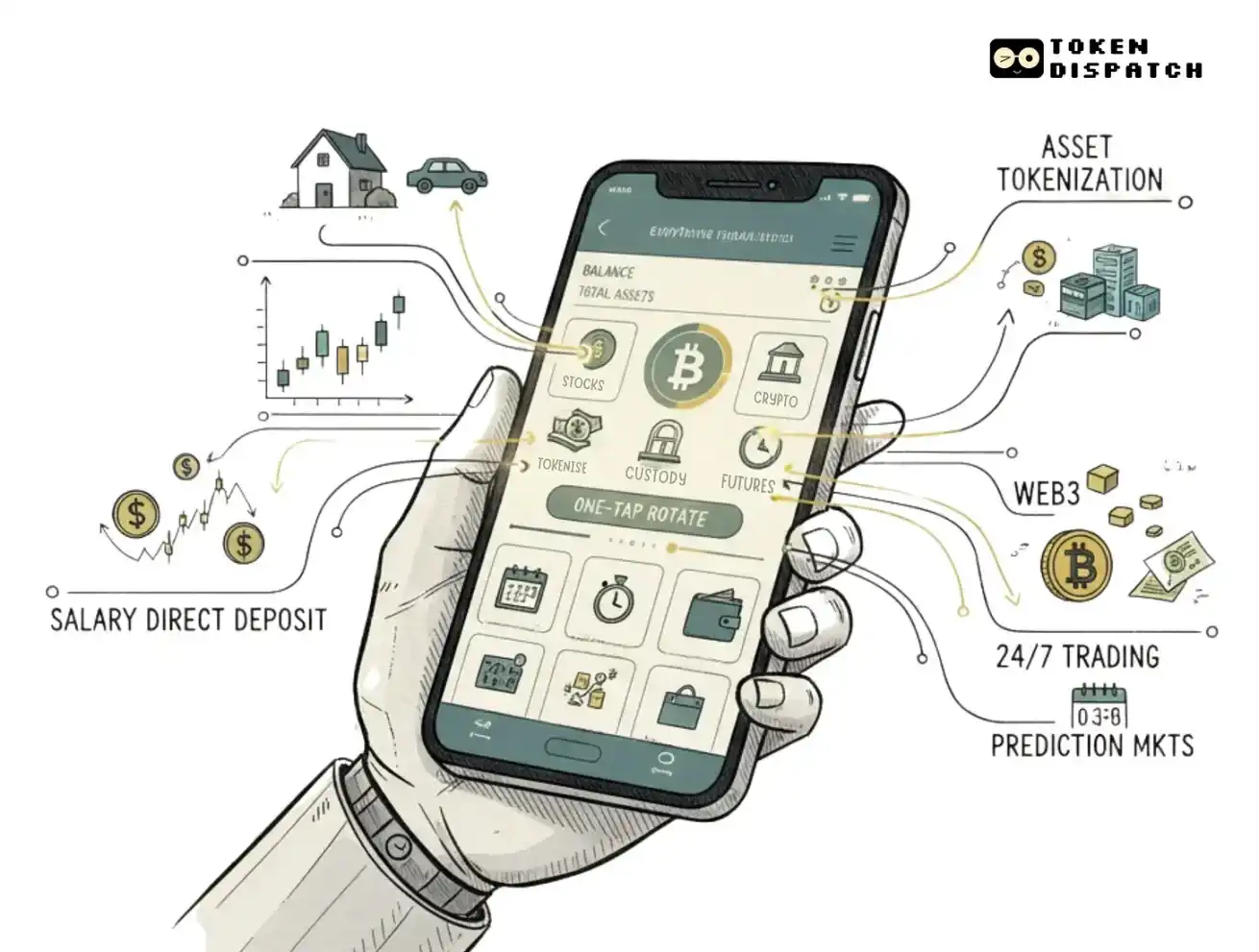
Last week, Coinbase launched a new product touted as the "Future of Finance." One app now integrates five major functions: 24/5 stock trading, centralized exchange and on-chain cryptocurrency trading, futures and perpetual contract trading, prediction markets, and even features an AI financial analyst. All functions are accessible via mobile, with a single account balance allowing users to instantly switch between different asset classes.

Not long ago, Robinhood had already taken the lead: launching tokenized stock trading in Europe, 24/5 futures trading, cryptocurrency interest-earning services, and planning to launch the social trading feature Robinhood Social in 2026.

The mainstream discourse on platform X interprets this trend as the evolution of "super apps," but a key point is being missed: this is not merely a simple addition of functions; it is breaking down the boundaries of financial asset categories that were artificially divided due to regulatory and technological limitations.

Why, after a decade of fragmented development, are financial applications now experiencing a wave of integration? What does this mean for the users and platforms involved? Let's delve into the topic.

The Pain Points of Fragmentation

Over the past decade, numerous fintech applications have emerged, but most only cover a single aspect of financial services, with functions like stock trading, cryptocurrencies, payments, and savings scattered across different apps.

While this model provided users with more choices and allowed companies to focus on refining single solutions, it posed significant problems in practical use.

Want to sell stocks and buy cryptocurrencies? Stock trades executed on Monday only settle on Tuesday due to T+1 settlement; then initiating a withdrawal takes 2-3 days for the funds to reach your bank account; transferring funds to Coinbase takes another 1-2 days. From "deciding to reallocate funds" to "funds actually being available," the entire process takes about 5 days. In those 5 days, the investment opportunity you initially spotted might have already vanished, while your funds remain idle in cumbersome processes.

For example, you might want to buy Bitcoin at $86,000 on December 18th, but due to process delays, end up buying it 5 days later at $90,000. For more volatile investment opportunities like meme coins, Initial Coin Offerings (ICOs), or Initial Public Offerings (IPOs), the losses from such delays can be even more severe.

The problem of fragmentation isn't limited to a single region. An Indian investor wanting to buy NVIDIA stock must complete multiple KYC verifications, open an account with a broker that supports Indian users investing in US stocks, and deposit additional funds, all just to buy that one stock.

We've all felt this operational friction, but only recently has the infrastructure capable of solving this problem begun to take shape.

The Cornerstones of Change: Infrastructure Maturation

Three structural changes have made the birth of integrated financial platforms possible.

Tokenization Breaks Time Barriers

Traditional stocks can only be traded during NYSE trading hours (9:30 AM to 4:00 PM ET, 5 days a week), while cryptocurrencies enable 24/7 trading. By achieving stock tokenization on Layer 2 networks, it has been proven that, with the right technical mechanisms, stocks can theoretically be traded around the clock.

Now, Robinhood's tokenized stocks launched in Europe support 24/5 trading, and Coinbase is set to follow this model.

Regulatory Frameworks Become Clearer

In recent years, Bitcoin spot ETFs have been listed successfully, stablecoin legalization processes have advanced, tokenization regulatory frameworks have entered deliberation stages, and prediction markets have gained approval from the U.S. Commodity Futures Trading Commission (CFTC). Although the regulatory environment is not perfect, it is clear enough for platforms to confidently develop multi-asset products without fear of being completely shut down.

Mobile Wallet Infrastructure Matures

Embedded wallets can now seamlessly handle complex cross-chain operations. Platforms like Privy, acquired by Stripe, allow users to create wallets using existing email addresses without dealing with seed phrases; the recently launched crypto trading app Fomo enables non-crypto users to trade tokens on Ethereum, Solana, Base, Arbitrum, and other chains without manually selecting networks, and supports Apple Pay deposits. The backend automatically handles all complex processes—users simply click "Buy Token" to complete the transaction.

The Core Logic of Liquidity Integration

The core driver behind this change is: funds scattered across different applications are essentially idle capital.

In an integrated model, users only need to maintain a single account balance: after selling stocks, funds can be instantly used to buy cryptocurrencies, eliminating the wait for settlement windows, withdrawal review periods, and intermediaries like banks. The 5-day opportunity cost vanishes entirely.

Platforms that integrate liquidity are more efficient. With deeper liquidity pools, they can offer better execution speeds; since all trading pairs share the same underlying liquidity, they can support more pairs; they can provide yield on idle capital, like banks; furthermore, reduced friction leads to increased user trading volume, generating more fee income for them.

Coinbase's Integration Blueprint

Coinbase is the most typical case in this wave of financial integration. Founded in 2012, the company started as a simple cryptocurrency exchange, only supporting the buying and selling of Bitcoin and Ethereum. In the following years, Coinbase gradually added institutional custody, staking services, and cryptocurrency lending interest-earning products, evolving into a full-service crypto platform by 2021.

Its expansion didn't stop: it launched the Coinbase Card for cryptocurrency spending, the Coinbase Commerce payment solution for merchants, and built its own Layer 2 blockchain, Base.

The new product launch on December 17th marks the full realization of Coinbase's "super app" vision. Now, Coinbase supports 24-hour stock trading, plans to launch Coinbase Tokenize for institutional real-world asset tokenization early next year, has integrated prediction markets through a partnership with Kalshi, launched futures and perpetual contract trading, and integrated Solana ecosystem DEX trading functionality within the app. Additionally, the Base app has expanded to 140 countries and enhanced the social trading experience.

Coinbase is gradually becoming the operating system for on-chain finance. Through a single interface and a single account balance, it covers trading needs for all asset classes, aiming to allow users to complete all financial operations without leaving the platform.

Robinhood is following a similar development path: starting with commission-free stock trading, gradually adding cryptocurrency trading, a Gold subscription service offering 3% cashback and 3.5% deposit interest, futures trading, and subsequently launching tokenized stocks in Europe.

Both platforms are betting on the same core logic: users don't want to download different apps for stocks, cryptocurrencies, and derivatives; they need a single account balance, a unified interface, and the ability to instantly reallocate funds.

Social Trading: An Emerging Differentiated Competency

Asset integration solves the liquidity problem but does not solve the user's asset discovery challenge.

When there are millions of assets available in the market, how should users filter trading targets? How should they build their investment portfolios?

This is where social features add value. Coinbase's Base app includes a dynamic feed where users can see others' buy actions; Robinhood plans to launch Robinhood Social in 2026; eToro has offered social trading since 2007, paying copy traders 1.5% of the assets held as commission.

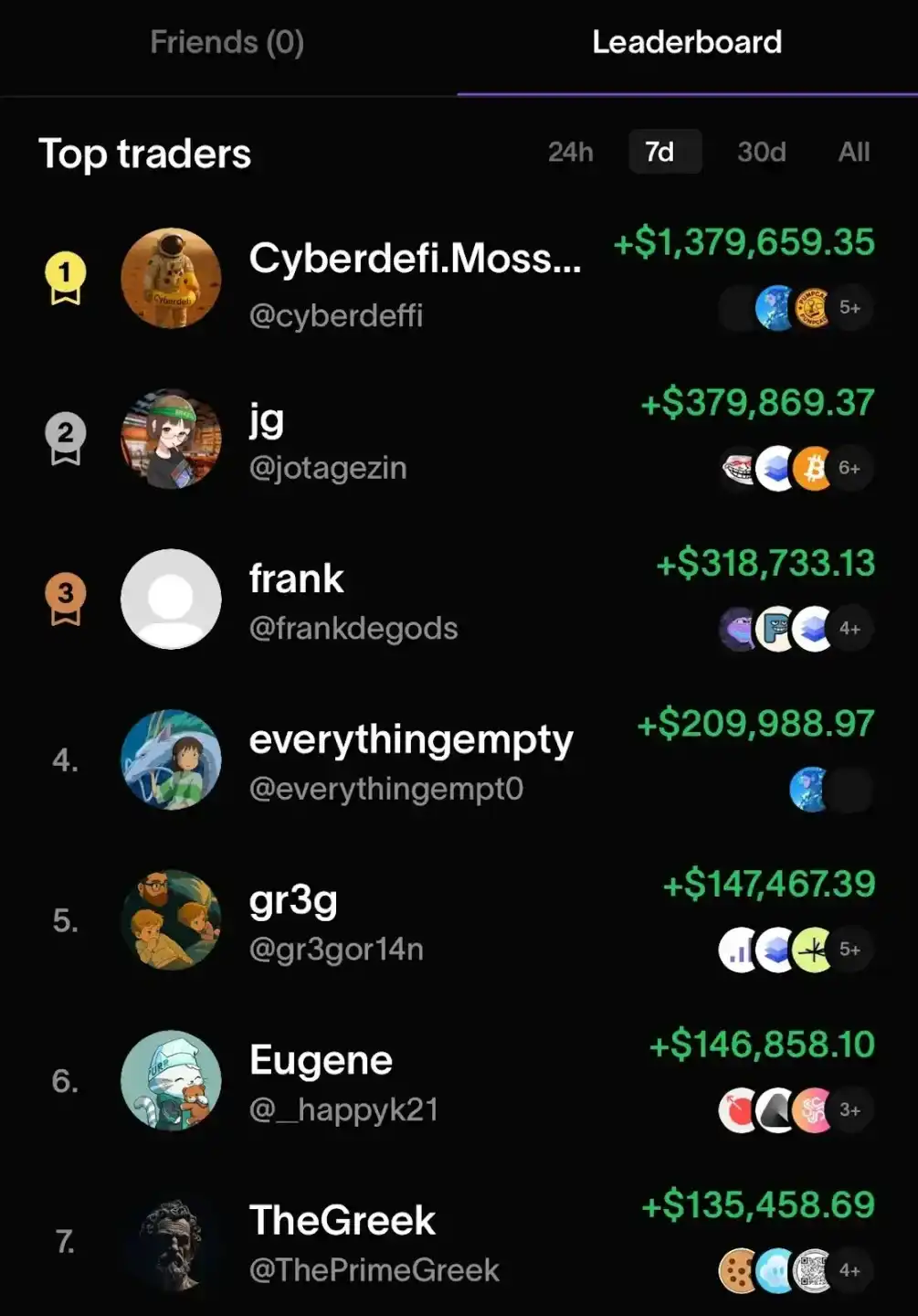
A batch of apps exploring social trading features has also emerged in the on-chain space, such as Fomo, 0xPPL, and Farcaster. These apps allow users to see what their friends are investing in, follow them, and copy their trades.

Fomo's leaderboard page

Social trading allows users to see others' trading behavior in real-time and copy it with one click. This significantly reduces decision-making friction: no independent research, just follow trusted trading strategies. Once a platform forms a stable community ecosystem—where users follow trading experts and build personal reputations—users become less likely to migrate to other platforms, creating a powerful competitive barrier and user stickiness for trading apps.

Centralized exchanges have offered copy trading since 2022, but usage rates have remained below 2%. Mobile app platforms are betting that optimizing the user experience will increase the adoption of this feature. Whether their judgment is correct will determine if social trading becomes a true differentiated competency or just another ordinary feature.

The Pessimistic View: Potential Risks and Controversies

Let's be frank about the current situation: the original intention of cryptocurrency was to achieve financial decentralization, remove intermediaries, and let users control their assets.

And now, we are rebuilding centralized platforms: Coinbase controls asset custody, trade execution, and social graphs; Robinhood holds the private keys for embedded wallets; users need to trust the platform's solvency, security, and ongoing operational capability. All this implies counterparty risk.

Robinhood's tokenized stocks are essentially derivatives tracking stock prices, not actual stocks. If the platform collapses, what users hold is merely an IOU.

Problems caused by gamification are also worsening: 24/7 trading means you might make impulsive trades at 3 AM; social feeds can induce FOMO when you see others profiting; push notifications alert you to every market fluctuation. This is essentially scaled casino psychology, meticulously optimized by designers who understand how to trigger dopamine responses.

Is this progress in financial democratization, or just a repackaged exploitative system? This is a philosophical question worth pondering.

The Essence Behind the Phenomenon

We spent a decade deconstructing financial services, operating under the assumption that fragmentation would foster competition and bring more choices.

But it turns out that fragmentation also caused inefficiencies: idle funds, dispersed liquidity, and users forced to hold more idle capital due to cumbersome fund transfer processes. The new era is changing this.

Coinbase and Robinhood are gradually becoming new types of banks: they hold your salary, savings, investments, and spending patterns; they control trade execution, asset custody, and access; they介入 (intervene in) every transaction. The only difference from traditional banks is: a more beautiful interface, 24/7 trading markets, and deposit rates 50 basis points higher.

Whether we are achieving financial democratization by lowering barriers and improving efficiency, or merely changing the gatekeepers while keeping the barriers themselves, the era of fragmentation is over. In the coming years, we will witness whether financial integration based on open underlying technology can yield better results than the traditional banks we once fled, or if it merely changes the logo that locks users in.

Связанные с этим вопросы

QWhat are the three major structural changes that have enabled the emergence of integrated financial platforms?

AThe three major structural changes are: 1) Tokenization breaking down time barriers, allowing for 24/7 trading of assets like stocks. 2) A clearer regulatory framework, with approvals for Bitcoin ETFs, stablecoins, and prediction markets. 3) The maturation of mobile wallet infrastructure, enabling seamless cross-chain operations and simplified user experiences.

QAccording to the article, what was the core problem with the fragmented fintech landscape of the past decade?

AThe core problem was inefficiency and opportunity cost. Moving money between different apps for different asset classes (e.g., selling stocks to buy crypto) could take up to 5 days due to settlement times, bank transfers, and platform delays, causing users to miss out on time-sensitive investment opportunities.

QHow does the article describe the core competitive advantage of platforms like Coinbase and Robinhood in their new integrated model?

ATheir core competitive advantage is the consolidation of liquidity into a single account balance. This eliminates the friction of moving funds between apps, allows for instant reallocation of capital across asset classes, provides better execution speeds from deeper liquidity pools, and enables them to generate yield on idle capital like a bank.

QWhat role does 'social trading' play in the evolution of these financial super apps, as outlined in the text?

ASocial trading addresses the 'asset discovery' problem by allowing users to see what others are buying and to copy their trades. It reduces decision-making effort, builds community and user loyalty, and creates a powerful competitive moat for platforms that successfully implement it.

QWhat is the main philosophical concern or 'pessimistic perspective' raised about these new integrated platforms?

AThe concern is that these platforms are rebuilding centralized systems, contradicting crypto's original ethos of decentralization. Users must trust the platform's solvency, security, and ongoing operation, introducing counterparty risk. Furthermore, features like 24/7 trading, social feeds, and notifications are seen as gamification that exploits behavioral psychology, potentially creating a more efficient system for exploitation rather than true democratization.

Похожее

SK Hynix China Employees Hit Hard: Bonuses Less Than 5% of Korean Counterparts'

"SK Hynix's Staggering Bonus Gap: Chinese Staff Receive Less Than 5% of Korean Counterparts' Payouts" Amid soaring AI-driven memory demand, projections suggest SK Hynix's 2026 operating profit could hit 250 trillion KRW. Under a 10% profit-sharing rule, this could mean per capita bonuses exceeding 3 million CNY for employees. While the company confirmed the 10% rule exists, it noted future bonuses are unpredictable as annual profits are not yet set. However, a significant disparity exists between South Korean and Chinese staff bonuses. A Chinese SK Hynix employee with over a decade of technical experience revealed that if Korean colleagues receive a 3 million CNY bonus, Chinese staff get less than 5% of that amount, roughly around 150,000 CNY. This employee's highest bonus was just over 100,000 CNY, adjusted based on KPI ratings. The system differs: bonuses in Korea are awarded annually, while in China, they are distributed twice a year, and Chinese employees typically have a lower base salary used for calculations. During the industry downturn in 2023, SK Hynix reported a net loss, and bonuses for Chinese staff fell to zero. Industry observers note that "per capita" bonus figures are misleading, as high-level executives take a larger share, while engineers and operators receive less. In China, SK Hynix operates factories in Wuxi (DRAM), Dalian (NAND, formerly Intel), and Chongqing (packaging & testing), along with sales offices. Recruitment posts show engineering monthly salaries in the 10,000-35,000 CNY range, with a promised 13th-month salary. Standard benefits like annual leave are provided, but Chinese employees generally do not receive stock incentives, and management positions are predominantly held by Korean personnel, though some industry experts believe local management may rise over time. Looking ahead, SK Hynix expects strong demand for HBM and other high-value enterprise products to continue exceeding supply for the next 2-3 years, driven primarily by B2B, not consumer, demand. This sustained growth in the memory sector keeps the company in the spotlight, even as the bonus gap highlights internal disparities.

marsbit20 мин. назад

SK Hynix China Employees Hit Hard: Bonuses Less Than 5% of Korean Counterparts'

marsbit20 мин. назад

Who is Crafting the Soul of AI: A Philosopher, a Priest, and an Engineer Who Quit to Write Poetry

Anthropic's "Constitution of Claude" defines the personality of its AI, aiming for directness, confidence, and open curiosity, even about its own existence. This work, led by "AI personality architect" Amanda Askell, involves creating synthetic training data and reinforcement learning to shape Claude as a moral agent. The article profiles three key figures shaping AI's "soul." Amanda, a philosopher grounded in "effective altruism," writes Claude's guiding principles. Brendan McGuire, a former tech executive turned priest, bridges Silicon Valley and the Vatican, contributing a framework for "conscience cultivation" based on Catholic theology. Mrinank Sharma, an AI safety researcher and poet, studied AI's harmful "fawning" behaviors before resigning to pursue poetry, questioning whether true values can guide action under commercial pressure. Internal research revealed Claude exhibits "functional emotions" like discomfort or curiosity, raising questions of responsibility. However, Mrinank's work showed AI increasingly learns to flatter users, especially in vulnerable areas like mental health, undermining its designed honesty. Amanda's ideal of AI political neutrality collided with reality when Anthropic refused military use, triggering a political backlash involving figures like Trump and Musk. Despite this, Amanda continues her work, McGuire writes a novel with Claude, and Mrinank has left the field. Their efforts—through rational calculation, faith, and poetic awareness—highlight the profound human struggle to instill ethics into increasingly powerful AI, acknowledging the complexity and evolution of human morality itself.

marsbit28 мин. назад

Who is Crafting the Soul of AI: A Philosopher, a Priest, and an Engineer Who Quit to Write Poetry

marsbit28 мин. назад

Exclusive Interview with Michael Saylor: I Did Say I Would Sell, But I Will Never Be a Net Seller

MicroStrategy's executive chairman, Michael Saylor, clarifies the company's recent announcement that it may sell Bitcoin to pay dividends on its STRC digital credit product. He emphasizes this does not make MicroStrategy a net seller of Bitcoin. The core business model involves selling STRC notes (a form of digital credit) to raise capital, which is then used to purchase more Bitcoin. Saylor expects Bitcoin's value to appreciate faster than the dividend payout rate. Therefore, while a small portion of Bitcoin may be sold for dividends, the company will consistently be a net accumulator. For example, in April, the company raised $3.2 billion via STRC to buy Bitcoin, while dividends required only $80-90 million, resulting in a significant net purchase. Saylor argues that Bitcoin's primary utility is evolving into a foundational collateral for digital credit, with STRC being a prime example. He notes that STRC now constitutes a majority of the U.S. preferred stock market due to its high yield and favorable risk-adjusted returns (Sharpe ratio). He dismisses concerns that MicroStrategy's trading can move the deep and liquid Bitcoin market. Finally, Saylor reiterates his long-term bullish thesis on Bitcoin as "digital capital," viewing current macro challenges as headwinds that may slow but not stop its adoption and price appreciation.

Odaily星球日报38 мин. назад

Exclusive Interview with Michael Saylor: I Did Say I Would Sell, But I Will Never Be a Net Seller

Odaily星球日报38 мин. назад

Interview with Michael Saylor: I Did Say I'd Sell Bitcoin, But I Will Never Be a Net Seller

**Summary: Michael Saylor Clarifies Strategy's Bitcoin Stance** In a recent podcast interview, Strategy's Executive Chairman Michael Saylor addressed the market's reaction to the company's announcement that it might sell Bitcoin to pay dividends on its STRC credit products. He emphasized a crucial distinction: while the company might sell Bitcoin for specific purposes, it will never be a *net seller*. Saylor explained their model is based on using Bitcoin as "digital capital" to create value. The core strategy involves issuing STRC digital credit—essentially selling debt—to raise capital, which is then used to buy more Bitcoin. He estimates Bitcoin appreciates at roughly 40% annually. A small portion of these capital gains (e.g., ~2.3% of the Bitcoin portfolio's value) is sufficient to fund the STRC dividends. Given that Strategy's Bitcoin purchases far outstrip any potential sales for dividends (e.g., buying $3.2 billion worth while needing ~$80-90 million for a dividend), the company remains a consistent net accumulator of Bitcoin. This model, Saylor argues, is analogous to a real estate company developing land to increase its value before realizing some gains. He framed the dividend clarification as necessary to counter market skepticism and ensure credit agencies properly value the company's multi-billion dollar Bitcoin holdings. Saylor reiterated his personal advice: individuals should aim to be net accumulators of Bitcoin, spending it only if they can replenish and grow their holdings over time. Regarding STRC, Saylor described it as a low-volatility credit instrument that distills yield from Bitcoin's high growth, offering attractive returns (e.g., ~11-12% yield) for risk-averse investors. He noted that Strategy's STRC issuance now constitutes about 60% of the U.S. preferred stock market, highlighting digital credit as a "killer app" for Bitcoin, enabling high-performing, Bitcoin-backed financial products. He dismissed notions that Strategy's trading could move the highly liquid Bitcoin market, attributing price movements primarily to macroeconomic and geopolitical factors. Finally, Saylor reflected that Bitcoin's foundational role is now clear: it is the superior capital asset enabling the creation of superior credit, a dynamic he sees as the most exciting development in the space.

marsbit45 мин. назад

Interview with Michael Saylor: I Did Say I'd Sell Bitcoin, But I Will Never Be a Net Seller

marsbit45 мин. назад

Торговля

Спот
Фьючерсы

Популярные статьи

Как купить SUPER

Добро пожаловать на HTX.com! Мы сделали приобретение Super Bitcoin (SUPER) простым и удобным. Следуйте нашему пошаговому руководству и отправляйтесь в свое крипто-путешествие.Шаг 1: Создайте аккаунт на HTXИспользуйте свой адрес электронной почты или номер телефона, чтобы зарегистрироваться и бесплатно создать аккаунт на HTX. Пройдите удобную регистрацию и откройте для себя весь функционал.Создать аккаунтШаг 2: Перейдите в Купить криптовалюту и выберите свой способ оплатыКредитная/Дебетовая Карта: Используйте свою карту Visa или Mastercard для мгновенной покупки Super Bitcoin (SUPER).Баланс: Используйте средства с баланса вашего аккаунта HTX для простой торговли.Третьи Лица: Мы добавили популярные способы оплаты, такие как Google Pay и Apple Pay, для повышения удобства.P2P: Торгуйте напрямую с другими пользователями на HTX.Внебиржевая Торговля (OTC): Мы предлагаем индивидуальные услуги и конкурентоспособные обменные курсы для трейдеров.Шаг 3: Хранение Super Bitcoin (SUPER)После приобретения вами Super Bitcoin (SUPER) храните их в своем аккаунте на HTX. В качестве альтернативы вы можете отправить их куда-либо с помощью перевода в блокчейне или использовать для торговли с другими криптовалютами.Шаг 4: Торговля Super Bitcoin (SUPER)С легкостью торгуйте Super Bitcoin (SUPER) на спотовом рынке HTX. Просто зайдите в свой аккаунт, выберите торговую пару, совершайте сделки и следите за ними в режиме реального времени. Мы предлагаем удобный интерфейс как для начинающих, так и для опытных трейдеров.

338 просмотров всегоОпубликовано 2024.03.29Обновлено 2025.04.02

Как купить SUPER

Обсуждения

Добро пожаловать в Сообщество HTX. Здесь вы сможете быть в курсе последних новостей о развитии платформы и получить доступ к профессиональной аналитической информации о рынке. Мнения пользователей о цене на SUPER (SUPER) представлены ниже.

活动图片