The Economic Calculus Behind Polymarket's Exit from Polygon

marsbitОпубликовано 2025-12-23Обновлено 2025-12-23

Введение

Polymarket, a leading prediction market platform, has announced plans to migrate from the Polygon network to its own Ethereum Layer 2 solution, named POLY. This move, confirmed by a team member on Discord, is driven by both product and economic motivations. Product-wise, the migration aims to provide a more stable and customizable infrastructure tailored to Polymarket’s specific needs, addressing limitations posed by Polygon’s occasional network instability. Economically, Polymarket seeks to capture and retain the full value of its ecosystem, preventing economic spillover to external networks. Data highlights Polymarket’s significant contribution to Polygon’s ecosystem: it accounts for approximately one-quarter of Polygon’s total value locked (~$326M vs. $1.19B) and around 23% of its gas consumption. The platform also drives substantial USDC liquidity and user activity on Polygon. The timing of the migration appears strategic, coinciding with Polymarket’s anticipated token generation event (TGE). Moving before token issuance reduces complexity and allows the project to reposition itself as a full-stack “app + chain” system, potentially unlocking higher valuation and narrative appeal. This shift reflects a broader trend where top-tier applications, having achieved scale and economic independence, may choose to decouple from underlying networks that no longer provide sufficient added value.

Author|Azuma(@azuma_eth)

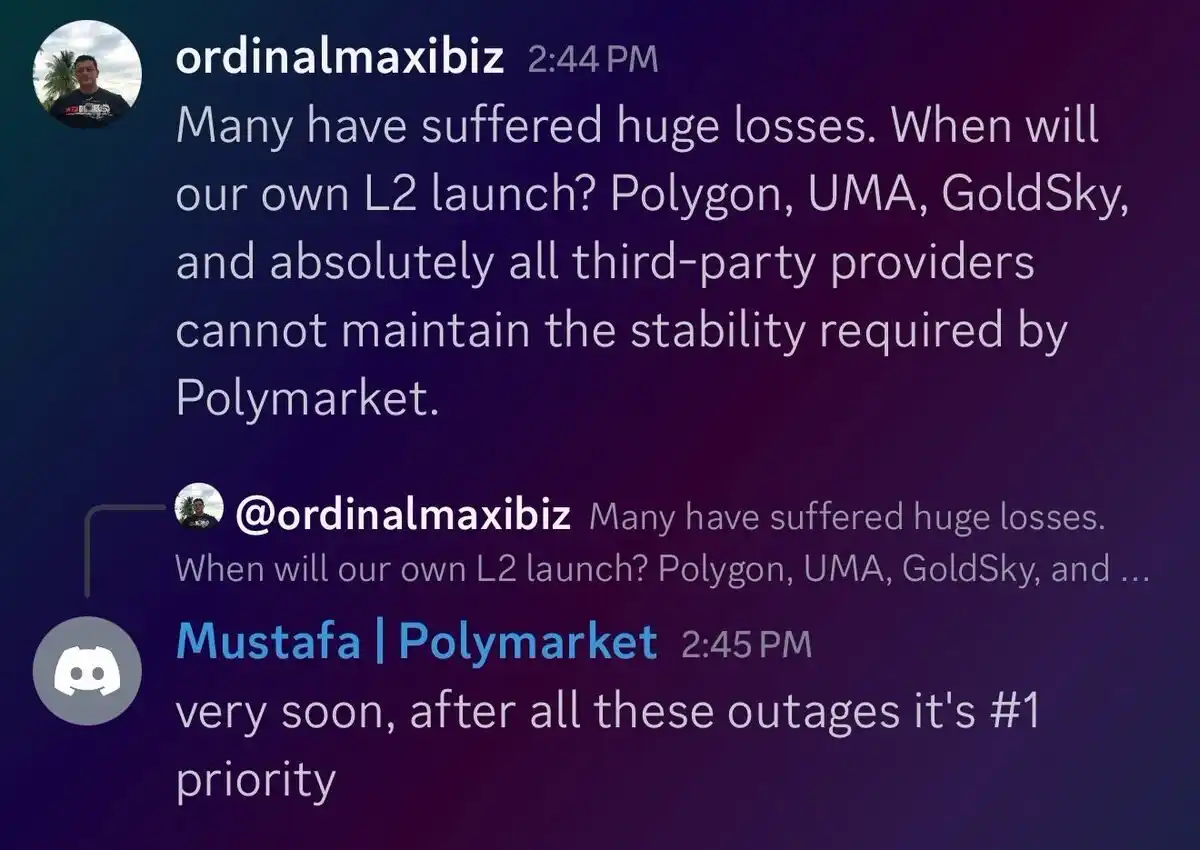
On December 22, news about the prediction market leader Polymarket sparked widespread attention — Mustafa, a team member of Polymarket, confirmed in the Discord community that Polymarket plans to migrate from Polygon and launch an Ethereum Layer2 network named POLY, which is the project's current top priority.

A Not-So-Surprising "Breakup"

Polymarket's decision to leave Polygon is not entirely unexpected. One is a red-hot application layer representative, the other is a gradually declining old infrastructure; the market heat and value expectations between the two were somewhat mismatched. As Polymarket gradually grows into a new behemoth, Polygon's relatively unstable network performance (the latest outage occurred on December 18) and relatively weak ecosystem have objectively become limitations for the former.

For Polymarket, building its own portal means a win-win choice in both product and economic dimensions.

In terms of product, besides seeking a more stable operating environment, building its own Layer2 network can help Polymarket tailor underlying features according to its platform needs, thereby more flexibly adapting to future upgrades and iterations of the platform.

The more significant meaning, however, lies in the economic aspect. Building its own network means Polymarket can bring the economic activities and peripheral services derived from its platform into its own system, preventing related value from spilling over to external networks, and instead gradually solidifying it into its own systemic advantages.

Explicit and Implicit Economic Contributions

As an application layer, Polymarket's explosive growth once brought substantial direct economic contributions to Polygon. Data history compiled by analyst dash on Dune shows:

  • Polymarket's monthly active users this month were 419,309, with a historical total of 1,766,193 users;
  • Total transactions this month were 19.63 million, with a historical total of 115 million transactions;
  • Total trading volume this month was $1.538 billion, with a historical total of $14.3 billion.

As for how to assess the proportion of Polymarket's contribution to the Polygon ecosystem's economy, Odaily Planet Daily discovered a rather coincidental ratio when compiling data from both.

  • First, in terms of deposited funds, Defillama data shows that the total value of positions on the Polymarket platform is currently about $326 million, accounting for about a quarter of Polygon's total network TVL of $1.19 billion;
  • Second, regarding gas consumption, Coin Metrics reported last October that transactions related to Polymarket were estimated to consume 25% of Polygon's total network gas;
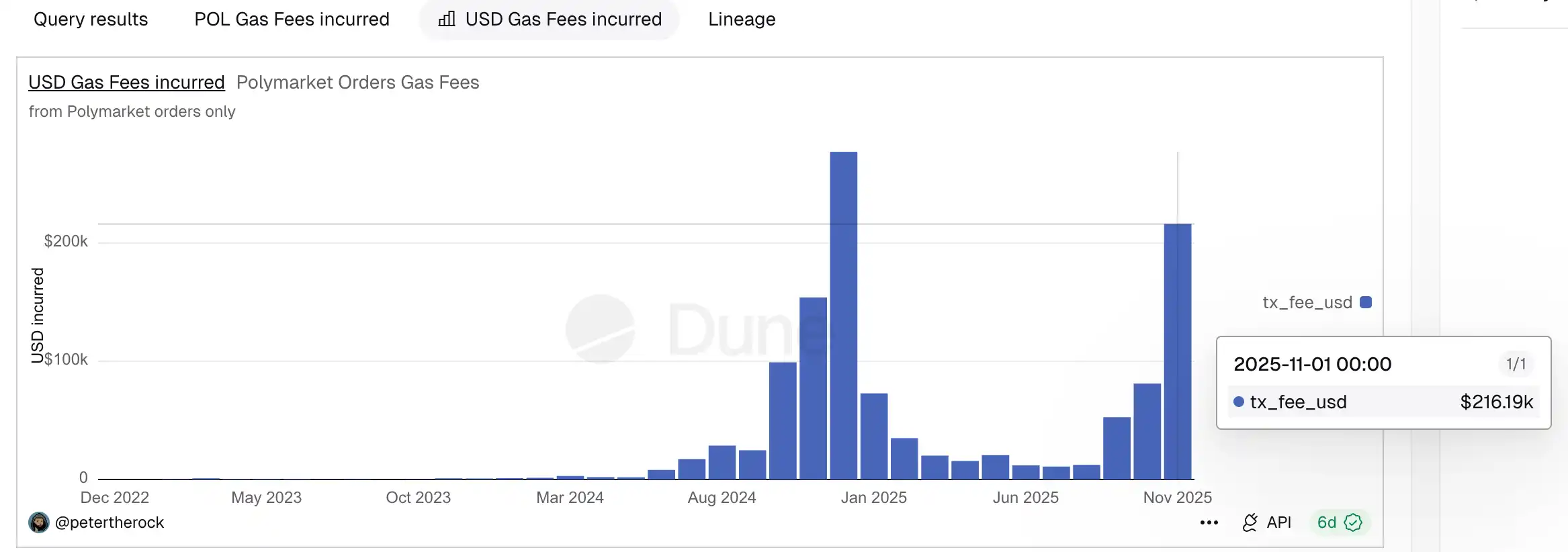
  • Considering this data is relatively old, we checked recent changes. Statistics charted by analyst petertherock on Dune show that in November, transactions related to Polymarket consumed about $216,000 in gas, while Token Terminal statistics show that Polygon's total network gas consumption that month was about $939,000, a ratio also close to a quarter (about 23%).

While this might be a coincidence due to statistical calibers and time windows, similar results across dimensions can serve as an estimated reference for measuring Polymarket's economic significance to Polygon.

Beyond quantifiable metrics like active users, deposited funds, transaction volume, and gas contributions, Polymarket's economic significance to Polygon is also reflected in a series of implicit contributions that are harder to measure directly but equally real.

First is the activation of stablecoin liquidity. All Polymarket transactions are settled in USDC. Its high-frequency, continuous trading behavior objectively significantly increases the circulation demand and usage scenarios for USDC on the Polygon network. Second is the附带价值 (fùdài jiàzhí -附带价值) of retained users'附带行为. Beyond the prediction market itself, these users might also turn to using other products on the Polygon ecosystem, such as DeFi, for convenience, thereby enhancing the overall ecological value of the Polygon network. These contributions are difficult to quantify with specific data but constitute the "real demand" that underlying networks value most and find most scarce.

Why Now? The Answer Isn't Hard to Guess

In fact, judging solely by user scale, data performance, and market presence, Polymarket is already fully confident to stand on its own. This is no longer a question of "should we leave," but rather "when to leave."

The core reason for choosing this particular moment to initiate the migration likely lies in the approaching Polymarket TGE (Token Generation Event). On one hand, once Polymarket completes its token issuance, its governance structure, incentive system, and economic model will become relatively solidified, making the cost and complexity of a subsequent底层迁移 (dǐcéng qiānyí - underlying migration) significantly higher; on the other hand, upgrading from a "single application" to a "application + infrastructure" full-stack system itself implies a change in valuation logic. Building its own Layer2 undoubtedly opens a higher ceiling for Polymarket in terms of narrative and capital.

In summary, Polymarket's departure from Polygon is essentially not just a simple underlying migration, but a microcosm of structural changes in the crypto industry. When top-tier applications begin to possess the ability to independently carry users, traffic, and economic activity, underlying networks that cannot provide additional value will inevitably be "betrayed."

Nothing more, just profit-seeking nature.

Связанные с этим вопросы

QWhy is Polymarket planning to migrate from Polygon to its own Layer2 network?

APolymarket is migrating to its own Layer2 network, named POLY, to achieve a more stable operating environment, customize the underlying infrastructure to better suit its platform's needs, and capture the economic value generated by its activities within its own ecosystem rather than allowing it to spill over to an external network like Polygon.

QWhat were some of the key economic contributions Polymarket made to the Polygon ecosystem?

APolymarket contributed significantly to Polygon's economy, accounting for approximately one-quarter of its total value locked (TVL) and gas consumption. It also drove substantial user activity, transaction volume, and helped vitalize USDC liquidity on the network.

QWhat specific data points illustrate Polymarket's user and transaction scale?

AAs of the article's data, Polymarket had 419,309 monthly active users and over 1.76 million historical users. It processed 19.63 million transactions in a month, with a total historical transaction count of 115 million, and a monthly transaction volume of $1.538 billion, accumulating to $14.3 billion historically.

QWhat is a major reason cited for Polymarket's decision to migrate at this particular time?

AA core reason for the timing of the migration is the impending Token Generation Event (TGE). Migrating before the token launch avoids the increased complexity and cost of doing so afterward and allows Polymarket to upgrade its valuation narrative from a single application to a full-stack 'app + chain' system.

QWhat does the author suggest is the broader implication of Polymarket's move for the crypto industry?

AThe author suggests that Polymarket's move is a microcosm of structural change in the crypto industry, where top-tier applications with the ability to independently support users, traffic, and economic activity will migrate away from underlying networks if those networks fail to provide additional value, driven primarily by the pursuit of greater economic benefit.

Похожее

Торговля

Спот
Фьючерсы

Популярные статьи

Как купить S

Добро пожаловать на HTX.com! Мы сделали приобретение Sonic (S) простым и удобным. Следуйте нашему пошаговому руководству и отправляйтесь в свое крипто-путешествие.Шаг 1: Создайте аккаунт на HTXИспользуйте свой адрес электронной почты или номер телефона, чтобы зарегистрироваться и бесплатно создать аккаунт на HTX. Пройдите удобную регистрацию и откройте для себя весь функционал.Создать аккаунтШаг 2: Перейдите в Купить криптовалюту и выберите свой способ оплатыКредитная/Дебетовая Карта: Используйте свою карту Visa или Mastercard для мгновенной покупки Sonic (S).Баланс: Используйте средства с баланса вашего аккаунта HTX для простой торговли.Третьи Лица: Мы добавили популярные способы оплаты, такие как Google Pay и Apple Pay, для повышения удобства.P2P: Торгуйте напрямую с другими пользователями на HTX.Внебиржевая Торговля (OTC): Мы предлагаем индивидуальные услуги и конкурентоспособные обменные курсы для трейдеров.Шаг 3: Хранение Sonic (S)После приобретения вами Sonic (S) храните их в своем аккаунте на HTX. В качестве альтернативы вы можете отправить их куда-либо с помощью перевода в блокчейне или использовать для торговли с другими криптовалютами.Шаг 4: Торговля Sonic (S)С легкостью торгуйте Sonic (S) на спотовом рынке HTX. Просто зайдите в свой аккаунт, выберите торговую пару, совершайте сделки и следите за ними в режиме реального времени. Мы предлагаем удобный интерфейс как для начинающих, так и для опытных трейдеров.

1.2k просмотров всегоОпубликовано 2025.01.15Обновлено 2025.03.21

Как купить S

Sonic: Обновления под руководством Андре Кронье – новая звезда Layer-1 на фоне спада рынка

Он решает проблемы масштабируемости, совместимости между блокчейнами и стимулов для разработчиков с помощью технологических инноваций.

2.2k просмотров всегоОпубликовано 2025.04.09Обновлено 2025.04.09

Sonic: Обновления под руководством Андре Кронье – новая звезда Layer-1 на фоне спада рынка

HTX Learn: Пройдите обучение по "Sonic" и разделите 1000 USDT

HTX Learn — ваш проводник в мир перспективных проектов, и мы запускаем специальное мероприятие "Учитесь и Зарабатывайте", посвящённое этим проектам. Наше новое направление .

1.8k просмотров всегоОпубликовано 2025.04.10Обновлено 2025.04.10

HTX Learn: Пройдите обучение по "Sonic" и разделите 1000 USDT

Обсуждения

Добро пожаловать в Сообщество HTX. Здесь вы сможете быть в курсе последних новостей о развитии платформы и получить доступ к профессиональной аналитической информации о рынке. Мнения пользователей о цене на S (S) представлены ниже.

活动图片