The answer could be revealed as soon as today; the entire internet is awaiting the 'AI stock god'’s playbook.

marsbitОпубликовано 2026-05-18Обновлено 2026-05-18

Введение

The article discusses the highly anticipated Q1 2026 13F filing from 24-year-old "AI stock guru" Leopold Aschenbrenner's fund, Situational Awareness LP. The fund gained fame after its publicly disclosed holdings skyrocketed from $225 million in Q4 2024 to $5.5 billion in Q4 2025. The market is eagerly awaiting the fund's latest portfolio, seen as a key indicator for AI investment trends. The filing was due by May 15 but has not yet been published. Three potential reasons are explored: 1) A late Friday submission causing an SEC processing delay, with the filing expected imminently. 2) The fund requested confidential treatment from the SEC, suggesting it is building a large, sensitive position. 3) The unlikely scenario that the fund's holdings dropped below the $100 million reporting threshold. The outcome is expected within days. If the filing is released, it will be analyzed for portfolio shifts. If confidential treatment was requested, it will intensify speculation about what major asset Aschenbrenner is accumulating.

Original | Odaily Planet Daily(@OdailyChina)

Author | Azuma(@azuma_eth)

Remember Leopold Aschenbrenner? The 24-year-old “New AI Stock God” we introduced in our article “SBF's Underling Turns $225 Million into $5.5 Billion in One Year”.

Leopold Aschenbrenner worked at FTX's Future Fund in 2022 and remained with the team until FTX's collapse. In 2024, Leopold Aschenbrenner wrote a 165-page super-paper titled “Situational Awareness: The Decade Ahead” and founded a fund of the same name, Situational Awareness LP, the same year, where he serves as Chief Investment Officer.

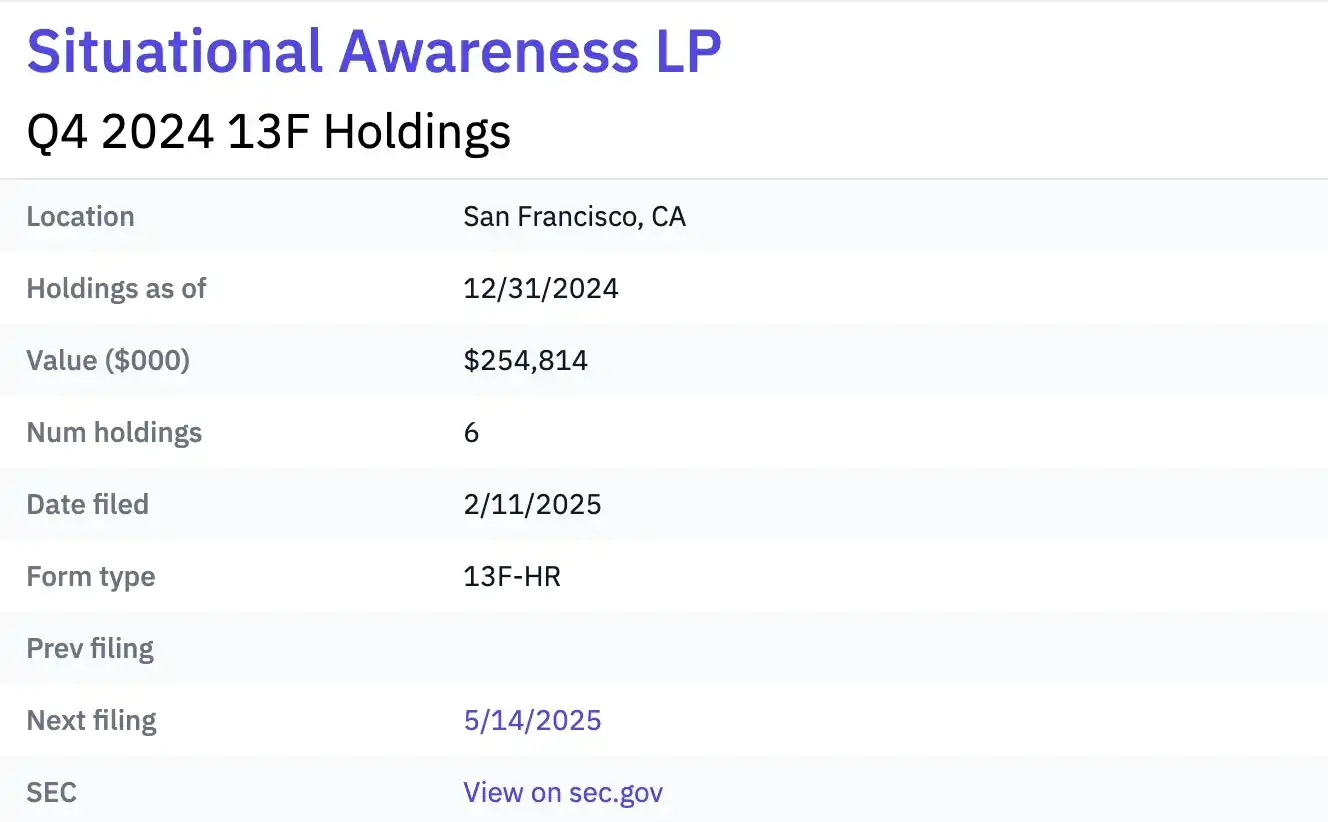
Situational Awareness LP focuses on investment opportunities in the AI industry chain. The fund's publicly disclosed holdings were “only” $225 million in Q4 2024, but by the Q4 2025 holdings disclosure released this February, that number had skyrocketed to $5.5 billion. This explosive investment performance has greatly boosted the reputation of Leopold Aschenbrenner and Situational Awareness LP, making it one of the most closely watched AI investment trends online.

Now, it's once again the critical window for Situational Awareness LP to disclose its holdings (13F). Starting last week, the entire internet has been eagerly waiting for the fund to reveal the current AI investment playbook, but as of publishing, the disclosure from Situational Awareness LP is still awaited.

The so-called 13F is a quarterly disclosure document required by the U.S. Securities and Exchange Commission (SEC) from funds with assets under management exceeding $100 million. The SEC mandates that funds meeting the disclosure requirements must submit this document within 45 days after the end of each calendar quarter. The fund is required to disclose its holdings of U.S. listed stocks, call/put options, convertible bonds, and specific ETF positions as of the end of the previous quarter.

Today is May 18th, three days past the Q1 2026 disclosure deadline of May 15th. Over the past few days, numerous sovereign wealth funds, university endowment funds, and traditional financial institutions have already disclosed their Q1 13F holdings reports, but the market is still waiting for Situational Awareness LP's disclosure.

Based on various market analyses, the following three scenarios may have affected Situational Awareness LP's 13F disclosure progress.

The first possibility is that Situational Awareness LP may have submitted the document to the SEC after 5:30 PM on May 15th. Since that day was a Friday, the SEC may not have had time to process it, so the document would need to be published on the SEC website the following Monday, after which the public could see it.

This is the mainstream market view. If this is the case, we can expect to see Situational Awareness LP's 13F file later today (or tomorrow at the latest).

The second possibility is that Situational Awareness LP has applied to the SEC for confidential treatment. This is a legal mechanism provided by the SEC that allows large funds to delay public disclosure of their holdings information while they are still actively building positions, with delays of up to one year.

Generally, the only reason a fund applies for confidential treatment is that they are building a position large enough that if the market were to learn about it prematurely, it would move the price against them before they finish building. If this is the case, it would mean Leopold Aschenbrenner is quietly accumulating a significant asset and temporarily does not want the market to know. This would undoubtedly warrant even closer market attention.

The third scenario is highly unlikely: Situational Awareness LP significantly reduced its holdings in the past quarter, bringing its portfolio size below the 13F disclosure threshold ($100 million). Considering the fund held $5.5 billion last quarter, the probability of this is extremely low.

In short, we only need to wait another 1 to 2 days to know the real reason for Situational Awareness LP's disclosure delay this time.

If it's the first scenario, we will bring you an analysis of the portfolio changes as soon as the 13F is released. If it's the second reason, the entire internet will truly be on edge—what exactly is Leopold Aschenbrenner hoarding? That would be the moment for internet investigators to shine.

Связанные с этим вопросы

QWhat is the name of the 24-year-old AI investment prodigy featured in the article and his fund?

AThe 24-year-old AI investment prodigy is Leopold Aschenbrenner. The fund he founded and serves as the Chief Investment Officer for is called Situational Awareness LP.

QWhat is a 13F filing according to the U.S. SEC, as explained in the article?

AA 13F filing is a quarterly report mandated by the U.S. Securities and Exchange Commission (SEC) for investment funds managing over $100 million in assets. It requires the fund to disclose its holdings of U.S. exchange-traded stocks, options, convertible bonds, and certain ETFs at the end of the quarter.

QWhat was the extraordinary growth in Situational Awareness LP's publicly disclosed portfolio value between Q4 2024 and Q4 2025?

ASituational Awareness LP's publicly disclosed portfolio value grew from $225 million in Q4 2024 to $5.5 billion in Q4 2025.

QWhat are the three possible reasons suggested in the article for Situational Awareness LP's delayed 13F filing for Q1 2026?

A1. The fund submitted the filing after 5:30 PM on the May 15th deadline (a Friday), and the SEC simply hasn't processed and published it yet. 2. The fund requested confidential treatment from the SEC to delay public disclosure, possibly because it is building a large position and wants to avoid price impact. 3. It's highly improbable, but the fund's holdings may have fallen below the $100 million reporting threshold.

QWhat significant action did Leopold Aschenbrenner take in 2024 besides founding his investment fund?

AIn 2024, besides founding Situational Awareness LP, Leopold Aschenbrenner wrote a 165-page paper titled 'Situational Awareness: The Decade Ahead,' which shares its name with his fund.

Похожее

70% of the Public Opposes AI, Americans Hope the U.S. Loses the AI War

70% of Americans believe AI development is moving too fast, with growing public resistance evolving from online criticism to real-world protests and violence. This widespread anti-AI sentiment stems from fears of job losses, rising utility costs, environmental damage, threats to democracy, and financial instability. Key incidents illustrate the backlash: Google's former CEO Eric Schmidt was loudly booed at a graduation for promoting AI; AI company ads are vandalized; protests and even violent attacks target AI firms and data centers. Polls show deep public pessimism and strong local opposition to data center construction, often surpassing resistance to nuclear power plants. The core grievances are economic and practical: AI is seen as automating jobs, concentrating wealth, and increasing household electricity and water bills due to massive data center resource demands. Environmentalists also oppose AI's high energy use and carbon emissions. This opposition has turned AI into a major political issue in the US. While the Trump administration prioritizes AI innovation for global competition, bipartisan pushback is growing. Democrats and factions within the MAGA movement are forming temporary alliances to support stricter regulations and local bans on new data centers, pressuring the administration to choose between its tech industry backers and its voter base. The situation highlights a profound national divide over AI's future.

marsbit19 мин. назад

70% of the Public Opposes AI, Americans Hope the U.S. Loses the AI War

marsbit19 мин. назад

Agents Take Over Traffic Distribution Power: What Are Tencent, ByteDance, and Alibaba Competing For?

In the race to dominate the AI era's entry point, China's tech giants—Tencent, ByteDance, and Alibaba—are aggressively deploying AI Agents to control the future of traffic distribution. Alibaba is pursuing a dual-track "closed loop + openness" strategy. Its Qianwen app is evolving into a super-Agent integrated across its ecosystem (Taobao, Alipay, etc.) to handle complex tasks like travel planning. Concurrently, it is opening its platform to external brands (Luckin Coffee, KFC) and has launched a B2B Agent platform, "Wukong," targeting enterprise automation. Its other flagship, Quark, aims to be an "AI super search box" for information and tasks. ByteDance is executing an omnipresent "sprawl strategy." Its Doubao app boasts over 300 million monthly active users and is evolving into a default AI entry point for daily life, with plans for paid versions and e-commerce integration. Its core weapon is the Kouzi platform, a visual "AI assembly factory" for developers to build custom Agents. ByteDance is also pushing hardware integration, collaborating on AI phones and developing smart glasses to embed Doubao everywhere. Tencent is playing its long-held "ultimate card" by quietly embedding an AI Agent directly into WeChat. This Agent, accessible via a swipe, can understand user commands and automatically execute tasks by calling upon WeChat's millions of mini-programs (e.g., finding and ordering coffee). This leverages WeChat's unparalleled 1.4-billion-user ecosystem to position the app as an AI-powered "service operating system," a move that could dramatically reshape the competitive landscape. The core battleground is shifting from competing for "user screen time" to competing to be the "default execution layer" for user intent. The business model is evolving from an "attention economy" to an "intent economy," where the Agent that can most efficiently fulfill a user's need gains control over service access and token flow. This represents a fundamental change in how users connect with digital services, making the fight for the Agent入口 (entry point) a pivotal moment for redefining industry leadership in the AI age.

marsbit2 ч. назад

Agents Take Over Traffic Distribution Power: What Are Tencent, ByteDance, and Alibaba Competing For?

marsbit2 ч. назад

Торговля

Спот
Фьючерсы

Популярные статьи

Неделя обучения по популярным токенам (2): 2026 может стать годом приложений реального времени, сектор AI продолжает оставаться в тренде

2025 год — год институциональных инвесторов, в будущем он будет доминировать в приложениях реального времени.

1.8k просмотров всегоОпубликовано 2025.12.16Обновлено 2025.12.16

Неделя обучения по популярным токенам (2): 2026 может стать годом приложений реального времени, сектор AI продолжает оставаться в тренде

Обсуждения

Добро пожаловать в Сообщество HTX. Здесь вы сможете быть в курсе последних новостей о развитии платформы и получить доступ к профессиональной аналитической информации о рынке. Мнения пользователей о цене на AI (AI) представлены ниже.

活动图片