The Allbirds, the Internet-Famous Shoes That Took Silicon Valley by Storm, Are Now All in on AI

marsbitОпубликовано 2026-04-16Обновлено 2026-04-16

Введение

Allbirds, the once-popular sustainable shoe brand favored by Silicon Valley elites and celebrities, has announced a drastic pivot from footwear manufacturing to AI infrastructure. On April 15, 2026, the company revealed plans to abandon its shoe business entirely, rebrand as "NewBird AI," and focus on GPU-as-a-service and AI cloud solutions. The move caused its stock to surge over 800% in a single day. The brand, known for its wool-based eco-friendly shoes, had struggled financially in recent years. Revenue fell from a peak of $298 million in 2022 to $152 million in 2025, with cumulative losses of $419 million over five years. In March 2026, Allbirds sold its intellectual property and footwear assets for just $39 million—a fraction of its former $4.1 billion valuation. The company secured up to $50 million in convertible notes to fund the acquisition of GPU hardware for AI compute leasing. However, the announcement lacked details about technical capacity, clients, or infrastructure plans. Critics highlight the high execution risks in the competitive AI infrastructure market, dominated by major cloud providers. The shift reflects a broader trend of companies rebranding around AI to attract investor interest, despite uncertain fundamentals. Allbirds also removed its "public benefit" corporate mission, signaling a departure from its original sustainability ethos. The move underscores the power of AI narrative in today’s capital markets, where storytelling often precedes subst...

Author: Bitpush

Leonardo DiCaprio invested, Barack Obama and Tim Cook scrambled to wear them, Emma Watson actively endorsed them...

Yet, this "middle-class top trend" is no longer selling.

On April 15, 2026, the American internet-famous sneaker brand Allbirds issued a major announcement: the company will completely abandon its shoe manufacturing business, fully pivot to artificial intelligence computing infrastructure, and rebrand as "NewBird AI".

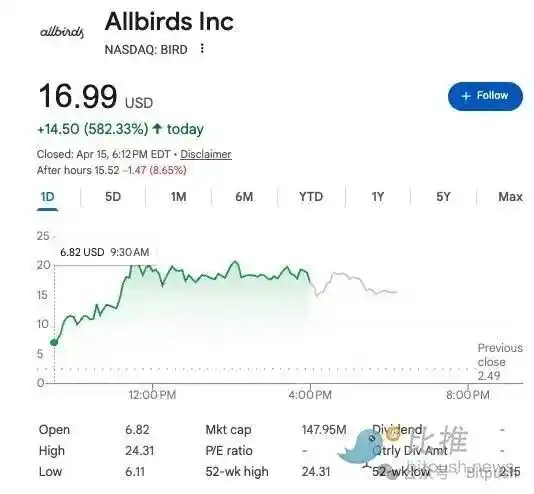
Upon the news, the stock price soared from under $3 to a session high of over $24, with a single-day surge exceeding 800% at one point.

Just half a month prior, this once-star brand had just sold off all its intellectual property and footwear assets for a mere $39 million — only one percent of its peak market valuation of $4.1 billion.

From wool shoes on the feet of Silicon Valley elites to a shell company turning around to deal in GPU computing power — the story of Allbirds is more than just the rise and fall of a startup; it lets us see the madness of today's capital markets: AI is the cure-all.

The Rise and Fall of the "Silicon Valley Miracle Shoe"

In 2015, former New Zealand professional soccer player Tim Brown and renewable materials expert Joey Zwillinger founded Allbirds in San Francisco. Their vision was simple and clear: use natural materials like merino wool and eucalyptus fiber to create a comfortable shoe that doesn't rely on petroleum-based ingredients.

In 2016, the first product, the Wool Runner, was launched and quickly became a hit in the Silicon Valley tech circle. Google co-founder Larry Page, Apple CEO Tim Cook, and even former U.S. President Barack Obama became devotees of these wool shoes.

Allbirds caught two perfect tailwinds. The first was the golden age of the DTC (Direct-to-Consumer) model — bypassing traditional retail channels to reach consumers directly through its website, controlling complete user data and brand narrative. The second was the ethical awakening of "sustainable consumption" — in the context of environmental protection becoming a global consensus, a shoe with a "zero carbon footprint" was itself a statement of values.

When these two narratives fermented in the soil of an economic upswing, Allbirds rapidly grew from a Kickstarter crowdfunding project to a publicly listed company valued at over $4 billion.

But Allbirds' fall was almost as rapid as its rise.

Its commercial collapse followed a classic DTC script: a single hit product supporting the entire brand, rushing to expand into apparel and physical retail before the foundation was solid, overextending its reach and causing a loss of brand focus.

As more and more brands began talking about sustainability, and as competitors like Hoka and On Running surpassed it in performance and design, Allbirds' sustainability narrative was quickly diluted.

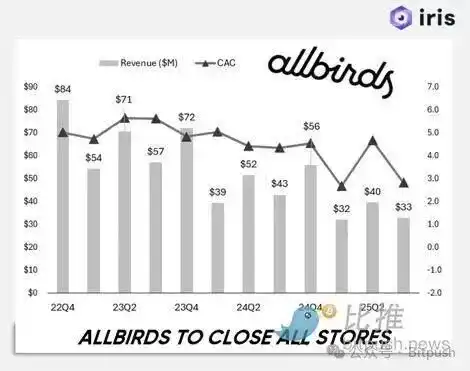
In 2022, the company's revenue reached a historical peak of $298 million; thereafter, it declined all the way, dropping to $152 million by 2025, nearly halved. Over the past five years, despite cumulative sales of approximately $1.2 billion, total losses reached a staggering $419 million.

In 2024, the company received a delisting warning from Nasdaq for its stock price trading below $1 for 30 consecutive days, and later maintained its listing status through a reverse stock split.

In February 2026, Allbirds announced the closure of all its full-price retail stores in the United States.

On March 30, 2026, Allbirds signed an agreement with the brand management company American Exchange Group to sell its intellectual property and related assets for $39 million. The buyer, which owns brands like Aerosoles and Ed Hardy, will continue to sell footwear products under the Allbirds name.

The price has also been slashed. Checking the website today, shoes that once cost over a hundred dollars are now on sale for around thirty-something dollars...

The listed company's "shell" was waiting for its next fate — and this answer came faster than anyone imagined.

From Selling Shoes to Buying GPUs

The April 15th announcement was one of the most unexpected transformations in business history. Allbirds announced it had entered into a convertible note financing agreement with an institutional investor for up to $50 million. The funds will be used to acquire high-performance GPU hardware and provide computing power access services to customers through a long-term leasing model. The company plans to rename itself "NewBird AI," with a long-term vision of becoming a "fully integrated GPU-as-a-Service (GPUaaS) and AI-native cloud solutions provider."

The market reaction was近乎疯狂 (nearly insane). At the close on April 14th, Allbirds' market capitalization was only about $21 million; after the announcement, the stock price一度触及 (once touched) $24.31, inflating the market cap to approximately $165 million. On Fidelity's trading heat list, Allbirds became one of the most active stocks of the day, showing the enthusiasm of retail traders.

This疯狂的市场反应 (crazy market reaction) is less about pricing the fundamentals of NewBird AI and more about pricing the "AI" label itself.

Allbirds' transformation announcement did not reveal any specific information about customer resources, technical team, or data center deployment plans — just the $50 million on its books and a vague blueprint of "buy GPUs and lease them out."

Independent consultant Bruce Winder commented: "I don't think Allbirds brings anything substantive to the table, aside from the brand awareness itself."

Notably, while pivoting to AI, Allbirds also requested shareholder approval in an SEC filing to amend its corporate charter, removing language about "serving the public interest" —这意味着 (this means) that this company, once proud of its B Corp certification, is actively shedding the environmental mission it was famous for. From "saving the planet" to "selling computing power," Allbirds' value shift is perhaps more symbolic than the business transformation itself.

The AI Narrative Remains the Most Powerful Business Magic

Allbirds is not the first to do this, and it certainly won't be the last. Over the past 18 months, from fast fashion to fresh food e-commerce, from logistics companies to home furnishing brands, a large number of traditional companies have rushed to slap an "AI" label on themselves. The reason is actually quite simple: the price-to-earnings ratio for selling shoes is only slightly over 10x, while selling computing power can be hyped to over 50x; GPUs are now hard currency, more sought after than gold, and whoever has priority access holds the chip to make money flipping them;再加上 (add to that) consumers' wallets are indeed thinner, so instead of continuing to spend money on advertising and competing for traffic with Temu, it's better to step back and gamble on enterprise AI compute leasing — at least the story sounds better.

Taking a longer historical view, this "changing shells" play is not new. During the 2017 crypto craze, a beverage company called Long Island Iced Tea changed its name to "Long Blockchain Corp.," and its stock price soared nearly 300% in a single day, only to be delisted from Nasdaq the following year. In 2024, several Bitcoin mining companies turned to building AI data centers, with Core Scientific being one of the most successful cases. From the internet bubble to blockchain, and now to AI, the capital market script has never changed: the赛道 (sector) is priced before profitability, the narrative happens before reality.

Allbirds' transformation essentially trades its remaining brand credit and listed shell resource for a GPU procurement contract. The core question is whether this admission ticket is truly valuable. AI infrastructure is a highly capital-intensive industry with extremely high technical barriers. The GPU leasing market already has players valued in the billions of dollars, alongside deep deployment by hyperscale cloud service providers like Amazon AWS and Microsoft Azure. Whether a company that once made shoes, with $50 million in financing and a set of GPU equipment, can survive in this crowded field remains a huge unknown. Not to mention, this financing still needs approval at a special shareholder meeting on May 18th.

Bloomberg Intelligence analyst Poonam Goyal commented: "This move takes it out of a structurally low-margin footwear and apparel model into a higher-value compute business, but execution risk remains high."

We are witnessing a footnote of an era: any entity — no matter what it once was — can be redefined as an AI company. As long as the story is compelling enough, capital will pay for it.

The AI narrative remains the most powerful business magic of the moment.

Связанные с этим вопросы

QWhat was the original business of Allbirds and why was it initially successful?

AAllbirds was originally a footwear company that produced comfortable shoes using natural materials like merino wool and eucalyptus fibers. It gained initial success by capitalizing on the DTC (Direct-to-Consumer) model and the growing consumer demand for sustainable, eco-friendly products, becoming popular among Silicon Valley elites and celebrities.

QWhat led to the decline of Allbirds' footwear business?

AThe decline was due to overexpansion into apparel and physical retail, which diluted the brand's focus, increased competition from brands like Hoka and On Running, and a failure to maintain its sustainable narrative as more brands adopted similar eco-friendly messaging. Revenue dropped from $298 million in 2022 to $152 million in 2025, with cumulative losses of $419 million over five years.

QWhat drastic change did Allbirds announce in April 2026, and how did the market react?

AIn April 2026, Allbirds announced it would completely abandon its shoe business, pivot to AI compute infrastructure by acquiring GPUs and offering GPU-as-a-Service, and rebrand to 'NewBird AI'. The market reacted wildly, with the stock price surging over 800% in a single day, from under $3 to over $24, due to investor enthusiasm for AI-related narrative.

QWhat were the financial terms of Allbirds' transition to AI, and what risks are involved?

AAllbirds secured up to $50 million in convertible notes to fund GPU acquisitions and plans to lease compute power. However, the move carries high execution risks as the AI infrastructure market is capital-intensive and dominated by major players like AWS and Azure. The company lacks disclosed details on customers, technical team, or data center plans, making success uncertain.

QHow does Allbirds' shift to AI reflect broader trends in capital markets?

AAllbirds' pivot exemplifies how companies are leveraging the 'AI narrative' to attract capital, as AI-related businesses often command higher valuations than traditional industries. This trend mirrors past cycles like the blockchain craze, where firms rebranded to tap into investor hype, prioritizing storytelling over fundamentals to drive stock performance.

Похожее

Claude Bill Skyrockets by 5 Billion, Surges 60-Fold Overnight—Can Your Token Budget Keep Up?

An enterprise reportedly ran up a staggering $500 million bill on Anthropic's Claude AI in just one month due to a simple oversight: failing to set usage limits for employee accounts. This incident highlights a growing trend of runaway AI costs. Other examples include a Google Cloud user hit with an unexpected $18,000 bill from API key abuse, and an OpenAI internal experiment that consumed 603 billion tokens, costing $1.3 million in 30 days. Major AI providers like OpenAI and GitHub are shifting from flat monthly fees to granular, usage-based pricing (per input/output/cached token), causing shock for some users whose costs skyrocketed by orders of magnitude. The root causes extend beyond pricing. The rise of autonomous AI agents executing long, complex tasks has drastically increased token consumption. Furthermore, misaligned incentives, like internal "leaderboards" ranking employees by AI usage, can encourage wasteful "tokenmaxxing"—using powerful models for trivial tasks just to inflate metrics. This has sparked a new industry focused on cost optimization. Solutions include providing AI with better context (reducing redundant searches) and intelligent model routing (matching tasks to the most cost-effective model). Research indicates token consumption for agentic tasks can vary wildly (up to 30x for the same job) without guaranteeing better results, and models often underestimate their own costs. As AI expenses begin to rival or even surpass human labor costs for some teams, companies are being forced to move from indiscriminate usage to meticulous "token accounting." The future belongs to those who can maximize the value of every token spent.

marsbit21 мин. назад

Claude Bill Skyrockets by 5 Billion, Surges 60-Fold Overnight—Can Your Token Budget Keep Up?

marsbit21 мин. назад

24/7 Unstoppable Derivatives Wave: Cryptocurrency Is Forcing Traditional Finance to 'Change Time Zones'

The article discusses how the 24/7 nature of the cryptocurrency market is compelling traditional finance to adapt its operating hours and infrastructure. The key catalyst is the CME Group's planned launch of nearly round-the-clock trading for regulated crypto derivatives, a move driven by strong institutional demand for continuous risk management. This shift highlights a fundamental change: derivatives, not spot trading, now dominate crypto market activity and price discovery. However, integrating continuous trading into traditional finance reveals structural tensions. While execution times can be extended, settlement, clearing, and regulatory reporting largely remain bound to traditional business-day cycles. This creates a lag where weekend price movements can impact risk exposures before traditional control systems are fully active. Furthermore, the article explores new challenges arising from this always-on environment. The inherent transparency of public blockchains, while ensuring auditable settlement, also exposes sensitive corporate information like treasury flows to competitors in real-time. This has elevated privacy from a feature to a core requirement for institutional adoption. The next phase hinges on building systems that balance this necessary privacy with regulatory accountability and compliance. In conclusion, the move towards 24/7 trading signifies more than crypto becoming institutionalized. It represents traditional finance beginning to adopt the temporal structure of crypto-native markets. The future will be defined by how successfully traditional risk, identity, privacy, and settlement frameworks can operate at the continuous speed cryptocurrency markets demand.

marsbit1 ч. назад

24/7 Unstoppable Derivatives Wave: Cryptocurrency Is Forcing Traditional Finance to 'Change Time Zones'

marsbit1 ч. назад

Unitree Passes the Hearing, Hangzhou Reaps the Rewards

Unitree Technology, a leading company in Hangzhou's tech scene known as one of the "Hangzhou Six Dragons," has officially passed the review for listing on the Shanghai Stock Exchange's STAR Market (科创板). It plans to raise 4.202 billion yuan for the research and development of intelligent robot models and robot hardware. This milestone will make Unitree the "first humanoid robotics stock." Founded in 2016 by Wang Xingxing, the company started humbly in a small office in Hangzhou's Binjiang district. Initially, the robotics sector was not viewed favorably by the market, with Unitree's products often labeled as "toys" and struggling to secure funding. At its most critical point, with only around 100,000 yuan left, Wang stopped his own salary to keep the company afloat. A crucial turning point came in 2018 when Hangzhou's state-owned capital system provided timely support. A financial platform under the city's state-owned assets completed due diligence in three days and granted a 20-million-yuan loan within a week. This "patient capital" infusion stabilized Unitree, enabling its transition from prototype development to mass production and commercial viability. Subsequently, Hangzhou Capital, through its two major 100-billion-yuan mother funds—the Hangzhou Science and Technology Innovation Fund and the Hangzhou Innovation Fund—participated in four of Unitree's financing rounds (B2, B3, C, and C+). This continuous backing helped the company grow, attract top-tier industrial investors like China Mobile, Tencent, Alibaba, and Geely, and solidify its position as a global leader in legged robotics. By 2025, Unitree achieved significant scale, with revenue reaching 16.99 billion yuan, net profit of 5.91 billion yuan, global leadership in humanoid robot shipments, and over 33,000 quadruped robots sold worldwide. Unitree's journey exemplifies Hangzhou's strategy of nurturing hard-tech startups from "seedlings" to industry leaders. Beyond Unitree, Hangzhou's capital ecosystem has supported other "Six Dragons" like Cloudwalk, BrainCo, and DeepSeek. The city has established a 500-billion-yuan "3+N" industrial fund cluster and specialized early-stage funds like the "Runmiao Fund" with a 20-year term to fill funding gaps for very early-stage projects. This robust "capital + talent" model, coupled with an influx of over 430,000 young professionals in 2025 alone, has fostered a vibrant innovation ecosystem. Hangzhou is now home to 48 unicorns and 413 potential unicorns, building comprehensive industrial chains in AI, robotics, brain-computer interfaces, and more. As Hangzhou experiences a wave of IPOs, it is solidifying its reputation as an ideal city for entrepreneurs.

marsbit1 ч. назад

Unitree Passes the Hearing, Hangzhou Reaps the Rewards

marsbit1 ч. назад

Торговля

Спот
Фьючерсы

Популярные статьи

Неделя обучения по популярным токенам (2): 2026 может стать годом приложений реального времени, сектор AI продолжает оставаться в тренде

2025 год — год институциональных инвесторов, в будущем он будет доминировать в приложениях реального времени.

1.8k просмотров всегоОпубликовано 2025.12.16Обновлено 2025.12.16

Неделя обучения по популярным токенам (2): 2026 может стать годом приложений реального времени, сектор AI продолжает оставаться в тренде

Обсуждения

Добро пожаловать в Сообщество HTX. Здесь вы сможете быть в курсе последних новостей о развитии платформы и получить доступ к профессиональной аналитической информации о рынке. Мнения пользователей о цене на AI (AI) представлены ниже.

活动图片