Tether Cooperates with U.S. Sanctions to Freeze $344 Million in USDT, Reigniting Debate Over Stablecoin 'One-Click Freeze Authority'

marsbitОпубликовано 2026-04-24Обновлено 2026-04-24

Введение

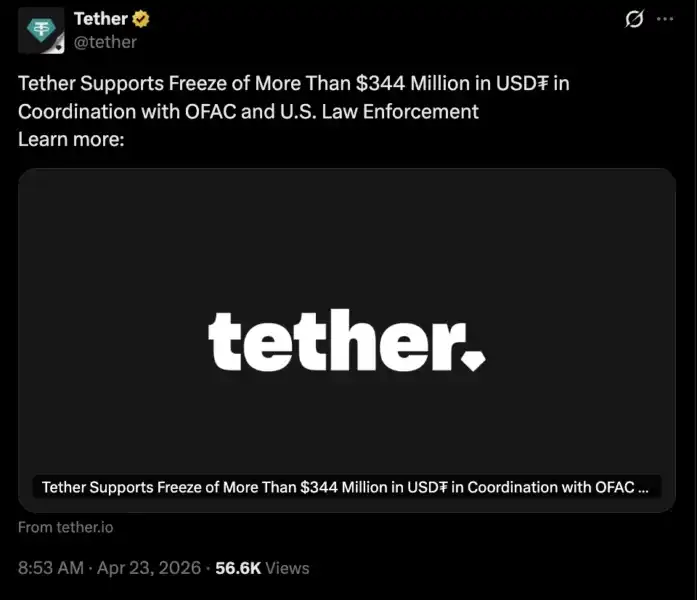
Tether, the issuer of USDT, has frozen over $344 million worth of USDT across two Tron blockchain addresses in its largest-ever single compliance action. The freeze was carried out on April 23 in coordination with the U.S. Office of Foreign Assets Control (OFAC) and other law enforcement agencies. The funds are suspected to be linked to sanctions evasion, criminal networks, or other illicit activities, though specific details were not disclosed. This action comes amid increased U.S. regulatory scrutiny, including sanctions against entities tied to Iran and Mexican drug cartels. Tether’s CEO, Paolo Ardoino, emphasized the company’s commitment to preventing illegal use of USDT, contrasting it with slower responses from competitors like Circle. To date, Tether has frozen over $4.4 billion in assets and collaborates with more than 340 law enforcement agencies across 65 countries. The move has reignited debate within the crypto community over the centralized "freeze authority" held by stablecoin issuers, challenging the notion that "your stablecoins are your own." Critics point to the built-in blacklist function in USDT’s smart contracts, which allows Tether to immobilize funds in targeted wallets, while proponents argue it enhances regulatory compliance and anti-money laundering efforts.

Author: Claude, Deep Tide TechFlow

Deep Tide Introduction: On April 23, Tether cooperated with OFAC and U.S. law enforcement agencies to freeze a total of 344 million USDT in two wallets on the Tron chain, setting a historical record for the largest single freeze. This action, occurring against the backdrop of intensified enforcement of Iran sanctions and criticism of Circle's ineffective freezing after the Drift Protocol's $285 million hack, has once again pushed the 'one-click freeze authority' of stablecoin issuers into the spotlight of public opinion. Tether has cumulatively frozen over $4.4 billion in assets, but its approximately $189 billion in circulation has never undergone a comprehensive audit.
The largest single compliance freeze in stablecoin history has been implemented.

On April 23, Tether issued a statement confirming it had cooperated with the U.S. Department of the Treasury's Office of Foreign Assets Control (OFAC) and multiple law enforcement agencies to freeze USDT in two wallet addresses on the Tron chain, totaling over $344 million. Blockchain security company PeckShield first identified the two blacklisted addresses on-chain: TNiq9...QZH81 held approximately $212.9 million, and TTiDL...pjSr9 held approximately $131.3 million.

Tether stated that the freezing action was based on intelligence shared by U.S. authorities, involving sanctions evasion, criminal networks, or other illegal activities, but did not disclose the specific subjects of the investigation or the nature of the case. Blockchain analysis company AMLbot claimed these two addresses had appeared in documents related to scams, with one linked to a forged $75 billion contract and another involving a Bitcoin-for-USDT scam promising 10% instant returns.

Largest Single Freeze in History, Nearly Double the Previous Record

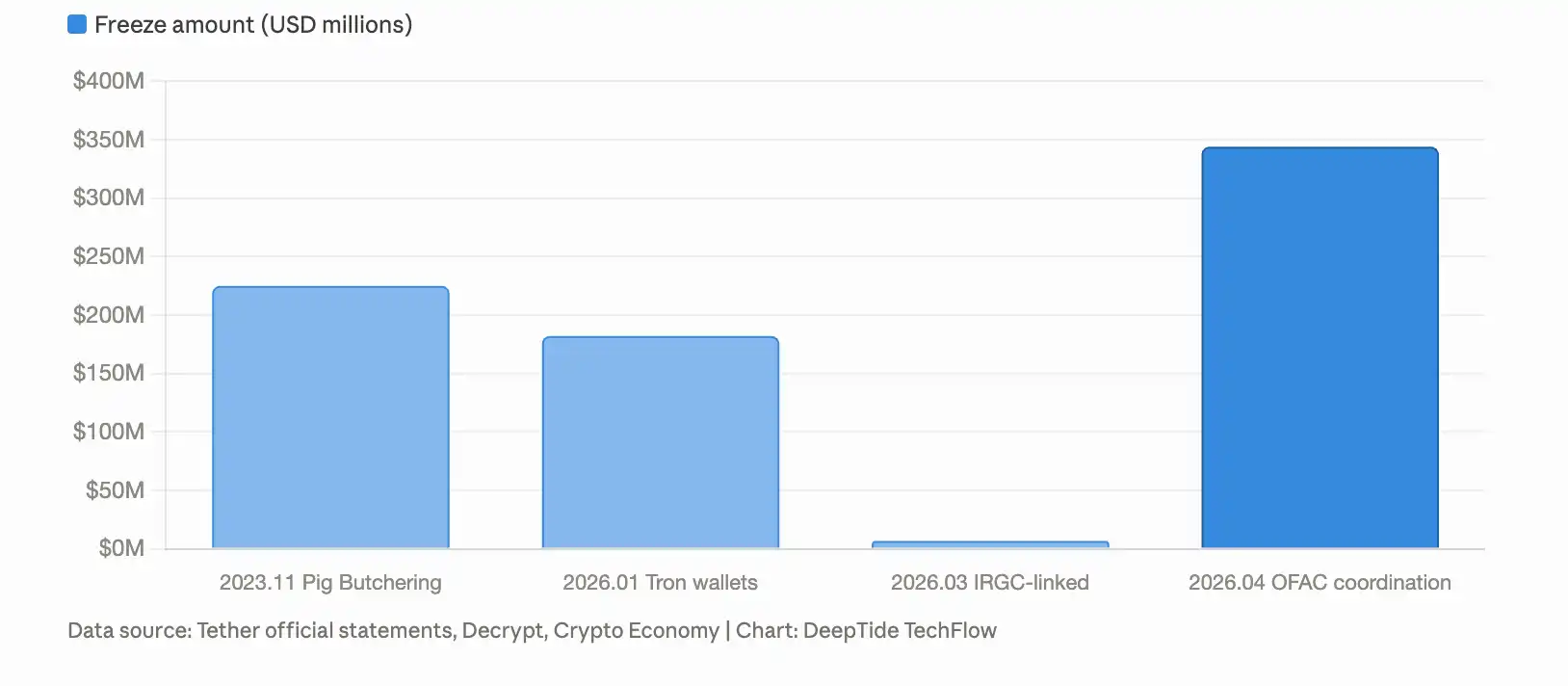
This is the largest single freeze action on record for Tether, nearly double the $182 million freeze in January of this year.

Tether CEO Paolo Ardoino stated in the declaration that USDT is not a safe haven for illegal activities, and when credible links to sanctioned entities or criminal networks are found, the company takes immediate action. He also subtly referenced competitor Circle's slow response in the Drift Protocol incident, saying, 'Recent events have shown that when platforms fail to act swiftly, law enforcement breaks down, users are exposed, and trust is lost.'

According to data disclosed by Tether, the company currently cooperates with over 340 law enforcement agencies in 65 countries, has assisted in over 2,300 cases, and has cumulatively frozen assets exceeding $4.4 billion, of which $2.1 billion is directly related to U.S. law enforcement. Previous large-scale freezes include: approximately $225 million frozen in November 2023 (related to investigations into human trafficking and pig-butchering scams in Southeast Asia), and approximately $182 million frozen in January 2026 (five Tron wallets).
Sanctions Background: Iran, Drug Networks, and OFAC Enforcement Escalation

According to The CC Press, this freeze was executed under OFAC's Iran-related sanctions framework. This timing is significant.

On the same day (April 23), the U.S. Treasury Department announced sanctions against 23 individuals and entities linked to the Sinaloa drug cartel, involving a complex supply chain network procuring fentanyl and methamphetamine precursor chemicals from Asia. Although this sanctions action is not the same case as the Tether freeze, both point to the same policy direction: the U.S. is comprehensively escalating its enforcement of sanctions through cryptocurrency channels.

Regarding Iran, the scale of using USDT to evade sanctions has expanded dramatically in recent years. According to a TRM Labs investigative report cited by The Block in January this year, two UK-registered exchanges, Zedcex and Zedxion, actually provided financial channels for the IRGC (Islamic Revolutionary Guard Corps), processing approximately $1 billion in transactions between 2023 and 2025, 56% of which were IRGC-related transactions, almost all settled using USDT on the Tron chain. IRGC-related transaction volume surged from $24 million in 2023 to $619 million in 2024.

U.S. Senator Richard Blumenthal has publicly called Tether a 'key money laundering tool' for the IRGC, sanctioned Iranian banks, and Iranian weapons manufacturers. In March of this year, Tether also froze $6.76 million USDT linked to networks associated with the IRGC and the Houthis.

Community Questions 'Your Coins Were Never Yours'

However, there is still controversy surrounding the specific attribution of this $344 million freeze.

According to on-chain analysis published by @asvanevik (Nansen CEO Alex Svanevik) on platform X, the network involved with the frozen addresses has been operating since 2021, had fund interactions with the Turkish exchange Paribu, but had only about $1.5 million in transaction records with known IRGC wallets, accounting for 0.4% of the total frozen amount. Svanevik assessed the credibility of attributing this network to the IRGC at 40%-50%.

Meanwhile, the crypto community's reaction is clearly divided.

Crypto media TFTC directly wrote: 'Tether one-click froze $344 million. Your stablecoin was never your stablecoin.' The media used this event as a counterexample to Bitcoin's uncensorable nature, emphasizing that Bitcoin has no issuer, no compliance desk, and no intermediary that can freeze balances.

On-chain data supports the realistic basis for this concern. The USDT smart contract has a built-in blacklist function on every supported chain. Once an address is blacklisted, the related tokens, even if visible on-chain, cannot be transferred, exchanged, or redeemed. To date, Tether has frozen over $3.3 billion USDT across more than 7,000 wallets.

On the other hand, the regulatory faction believes this precisely proves that stablecoins can become effective compliance infrastructure. Unlike cash, every transaction on a public chain is traceable, and the issuer's freezing capability provides law enforcement with speed and precision unattainable by traditional finance.

Between regulatory compliance and the ideal of decentralization, stablecoins are moving towards an increasingly clear hybrid model:

Centralized control rights operating on decentralized infrastructure.

Связанные с этим вопросы

QWhat was the record amount of USDT frozen by Tether in a single action on April 23rd, and on which blockchain did it occur?

ATether froze a record 344 million USDT in a single action on the Tron blockchain on April 23rd.

QWhich U.S. government office did Tether cooperate with to execute the freezing of the 344 million USDT?

ATether cooperated with the U.S. Treasury's Office of Foreign Assets Control (OFAC) to execute the freezing.

QWhat is the main criticism from the crypto community regarding Tether's ability to freeze funds, as highlighted in the article?

AThe main criticism is that it demonstrates the principle 'your stablecoin is never your stablecoin,' highlighting the centralized control and lack of user sovereignty over their assets, in contrast to the censorship-resistant nature of assets like Bitcoin.

QAccording to the article, what was one of the alleged illicit activities connected to the frozen addresses, as identified by blockchain analysis firm AMLbot?

AAMLbot identified that one of the addresses was associated with a fake $75 billion contract, and another was involved in a Bitcoin-for-USDT scam promising 10% instant returns.

QHow does the article describe the evolving model of stablecoins in terms of infrastructure and control?

AThe article describes stablecoins as moving toward a clear hybrid model: decentralized infrastructure running with centralized control.

Похожее

Anthropic's IPO Launch: Commercial Miracle or Valuation Bubble?

Anthropic has confidentially filed for an IPO, led by Morgan Stanley and Goldman Sachs, potentially going public by October. Following its latest $650 billion funding round, its pre-IPO valuation stands at $965 billion, with projections reaching up to $2 trillion at listing, which would make it the highest-valued private company ever. The article, written by Fu Sheng, addresses skepticism that this represents an AI bubble akin to the 2000 dot-com crash. It argues the current situation differs fundamentally. Unlike the internet bubble era, which relied on speculative narratives with little revenue, Anthropic's valuation is backed by unprecedented, measurable financial performance. Key data points include: * **Revenue Growth:** ARR skyrocketed from $10 billion in early 2025 to $470 billion by May 2026, targeting $100 billion by year-end—a growth curve unmatched in business history. * **Profitability:** It achieved operating profitability in Q2 2026 with an estimated $5.6 billion profit. * **Efficiency:** With ~3,000 employees and ~$470 billion ARR, its revenue per employee exceeds $10 million. Products like Claude Code, launched less than a year ago, already generate $25 billion in annualized revenue. * **Enterprise Adoption:** It boasts a strong enterprise client base, with 8 of the Fortune 10 and over 1,000 large firms spending over $1 million annually on Claude. The valuation is framed using a traditional SaaS model (e.g., a 10x Price-to-Sales multiple on $100 billion revenue). The author contends the core question for analysts has shifted from "How big could this be?" to "How much is it earning and will earn next quarter?" The discussion extends beyond Anthropic to a broader paradigm shift: the transition from a "carbon-based" to a "silicon-based" economy. Companies are increasingly prioritizing investment in compute and AI capabilities over human resources, as these directly scale productivity and competitive advantage. Anthropic's IPO is thus positioned not just as a corporate milestone, but as a price anchor for this new economic era.

链捕手1 ч. назад

Anthropic's IPO Launch: Commercial Miracle or Valuation Bubble?

链捕手1 ч. назад

Near Returns to the AI Stage: Transformation into a Public Chain Due to 'Payroll Difficulties,' Agent and Privacy Emerge as New Growth Narratives

NEAR Returns to AI Origins: From Payroll Struggles to Blockchain, Now Focusing on AI Agents and Privacy NEAR Protocol's journey began not with grand blockchain ambitions, but from a practical hurdle: its AI startup founders, including Transformer paper co-author Illia Polosukhin, couldn't efficiently pay international developers in 2017. This led them to pivot and build a high-performance, scalable blockchain. After years navigating various crypto narratives like sharding and cross-chain interoperability, NEAR is now leveraging its AI roots to re-enter the AI arena. A key driver is its "NEAR Intents" layer, which abstracts complex cross-chain transactions. Users simply state their goal (e.g., swap BTC for ETH), and a solver network finds the optimal route. This system has processed over $20B in cross-chain volume, generating significant fee revenue. A major growth area is private transactions via "Confidential Intents/Swaps," which hide trade details until settlement to protect against MEV and front-running. Remarkably, private swaps recently accounted for over 40% of NEAR's transaction volume, highlighting strong demand but also potential regulatory scrutiny. With its AI-founder pedigree, NEAR is positioning itself at the intersection of blockchain, AI agents, and privacy, aiming to become infrastructure for the emerging agent economy while navigating the challenges of its rapid adoption.

marsbit3 ч. назад

Near Returns to the AI Stage: Transformation into a Public Chain Due to 'Payroll Difficulties,' Agent and Privacy Emerge as New Growth Narratives

marsbit3 ч. назад

From Ethereum to AI's 'CROPS': What Exactly is This Set of 'Slow Variables' That Vitalik Repeatedly Emphasizes?

In recent discussions, Vitalik Buterin has frequently emphasized the concept of "CROPS," a framework defining core values for Ethereum's development. CROPS stands for Censorship Resistance, Capture Resistance, Open Source, Privacy, and Security. Initially outlined in the Ethereum Foundation's "EF Mandate," it represents a commitment to user sovereignty, ensuring that the network resists external control, remains open, protects privacy, and prioritizes security. The relevance of CROPS extends beyond Ethereum's foundational principles, becoming crucial in the context of AI integration. As AI agents begin handling wallet operations and automated transactions, the risk increases that users may cede control over their digital assets, privacy, and intentions to centralized AI service providers. A "CROPS AI" would therefore emphasize local execution where possible, privacy-preserving remote model calls (e.g., using zero-knowledge proofs), and transparent, verifiable processes to maintain user agency. Vitalik highlights a significant convergence between "CROPS Ethereum access layer" and "CROPS AI." Both address the same fundamental challenge: how users can access powerful services—be it blockchain data via RPCs or AI models—without exposing sensitive information or relinquishing ultimate control. This intersection points toward a future digital entry point that is more private, secure, and user-controlled. Ultimately, CROPS is not merely an abstract ideal but a practical guidepost. It steers development—from protocol resilience and wallet design to AI agent safety—towards a future where users retain self-sovereignty even as digital systems grow more complex and powerful. In an era of accelerating AI adoption, these "slow variables" of censorship resistance, openness, privacy, and security may define Ethereum's enduring value.

marsbit3 ч. назад

From Ethereum to AI's 'CROPS': What Exactly is This Set of 'Slow Variables' That Vitalik Repeatedly Emphasizes?

marsbit3 ч. назад

Торговля

Спот
Фьючерсы

Популярные статьи

Как купить ONE

Добро пожаловать на HTX.com! Мы сделали приобретение Harmony (ONE) простым и удобным. Следуйте нашему пошаговому руководству и отправляйтесь в свое крипто-путешествие.Шаг 1: Создайте аккаунт на HTXИспользуйте свой адрес электронной почты или номер телефона, чтобы зарегистрироваться и бесплатно создать аккаунт на HTX. Пройдите удобную регистрацию и откройте для себя весь функционал.Создать аккаунтШаг 2: Перейдите в Купить криптовалюту и выберите свой способ оплатыКредитная/Дебетовая Карта: Используйте свою карту Visa или Mastercard для мгновенной покупки Harmony (ONE).Баланс: Используйте средства с баланса вашего аккаунта HTX для простой торговли.Третьи Лица: Мы добавили популярные способы оплаты, такие как Google Pay и Apple Pay, для повышения удобства.P2P: Торгуйте напрямую с другими пользователями на HTX.Внебиржевая Торговля (OTC): Мы предлагаем индивидуальные услуги и конкурентоспособные обменные курсы для трейдеров.Шаг 3: Хранение Harmony (ONE)После приобретения вами Harmony (ONE) храните их в своем аккаунте на HTX. В качестве альтернативы вы можете отправить их куда-либо с помощью перевода в блокчейне или использовать для торговли с другими криптовалютами.Шаг 4: Торговля Harmony (ONE)С легкостью торгуйте Harmony (ONE) на спотовом рынке HTX. Просто зайдите в свой аккаунт, выберите торговую пару, совершайте сделки и следите за ними в режиме реального времени. Мы предлагаем удобный интерфейс как для начинающих, так и для опытных трейдеров.

712 просмотров всегоОпубликовано 2024.04.12Обновлено 2026.06.02

Как купить ONE

Обсуждения

Добро пожаловать в Сообщество HTX. Здесь вы сможете быть в курсе последних новостей о развитии платформы и получить доступ к профессиональной аналитической информации о рынке. Мнения пользователей о цене на ONE (ONE) представлены ниже.

活动图片













