Telegram Takes Direct Control of TON, Social Traffic Rewrites the Public Chain Narrative

marsbitОпубликовано 2026-05-11Обновлено 2026-05-11

Введение

Telegram founder Pavel Durov announced that Telegram will replace the TON Foundation as the core driver and largest validator of The Open Network (TON). Key initiatives include a sixfold reduction in transaction fees, performance upgrades, and improved developer tools within the next few weeks. This marks a strategic shift from Telegram merely providing user access to deeply integrating TON into its platform's core infrastructure. The goal is to transform Telegram's massive social traffic into sustainable on-chain activity. While viral mini-apps like Notcoin have demonstrated Telegram's ability to drive user adoption, TON aims to support frequent, low-value transactions inherent to social platforms—such as tipping, in-app payments, and game rewards. Ultra-low fees and sub-second finality (0.6 seconds) are crucial to making blockchain interactions seamless and nearly invisible within the Telegram user experience. However, Telegram's increased central role raises questions about network decentralization. Durov argues that Telegram's participation will attract more large validators, thereby enhancing decentralization. TON also offers high annual staking rewards (18.8%), aiming to retain capital within its ecosystem. The fundamental challenge for TON is no longer leveraging Telegram's user base, but becoming an indispensable, seamless infrastructure layer for Telegram's everyday applications—moving from an adjacent chain to an embedded utility.

Author | Asher(@Asher_ 0210)
On May 4th, Telegram founder Pavel Durov announced on platform X that TON network transaction fees have been reduced by 6 times, nearing zero. More crucially, he stated that Telegram will replace the TON Foundation, becoming the new core driving force of the TON network and its largest validator. TON's focus will now shift to technological advantages, including a new ton.org, new developer tools, and performance upgrades, with a timeframe of the next 2 to 3 weeks.
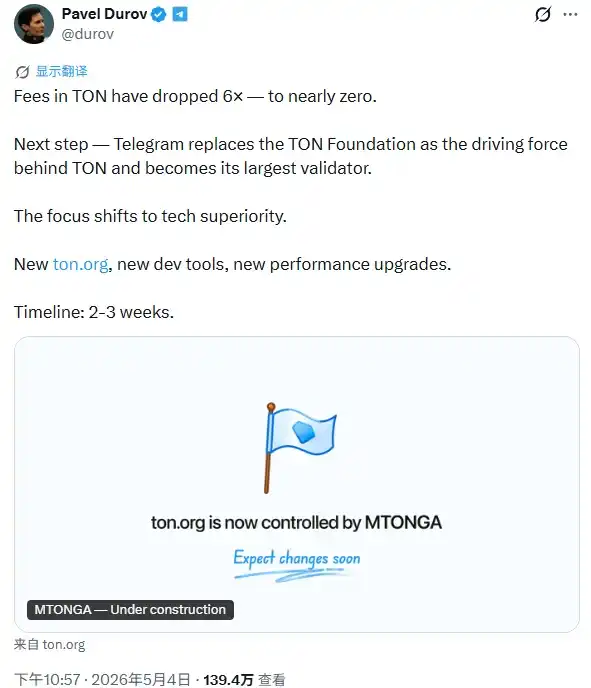
Telegram Founder: TON Fees Reduced by 6x, Telegram to Become Largest Validator

In the past, the relationship between TON and Telegram was more like a strong binding with weak leadership. Telegram provided the gateway, while the Foundation and community were responsible for advancement, with a layer of distance always between them. But this time, Telegram isn't just continuing to bring users to TON; it's beginning to enter more foundational positions such as validator, technical roadmap, and development tools. TON is no longer just a chain adjacent to the Telegram ecosystem but is being reintegrated into Telegram's product system.

TON Doesn't Lack a Gateway; It Lacks Turning the Gateway into Use Cases

Past market discussions about TON often revolved around Telegram's user scale. But for a public chain, having a gateway doesn't equal having an ecosystem, and having user reach doesn't equal having long-term usage. TON's unique aspect is its inherent attachment to a high-frequency social platform, where Mini Apps, wallets, channels, bots, games, and payments already exist within Telegram. This allows TON to avoid having to find users from scratch like most Layer1s. However, if these scenarios cannot solidify into sustained on-chain interactions, Telegram's traffic can only bring waves of short-term hype.

Projects like Notcoin and Dogs have proven that Telegram can quickly generate viral spreads. Simple gameplay combined with social relationship chains can indeed attract a large number of users into crypto applications in a short time. But such explosions come and go quickly. TG mini-games and airdrops can bring attention but can hardly alone sustain a long-term ecosystem.

Therefore, the fee reduction, speed increase, developer tools, and validator role emphasized by Pavel Durov this time point not to a single technological upgrade, but to TON addressing its most critical missing link—transforming Telegram's gateway into sustainable use cases. Only when fees are low enough, confirmation speeds are fast enough, and developer integration is simple enough can scenarios like channel tipping, Mini Apps tasks, game rewards, creator revenue, ad revenue sharing, bot calls, and group micropayments potentially evolve from product features into on-chain activities.

TON no longer needs to repeat the story of "backed by Telegram." What it truly needs to prove is whether the high-frequency behaviors within Telegram can be effectively borne by TON.

Fee Reduction and Speed Increase Aim to Enable Smaller, Higher-Frequency Transactions

The fee reduction by TON this time shouldn't be understood merely as cost optimization typical of public chains. Viewed within the context of Telegram, it actually solves the problem of whether small-amount, high-frequency interactions can become viable.

Most potential on-chain behaviors within Telegram are not large transfers but more fragmented daily operations. Individual transaction amounts are low, but occurrence frequency is high. If users have to perceive fees, wait for confirmations, and repeatedly handle wallet interactions with every button click, these scenarios can hardly truly take off.

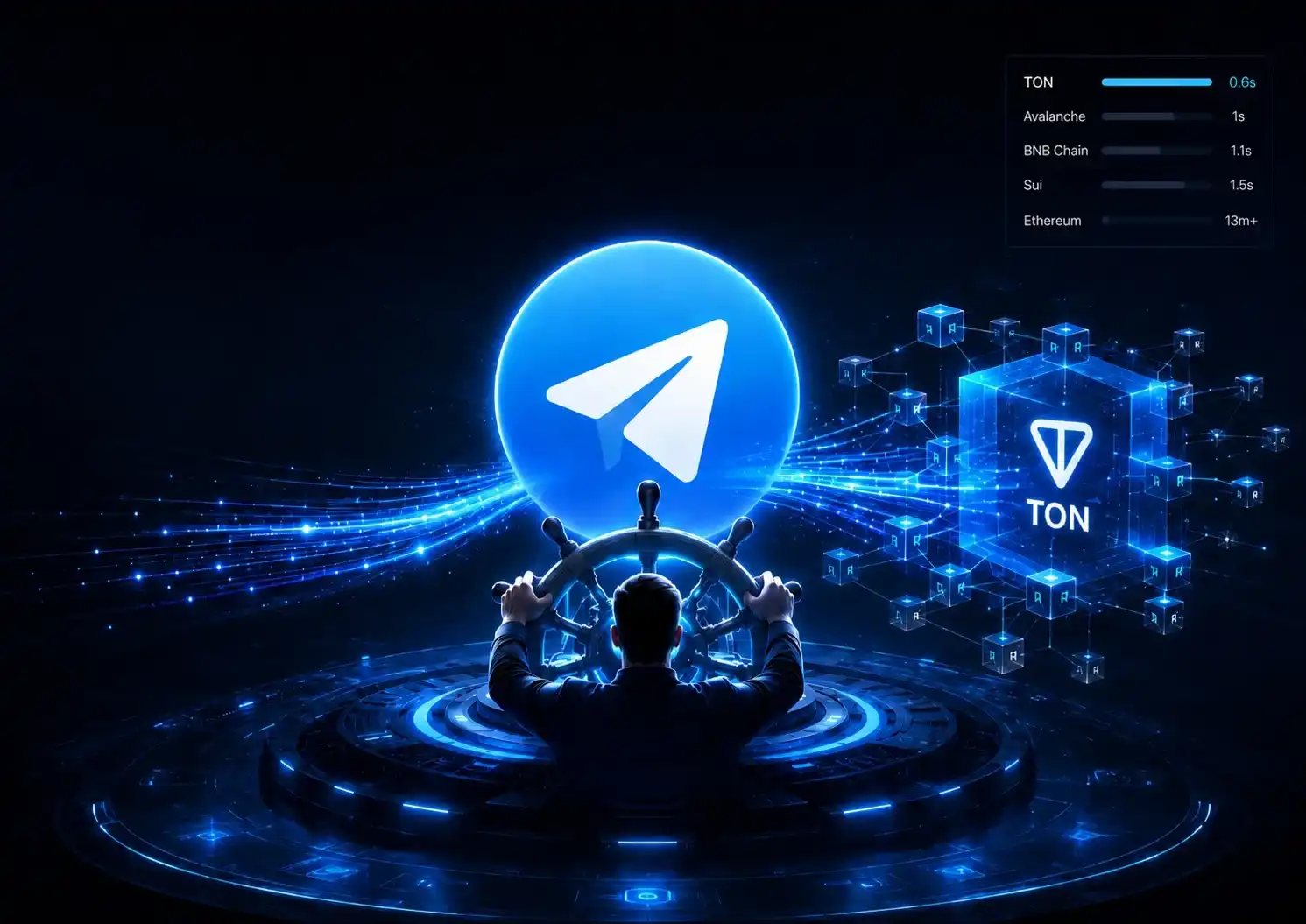
Therefore, fee reduction and speed increase must be considered together. Fees approaching zero lower the usage barrier; reducing finality time to 0.6 seconds lowers the perception of waiting. For Telegram, the chain shouldn't become an extra layer perceived by users but should be hidden as much as possible behind product actions like sending messages, clicking buttons, and viewing balance changes.
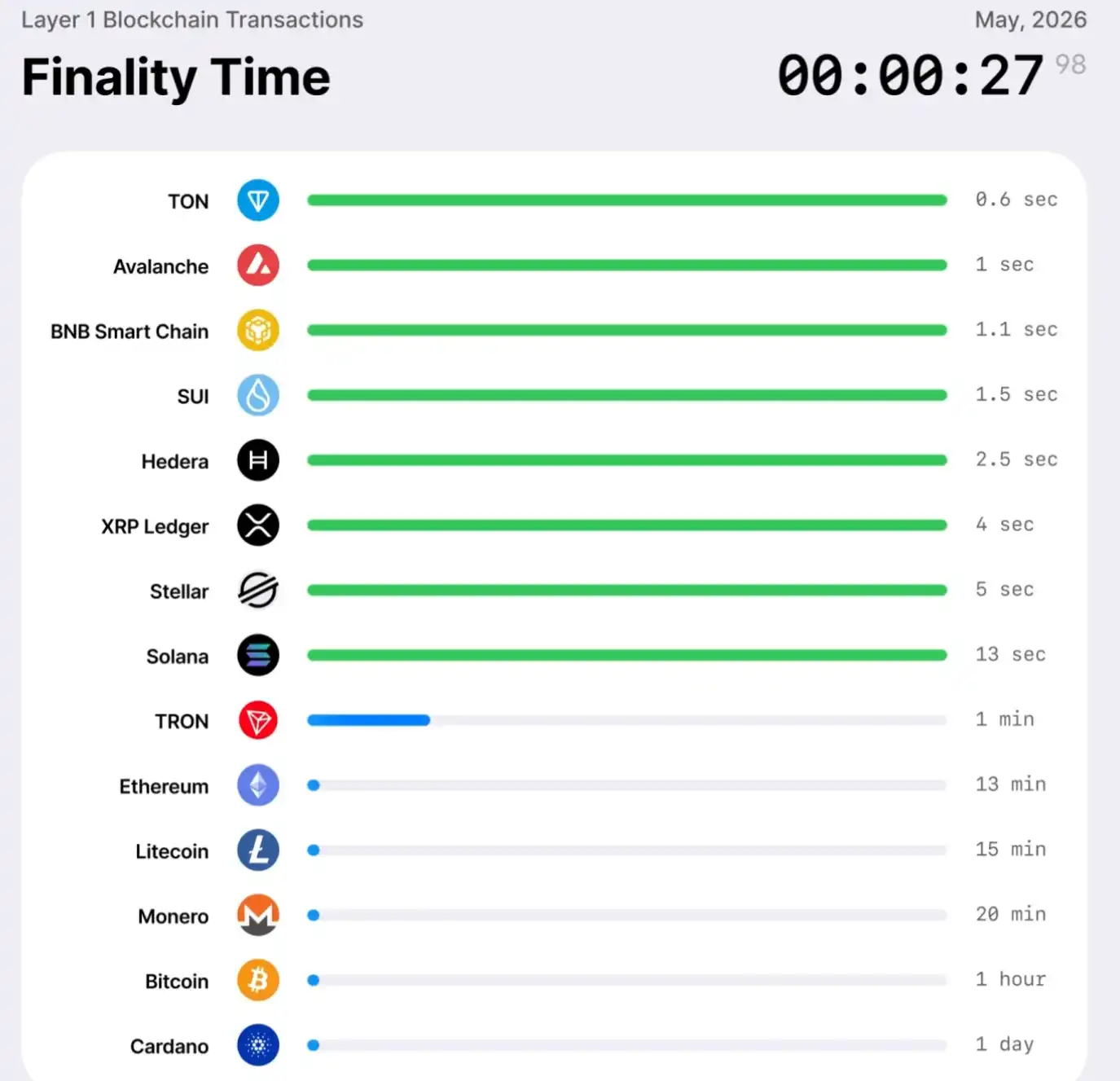
Comparison of "Finality Time" Among Mainstream Public Chains

This also distinguishes TON from many other Layer1s. Its goal isn't solely to make DeFi trades faster or transfers cheaper; it aims to embed the chain into Telegram's daily use. Only when cost, waiting time, and wallet operations are minimized enough can TON potentially evolve from a Telegram-related public chain into the underlying network directly invoked by Telegram's application layer.

From Gateway to Validator, Telegram Begins Penetrating TON's Core

Telegram becoming TON's largest validator is the most significant step in this change. It means Telegram is no longer just providing TON with a gateway and brand endorsement but is entering the network's security and operational mechanisms. Previously, TON was driven by the Foundation and community, which offered greater openness but a relatively decentralized pace. Now, with Telegram directly involved, its products, wallet, Mini Apps, payments, and developer tools have the opportunity to be realigned.

Efficiency may increase, but controversy will also grow. Telegram replacing the TON Foundation as the main driving force and becoming the largest validator will inevitably lead to renewed external discussions about TON's centralization risks. In response, Pavel Durov stated that Telegram's participation would attract more large-scale participants into the validator pool, thereby enhancing decentralization. This logic is not without merit, but the final judgment will depend on results, not statements.

The truly important aspects going forward are whether the validator structure can become more diverse, whether governance information is sufficiently transparent, whether the Foundation and community retain independent space, and whether ecosystem projects can continue developing without relying on Telegram's will.

Therefore, Telegram's return is not a simple positive but a trade-off. For TON to enter the mainstream application layer, it needs Telegram's strong execution capabilities; but the more prominent Telegram's role, the more TON needs to prove it is not merely an internal settlement chain serving Telegram.

High Staking Rewards Retain More Tokens for TON

Pavel Durov subsequently emphasized that TON ranks first in annual staking rewards among the top 50 cryptocurrencies by market cap, with a high rate of 18.8%. Compared to fee reduction and speed increase, high staking rewards are more likely to mobilize capital sentiment and provide TON with another layer of holding rationale in the market's eyes.
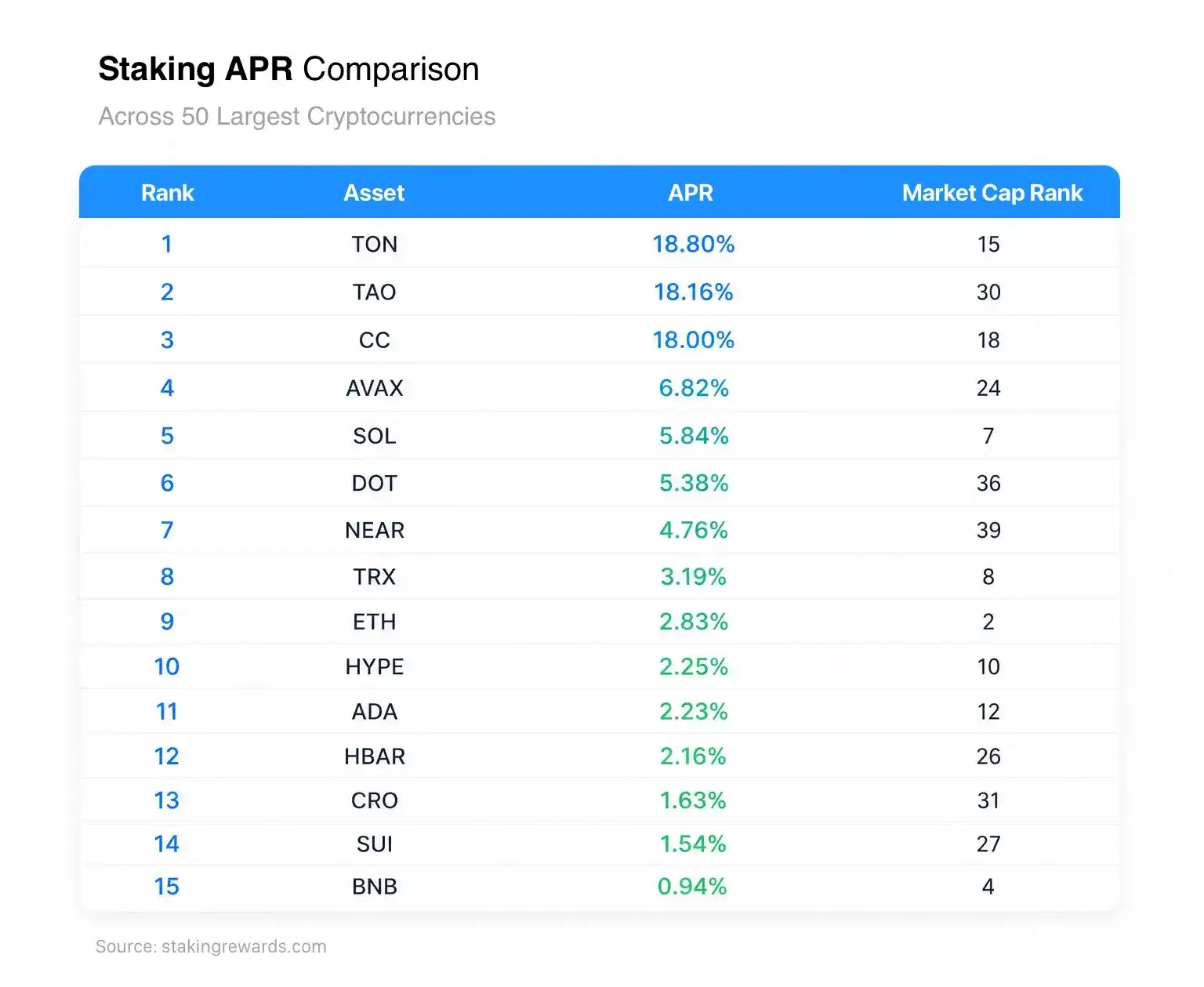
TON Annual Staking Rewards Rank First Among Top 50 Cryptocurrencies

This also makes TON's narrative somewhat more complete. It's not just relying on Telegram's user gateway to attract attention or improving experience through technical upgrades; it's also using staking rewards to keep capital within its ecosystem. The simultaneous presence of gateway, performance, validators, and rewards makes this change more substantial than a single positive factor.

Of course, high yield itself is not the end goal; it's more like buying TON a longer observation period. As long as subsequent developer tools and performance upgrades are delivered, and more capital is locked into the network, a positive feedback loop with real usage may form. For TON, the value of staking rewards isn't just about increasing holding returns but making the market willing to continue waiting for it to truly convert Telegram's gateway advantage.

TON's Return to Telegram Is Not the Finish Line, But a Tougher Challenge

The key for TON going forward is not to continue leveraging Telegram for traffic, but to truly become part of Telegram's application ecosystem. If Telegram's chat, payments, applications, creator economy, and automated interactions are gradually undertaken by TON, then TON's competitors will not just be other Layer1s, but all networks attempting to become the next-generation application infrastructure.

TON isn't just repeating the social traffic story; it's beginning to attempt to turn social traffic into on-chain order. The gateway is just the beginning; usage is the answer. Telegram can push TON to the forefront, but whether it stays there ultimately depends on whether TON can become the layer of infrastructure that operates behind user perception, within the functioning of applications.

If the past TON was still proving how close it is to Telegram, now it must prove how deeply integrated it can be within Telegram's daily use. True mainstream adoption isn't about making users aware they are using a chain, but about making the chain part of the application experience.

TON's opportunity lies here, and so does its pressure.

Связанные с этим вопросы

QAccording to the article, what is the new role that Telegram will assume in the TON network, as announced by Pavel Durov?

ATelegram will become the new core driver of the TON network, replacing the TON Foundation. It will also become the network's largest validator.

QWhat is identified as the key challenge TON needs to overcome, beyond just having access to Telegram's large user base?

ATON needs to transform its access and user reach into sustainable, long-term usage scenarios. It must convert Telegram's high-frequency social interactions into persistent on-chain activities.

QWhy are the reductions in transaction fees and improvements in speed particularly important for TON within the Telegram context?

ALow fees (approaching zero) and fast finality (0.6 seconds) are crucial to enable the small, frequent, and fragmented transactions typical of Telegram's daily use cases. They lower the barrier and reduce user friction, allowing the blockchain to operate seamlessly in the background of the app experience.

QWhat potential downside or concern is raised regarding Telegram becoming the core driver and largest validator of TON?

AThe move raises concerns about increased centralization risk and questions regarding the future independence of the TON Foundation and community projects. It represents a trade-off between stronger execution from Telegram and the need for TON to maintain network decentralization.

QHow does the article frame the high annual staking reward offered by TON, and what purpose does it serve?

AThe high staking reward (18.8% annually, ranked first among top 50 cryptocurrencies) is seen as a mechanism to attract and lock in capital within the TON ecosystem. It provides an additional incentive for holding TON and buys time for the network to realize its potential in converting Telegram's user base into active usage.

Похожее

Seeking Alpha's Hot Article: Why Might the U.S. Stock Market Crash in June?

In a recent Seeking Alpha article, financial professor and analyst Damir Tokic argues that the US stock market may be poised for a significant crash in June 2026. The core thesis centers on a "mega-bubble" in equities, particularly within the technology sector, which has driven the S&P 500 to near-record valuations, with a Shiller P/E ratio exceeding 40—a level comparable to the 2000 dot-com bubble. Tokic identifies two primary catalysts for a potential collapse. First, he points to unsustainable market exuberance fueled by what he terms the "Trump Stimulus"—massive AI capital expenditure by tech giants, which he believes is politically driven and cannot last. Second, and more urgently, he highlights the escalating Iran war as a critical threat. The ongoing closure of the Strait of Hormuz has created a severe global energy supply crunch. Strategic petroleum reserves are projected to hit critically low operational levels by June, potentially causing oil prices to spike above $200 per barrel and triggering a severe, supply-driven inflationary shock. This scenario, Tokic warns, would force the Federal Reserve's hand. Despite currently maintaining a dovish bias, the Fed would likely be compelled to officially pivot to a hawkish stance at its June FOMC meeting to combat soaring inflation and bond yields. He contends that such a shift—or even a failure to act, which would destroy Fed credibility—could be the trigger that punctures the market bubble. The resulting downturn, he concludes, could rival the bear markets of 2000 and 2008, advising investors to prepare for a major correction.

marsbit10 мин. назад

Seeking Alpha's Hot Article: Why Might the U.S. Stock Market Crash in June?

marsbit10 мин. назад

AI PC Battle: Bet on the Toll Booth, Not the Camp

**Title:** The AI PC Battle: Don't Bet on Sides, Bet on the Tollbooth **Summary:** The AI PC competition is moving beyond simple "x86 vs. Arm" narratives. The core investment thesis should focus on identifying which players can sustain margins, cash flow, and pricing power throughout the upgrade cycle, rather than backing a particular architecture. The opportunity is analyzed in three layers: 1. **The Advanced Foundry Tollbooth:** TSMC is positioned to collect "tolls" regardless of which chip designer wins, due to its dominant ~70% share in advanced semiconductor manufacturing, which is essential for high-end AI PC chips. 2. **Compute & Platform Spillover:** AMD represents an offensive in the x86 CPU+GPU space, while NVIDIA leverages its GPU and CUDA software stack dominance. Both benefit from the demand for increased local AI compute. 3. **Architecture Diffusion & Turnaround Plays:** ARM and Intel offer potential for significant upside (elasticity), but investments here require stricter discipline due to higher execution risks and competitive challenges. The industry is transitioning from concept to shipment validation. While short-term forecasts for AI PC adoption have been revised down slightly due to tariffs and procurement delays, the long-term trend towards AI becoming a standard PC feature remains intact. The key driver for upgrade cycles will be whether compelling enterprise applications (e.g., privacy-sensitive computing, low-latency inference) emerge beyond consumer-focused features like meeting summarization. Investment strategy should prioritize companies with platform-level advantages and recurring revenue streams. TSMC offers high certainty as the foundational tollbooth. AMD presents a strong offensive play within the established ecosystem. ARM and Intel are higher-risk, higher-potential-reward turnaround bets. The report cautions against chasing short-term hype and emphasizes a disciplined, long-term approach focused on buying ecosystem strength and cash-flow certainty after market enthusiasm subsides. **Key Risks:** Underwhelming AI PC applications slowing upgrade cycles; slow improvement in Windows on Arm compatibility; macro/tariff impacts on PC demand; potential advanced node supply-demand mismatches affecting TSMC; high overall AI sector valuations making stocks vulnerable to a risk-off shift in markets.

marsbit24 мин. назад

AI PC Battle: Bet on the Toll Booth, Not the Camp

marsbit24 мин. назад

Ten-Thousand-Word Analysis: From $10 to $290, MRVL Wins the Entire AI Era by 'Not Making GPUs'

Marvell Technology's stock price surged from under $10 in 2016 to a record $290 in June 2026, fueled not by making GPUs, but by dominating AI infrastructure connectivity. This analysis argues the market misvalues MRVL as merely a smaller Broadcom in custom AI chips, overlooking its true, unique position. Marvell's core strength lies in enabling high-speed data flow for AI clusters through three interconnected businesses. First, it holds a commanding ~70% market share in high-speed optical DSPs (essential for data center light modules), a deep-moat business with accelerating growth. Second, its custom AI chip design business serves hyperscalers like AWS, Microsoft, and Google, with a significant revenue pipeline despite lower margins. Third, stable cash flows come from Ethernet switch chips and enterprise storage controllers. Together, they form a full-stack "AI data movement" platform. CEO Matt Murphy's transformative leadership since 2016, involving strategic divestments, key acquisitions (like Inphi for optical DSPs), and securing long-term agreements with major cloud providers, repositioned the company. A pivotal $2 billion strategic investment from NVIDIA in 2026 underscored Marvell's critical role in the AI ecosystem, particularly through collaborations like NVLink Fusion. While Marvell faces risks—including client concentration (losing the Amazon Trainium3 design), lower-margin business mix, competitive threats, insider selling, and complex supply chains—its fundamentals remain strong. The optical interconnect moat is widening with the acquisition of Celestial AI (photonics fabric), and financial metrics show accelerating revenue growth and operating leverage. With a PEG ratio suggesting undervaluation relative to its growth, the thesis is that the market undervalues Marvell's monopolistic position in AI "plumbing" while overemphasizing its competitive custom chip segment. The story transcends investing, symbolizing how in any complex system—from the internet to AI—the value of "connection" ultimately surpasses that of individual "nodes."

marsbit54 мин. назад

Ten-Thousand-Word Analysis: From $10 to $290, MRVL Wins the Entire AI Era by 'Not Making GPUs'

marsbit54 мин. назад

AI Relay Stations Spark Heated Debate on Zhihu: Behind Cheap Tokens, What Are Users Really Worried About?

A discussion on Zhihu about "AI relay stations" shifted the niche developer topic of "cheap tokens" into broader user awareness. Users moved beyond simply questioning the legitimacy of these services to focus on practical concerns: Where do cheap tokens truly come from? Is the model being accessed the real one? Can relay stations see prompts, code, and API keys? For occasional users, are the risks worth it? The core debate centered less on price and more on trust. A primary worry is model authenticity—the risk of "model swapping," where users paying for a premium model might be routed to a cheaper one, creating an information asymmetry. Others argued that cost comparisons matter; while cheaper than official pay-as-you-go APIs, relay stations may not be the lowest-cost option versus subscriptions, domestic models, or free tiers, making user needs assessment crucial. Speculation about token sources ranged from legitimate bulk discounts to gray-area methods like account sharing or exploiting regional pricing. This opacity makes risk assessment difficult for users. Data security emerged as a critical concern, especially for enterprise use. When processing sensitive information like code, contracts, or client data, the inability to verify a relay station's data handling, retention, or access policies poses significant compliance and confidentiality risks. The evolving consensus suggests relay stations can be used cautiously for low-sensitivity, disposable tasks (e.g., summarizing public info, simple translation). However, they should not be the default for sensitive, professional, or production workflows involving proprietary data, Agents, or automated systems. Recommendations include avoiding large prepayments, not relying on a single service, using test prompts to monitor quality, anonymizing data where possible, and keeping official channels as backups. Ultimately, the discussion framed tokens not just as a billing unit but as a measure of real cost encompassing price, model integrity, data security, and service stability. The popularity of relay stations highlights user demand for affordable access, but the debate underscores a key trade-off: the savings from cheap tokens may come at the price of trust, transparency, and control over one's data and AI experience.

marsbit1 ч. назад

AI Relay Stations Spark Heated Debate on Zhihu: Behind Cheap Tokens, What Are Users Really Worried About?

marsbit1 ч. назад

Торговля

Спот
Фьючерсы

Популярные статьи

Как купить TON

Добро пожаловать на HTX.com! Мы сделали приобретение TONCOIN (TON) простым и удобным. Следуйте нашему пошаговому руководству и отправляйтесь в свое крипто-путешествие.Шаг 1: Создайте аккаунт на HTXИспользуйте свой адрес электронной почты или номер телефона, чтобы зарегистрироваться и бесплатно создать аккаунт на HTX. Пройдите удобную регистрацию и откройте для себя весь функционал.Создать аккаунтШаг 2: Перейдите в Купить криптовалюту и выберите свой способ оплатыКредитная/Дебетовая Карта: Используйте свою карту Visa или Mastercard для мгновенной покупки TONCOIN (TON).Баланс: Используйте средства с баланса вашего аккаунта HTX для простой торговли.Третьи Лица: Мы добавили популярные способы оплаты, такие как Google Pay и Apple Pay, для повышения удобства.P2P: Торгуйте напрямую с другими пользователями на HTX.Внебиржевая Торговля (OTC): Мы предлагаем индивидуальные услуги и конкурентоспособные обменные курсы для трейдеров.Шаг 3: Хранение TONCOIN (TON)После приобретения вами TONCOIN (TON) храните их в своем аккаунте на HTX. В качестве альтернативы вы можете отправить их куда-либо с помощью перевода в блокчейне или использовать для торговли с другими криптовалютами.Шаг 4: Торговля TONCOIN (TON)С легкостью торгуйте TONCOIN (TON) на спотовом рынке HTX. Просто зайдите в свой аккаунт, выберите торговую пару, совершайте сделки и следите за ними в режиме реального времени. Мы предлагаем удобный интерфейс как для начинающих, так и для опытных трейдеров.

3.1k просмотров всегоОпубликовано 2024.03.29Обновлено 2026.06.02

Как купить TON

Обсуждения

Добро пожаловать в Сообщество HTX. Здесь вы сможете быть в курсе последних новостей о развитии платформы и получить доступ к профессиональной аналитической информации о рынке. Мнения пользователей о цене на TON (TON) представлены ниже.

活动图片