T. Rowe Price expands crypto ETF strategy with up to 15 assets: Details

ambcryptoОпубликовано 2026-03-17Обновлено 2026-03-17

Введение

T. Rowe Price has amended its filing with the SEC for its proposed actively managed crypto ETF, expanding its strategy to include a wider range of 5 to 15 digital assets. Beyond major cryptocurrencies like Bitcoin and Ethereum, the fund may invest in more volatile tokens such as Dogecoin, Shiba Inu, Solana, XRP, and SUI. The filing highlights a focus on security, with Anchorage Digital Bank serving as custodian, and initially uses a cash creation/redemption model. It also leaves open the possibility for future in-kind transactions and staking, pending regulatory clarity. This move reflects growing institutional interest in crypto and intensifying competition among asset managers to offer diversified products.

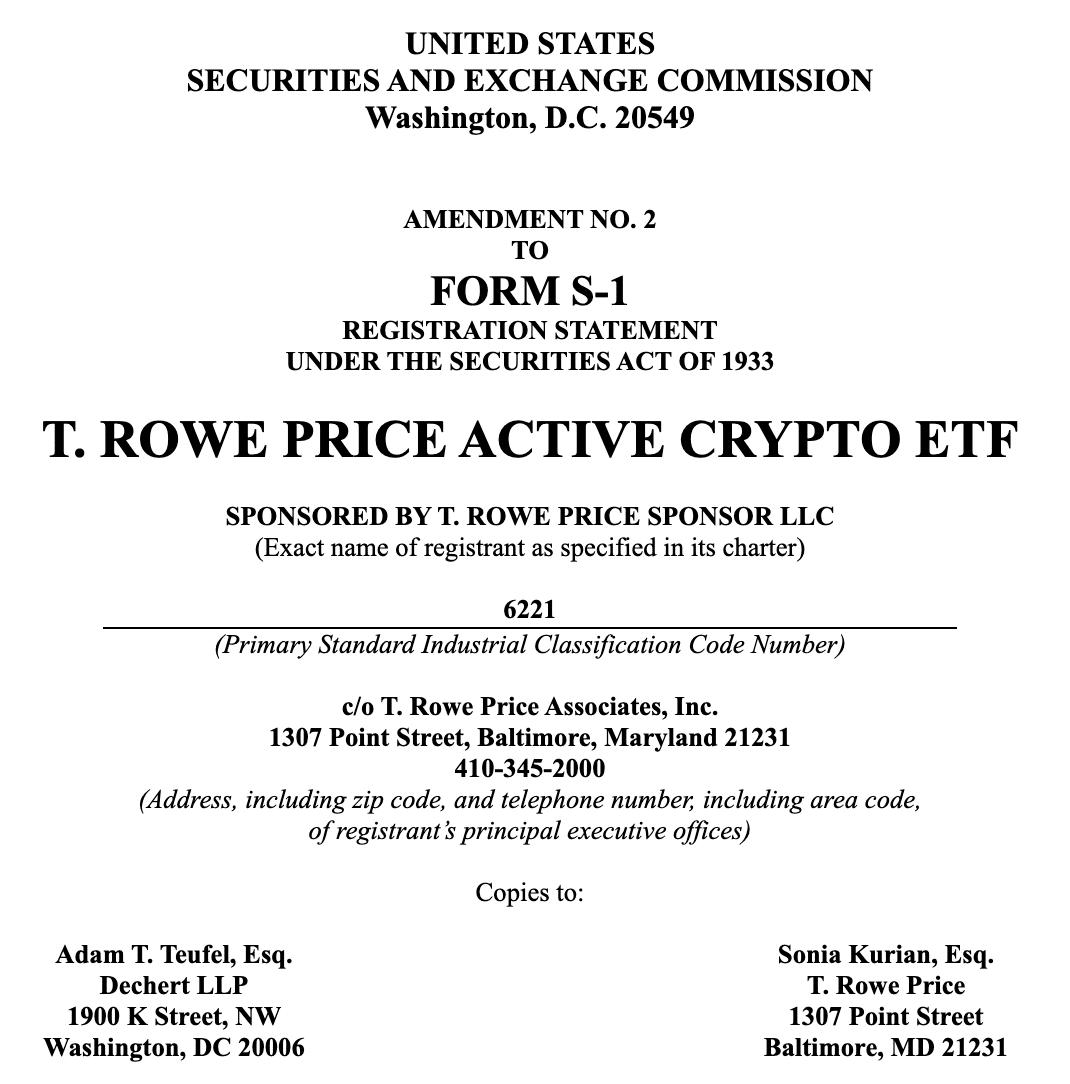
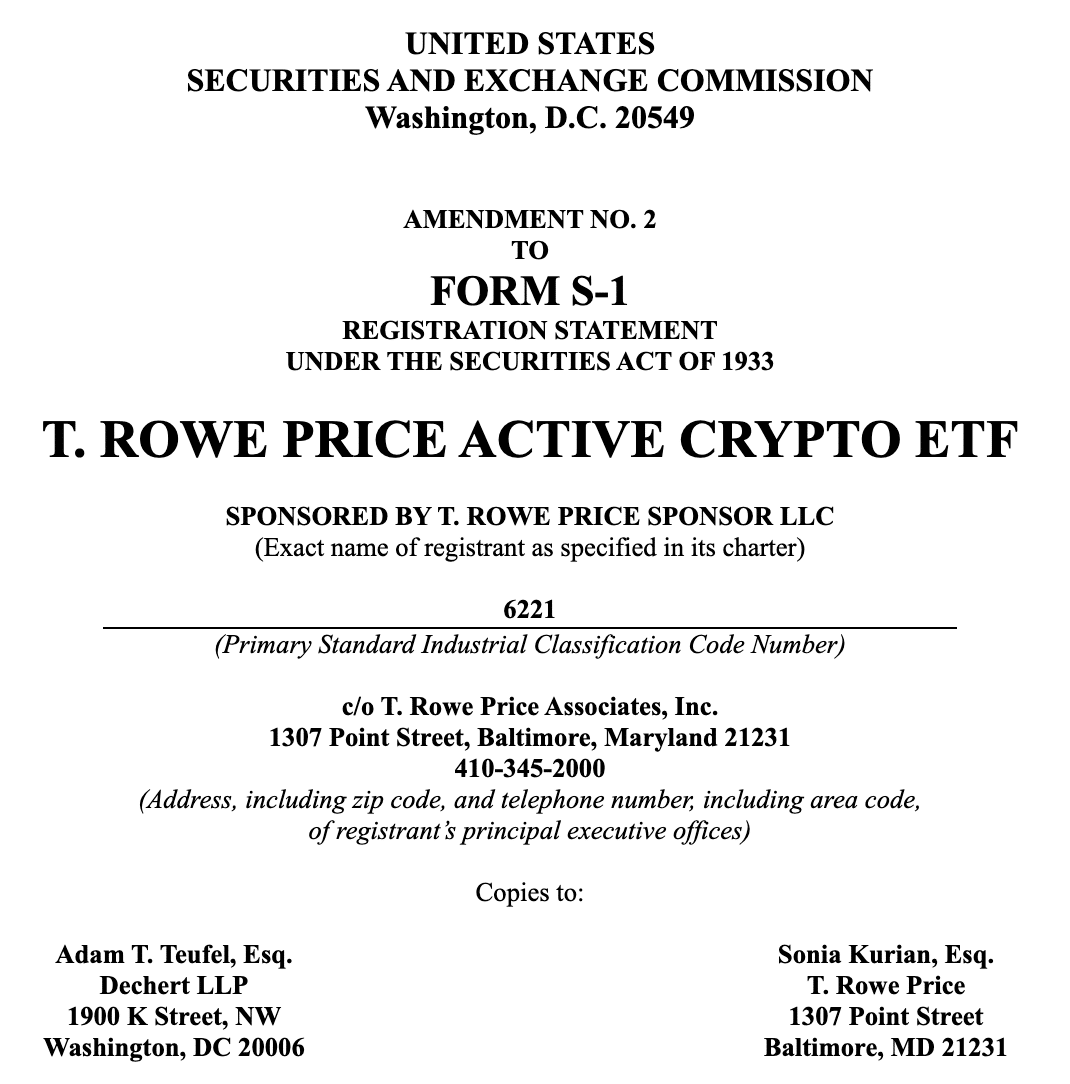
On the 16th of March, T. Rowe Price, an investment management company, filed an amended S-1 registration statement with the U.S. Securities and Exchange Commission (SEC), providing new details about its proposed Price Active Crypto ETF.

It is worth noting that T. Rowe Price first filed for the Price Active Crypto ETF with the U.S. SEC in October 2025.

Source: SEC

T. Rowe amends its crypto ETF filing

The filing suggests that traditional financial firms may be becoming more open to crypto. Instead of focusing solely on major assets such as Bitcoin [BTC] and Ethereum [ETH], the firm is considering a broader strategy that includes more volatile tokens, such as Dogecoin [DOGE] and Shiba Inu [SHIB].

That said, the proposed ETF would be actively managed, meaning managers could shift investments among approximately five to fifteen digital assets depending on market conditions.

The list will also include altcoins such as Solana [SOL], Ripple [XRP], and SUI [Sui], aiming to generate returns by moving between assets rather than simply tracking a single cryptocurrency.

Several factors may explain why this shift is happening now. Regulatory clarity has improved with legislation such as the GENIUS Act, giving traditional firms greater confidence to enter the crypto market.

At the same time, competition is increasing. After the U.S. SEC approved Generic Listing Standards in 2025 to speed up approvals for crypto exchange-traded products, asset managers began racing to launch more diversified crypto ETFs.

How is this filing different from the October filing?

The firm’s amended structure reflects a strong focus on security and compliance. The digital assets will be stored with Anchorage Digital Bank, which will act as the custodian for the tokens.

Initially, the ETF will use a cash-based creation and redemption model, meaning investors will buy or sell shares using cash rather than exchanging cryptocurrencies directly.

However, the filing notes that the fund could permit “in-kind” transactions in the future if regulations permit.

In the future, the Fund may engage in in-kind creations and redemptions.

The fund will also use the FTSE Crypto U.S. Listed Index as a reference point to guide its investment decisions, while managers will retain flexibility to adjust the portfolio.

Moreover, the filing also mentions the possibility of staking. If introduced, this would allow the fund to generate additional income by supporting blockchain networks rather than relying solely on price gains.

However, T. Rowe Price said staking will only be considered once regulators and tax authorities provide clearer guidance. By working with Anchorage Digital as custodian, the firm is trying to ensure the fund meets strict regulatory standards.

Other ETF performance

The timing of T. Rowe Price’s filing update comes as the U.S. crypto ETF market shows mixed signals. At the time of writing, Bitcoin and Ethereum ETFs recorded net inflows of $199.4 million and $35.9 million, respectively, while investor interest in altcoins has become more mixed.

For example, Solana ETFs saw only about $2.1 million in inflows, while the XRP ETF recorded roughly $5.98 million in outflows.

Crypto ETF race intensifies

At the same time, competition among crypto ETF providers is intensifying, particularly on fees. Hashdex recently reduced the management fee for its Hashdex Nasdaq Crypto Index US ETF from 0.50% to 0.25%.

Additionally, large financial institutions are also starting to take stronger positions in the crypto market. Morgan Stanley, for instance, recently updated its filings as it prepares to expand access to digital assets for its wealth management clients.

Therefore, if approved, the Price Active Crypto ETF could represent another major step in the institutional adoption of digital assets.


Final Summary

  • By including altcoins such as Solana, XRP, and Sui, the fund highlights increasing institutional interest in diversified crypto strategies.
  • The proposal reflects intensifying competition in the crypto ETF market, as firms race to launch innovative and cost-efficient products.

Связанные с этим вопросы

QWhat is the main update T. Rowe Price made to its crypto ETF filing on March 16th?

AT. Rowe Price filed an amended S-1 registration statement with the SEC, providing new details about its proposed Price Active Crypto ETF, including a broader strategy that could include up to 15 digital assets, such as more volatile tokens like Dogecoin and Shiba Inu.

QHow does the proposed Price Active Crypto ETF differ from a typical single-asset ETF?

AThe proposed ETF is actively managed, meaning managers can shift investments among approximately five to fifteen digital assets depending on market conditions, aiming to generate returns by moving between assets rather than simply tracking a single cryptocurrency.

QWhich company will serve as the custodian for the digital assets in T. Rowe Price's ETF?

AAnchorage Digital Bank will act as the custodian for the tokens in the proposed ETF.

QWhat regulatory development in 2025 helped speed up approvals for crypto exchange-traded products?

AThe U.S. SEC approved Generic Listing Standards in 2025 to speed up approvals for crypto exchange-traded products.

QWhat additional feature might the fund consider in the future, pending regulatory clarity?

AThe fund might consider staking in the future to generate additional income by supporting blockchain networks, but only once regulators and tax authorities provide clearer guidance.

Похожее

$9.4 Billion: The Largest Robotics Funding This Year Has Emerged

Munich-based humanoid robotics company Neura has completed a $1.4 billion (approximately RMB 94.9 billion) Series C funding round, valuing the company at around $7 billion and positioning it among the global leaders in the sector. The investment round is notable not just for its size—reportedly the largest in robotics this year—but also for its strategic backers, which include tech giants like NVIDIA and Amazon, alongside established industrial players such as German engineering firms Bosch and Schaeffler. This mix of investors signals a significant shift in the industry's focus from technological demonstrations and general-purpose narratives toward practical, industrial deployment and commercialization. Neura's approach centers on developing humanoid robots for defined, high-value industrial tasks rather than pursuing a general-purpose model. Its early validation comes from a partnership with BMW, where its robots are being tested on actual production lines. The involvement of Bosch and Schaeffler, companies deeply embedded in global manufacturing, underscores a growing belief that humanoid robots are transitioning from labs to viable factory-floor solutions. The article highlights two converging trends driving investment: advancements in AI and large language models, which enhance robots' perception and decision-making in unstructured environments, and mounting pressure from labor shortages and rising costs in major manufacturing regions. The funding landscape is now bifurcating between companies like Figure AI, focusing on versatile general-purpose robots, and firms like Neura, targeting specific vertical industrial applications with clearer, shorter paths to ROI. While technical hurdles remain, the core challenges for widespread adoption are increasingly seen as engineering and commercial in nature: managing the high integration and customization costs for different factory environments and establishing robust, localized maintenance and service networks. The record investment in Neura, particularly from industrial capital, indicates the industry's growing confidence in moving from proving feasibility to solving the practical problems of scalability, reliability, and building sustainable business models around humanoid robots in real-world settings like automotive manufacturing and hazardous labor environments.

marsbit2 ч. назад

$9.4 Billion: The Largest Robotics Funding This Year Has Emerged

marsbit2 ч. назад

"119 to 176 Dollars": Behind SpaceX's Listing, MSX Once Again Successfully Executes the Pre-IPO Closed Loop

Following May's 300% gain on Cerebras, MSX delivered another outstanding performance during SpaceX's listing night. On June 12, SpaceX (SPCX) launched on Nasdaq, reaching a high of $176. This marked the successful culmination of MSX's Pre-IPO project launched in March, where users subscribed at $119, achieving gains of approximately 40-48%. This event validated MSX's complete Pre-IPO mechanism, a crucial advantage in a market where access to top-tier private company equity is typically limited to institutions. MSX's model provides a full cycle for users: subscription (at $119 for SpaceX), real-time on-chain portfolio tracking, optional early redemption, seamless conversion to tradable spot assets (SPCX.M) upon IPO, and final settlement in stablecoins. This end-to-end process distinguishes MSX from platforms that faced settlement issues during the SpaceX IPO, highlighting that the core challenge of Pre-IPO is not just access, but a clear exit and conversion path post-listing. This success with SpaceX is MSX's second major Pre-IPO verification, following the Cerebras listing in May, which yielded ~300% returns for early participants. These back-to-back achievements demonstrate MSX's capability to source, structure, and deliver real assets through a replicable on-chain model. The true barrier for Pre-IPO products lies not in providing an entry point, but in ensuring reliable fulfillment from subscription through to post-IPO liquidity. MSX's proven闭环 (closed-loop) process addresses this, offering Web3 users a structured way to access high-growth, pre-public companies in sectors like AI and frontier tech. MSX plans to continue expanding its Pre-IPO portfolio with this focus on authenticity, transparency, and post-listing execution.

Odaily星球日报14 ч. назад

"119 to 176 Dollars": Behind SpaceX's Listing, MSX Once Again Successfully Executes the Pre-IPO Closed Loop

Odaily星球日报14 ч. назад

Торговля

Спот
Фьючерсы
活动图片