Surprise Lasted Only Hours! Apple AI for China Version Suddenly Launched and Then Withdrawn, No Official Release Plan Yet

marsbitОпубликовано 2026-03-31Обновлено 2026-03-31

Введение

Apple Intelligence, Apple's generative AI service, experienced an unexpected and brief beta launch for the Chinese market in the early hours of March 31, 2026. The service, which included a new Siri interface and features like photo object removal, AI-generated emojis, real-time translation, and visual intelligence tools, became active on some devices running iOS 26.4 or later. However, many users reported unstable activation and issues with key functions, particularly the GPT extension plugin. According to Bloomberg's Mark Gurman, this activation was unplanned. He reported that while the technology had been ready for months, Apple had not yet received final approval from Chinese regulators and had no official release plan for the region. The launch was deemed an accident, inconsistent with Apple’s typical product rollout strategy for a major market like China. A key piece of evidence was the inclusion of a Google reverse image search feature, which is inaccessible within the country. Apple has since taken the service offline, with users no longer able to download it from their settings. The incident highlights the significant compliance challenges and technical complexities global tech companies face when deploying AI services in China.

At 3:31 AM Beijing time on March 31, 2026, the beta version of Apple's generative AI service, Apple Intelligence, was activated in batches on some devices that had been upgraded to iOS 26.4 or above in China. Although this feature brought a brand-new Siri interface and covered core collaboration tools such as photo erasure, smart emoji, real-time translation, and visual intelligence, a large number of users reported that the activation process was unstable, and the critical GPT extension plugin could not function properly.
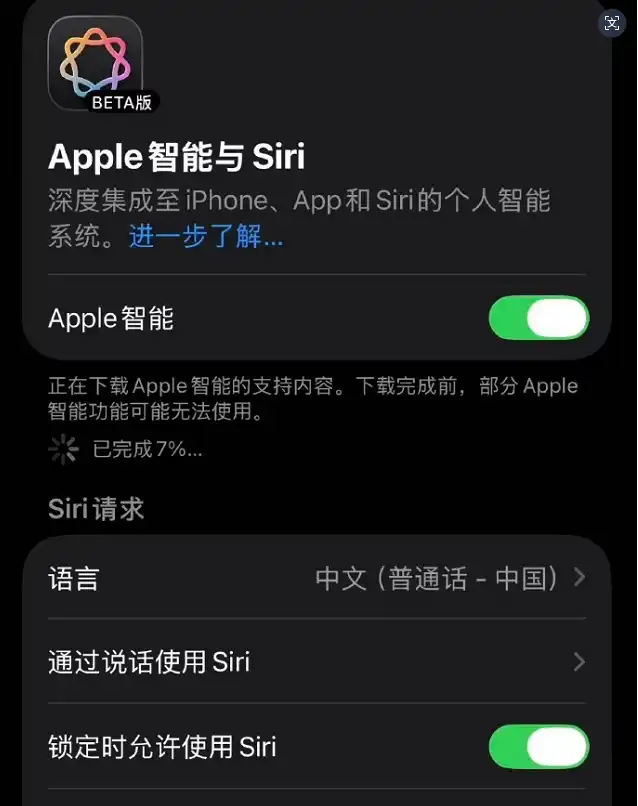
However, this highly anticipated launch was subsequently suggested to possibly be an "accident." According to veteran Bloomberg reporter Mark Gurman's latest report, the activation of Apple Intelligence in China was an unplanned and accidental launch. Gurman pointed out that although the relevant features have been technically ready for months, Apple has not yet obtained final approval from Chinese regulatory authorities, and there is currently no clear near-term release schedule. This incident is also unrelated to the ongoing iOS 26.5 testing cycle.

Signs supporting the "accident theory" are quite evident: First, Apple rarely releases major features in a strategic market like China without an official announcement; second, a launch in the early morning does not align with its usual product release rhythm; the most critical evidence is that the Google Reverse Image Search function included in this test version cannot connect properly within China.

Currently, Apple has taken emergency measures to take it offline. Many users have reported that after clicking download in the "Apple Intelligence and Siri" settings, the progress bar no longer appears. This incident once again highlights the compliance challenges and technical adaptation complexities faced by top-tier terminal manufacturers when deploying AI services in China.

Связанные с этим вопросы

QWhat is the name of Apple's generative AI service mentioned in the article, and what was the issue with its release in China?

AThe service is called 'Apple Intelligence'. The issue was that its beta version was unexpectedly and non-programmatically activated for some users in China, only to be taken down hours later as it was not yet approved by Chinese regulators.

QAccording to Bloomberg's Mark Gurman, why was the activation of Apple Intelligence in China considered an 'accidental launch'?

AMark Gurman stated that the activation was a 'non-planned, accidental launch' because although the feature was technically ready, Apple had not yet obtained final approval from Chinese regulators and had no clear near-term release plan.

QWhat were some of the key features of the Apple Intelligence beta that became available?

AThe key features included a new Siri interface, photo object removal, smart emoji creation, real-time translation, and visual intelligence tools.

QWhat specific technical issue did users encounter with the beta version, indicating it was not fully functional in China?

AA critical issue was that the GPT extension plugin could not be used normally, and the Google reverse image search feature included in the beta could not connect properly within China.

QWhat action did Apple take after the accidental launch was identified?

AApple urgently took the service offline. Many reported that the download progress bar would no longer appear when attempting to access the 'Apple Intelligence and Siri' settings.

Похожее

24/7 Unstoppable Derivatives Wave: Cryptocurrency Is Forcing Traditional Finance to 'Change Time Zones'

The article discusses how the 24/7 nature of the cryptocurrency market is compelling traditional finance to adapt its operating hours and infrastructure. The key catalyst is the CME Group's planned launch of nearly round-the-clock trading for regulated crypto derivatives, a move driven by strong institutional demand for continuous risk management. This shift highlights a fundamental change: derivatives, not spot trading, now dominate crypto market activity and price discovery. However, integrating continuous trading into traditional finance reveals structural tensions. While execution times can be extended, settlement, clearing, and regulatory reporting largely remain bound to traditional business-day cycles. This creates a lag where weekend price movements can impact risk exposures before traditional control systems are fully active. Furthermore, the article explores new challenges arising from this always-on environment. The inherent transparency of public blockchains, while ensuring auditable settlement, also exposes sensitive corporate information like treasury flows to competitors in real-time. This has elevated privacy from a feature to a core requirement for institutional adoption. The next phase hinges on building systems that balance this necessary privacy with regulatory accountability and compliance. In conclusion, the move towards 24/7 trading signifies more than crypto becoming institutionalized. It represents traditional finance beginning to adopt the temporal structure of crypto-native markets. The future will be defined by how successfully traditional risk, identity, privacy, and settlement frameworks can operate at the continuous speed cryptocurrency markets demand.

marsbit32 мин. назад

24/7 Unstoppable Derivatives Wave: Cryptocurrency Is Forcing Traditional Finance to 'Change Time Zones'

marsbit32 мин. назад

Unitree Passes the Hearing, Hangzhou Reaps the Rewards

Unitree Technology, a leading company in Hangzhou's tech scene known as one of the "Hangzhou Six Dragons," has officially passed the review for listing on the Shanghai Stock Exchange's STAR Market (科创板). It plans to raise 4.202 billion yuan for the research and development of intelligent robot models and robot hardware. This milestone will make Unitree the "first humanoid robotics stock." Founded in 2016 by Wang Xingxing, the company started humbly in a small office in Hangzhou's Binjiang district. Initially, the robotics sector was not viewed favorably by the market, with Unitree's products often labeled as "toys" and struggling to secure funding. At its most critical point, with only around 100,000 yuan left, Wang stopped his own salary to keep the company afloat. A crucial turning point came in 2018 when Hangzhou's state-owned capital system provided timely support. A financial platform under the city's state-owned assets completed due diligence in three days and granted a 20-million-yuan loan within a week. This "patient capital" infusion stabilized Unitree, enabling its transition from prototype development to mass production and commercial viability. Subsequently, Hangzhou Capital, through its two major 100-billion-yuan mother funds—the Hangzhou Science and Technology Innovation Fund and the Hangzhou Innovation Fund—participated in four of Unitree's financing rounds (B2, B3, C, and C+). This continuous backing helped the company grow, attract top-tier industrial investors like China Mobile, Tencent, Alibaba, and Geely, and solidify its position as a global leader in legged robotics. By 2025, Unitree achieved significant scale, with revenue reaching 16.99 billion yuan, net profit of 5.91 billion yuan, global leadership in humanoid robot shipments, and over 33,000 quadruped robots sold worldwide. Unitree's journey exemplifies Hangzhou's strategy of nurturing hard-tech startups from "seedlings" to industry leaders. Beyond Unitree, Hangzhou's capital ecosystem has supported other "Six Dragons" like Cloudwalk, BrainCo, and DeepSeek. The city has established a 500-billion-yuan "3+N" industrial fund cluster and specialized early-stage funds like the "Runmiao Fund" with a 20-year term to fill funding gaps for very early-stage projects. This robust "capital + talent" model, coupled with an influx of over 430,000 young professionals in 2025 alone, has fostered a vibrant innovation ecosystem. Hangzhou is now home to 48 unicorns and 413 potential unicorns, building comprehensive industrial chains in AI, robotics, brain-computer interfaces, and more. As Hangzhou experiences a wave of IPOs, it is solidifying its reputation as an ideal city for entrepreneurs.

marsbit57 мин. назад

Unitree Passes the Hearing, Hangzhou Reaps the Rewards

marsbit57 мин. назад

Are Rising U.S. Stocks Getting More Dangerous? Goldman Sachs: Downside Protection Mechanisms Have Almost Failed

The US stock market rally is showing signs of becoming increasingly precarious as key downside protection mechanisms fail, according to Goldman Sachs. Derivatives strategist Brian Garrett notes that the S&P 500 options volatility skew has plunged to an 18-month low, indicating the market now prices an 8% probability for both a 10% drop and a 10% rise—a sign of "skew failure." Concurrently, Goldman's Panic Index hit a two-year low, reflecting minimal demand for tail-risk hedging. This complacency emerges amid a relentless market surge, with the S&P 500 setting new records frequently in 2024. Garrett highlights three major concerns: extreme concentration in the top ten stocks (40% of index weight), heavy reliance on AI-themed performance, and a price pattern eerily similar to the 1998-1999 period. Despite pervasive media pessimism, this fear is absent in options pricing. Downside hedge costs are historically low. Goldman suggests tactical trades: buying RSP outperformance options versus the SPX for a broadening rally, purchasing VIX calls for protection, and going long on Bitcoin ETF volatility. Hedge funds have been net buyers for two weeks, with sector rotation into financials and out of industrials. Notably, the global single-stock leveraged/ inverse ETF AUM has doubled to over $60 billion in two months, underscoring growing speculative activity.

marsbit1 ч. назад

Are Rising U.S. Stocks Getting More Dangerous? Goldman Sachs: Downside Protection Mechanisms Have Almost Failed

marsbit1 ч. назад

Торговля

Спот
Фьючерсы

Популярные статьи

Неделя обучения по популярным токенам (2): 2026 может стать годом приложений реального времени, сектор AI продолжает оставаться в тренде

2025 год — год институциональных инвесторов, в будущем он будет доминировать в приложениях реального времени.

1.8k просмотров всегоОпубликовано 2025.12.16Обновлено 2025.12.16

Неделя обучения по популярным токенам (2): 2026 может стать годом приложений реального времени, сектор AI продолжает оставаться в тренде

Обсуждения

Добро пожаловать в Сообщество HTX. Здесь вы сможете быть в курсе последних новостей о развитии платформы и получить доступ к профессиональной аналитической информации о рынке. Мнения пользователей о цене на AI (AI) представлены ниже.

活动图片