Sui Reveals What Caused Three Mainnet Halts After Major Network Upgrade

bitcoinistОпубликовано 2026-06-02Обновлено 2026-06-02

Введение

The Sui mainnet experienced three outages on May 28 and 29 following its 1.72 network upgrade. The first two halts, on Thursday and Friday morning, were caused by a bug in the new hybrid gas charging logic for address balances. A transaction cancellation due to insufficient funds could later trigger an underflow during the gas settlement process. A temporary patch was applied, but a masked error caused a repeat halt Friday morning. The third outage Friday afternoon was a separate issue triggered by a scheduled epoch change. A bug prevented validators from properly persisting the failed status of a randomness generation protocol, stalling the transition. All issues have been resolved with no risk to user funds, and network activity has resumed. The Sui Foundation cited lessons around improving epoch resilience and the critical nature of gas charging logic.

Sui’s mainnet suffered three separate outages across May 28 and May 29 after the network’s 1.72 release exposed edge cases in gas charging and validator restart logic, according to a postmortem from the Sui Foundation. The foundation said the issues have since been resolved, network activity has resumed, and “no user funds were at risk.”

The incidents began on Thursday, May 28, when Sui’s mainnet halted at around 7 a.m. PT and remained down until roughly 1:30 p.m. PT. A second outage followed on Friday morning, starting at about 5 a.m. PT and ending around 8:30 a.m. PT. The third halt began Friday afternoon at approximately 1:30 p.m. PT and was resolved around 7:20 p.m. PT.

According to the foundation, the first two outages stemmed from crash bugs involving the interaction between gas charging logic and Sui’s 1.72 upgrade, which introduced address balances. The third outage was separate, triggered during a scheduled epoch change after validator restarts exposed a latent bug in how randomness state was preserved.

“During the outages, no user funds were at risk, and the network did not revert any committed transactions when it resumed,” the Sui Foundation said. “As of now, validators have fully addressed the known issues caused by both the original gas-charging bug and the randomness-state bug, and network activity has resumed.”

Sui Gas Charging Bug Triggered Initial Halts

The first problem centered on Sui’s new address balance feature, which allows users to store funds and pay for gas without relying solely on coin objects. Transactions on Sui can pay gas through address balances, coin objects, or a hybrid structure combining both.

The edge case emerged in that hybrid gas path. When a transaction attempted to spend from an address balance that could not cover competing transactions, the scheduler correctly cancelled it with an InsufficientFundsForWithdraw error. But later, during gas smashing — the process of combining input coins into a single gas-paying coin — the same reservation could still attempt to debit funds again.

In the foundation’s explanation, the crash did not occur directly during gas smashing but during settlement, when balance deltas were reconciled by a system transaction. A negative delta applied to a zero balance caused an underflow.

The immediate fix was conceptually straightforward: avoid gas smashing when a transaction is cancelled with InsufficientFundsForWithdraw. Validators adopted that fix on Thursday, bringing the network back online. But the foundation acknowledged that the patch was an interim measure, chosen to restore the network while engineers developed a more complete solution.

“Changing gas logic is a delicate operation,” the foundation wrote. “As explained above, there are complicated interactions between address balances and coins. Other than fixing bugs, gas logic changes must preserve all previous behavior or use appropriate version gating.”

That interim patch contained a known weakness. If a transaction had multiple cancellation reasons, another error could mask the InsufficientFundsForWithdraw condition. When that happened Friday morning, the original underflow path could still be reached, causing a second halt.

Epoch Change Exposed Randomness-State Bug

The third outage came after the network had resumed normal operation Friday morning. At the next scheduled epoch change, validators failed to complete the transition because of a bug tied to Sui’s distributed key generation protocol, or DKG, which bootstraps randomness for transactions that depend on on-chain randomness.

During the earlier restart cycle, participation was not high enough for the next epoch’s DKG process, so randomness was disabled as designed. The problem was that the failure verdict was not written to disk. As validators restarted again, they came back up without remembering that DKG had failed.

“With validators no longer remembering DKG had failed, neither could happen, the paused queue grew, and end-of-epoch logic — which must drain that queue before closing — was left waiting on DKG that would never come,” the foundation said.

The fix had two parts: persisting DKG status across restarts and adding a mechanism that allowed validators to close the stuck epoch at a coordinated point. That mechanism was used once to close the affected epoch, after which the network moved into the next epoch and randomness was restored.

The postmortem framed the outages as a broader engineering lesson for Sui. The foundation said end-of-epoch resilience needs further investment, particularly around graceful degradation and operational force-close mechanisms. It also said gas charging deserves the same level of rigor as the Move VM or Mysticeti consensus, given its interaction with settlement, conservation checks, and scheduling.

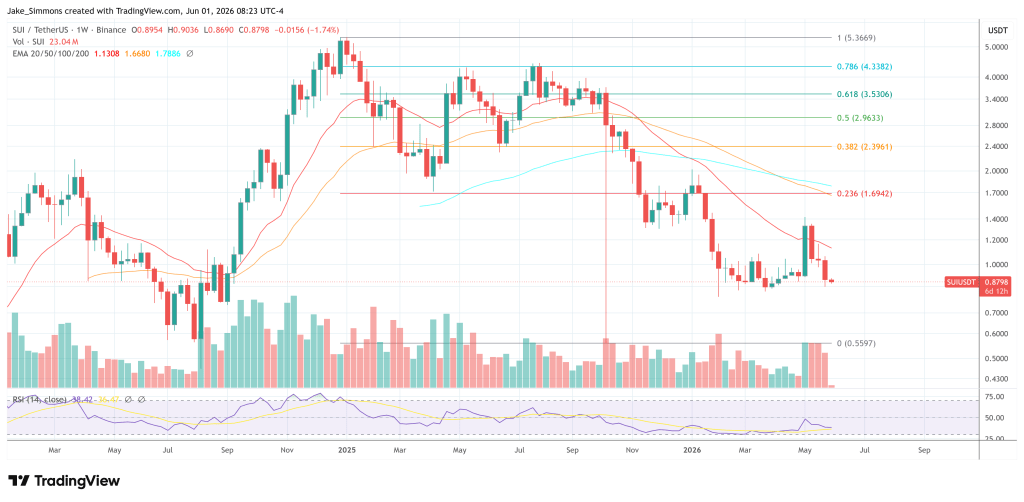
At press time, SUI traded at $0.8798.

Sui remains below the 20-week EMA, 1-week chart | Source: SUIUSDT on TradingView.com

Связанные с этим вопросы

QWhat were the root causes of the three mainnet halts experienced by Sui?

AThe first two outages were caused by crash bugs involving the interaction between the new address balance feature in the 1.72 upgrade and gas charging logic. The third outage was caused by a latent bug related to how randomness state was preserved during validator restarts, which was exposed during a scheduled epoch change.

QAccording to the postmortem, were any user funds at risk during the network outages?

ANo. The Sui Foundation stated that during the outages, no user funds were at risk, and the network did not revert any committed transactions when it resumed.

QWhat specific condition triggered the gas-charging bug that led to the first two halts?

AThe bug was triggered in a hybrid gas payment scenario. When a transaction attempted to spend from an address balance that could not cover competing transactions, it was cancelled. Later, during the 'gas smashing' process, the system incorrectly tried to debit funds from the same cancelled reservation again, leading to an underflow error during settlement.

QWhat was the key issue with the Distributed Key Generation (DKG) protocol that caused the third outage?

ADuring validator restarts, the failure verdict of a DKG process (which was disabled due to low participation) was not written to disk. When validators restarted again, they had no memory of the DKG failure. This caused the end-of-epoch logic to wait indefinitely for a DKG process that would never complete, stalling the epoch transition.

QWhat broader engineering lessons did the Sui Foundation highlight from these incidents?

AThe foundation highlighted two main areas for improvement: 1) Enhancing end-of-epoch resilience with better graceful degradation and operational force-close mechanisms. 2) Applying the same level of engineering rigor to gas charging logic as is applied to the Move VM or consensus, due to its complex interactions with settlement, conservation checks, and scheduling.

Похожее

TaiJi Completes $3.5 Million Strategic Financing with Participation from Castrum Capital, Becker Ventures, and Coinvestor Ventures

TaiJi, an AI-driven market intelligence platform for Web3, has completed a $3.5 million strategic funding round. The investment was led by Castrum Capital, Becker Ventures, and Coinvestor Ventures. The funds will be allocated to product R&D, upgrading its AI inference engine, building a multi-agent analysis system, improving market data infrastructure, expanding its global community, and advancing ecosystem partnerships, particularly within the BSC ecosystem. TaiJi aims to transform how users understand the Web3 market by moving beyond simple data display. It integrates market data, on-chain signals, liquidity changes, social sentiment, and news events into a unified AI system. This system generates structured event inferences, impact pathways, risk assessments, and follow-up indicators. The platform's core approach involves a multi-agent framework where specialized agents (Market, On-chain, Sentiment, Risk, Event) collaboratively analyze disparate signals to produce coherent market intelligence. Its initial product will feature modules including Market Intelligence, a Scenario Engine for AI-powered event analysis, an Impact Map, Risk Signals, and a personalized user dashboard called "My TaiJi." TaiJi emphasizes that it does not custody user assets, execute trades, provide investment advice, or promise returns. Following this funding round, the company plans to accelerate product development and testing, gradually rolling out its core features to the broader Web3 market.

marsbit28 мин. назад

TaiJi Completes $3.5 Million Strategic Financing with Participation from Castrum Capital, Becker Ventures, and Coinvestor Ventures

marsbit28 мин. назад

Huang Renxun and Marvell CEO Discuss on Stage: The Future of AI Competition is Not Computing Power but Connectivity, 'Use Copper Where You Can, Use Optics Only Where You Must'

Summary: At Computex 2024, NVIDIA CEO Jensen Huang joined Marvell CEO Matt Murphy on stage, highlighting the strategic partnership between their companies. The core theme was that the next decisive battleground for AI infrastructure is not compute or memory, but connectivity. As AI models evolve into vast agent-based systems, the ability to connect millions of processors efficiently is becoming the critical bottleneck. Huang announced NVIDIA's strategic $20 billion investment in Marvell, reflecting the deep integration between their technologies for AI data centers. A key discussion point was the transition from copper to optical interconnects within racks. The guiding principle, articulated by Huang, is: "You use optics wherever you must, you use copper wherever you can." While copper remains cost-effective for short distances, its physical limits are being reached as bandwidth demands double. When moving to 400Gbps, copper can no longer fully connect an entire rack. This shift necessitates innovations like Co-Packaged Optics (CPO), which integrates optical engines directly into the chip package to solve density and power challenges. Marvell demonstrated its 51.2T CPO-based switch, eliminating copper traces on the PCB. The future vision is a "distance-free data center," where optical connectivity removes physical constraints. This allows for fully disaggregated, dynamic architectures where compute, memory, and storage pools can be combined on-demand based on workload requirements, rather than being limited by connection boundaries. Marvell, positioned as a neutral "Switzerland" in the ecosystem with a comprehensive portfolio across all connectivity distances, is central to enabling this next era of AI infrastructure.

marsbit33 мин. назад

Huang Renxun and Marvell CEO Discuss on Stage: The Future of AI Competition is Not Computing Power but Connectivity, 'Use Copper Where You Can, Use Optics Only Where You Must'

marsbit33 мин. назад

Торговля

Спот
Фьючерсы

Популярные статьи

Как купить SUI

Добро пожаловать на HTX.com! Мы сделали приобретение SUI Network (SUI) простым и удобным. Следуйте нашему пошаговому руководству и отправляйтесь в свое крипто-путешествие.Шаг 1: Создайте аккаунт на HTXИспользуйте свой адрес электронной почты или номер телефона, чтобы зарегистрироваться и бесплатно создать аккаунт на HTX. Пройдите удобную регистрацию и откройте для себя весь функционал.Создать аккаунтШаг 2: Перейдите в Купить криптовалюту и выберите свой способ оплатыКредитная/Дебетовая Карта: Используйте свою карту Visa или Mastercard для мгновенной покупки SUI Network (SUI).Баланс: Используйте средства с баланса вашего аккаунта HTX для простой торговли.Третьи Лица: Мы добавили популярные способы оплаты, такие как Google Pay и Apple Pay, для повышения удобства.P2P: Торгуйте напрямую с другими пользователями на HTX.Внебиржевая Торговля (OTC): Мы предлагаем индивидуальные услуги и конкурентоспособные обменные курсы для трейдеров.Шаг 3: Хранение SUI Network (SUI)После приобретения вами SUI Network (SUI) храните их в своем аккаунте на HTX. В качестве альтернативы вы можете отправить их куда-либо с помощью перевода в блокчейне или использовать для торговли с другими криптовалютами.Шаг 4: Торговля SUI Network (SUI)С легкостью торгуйте SUI Network (SUI) на спотовом рынке HTX. Просто зайдите в свой аккаунт, выберите торговую пару, совершайте сделки и следите за ними в режиме реального времени. Мы предлагаем удобный интерфейс как для начинающих, так и для опытных трейдеров.

1.1k просмотров всегоОпубликовано 2024.03.29Обновлено 2026.06.02

Как купить SUI

Обсуждения

Добро пожаловать в Сообщество HTX. Здесь вы сможете быть в курсе последних новостей о развитии платформы и получить доступ к профессиональной аналитической информации о рынке. Мнения пользователей о цене на SUI (SUI) представлены ниже.

活动图片