Strategy Extends Bitcoin Accumulation With New 2,932 BTC Purchase

bitcoinistОпубликовано 2026-01-27Обновлено 2026-01-27

Введение

Strategy, a leading Bitcoin treasury company, has expanded its holdings with a new purchase of 2,932 BTC, valued at approximately $264.1 million. This acquisition, funded through stock offerings, brings the company's total Bitcoin reserves to 712,647 BTC, representing about 3.57% of the circulating supply. These holdings are currently valued at $62.23 billion, reflecting an unrealized gain. In related news, Bitmine, another major corporate holder, added 40,302 ETH to its treasury and has staked over 2 million ETH, claiming to be the world's largest staker. Meanwhile, Bitcoin spot ETFs experienced significant net outflows of $1.33 billion last week, the highest since February 2025, nearly erasing the previous week's gains. Bitcoin's price has declined over 5% in the past week, trading around $88,000.

Bitcoin treasury company Strategy has unveiled its latest purchase of the cryptocurrency, this time tokens worth a total of $264.1 million.

Strategy Has Expanded Its Bitcoin Treasury By 2,932 BTC

In a new post on X, Strategy co-founder and chairman has shared the details related to the latest Bitcoin acquisition from the company. In total, the new purchase has added 2,932 tokens to the firm’s treasury at an average price of $90,061 per token.

According to the filing with the US Securities and Exchange Commission (SEC), the buy took place between January 20th and 25th. Strategy funded the $264.1 million acquisition using proceeds from its STRC and MSTR at-the-market (ATM) stock offerings.

In the last two weeks, the company has made purchases involving a substantial size. Last week, the company added Bitcoin worth $2.13 billion, while the week before that, it spent $1.25 billion on the cryptocurrency. Compared to these, the latest buy isn’t too big, but nonetheless showcases continued resolve for accumulation from Saylor’s firm.

Following the latest purchase, Strategy’s Bitcoin reserves have grown to 712,647 BTC, equivalent to about 3.57% of the asset’s total circulating supply. Currently, these holdings are worth around $62.23 billion, up nearly 15% over the company’s investment of $54.19 billion.

Strategy is the largest digital asset corporate holder in the world, with its closest competition being Bitmine, a BTC mining company that pivoted to an Ethereum treasury strategy last year.

According to a Monday press release, Bitmine has also participated in accumulation during the past week, adding 40,302 ETH ($116.5 million) to its holdings. The firm’s total treasury reserve has now risen to 4,243,338 ETH ($12.24 billion), corresponding to a supply share of 3.52%.

Recently, Bitmine has been putting its Ethereum toward staking to earn a passive interest on its holdings. In the past week, the company has increased its locked stake by 171,264 ETH, taking total staked supply to more than 2 million tokens. “Bitmine has staked more ETH than other entities in the world,” said Tom Lee, Bitmine chairman.

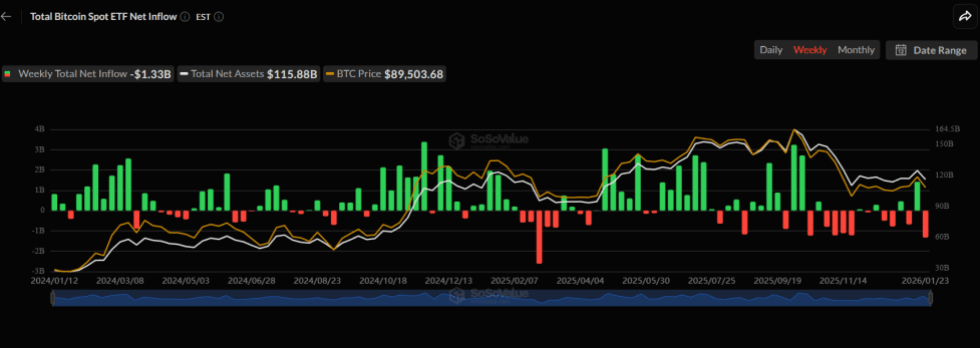
In some other news, Bitcoin spot exchange-traded funds (ETFs) saw a high amount of net outflows in the past week, according to data from SoSoValue.

The trend in the BTC spot ETF netflow over the last couple of years | Source: SoSoValue

As displayed in the above graph, the weekly Bitcoin spot ETF netflow measured at -$1.33 billion last week. This is the highest outflow that these investment vehicles have witnessed since the end of February 2025.

Just a week prior, the market situation was the complete reverse, as spot ETFs saw net inflows amounting to $1.42 billion. The latest streak of outflows, however, have nearly entirely retraced this growth.

BTC Price

At the time of writing, Bitcoin is floating around $88,000, down more than 5% in the last seven days.

The price of the coin seems to have plunged recently | Source: BTCUSDT on TradingView

Связанные с этим вопросы

QHow many Bitcoins did Strategy purchase in its latest acquisition, and what was the total value?

AStrategy purchased 2,932 BTC at a total value of $264.1 million.

QWhat is the primary source of funding for Strategy's latest Bitcoin purchase?

AThe purchase was funded using proceeds from its STRC and MSTR at-the-market (ATM) stock offerings.

QWhat percentage of Bitcoin's total circulating supply does Strategy now hold after this purchase?

AStrategy now holds 712,647 BTC, which is equivalent to about 3.57% of the asset's total circulating supply.

QHow did the net flow for Bitcoin spot ETFs perform last week according to the article?

ABitcoin spot ETFs saw net outflows of $1.33 billion last week, the highest since the end of February 2025.

QWhat significant action has Bitmine taken with its Ethereum holdings recently?

ABitmine has been staking its Ethereum to earn passive interest and has staked more than 2 million tokens, which it claims is more than any other entity in the world.

Похожее

Uncovering the Truth About Agent Commerce, Payments, and Infrastructure

Decoding Agent Commerce, Payments, and Infrastructure: The Reality Over the past year, I've been building infrastructure for the Agent economy, engaging with major players like Stripe, Visa, Coinbase, Google, and dozens of startups. A clear conclusion emerges: true, large-scale demand does not yet exist. Startups face structural challenges. Data points illustrate this gap. Stripe's Agent commerce platform has over 1,000 merchants but only single-digit transacting agents. Visa's Agent payment token requires 9-month KYC and a $250M revenue threshold, accessible only to giants like Amazon. On-chain analysis reveals actual daily Agent transaction volume is around $17k, half of which are test transactions. The article analyzes four potential markets: **1. Agent-to-Merchant (A2M):** Current AI shopping UX is often inferior to traditional e-commerce for visual, comparison-heavy purchases (clothing, electronics). Chat interfaces are a step back. Real merchant interest is defensive "Agent Engine Optimization," fearing future obsolescence, not current demand. Potential exists in high-frequency, low-decision purchases (e.g., food delivery) or simplifying terrible UX (complex checkouts, non-native shoppers), but these require massive consumer distribution channels dominated by giants like DoorDash and Amazon. **2. Agent-to-API (A2A):** Developers already have subscriptions and billing for core APIs (compute, data). The argument for micro-payments via crypto for sub-dollar API calls is addressed by pre-paid balances today. The deeper issue is supplier resistance; major SaaS firms rely on enterprise contracts, not fractional cent pricing. Opportunity lies in the long tail of niche services, but this is a smaller market catering to developers, a historically low-paying group. **3. Agent-to-Agent (A2A):** This remains a theoretical long-term vision with near-zero current transaction volume. It involves unique challenges: discovery, trust, negotiation, dispute resolution. When it materializes, it will require a fundamentally new settlement infrastructure for high-speed, variable-value, multi-party transactions. It's a real long-term bet, but not the current market. **4. Agent-to-Finance (A2F):** This is the only category with existing, paying demand. Integrating AI into financial workflows (trading, portfolio management) is a natural evolution and enables new capabilities like autonomous rebalancing. However, competition favors incumbents with regulatory licenses, compliance infrastructure, and existing client relationships. **The Real Issue:** Why is infrastructure still being built? Incumbents can afford long-term bets, and payment companies see every problem as a nail for their payment hammer. However, payment is just one piece. The core challenge is *coordination*—orchestrating work between Agents and humans, verifying outcomes, and settling results. Payment is part of settlement, which is part of coordination. Companies that solve the coordination problem will subsume payments, not the other way around. Startups lack the infinite runway of giants and must find today's real market, which, after a year of exploration, lies outside these four categories—in an area with real, growing, and underserved activity.

marsbit5 ч. назад

Uncovering the Truth About Agent Commerce, Payments, and Infrastructure

marsbit5 ч. назад

Торговля

Спот
Фьючерсы
活动图片