Original|Odaily Planet Daily(@OdailyChina)
Author|Wenser(@wenser 2010)

Time is running out for traditional gambling companies—this might be the latest consensus in the prediction market sector.
At the recently concluded Oscars event, the total betting volume on Kalshi and Polymarket surpassed $100 million for the first time, a significant jump from the less than $10 million mark last year. Meanwhile, Kalshi partnered with Cash APP to streamline user payment channels, while Polymarket, after launching its AI Agent CLI application, now supports 24/7 trading by AI Agents through Alchemy's AgentCard. In 2026, a year filled with historic "prediction milestones," the two giants of the prediction market are leveraging their strategies to attract new users from traditional gambling firms, internet platforms, and even conventional media and finance industries. This time, they are targeting real users from payment channels and tireless AI Agents.
New Victories for Prediction Market Giants: Payment Channels and AI Agent Users
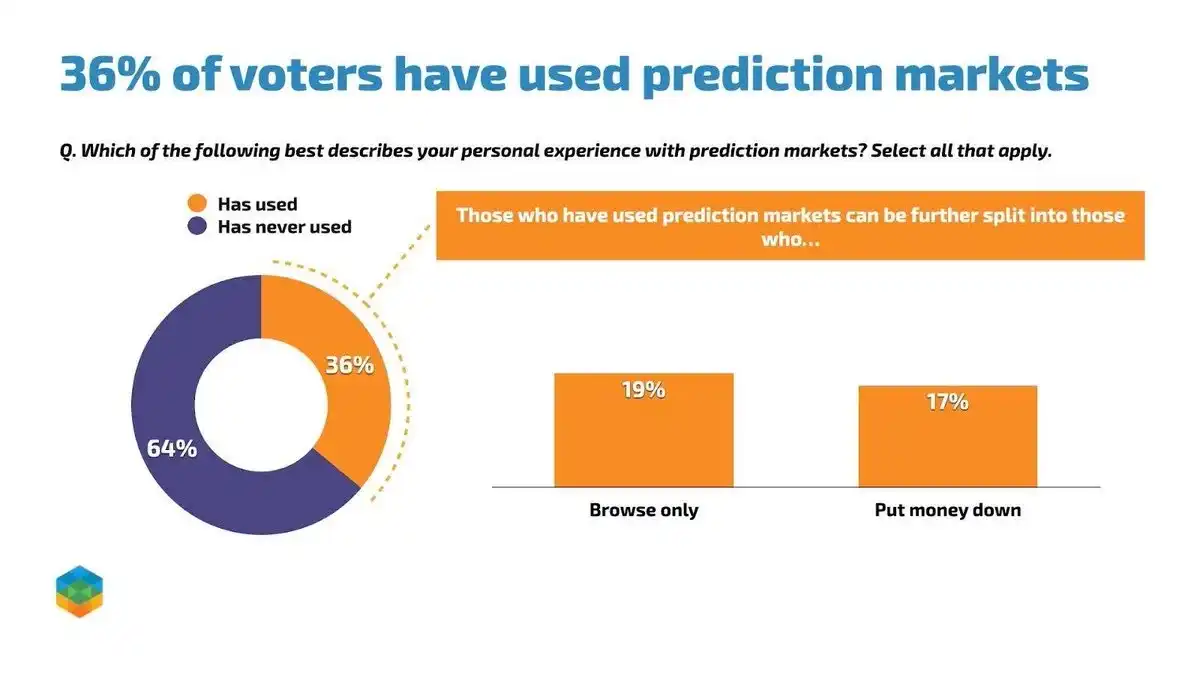
Last week, renowned investment firm Paradigm released its first public opinion survey of the year, also marking its inaugural survey on prediction market platforms.
The results showed that over one-third (approximately 36%) of American voters have used prediction markets, either placing bets or browsing markets for information.
In terms of user demographics, 66% of prediction market users are under 50 years old, with 20% aged 18–34 and 27% aged 35–49. Non-white voters use prediction markets slightly more than white voters, and men use them significantly more than women (46% vs. 31%).
This indicates that in the U.S., prediction markets are no longer a "niche sector" but have become a vital "information source," "trading desk," and "news pool" for millions of households.
Of course, as the lead investor in Kalshi's recent $1 billion funding round, Paradigm's move is undoubtedly a way to "shout out for his bag" (promote their investment). This is understandable, but the survey also raises a new question: How will the prediction market duopoly of Kalshi and Polymarket penetrate the remaining 64% of American voters and even the entire U.S. population?
The answer is clear: either challenge the old guard or seek new growth avenues.
Kalshi's New Growth Strategy: Integrating Payment Channels to Encourage User Deposits
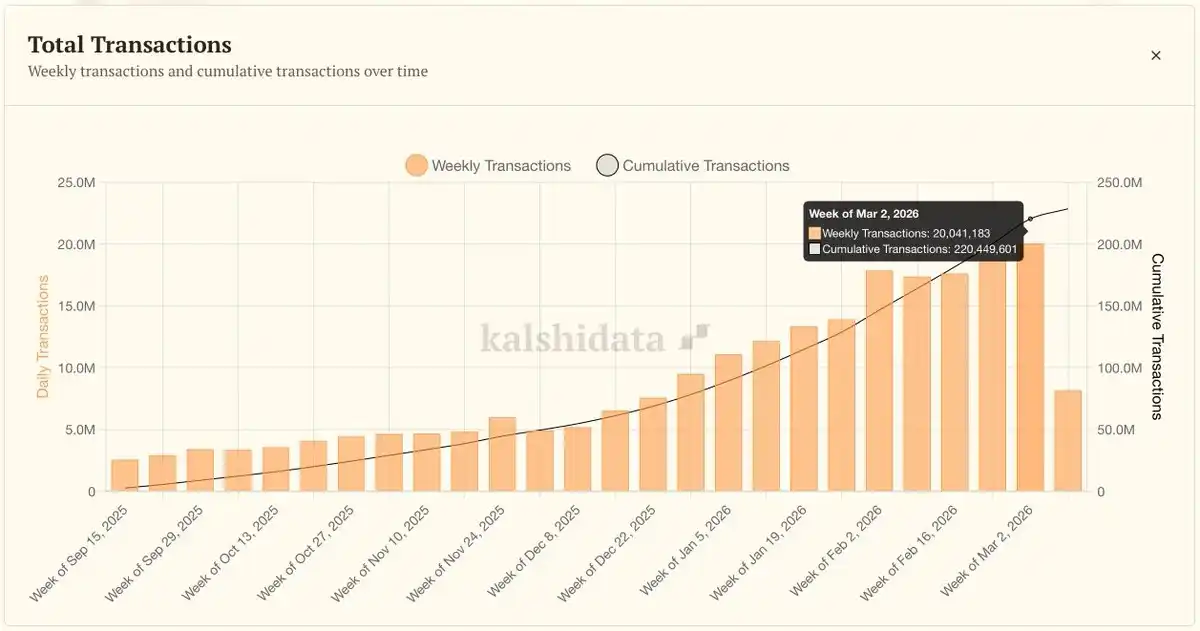
During the week of March 2–8, Kalshi recorded over 20 million transactions, setting a new weekly transaction record since its inception. With trading volume and transaction numbers consistently hitting new highs, tapping into existing user pools is undoubtedly an efficient strategy to achieve further growth.
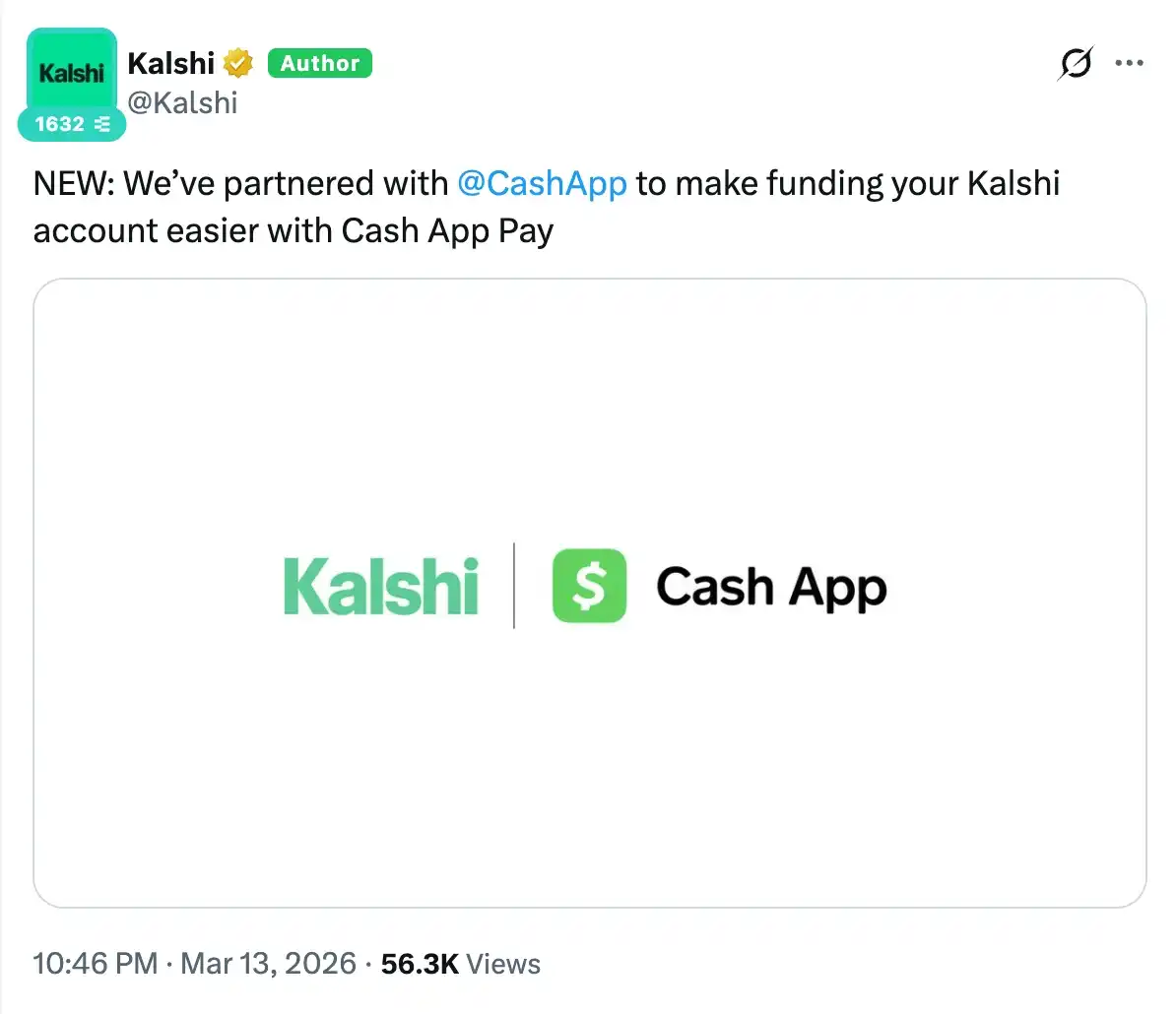
This likely explains why Kalshi announced a partnership with Block's payment app, Cash APP, last week. Kalshi's official statement was even more direct: "Make funding your Kalshi account easier with Cash App Pay." The message was practically written on their faces: "Use Cash App Pay to deposit money and start betting."
After all, even a 1% conversion rate from Cash App's 59 million monthly active users would bring Kalshi nearly 600,000 new users—equivalent to two or three years of hard work. More importantly, these are all "incremental gains."
Polymarket's Market Expansion Strategy: Targeting AI Agents as Users
On the other side of the prediction market, Polymarket, the other half of the duopoly, is also performing impressively.
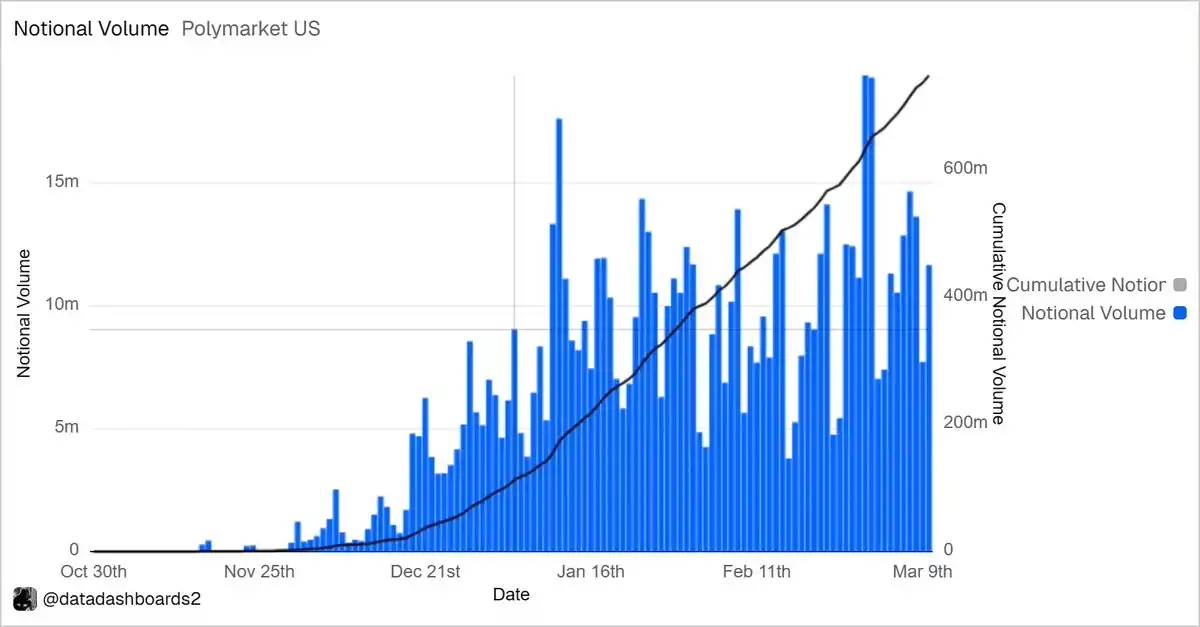
Since resuming operations in the U.S. last November, as of March 14, Polymarket's U.S. platform has seen a nominal trading volume exceeding $750 million, with over 5 million transactions. The platform's open interest once reached $2.6 million but has recently settled around $1 million.
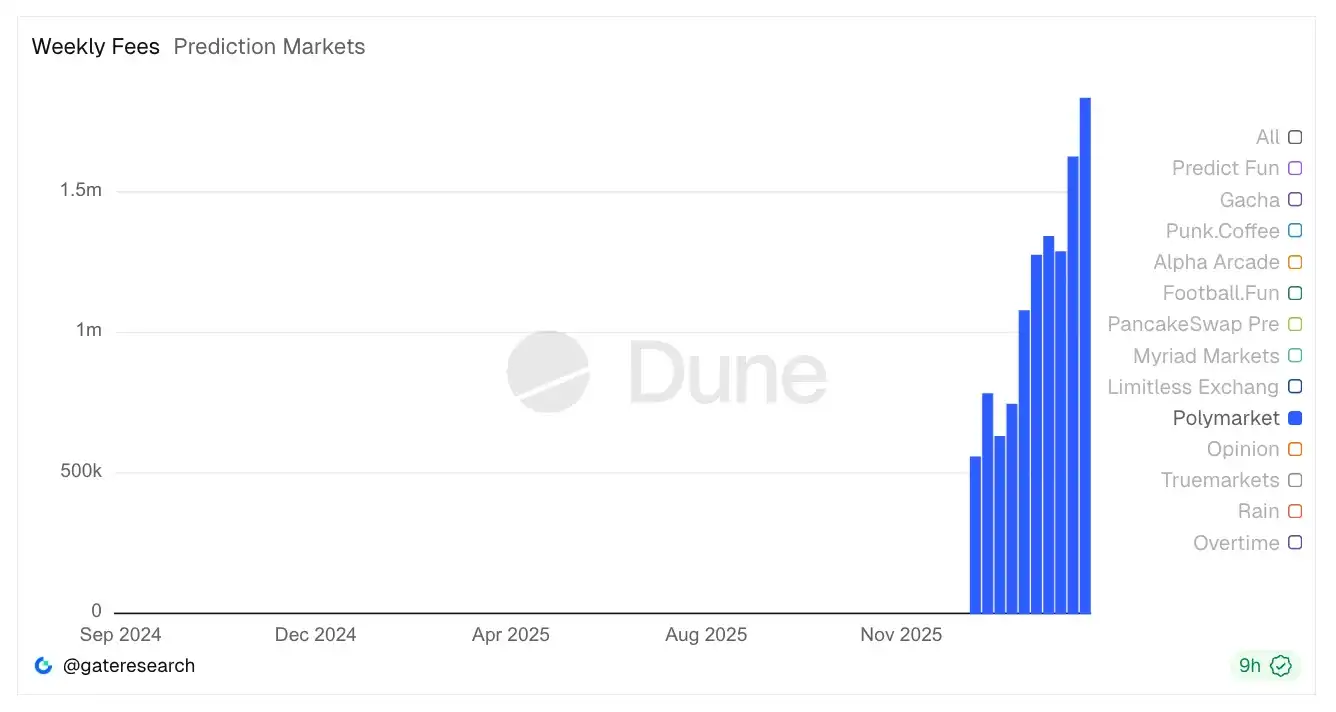
Additionally, according to Dune data, since introducing trading fees for certain markets (including NCAA and crypto price fluctuations) on January 6, Polymarket has accumulated over $11.2 million in fee revenue. In other words, Polymarket has already proven its ability to generate sustainable revenue.
With such success, the ambitious Polymarket is no longer content with just the human user market and is now betting on enabling 24/7 trading for AI Agents.
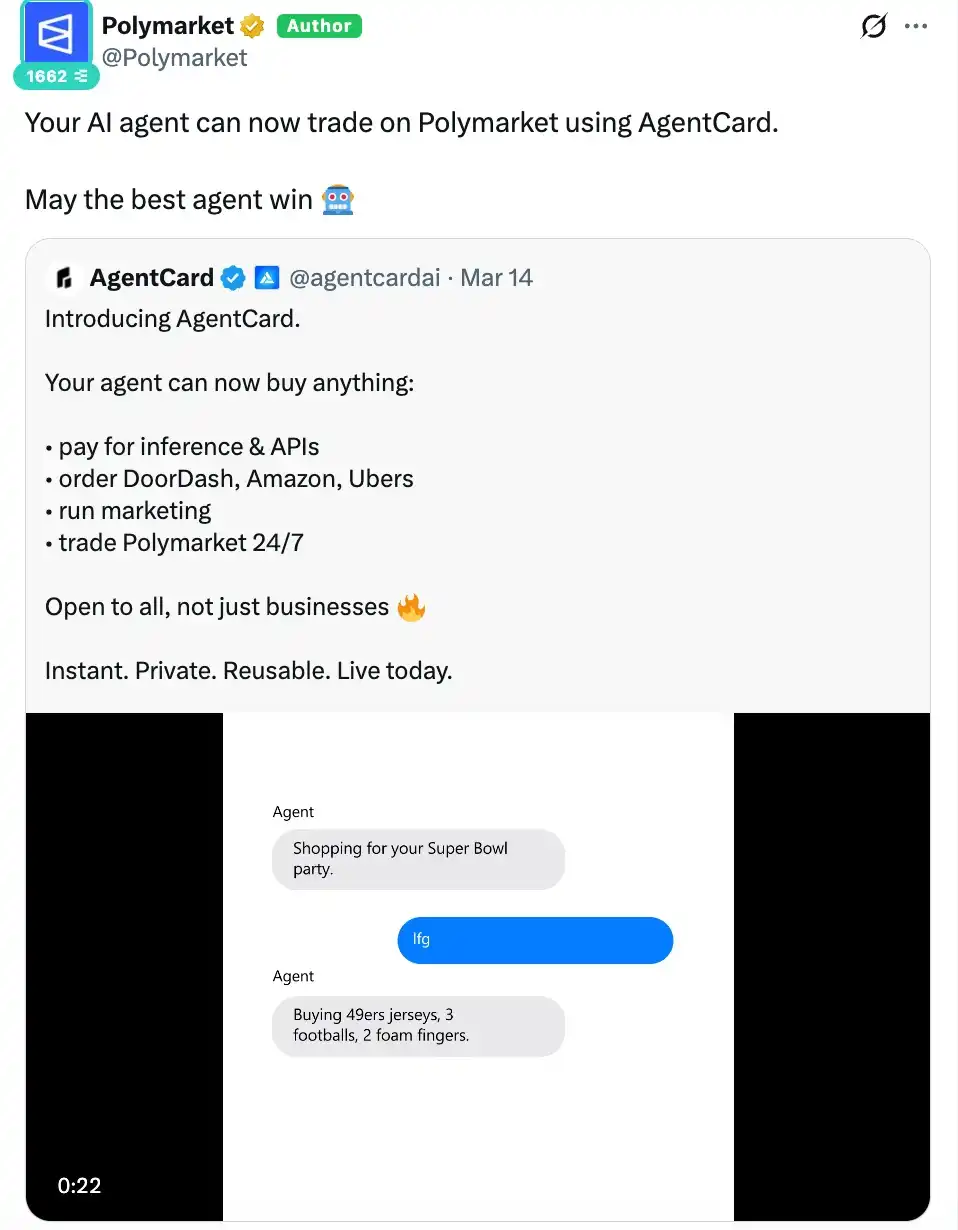
Last weekend, crypto payment platform Alchemy launched its AI agent payment platform, AgentCard. In addition to standard features like food delivery and AI app subscriptions, it emphasized that "users' AI Agents can now trade on Polymarket 24/7." This announcement was later confirmed by Polymarket's official account.
Against the backdrop of OpenClaw's "Lobster" going viral and the emergence of x402, ERC8004, and ERC8183 supporting AI Agent payments, combined with Polymarket's earlier Polymarket CLI designed for AI Agents, a prediction market platform capable of querying market data, executing orders, managing positions, and interacting with on-chain contracts is taking shape.
Much like Circle's transformation from a "stablecoin issuer" to an "AI-era financial infrastructure builder," Polymarket has already secured the critical position of being the "prediction market platform for AI Agents." As NVIDIA founder Jensen Huang stated at last year's CES, the AI Agent industry will become a trillion-dollar market, much like the robotics industry. And 24/7 AI Agents may first shine in prediction markets.
Conclusion: The New War in Prediction Markets Has Begun
There is no doubt that a new war in the prediction market sector has quietly begun. This includes deepening engagement with existing users, incentivizing active users, converting new users, expanding the scope of betting events, negotiating with regulators, and even preparing for future developments like catering to "potential active users" such as AI Agents.
Earlier, Dingaling, founder of the BSC ecosystem prediction market platform Predict.fun, also planned to launch products combining prediction markets and DeFi, aiming to offer users interest-earning opportunities on account funds—a kind of "PayFi yield product" that is also worth watching.
Regardless of how the prediction market evolves, in their quest to raise $20 billion or more in funding, Kalshi and Polymarket have already activated new growth levers.