Stablecoin Yield Off The Table? Crypto Leaders Review CLARITY Act’s Latest Text

bitcoinistОпубликовано 2026-03-25Обновлено 2026-03-25

Введение

In a closed-door Capitol Hill meeting, crypto industry leaders reviewed the latest draft of the CLARITY Act, a long-awaited crypto market structure bill. The new text explicitly prohibits digital asset service providers—including exchanges, brokers, and affiliates—from offering any form of yield on stablecoin holdings that resembles a bank deposit. This aims to address banking industry concerns about financial risks. The proposal does, however, allow rewards based on specific user activities—such as loyalty, promotional, or subscription programs—provided they are not economically equivalent to interest. Regulatory agencies including the SEC, CFTC, and Treasury would have one year to define acceptable rewards and establish anti-evasion rules. Reactions within the crypto industry are mixed. Some view the language as overly restrictive and vague, potentially allowing future regulators to broadly interpret the “economic equivalence” standard. Others see it as a balanced compromise that preserves transaction-based incentives while clearly distinguishing stablecoins from interest-bearing accounts. Banking representatives are set to review the draft next.

In a closed-door meeting on Capitol Hill, crypto industry leaders reviewed the latest text of the long-awaited crypto market structure bill, which focused on key proposals to address the stablecoin yield and rewards dispute.

Latest CLARITY Act Draft Says No To Stablecoin Yield

On Monday, the crypto industry got the first look at the latest version of the crypto market structure bill, known as the CLARITY Act, which addresses the main issue that has stalled the legislation over the past two months.

Industry sources shared details of the latest legislative text with the Journalist Eleanor Terret. According to an internal stakeholder email shared with Terret, the proposal would prohibit platforms from offering yield, directly or indirectly, for holding a stablecoin, or in a manner that resembles a bank deposit.

Notably, this restriction would broadly apply to digital asset service providers, including exchanges and brokers, as well as their affiliates. The proposal seeks to limit workarounds and prohibit any activity that is “economically or functionally equivalent” to interest, addressing concerns from the banking industry side.

It’s worth noting that the crypto market structure bill has been stalled since the Senate Banking Committee published its draft in mid-January. The text included several divisive policies, including significant restrictions for DeFi and the payment of interest on stablecoins.

The yield dispute became a major sticking point between the banking and crypto industries, leading to a prolonged negotiation period. The banking side has criticized the landmark stablecoin legislation, the GENIUS Act, for loopholes that could allegedly put the financial system at risk and distort market dynamics.

Ahead of the January draft, banks pressed lawmakers to include language in the CLARITY Act that bans yield on stablecoins from crypto exchanges, brokers, and related entities, rather than only issuers.

To address this issue, the Senate Banking Committee proposed that issuers offer rewards for specific actions, such as account openings and cashback, but prohibited interest payments to passive token holders. A month ago, the White House held a meeting to negotiate between the two sides.

As reported by Bitcoinist, Patrick Witt, executive director of the US President’s Council of Advisors on Digital Assets, reportedly brought a draft text that left earning yield on idle stablecoin balance “effectively off the table,” narrowing the debate to whether crypto firms could offer rewards linked to specific activities.

Terret’s report shared that the latest proposal would allow rewards based on user activity, including loyalty, promotional, or subscription programs, if they are not considered equivalent to interest from an economic or functional standpoint.

In addition, the latest version of the CLAIRTY Act would require the Securities and Exchange Commission (SEC), the Commodity Futures Trading Commission (CFTC), and the Treasury Department to collaborate to define acceptable rewards and establish anti-evasion regulations within a year.

Rewards Compromise Sees Mixed Reactions

The text has received mixed reactions from the crypto industry, with some calling the language more “restrictive.” One crypto industry leader who reviewed the text told Terret that the draft “is a ‘departure’ from what had been previously discussed with the White House.”

The unnamed source reportedly warned that the “economic equivalence” standard on stablecoin rewards is vague, risking a more restrictive interpretation by future regulators. Furthermore, they highlighted the potential challenges in structuring incentives due to limits on tying rewards to balances or transaction amounts. “Overall, this is a more narrow and restrictive approach toward crypto,” they stated.

On the contrary, another unnamed industry leader considers that the text is “largely in line with expectations.” They told Terret that the draft reflects a “balanced outcome” that preserves transaction-based incentives while making clear stablecoins cannot function like interest-bearing deposit accounts.

“This is the best possible result,” they reportedly affirmed, concluding that the text is “broader than the initial Tillis-Alsobrooks proposal, which would have been more restrictive on crypto.” Bank representatives will now review the draft at a similar meeting on Tuesday.

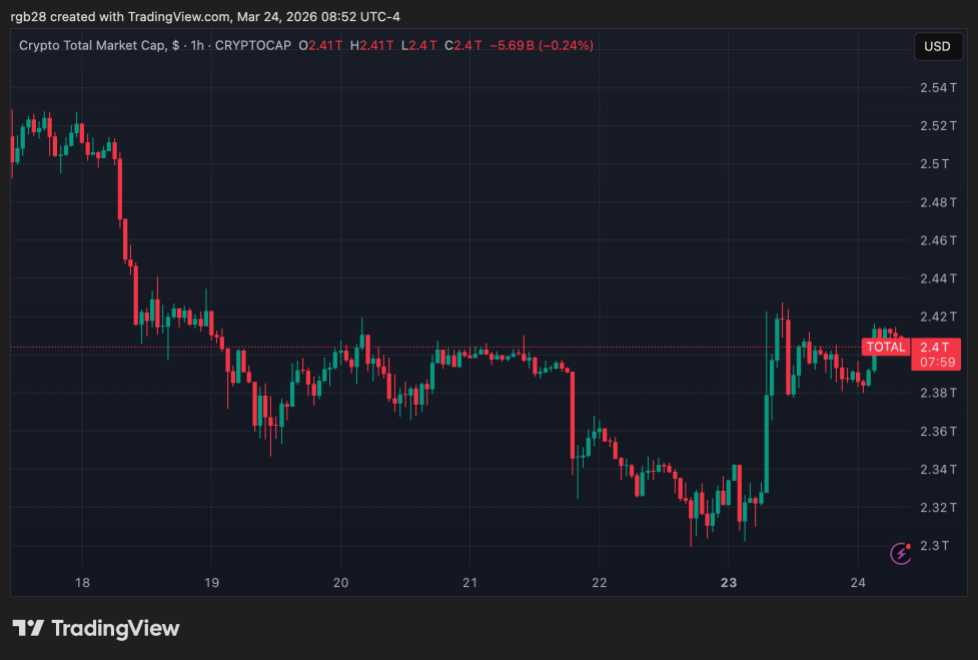
The total crypto market capitalization is at $2.4 trillion in the one-week chart. Source: TOTAL on TradingView

Связанные с этим вопросы

QWhat is the main focus of the latest CLARITY Act draft regarding stablecoins?

AThe latest CLARITY Act draft prohibits platforms from offering yield, directly or indirectly, for holding a stablecoin or in a manner that resembles a bank deposit.

QWhich entities would be broadly affected by the stablecoin yield restrictions in the proposal?

AThe restrictions would broadly apply to digital asset service providers, including exchanges and brokers, as well as their affiliates.

QWhat was the major sticking point that stalled the crypto market structure bill since January?

AThe yield dispute, particularly over the payment of interest on stablecoins, became a major sticking point between the banking and crypto industries.

QAccording to the latest proposal, under what conditions can platforms offer rewards?

APlatforms can offer rewards based on user activity, such as loyalty, promotional, or subscription programs, if they are not considered economically or functionally equivalent to interest.

QHow did crypto industry leaders react to the latest legislative text?

AReactions were mixed, with some calling it more restrictive and a departure from previous discussions, while others considered it a balanced outcome that was largely in line with expectations.

Похожее

Agents Take Over Traffic Distribution Power: What Are Tencent, ByteDance, and Alibaba Competing For?

In the race to dominate the AI era's entry point, China's tech giants—Tencent, ByteDance, and Alibaba—are aggressively deploying AI Agents to control the future of traffic distribution. Alibaba is pursuing a dual-track "closed loop + openness" strategy. Its Qianwen app is evolving into a super-Agent integrated across its ecosystem (Taobao, Alipay, etc.) to handle complex tasks like travel planning. Concurrently, it is opening its platform to external brands (Luckin Coffee, KFC) and has launched a B2B Agent platform, "Wukong," targeting enterprise automation. Its other flagship, Quark, aims to be an "AI super search box" for information and tasks. ByteDance is executing an omnipresent "sprawl strategy." Its Doubao app boasts over 300 million monthly active users and is evolving into a default AI entry point for daily life, with plans for paid versions and e-commerce integration. Its core weapon is the Kouzi platform, a visual "AI assembly factory" for developers to build custom Agents. ByteDance is also pushing hardware integration, collaborating on AI phones and developing smart glasses to embed Doubao everywhere. Tencent is playing its long-held "ultimate card" by quietly embedding an AI Agent directly into WeChat. This Agent, accessible via a swipe, can understand user commands and automatically execute tasks by calling upon WeChat's millions of mini-programs (e.g., finding and ordering coffee). This leverages WeChat's unparalleled 1.4-billion-user ecosystem to position the app as an AI-powered "service operating system," a move that could dramatically reshape the competitive landscape. The core battleground is shifting from competing for "user screen time" to competing to be the "default execution layer" for user intent. The business model is evolving from an "attention economy" to an "intent economy," where the Agent that can most efficiently fulfill a user's need gains control over service access and token flow. This represents a fundamental change in how users connect with digital services, making the fight for the Agent入口 (entry point) a pivotal moment for redefining industry leadership in the AI age.

marsbit29 мин. назад

Agents Take Over Traffic Distribution Power: What Are Tencent, ByteDance, and Alibaba Competing For?

marsbit29 мин. назад

From Banning Doubao to Embracing Honor: Why Did WeChat Suddenly 'Change Its Face'?

The article explores the sudden shift in WeChat's strategy towards AI assistants from mobile phone manufacturers, transitioning from strict opposition to active collaboration. For over a year, WeChat fiercely resisted attempts by phone AI assistants (like ByteDance's Doubao in late 2025) to control its features via GUI automation ("simulated clicking"), citing security and data control concerns. This stance created a significant barrier for system-level AI integration. Now, Tencent has initiated A2A (Agent-to-Agent) partnerships with major phone brands like Honor, Xiaomi, OPPO, and vivo. This model allows a phone's system AI (e.g., Honor's YOYO) to parse a user's voice command and send a structured request directly to WeChat's own internal AI agent via secure APIs. WeChat then executes the action (e.g., sending a message) and returns the result. The article attributes Tencent's "change of face" to strategic pressure. While leading in social app usage, Tencent trails rivals like ByteDance and Alibaba in standalone AI app popularity. WeChat, with its vast mini-program ecosystem, is Tencent's key asset for an AI comeback. The upcoming WeChat AI agent aims to handle tasks like booking and payments within the app. However, phone system assistants remain the primary AI entry point for most users. The A2A collaboration allows Tencent to extend WeChat's AI reach to this crucial system layer while maintaining control over its core functions and data. For phone manufacturers, embracing A2A is a pragmatic move. The GUI route proved unviable due to WeChat's blocks. A2A offers a compliant path to integrate a vital service, enhancing their AI assistants' usefulness. It allows them to focus on developing their own AI ecosystems for other services while cooperating on WeChat access. The collaboration is framed as a mutual, strategic necessity: Tencent gains a distribution channel, and manufacturers gain a key functionality. The partnership relies on a "dual authorization" mechanism for security, requiring both user and app consent for each action. While questions about long-term data privacy practices remain, experts note A2A is more secure and compliant than GUI automation. Ultimately, this cooperation is seen as a tentative, calculated truce. Tencent's long-term goal is to make WeChat an AI-powered "service OS." Phone manufacturers aim to make their system AI the central user interface. Their paths may converge or clash in the future, but for now, the A2A deal represents the opening chapter in the battle for the AI-era user入口, driven by necessity and strategic calculus on both sides.

marsbit2 ч. назад

From Banning Doubao to Embracing Honor: Why Did WeChat Suddenly 'Change Its Face'?

marsbit2 ч. назад

Торговля

Спот
Фьючерсы

Популярные статьи

Как купить S

Добро пожаловать на HTX.com! Мы сделали приобретение Sonic (S) простым и удобным. Следуйте нашему пошаговому руководству и отправляйтесь в свое крипто-путешествие.Шаг 1: Создайте аккаунт на HTXИспользуйте свой адрес электронной почты или номер телефона, чтобы зарегистрироваться и бесплатно создать аккаунт на HTX. Пройдите удобную регистрацию и откройте для себя весь функционал.Создать аккаунтШаг 2: Перейдите в Купить криптовалюту и выберите свой способ оплатыКредитная/Дебетовая Карта: Используйте свою карту Visa или Mastercard для мгновенной покупки Sonic (S).Баланс: Используйте средства с баланса вашего аккаунта HTX для простой торговли.Третьи Лица: Мы добавили популярные способы оплаты, такие как Google Pay и Apple Pay, для повышения удобства.P2P: Торгуйте напрямую с другими пользователями на HTX.Внебиржевая Торговля (OTC): Мы предлагаем индивидуальные услуги и конкурентоспособные обменные курсы для трейдеров.Шаг 3: Хранение Sonic (S)После приобретения вами Sonic (S) храните их в своем аккаунте на HTX. В качестве альтернативы вы можете отправить их куда-либо с помощью перевода в блокчейне или использовать для торговли с другими криптовалютами.Шаг 4: Торговля Sonic (S)С легкостью торгуйте Sonic (S) на спотовом рынке HTX. Просто зайдите в свой аккаунт, выберите торговую пару, совершайте сделки и следите за ними в режиме реального времени. Мы предлагаем удобный интерфейс как для начинающих, так и для опытных трейдеров.

1.4k просмотров всегоОпубликовано 2025.01.15Обновлено 2026.06.02

Как купить S

Sonic: Обновления под руководством Андре Кронье – новая звезда Layer-1 на фоне спада рынка

Он решает проблемы масштабируемости, совместимости между блокчейнами и стимулов для разработчиков с помощью технологических инноваций.

2.3k просмотров всегоОпубликовано 2025.04.09Обновлено 2025.04.09

Sonic: Обновления под руководством Андре Кронье – новая звезда Layer-1 на фоне спада рынка

HTX Learn: Пройдите обучение по "Sonic" и разделите 1000 USDT

HTX Learn — ваш проводник в мир перспективных проектов, и мы запускаем специальное мероприятие "Учитесь и Зарабатывайте", посвящённое этим проектам. Наше новое направление .

1.8k просмотров всегоОпубликовано 2025.04.10Обновлено 2025.04.10

HTX Learn: Пройдите обучение по "Sonic" и разделите 1000 USDT

Обсуждения

Добро пожаловать в Сообщество HTX. Здесь вы сможете быть в курсе последних новостей о развитии платформы и получить доступ к профессиональной аналитической информации о рынке. Мнения пользователей о цене на S (S) представлены ниже.

活动图片