Spain’s regulator sets out MiCA transition rules for crypto platforms

cointelegraphОпубликовано 2025-12-16Обновлено 2025-12-16

Введение

Spain's National Securities Market Commission (CNMV) has published a Q&A document detailing the national transition rules for implementing the EU’s Markets in Crypto-Assets Regulation (MiCA). The guidelines clarify authorization procedures, operational conduct, and transitional timelines for crypto-asset service providers (CASPs). Spain has set a shortened transition period ending December 30, 2025, requiring all in-scope entities to obtain MiCA authorization by that date or cease operations. The move aligns with broader EU efforts to reduce regulatory uncertainty and strengthen investor protection, mirroring similar steps taken by Italy and other member states.

Spain’s national securities regulator, the Comisión Nacional del Mercado de Valores (CNMV), has published a dedicated Q&A laying out how it intends to apply the European Union’s Markets in Crypto-Assets Regulation (MiCA) on the ground.

The document outlines what crypto companies can expect on authorizations, notifications, day-to-day conduct, and the transitional regime, pushing platforms toward a clear “comply or quit” decision as MiCA comes into force.

The move puts Spain alongside other EU member states, such as Italy, which are actively using MiCA’s transitional flexibilities rather than allowing prolonged regulatory uncertainty.

CNMV spells out MiCA approvals

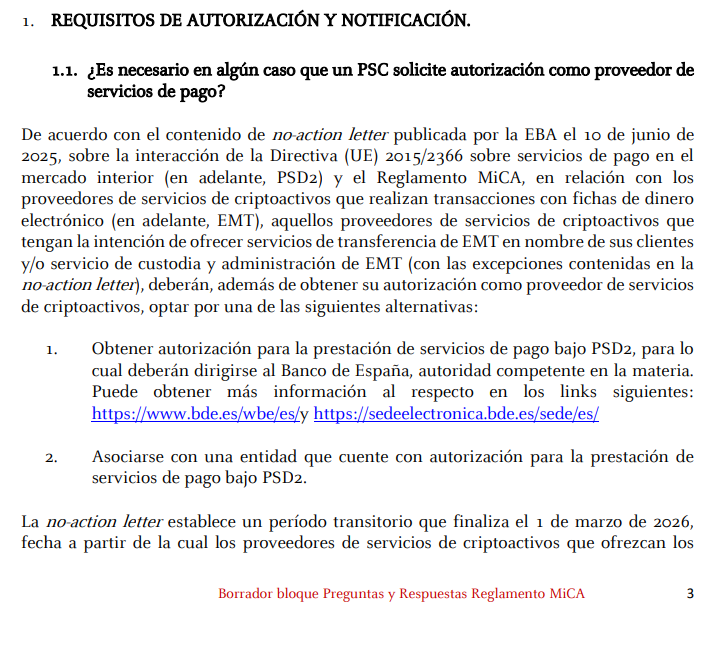
CNMV’s MiCA FAQ walks crypto-asset service providers (CASPs) through the main questions around getting authorized in Spain, clarifying how national procedures fit with MiCA.

The CNMV published a Q&A on MiCA. Source: CNMV

It addresses which firms fall within scope, how MiCA interacts with existing national registrations, and how entities should approach the authorization and notification processes CNMV has already put in place.

The Q&A also explains how authorization-related notifications and cross-border activity should be handled during the transitional period, stressing that firms must take transitional deadlines seriously.

Related: EU may consolidate crypto regulations, IMF warns of stablecoin risk: Global Express

Operating during the transition

Under MiCA, member states may permit existing providers to continue operating for a limited transitional period, until July 1, 2026, or until they are granted or denied authorization, whichever comes first. However, Spain has opted for a shortened transitional period ending on Dec. 30, 2025.

Entities benefiting from the transition must obtain MiCA authorization by that date if they wish to continue providing in-scope crypto-asset services in Spain.

Companies that fail to do so will no longer be permitted to operate, and continued activity without authorization would breach MiCA rules. Businesses must be prepared to adapt their models or cease operations depending on the outcome of their authorization process.

Related: Poland resubmits vetoed crypto bill with ‘not even a comma’ changed

Wider supervisory tightening

The Q&A is accompanied by new criteria on how MiCA will apply to funds, venture capital vehicles, and MiFID II entities, as well as updated guidance on when investment-related influencers are considered to be engaging in client acquisition. The regulator frames these measures as part of a broader effort to strengthen investor protection as MiCA enters into force.

The move follows similar action in Italy, where the Italian regulator CONSOB set a deadline of Dec. 30, 2025, for existing VASPs to apply for MiCA-style authorization or exit, with transitional operation permitted only for those that file and, in any event, no later than June 30, 2026.

Related: Europe reconsiders crypto oversight as ESMA centralization gains momentum

Похожее

The Tao (τ) Law Makes EDA Go Viral

In May 2026, Huawei's semiconductor division introduced the "Tao (τ) Law" at IEEE ISCAS, shifting the industry focus from Moore's Law's geometric scaling to "time scaling." Unlike traditional approaches relying on transistor miniaturization, τ Law optimizes the time constant (τ) across device, circuit, chip, and system levels to improve information processing speed and efficiency. Huawei has already applied this principle, mass-producing 381 chips across various applications, with a target to achieve performance equivalent to 1.4nm technology by 2031. The implementation of τ Law, involving techniques like Chiplet, 3DIC, and Logic Folding, places new demands on EDA tools, highlighting gaps in current offerings. Traditional 2D or pseudo-3D EDA flows lack native support for true 3D design, cross-layer co-optimization (STCO), and coupled multi-physics analysis (thermal, power, stress), which are crucial for advanced integration. Chinese EDA companies, such as Empyrean Software, Primarius Technologies, and Xpeedic, are evolving from point-tool specialists to providing full-flow, system-level solutions. For instance, Peking University has developed a prototype "true 3D" EDA tool showing significant improvements in wirelength and timing. Empyrean Software has also launched a comprehensive 3DIC design and verification platform. The τ Law framework presents an opportunity for the domestic EDA industry to transition from achieving basic functionality to developing robust, integrated toolsets essential for next-generation chip design.

marsbit47 мин. назад

The Tao (τ) Law Makes EDA Go Viral

marsbit47 мин. назад

It's Not Jensen Huang Who Wants to Change the PC, But the PC That's Revolting Against Itself

The 40-year-old PC industry is undergoing a fundamental transformation, driven by the rise of AI PCs. At the GTC Taipei 2026 event, NVIDIA, backed by Microsoft and major PC OEMs, announced the RTX Spark super chip for Windows PCs, marking its official entry into the PC core processor market. This move aims to redefine the AI PC by shifting its core from the CPU to an AI-focused SoC (System on Chip). NVIDIA envisions the PC evolving from a personal computer to a "personal AI"—a platform where local AI Agents can autonomously perform tasks. While Intel pioneered the AI PC concept earlier in 2026, NVIDIA's aggressive push, leveraging its vast CUDA developer ecosystem of 6 million, positions it to potentially reshape the industry's long-standing Wintel (Windows-Intel) power structure. NVIDIA's strategy extends beyond hardware; it's about embedding its CUDA, RTX, and AI software stack into the PC platform itself. The article identifies key shifts: 1) The move from a CPU-centric to an AI SoC-centric architecture, similar to Apple's approach with its M-series chips. 2) The PC's evolution from a human-operated tool to a platform for human-Agent collaboration. 3) The extension of NVIDIA's data center-centric CUDA ecosystem to personal devices via RTX Spark. Ultimately, the change is driven by the broader trend of AI moving to personal devices. Companies like Intel, AMD, Qualcomm, and Apple are all participating in this shift. NVIDIA's entry accelerates the competition, but the core driver is the technology itself finding its optimal expression in the PC. The industry is reinventing itself, with the outcome hinging on execution, ecosystem development, and the creation of compelling local AI applications.

marsbit3 ч. назад

It's Not Jensen Huang Who Wants to Change the PC, But the PC That's Revolting Against Itself

marsbit3 ч. назад

Торговля

Спот
Фьючерсы

Популярные статьи

Как купить S

Добро пожаловать на HTX.com! Мы сделали приобретение Sonic (S) простым и удобным. Следуйте нашему пошаговому руководству и отправляйтесь в свое крипто-путешествие.Шаг 1: Создайте аккаунт на HTXИспользуйте свой адрес электронной почты или номер телефона, чтобы зарегистрироваться и бесплатно создать аккаунт на HTX. Пройдите удобную регистрацию и откройте для себя весь функционал.Создать аккаунтШаг 2: Перейдите в Купить криптовалюту и выберите свой способ оплатыКредитная/Дебетовая Карта: Используйте свою карту Visa или Mastercard для мгновенной покупки Sonic (S).Баланс: Используйте средства с баланса вашего аккаунта HTX для простой торговли.Третьи Лица: Мы добавили популярные способы оплаты, такие как Google Pay и Apple Pay, для повышения удобства.P2P: Торгуйте напрямую с другими пользователями на HTX.Внебиржевая Торговля (OTC): Мы предлагаем индивидуальные услуги и конкурентоспособные обменные курсы для трейдеров.Шаг 3: Хранение Sonic (S)После приобретения вами Sonic (S) храните их в своем аккаунте на HTX. В качестве альтернативы вы можете отправить их куда-либо с помощью перевода в блокчейне или использовать для торговли с другими криптовалютами.Шаг 4: Торговля Sonic (S)С легкостью торгуйте Sonic (S) на спотовом рынке HTX. Просто зайдите в свой аккаунт, выберите торговую пару, совершайте сделки и следите за ними в режиме реального времени. Мы предлагаем удобный интерфейс как для начинающих, так и для опытных трейдеров.

1.4k просмотров всегоОпубликовано 2025.01.15Обновлено 2026.06.02

Как купить S

Sonic: Обновления под руководством Андре Кронье – новая звезда Layer-1 на фоне спада рынка

Он решает проблемы масштабируемости, совместимости между блокчейнами и стимулов для разработчиков с помощью технологических инноваций.

2.3k просмотров всегоОпубликовано 2025.04.09Обновлено 2025.04.09

Sonic: Обновления под руководством Андре Кронье – новая звезда Layer-1 на фоне спада рынка

HTX Learn: Пройдите обучение по "Sonic" и разделите 1000 USDT

HTX Learn — ваш проводник в мир перспективных проектов, и мы запускаем специальное мероприятие "Учитесь и Зарабатывайте", посвящённое этим проектам. Наше новое направление .

1.8k просмотров всегоОпубликовано 2025.04.10Обновлено 2025.04.10

HTX Learn: Пройдите обучение по "Sonic" и разделите 1000 USDT

Обсуждения

Добро пожаловать в Сообщество HTX. Здесь вы сможете быть в курсе последних новостей о развитии платформы и получить доступ к профессиональной аналитической информации о рынке. Мнения пользователей о цене на S (S) представлены ниже.

活动图片