Spain’s BBVA Latest To Join Bank Consortium Launching Euro Stablecoin

bitcoinistОпубликовано 2026-02-06Обновлено 2026-02-06

Введение

BBVA has become the twelfth member of a European banking consortium that plans to launch a euro-pegged stablecoin in the second half of 2026. The consortium, which includes major banks like ING, BNP Paribas, and UniCredit, formed a joint venture called Qivalis to issue the stablecoin. Headquartered in Amsterdam, Qivalis is awaiting regulatory approval from the Dutch Central Bank. The initiative aims to create a MiCAR-compliant European alternative to the USD-dominated stablecoin market. Currently, no euro stablecoin ranks in the top ten by market cap, with USD-based tokens like USDT and USDC continuing to dominate.

BBVA is the latest entrant to the European bank consortium gearing up to launch a euro-pegged stablecoin in the second half of 2026.

BBVA Has Joined Banking Consortium Behind Qivalis

According to a website announcement, BBVA has joined a consortium of eleven European financial institutions that have created a joint venture to launch a stablecoin tied to the euro. This consortium was first formed in September 2025 with the goal behind it being the creation of a European alternative to the currently USD-dominated stablecoin market. Initially, it consisted of nine banks: ING, Banca Sella, KBC, Danske Bank, DekaBank, UniCredit, SEB, CaixaBank, and Raiffeisen Bank International.

In the months that followed the consortium’s inauguration, two more banks, BNP Paribas and DZ BANK, joined the fray. Now, it seems the group has gained a twelfth member with BBVA also signing up. Alicia Pertusa, head of partnerships & innovation at BBVA CIB, said:

Collaboration between banks is key to create common standards that support the evolution of the future banking model and deliver financial innovation to our clients in a consistent and practical way.

BBVA, standing for Banco Bilbao Vizcaya Argentaria, is a Spanish multinational financial services institution that mainly operates in Europe and South America. It’s Spain’s second-largest bank in terms of assets.

Previously, the bank has had involvement in projects related to digital assets, including a collaboration with SWIFT to develop a blockchain platform to serve as a shared digital registry for banks globally. With its entry into the consortium, BBVA is now also backing the euro stablecoin.

The consortium has created a new company called Qivalis to handle the issuance of the stablecoin. The firm is headquartered in Amsterdam and is currently waiting on approval from the Dutch Central Bank to operate as an electronic money institution.

Jan-Oliver Sell, Qivalis CEO, noted:

Having BBVA join the banking consortium marks an important step forward. With their addition, our network now brings together twelve European banks committed to building a secure, MiCAR‐compliant euro stablecoin framework.

Currently, Qivalis has slated the commercial launch of the euro-pegged stablecoin for the second half of this year, after the regulatory and technical hurdles are overcome.

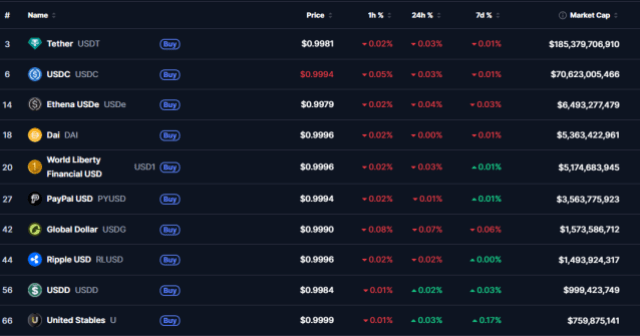
Stablecoins have been gaining momentum around the world lately, with positive legislation related to them occurring in many jurisdictions. So far, however, users have shown a continued preference for USD-based tokens. As CoinMarketCap‘s stablecoin leaderboard shows, there isn’t a single non-USD coin inside the top ten.

Tether's coin continues to be the most dominant in the space | Source: CoinMarketCap

The largest non-USD stablecoin is Circle‘s EURC right now, but its market cap of $432 million is pretty small when compared to the USD stablecoins. For perspective, Circle’s USD token, USDC, boasts a market cap of more than $70 billion.

BTC Price

Bitcoin has continued to slide recently as its price has come down to the $69,400 level.

Looks like the price of the coin has plunged | Source: BTCUSDT on TradingView

Связанные с этим вопросы

QWhat is the name of the new company created by the banking group to issue the euro stablecoin?

AThe new company created to issue the euro stablecoin is called Qivalis.

QHow many banks are now part of the consortium after BBVA joined?

AThere are now twelve banks in the consortium after BBVA joined.

QWhat is the stated goal of the banking consortium in creating a euro stablecoin?

AThe goal is to create a European alternative to the currently USD-dominated stablecoin market.

QWhat is the current status of the largest non-USD stablecoin, EURC, in terms of market capitalization?

ACircle's EURC has a market capitalization of $432 million, which is small compared to USD stablecoins like USDC which has a market cap of over $70 billion.

QFrom which central bank is Qivalis currently awaiting approval to operate?

AQivalis is currently waiting for approval from the Dutch Central Bank to operate as an electronic money institution.

Похожее

Why Pricing Social Interactions is Doomed to Fail?

Titled "Why Putting a Price on Social Interaction Is Doomed to Fail," this article critiques attempts to monetize social networks directly through SocialFi models, arguing their inevitable failure stems from a fundamental misunderstanding of media dynamics. Using Marshall McLuhan's theory of "hot" and "cold" media, the author posits that social networks are inherently "cold" media. Their value isn't contained in individual posts but is co-created through user participation, interpretation, and fragmented, ongoing interaction (e.g., replies, shares). This ambiguity and need for user involvement are core to their function. The article asserts that SocialFi projects like Friend.tech failed because introducing real-time, tradable financial pricing (a definitive "hot" signal) into this "cold" environment doesn't add a layer—it replaces the medium's essence. The unambiguous price signal overshadows and nullifies the nuanced, participatory social signal. Users become traders, not participants, and when speculative profits vanish, the underlying social ecosystem—never genuinely cultivated—collapses entirely. This principle extends beyond crypto. The author argues platforms like Twitter have gradually "heated up" through metrics (likes, retweets counts, algorithmically defined value), shifting users from participants to performers and eroding organic engagement. The solution isn't to abandon capital but to manage its entry point. Successful models like Substack, Patreon, or Bandcamp allow capital to "condense" at specific, isolated nodes (e.g., subscriptions, one-time payments) without permeating and "heating" every social interaction. They preserve the core "cold," participatory medium while enabling monetization at designated boundaries. The NFT boom and bust serves as a stark parallel: the ancient "cold" medium of collecting (valued for story, community, gradual accumulation) was rapidly destroyed by platforms that introduced real-time floor prices, rarity scores, and trading dashboards, transforming collectors into speculators and vaporizing cultural value when prices fell. The core lesson: "Liquidity equals heat." Injecting high liquidity and definitive pricing into a "cold" participatory medium doesn't optimize it; it fundamentally alters and destroys its value-creating mechanism. The future lies not in pricing every social gesture but in finding precise, non-invasive points for capital to condense without overheating the entire ecosystem.

marsbit6 мин. назад

Why Pricing Social Interactions is Doomed to Fail?

marsbit6 мин. назад

Jensen Huang's CMU Speech: In the AI Era, Don't Just Watch, Build

Jensen Huang, CEO of NVIDIA and a first-generation immigrant, delivered the commencement address to Carnegie Mellon University's class of 2026. He shared his personal journey from a humble background to founding NVIDIA, emphasizing resilience, learning from failure, and the responsibility that comes with leadership. Huang framed the present moment as the dawn of the AI revolution, a shift he believes is more profound than previous computing waves. He described AI as fundamentally resetting computing—moving from human-written software to machines that understand, reason, and use tools. This will create a new industry for generating intelligence and transform every sector. While acknowledging AI's potential to automate tasks and displace some jobs, Huang distinguished between the *tasks* of a job and its core *purpose*. He argued AI will augment human capability, not replace humans. The real risk, he stated, is not AI itself, but people being left behind by those who effectively use AI. He presented AI as a generational opportunity for massive infrastructure investment—in chip factories, data centers, energy grids, and advanced manufacturing—that could re-industrialize nations like the U.S. and bridge the digital divide by making computing and intelligent tools accessible to all. Huang called for a balanced approach: advancing AI safely and responsibly, establishing prudent policies, ensuring broad access, and encouraging universal participation. He urged the graduates not to fear the future but to engage with optimism and ambition, reminding them of CMU's motto, "My heart is in the work." His core message was clear: this is their moment to actively build and shape the AI-powered future, not merely observe it.

marsbit1 ч. назад

Jensen Huang's CMU Speech: In the AI Era, Don't Just Watch, Build

marsbit1 ч. назад

The Era Has Arrived Where Human Writers Must Prove They Are Not Machines

The article describes an era where AI-generated content is flooding the market, forcing human authors to prove they are not machines. It begins with the example of dozens of AI-written, error-ridden biographies of Henry Kissinger appearing on Amazon within hours of his death, a pattern repeated for other deceased celebrities and even living experts who find fraudulent books under their names. This spam content has exploded, with monthly new book releases on platforms like Amazon reaching 300,000 by late 2025. The issue spans genres, from suspiciously high proportions of AI-written teen romance and self-help books to dangerous, AI-generated foraging guides containing lethal advice. The platforms' automated review systems, designed to catch plagiarism and banned words, are ill-equipped to detect AI-generated text that avoids these pitfalls while being nonsensical or fraudulent. The problem has infiltrated traditional publishing. A major publisher, Hachette, had to recall a bestselling horror novel after AI detection tools suggested 78% of its content was machine-generated. An acclaimed European philosophy book was later revealed to be entirely written by AI under a fake author persona. In response, authors are fighting back. At the 2026 London Book Fair, 10,000 writers published a blank book titled "Don't Steal This Book" containing only their signatures—using emptiness as a protest weapon in an age of AI overproduction. Initiatives like the "Human Author Certification" program have emerged, ironically placing the burden on humans to prove their work is not machine-made. The article warns of a vicious cycle: AI-generated low-quality books pollute the data used to train future AI models, leading to "model collapse" and an ever-worsening flood of digital waste, eroding trust in publishing and devaluing human creativity.

marsbit1 ч. назад

The Era Has Arrived Where Human Writers Must Prove They Are Not Machines

marsbit1 ч. назад

Торговля

Спот
Фьючерсы

Популярные статьи

Как купить S

Добро пожаловать на HTX.com! Мы сделали приобретение Sonic (S) простым и удобным. Следуйте нашему пошаговому руководству и отправляйтесь в свое крипто-путешествие.Шаг 1: Создайте аккаунт на HTXИспользуйте свой адрес электронной почты или номер телефона, чтобы зарегистрироваться и бесплатно создать аккаунт на HTX. Пройдите удобную регистрацию и откройте для себя весь функционал.Создать аккаунтШаг 2: Перейдите в Купить криптовалюту и выберите свой способ оплатыКредитная/Дебетовая Карта: Используйте свою карту Visa или Mastercard для мгновенной покупки Sonic (S).Баланс: Используйте средства с баланса вашего аккаунта HTX для простой торговли.Третьи Лица: Мы добавили популярные способы оплаты, такие как Google Pay и Apple Pay, для повышения удобства.P2P: Торгуйте напрямую с другими пользователями на HTX.Внебиржевая Торговля (OTC): Мы предлагаем индивидуальные услуги и конкурентоспособные обменные курсы для трейдеров.Шаг 3: Хранение Sonic (S)После приобретения вами Sonic (S) храните их в своем аккаунте на HTX. В качестве альтернативы вы можете отправить их куда-либо с помощью перевода в блокчейне или использовать для торговли с другими криптовалютами.Шаг 4: Торговля Sonic (S)С легкостью торгуйте Sonic (S) на спотовом рынке HTX. Просто зайдите в свой аккаунт, выберите торговую пару, совершайте сделки и следите за ними в режиме реального времени. Мы предлагаем удобный интерфейс как для начинающих, так и для опытных трейдеров.

1.3k просмотров всегоОпубликовано 2025.01.15Обновлено 2025.03.21

Как купить S

Sonic: Обновления под руководством Андре Кронье – новая звезда Layer-1 на фоне спада рынка

Он решает проблемы масштабируемости, совместимости между блокчейнами и стимулов для разработчиков с помощью технологических инноваций.

2.2k просмотров всегоОпубликовано 2025.04.09Обновлено 2025.04.09

Sonic: Обновления под руководством Андре Кронье – новая звезда Layer-1 на фоне спада рынка

HTX Learn: Пройдите обучение по "Sonic" и разделите 1000 USDT

HTX Learn — ваш проводник в мир перспективных проектов, и мы запускаем специальное мероприятие "Учитесь и Зарабатывайте", посвящённое этим проектам. Наше новое направление .

1.8k просмотров всегоОпубликовано 2025.04.10Обновлено 2025.04.10

HTX Learn: Пройдите обучение по "Sonic" и разделите 1000 USDT

Обсуждения

Добро пожаловать в Сообщество HTX. Здесь вы сможете быть в курсе последних новостей о развитии платформы и получить доступ к профессиональной аналитической информации о рынке. Мнения пользователей о цене на S (S) представлены ниже.

活动图片