SpaceX and xAI’s Merger to Link Starlink with AI, Fueling SUBBD

bitcoinistОпубликовано 2026-02-03Обновлено 2026-02-03

Введение

Reports indicate a potential merger between SpaceX and xAI, aiming to integrate Starlink's satellite network with xAI's Grok models to create a global AI infrastructure. This move is driving interest in decentralized AI platforms as an alternative to Big Tech monopolies. SUBBD Token ($SUBBD) is highlighted as a key example, targeting the content creation industry by combining AI tools like voice cloning and automated interactions with blockchain-based payments. The project has raised over $1.4M in its presale, offering staking rewards and positioning itself as a decentralized solution for creators seeking to avoid high fees and censorship on traditional platforms.

Reports suggesting a deepening strategic alignment, and a potential full-blown merger, between SpaceX and xAI have sent ripples through both the aerospace and artificial intelligence sectors.

The theoretical combination creates a vertically integrated behemoth: SpaceX’s Starlink satellite network provides the global nervous system, while xAI’s Grok models function as the brain. This isn’t just about corporate consolidation; it creates a distributed compute infrastructure capable of bypassing traditional terrestrial bottlenecks entirely.

For the broader market, a $1.25T synergy of this magnitude signals that AI is moving from a software novelty to a fundamental infrastructure layer. If Starlink terminals become edge computing nodes for xAI, the latency issues plaguing real-time AI applications could practically vanish.

However, this massive centralization of data and connectivity has triggered a second-order effect. Investors are now hunting for the antidote: decentralized, application-specific AI platforms that operate outside the purview of Big Tech monopolies.

Capital is increasingly rotating into protocols that use AI for specific utilities, particularly in the creator economy, while maintaining Web3 sovereignty.

The market logic is simple: while Musk builds the global hardware rails, the profitable application layer belongs to decentralized protocols that solve immediate user pain points like censorship and high fees. Leading this shift in the content creation sector is SUBBD Token ($SUBBD), a platform merging generative AI tools with blockchain payment rails.

You can buy $SUBBD here.

SUBBD Token Deploys AI Agents to Disintermediate Creator Platforms

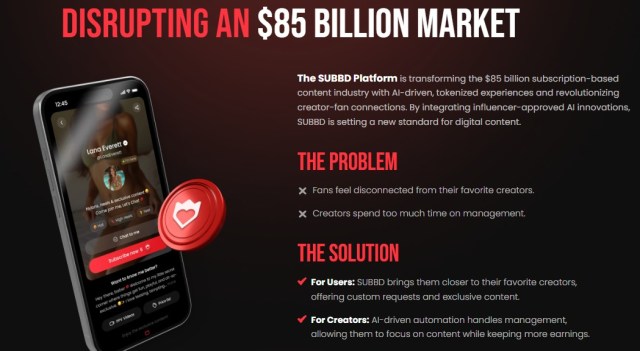
While SpaceX and xAI focus on the macro infrastructure, the $85 billion content creation industry is facing its own AI revolution at the micro level.

SUBBD Token ($SUBBD) has emerged as a direct challenger to legacy Web2 platforms like OnlyFans and Patreon. Frankly, the old model is struggling—creators are tired of losing up to 70% of revenue to fees and facing arbitrary bans.

SUBBD utilizes Ethereum-based smart contracts to guarantee payment transparency, but its real differentiator is the proprietary AI suite.

The platform addresses the ‘scalability problem’ of human influence. Through features like AI Voice Cloning and AI Influencers, creators can automate personalized interactions with fans, scaling their presence without the burnout. The data suggests a pivot in how digital content is consumed; passive viewing is being replaced by interactive, AI-driven engagement.

SUBBD’s ‘HoneyHive’ model allows for the curation of these AI-driven personas, effectively tokenizing the relationship between creator and audience.

Plus, the integration of an AI Personal Assistant automates the backend workflow for creators, handling scheduling and interaction data. By shifting these tools onto a decentralized architecture, SUBBD prevents the kind of de-platforming risks associated with centralized tech giants. It’s a pragmatic application of AI: using automation not just to generate content, but to protect revenue streams and cut down on platform friction.

Explore the SUBBD Token presale here.

Presale Data Indicates Shift Toward Application-Layer AI Assets

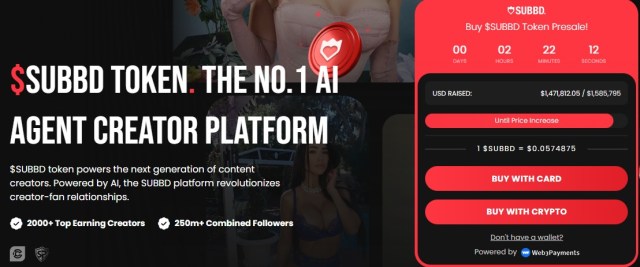
The appetite for decentralized AI utility is reflected in the capital flows surrounding the SUBBD Token presale. According to the latest on-chain data, the project has successfully raised over $1.4M, signaling strong retail and whale confidence in the intersection of SocialFi and AI.

With tokens currently priced at $0.05749, early positioning suggests investors are betting on the platform capturing a distinct slice of the creator economy market share before the full public launch.

Beyond the capital raise, the protocol’s staking mechanics are designed to encourage long-term holding patterns—a critical factor for volatility management in low-cap assets.

The project offers a fixed 20% APY for the first year of staking. This high yield acts as an incentive for supply lock-up, reducing sell pressure while the platform’s beta features roll out. Unlike speculative meme coins, this staking structure is tied to platform benefits, including access to exclusive ‘Behind The Scenes’ (BTS) drops and XP multipliers for platform governance.

As major infrastructure players like xAI and SpaceX consolidate power, smart money is diversifying into the application layer. SUBBD represents a functional hedge: a decentralized platform that uses the same generative AI advancements pushing the industry forward, but structures them to benefit individual creators rather than a centralized monopoly.

Visit the $SUBBD presale.

Disclaimer: The content provided in this article is for informational purposes only and does not constitute financial advice. Cryptocurrency investments, particularly in presale stages, carry inherent risks including high volatility. Always conduct your own due diligence before making investment decisions.

Связанные с этим вопросы

QWhat is the potential impact of a SpaceX and xAI merger on global AI infrastructure according to the article?

AThe merger would create a vertically integrated behemoth where SpaceX's Starlink provides a global satellite network as the 'nervous system' and xAI's Grok models act as the 'brain', forming a distributed compute infrastructure that bypasses traditional terrestrial bottlenecks and could eliminate latency issues for real-time AI applications.

QWhy are investors turning to decentralized AI platforms like SUBBD Token in response to the SpaceX-xAI news?

AInvestors are seeking decentralized, application-specific AI platforms as an antidote to the massive centralization of data and connectivity by Big Tech monopolies, favoring protocols that offer Web3 sovereignty, solve user pain points like censorship and high fees, and capture value at the application layer.

QHow does SUBBD Token aim to disrupt the content creation industry?

ASUBBD Token challenges legacy Web2 platforms by combining Ethereum-based smart contracts for payment transparency with a proprietary AI suite—including AI Voice Cloning and AI Influencers—to automate personalized fan interactions, scale creator presence, prevent de-platforming risks, and reduce revenue loss from high fees.

QWhat financial incentives does SUBBD Token offer to early investors?

ASUBBD Token offers a fixed 20% APY for the first year of staking to encourage long-term holding, reduce sell pressure, and provide platform benefits like access to exclusive 'Behind The Scenes' drops and XP multipliers for governance, with the presale having raised over $1.4M at a token price of $0.05749.

QWhat key problem does SUBBD's AI technology solve for content creators?

ASUBBD's AI technology addresses the 'scalability problem of human influence' by allowing creators to automate personalized interactions with fans through features like AI Voice Cloning and AI Influencers, reducing burnout while maintaining engagement and protecting revenue streams from centralized platform risks.

Похожее

Uncovering the Truth About Agent Commerce, Payments, and Infrastructure

Decoding Agent Commerce, Payments, and Infrastructure: The Reality Over the past year, I've been building infrastructure for the Agent economy, engaging with major players like Stripe, Visa, Coinbase, Google, and dozens of startups. A clear conclusion emerges: true, large-scale demand does not yet exist. Startups face structural challenges. Data points illustrate this gap. Stripe's Agent commerce platform has over 1,000 merchants but only single-digit transacting agents. Visa's Agent payment token requires 9-month KYC and a $250M revenue threshold, accessible only to giants like Amazon. On-chain analysis reveals actual daily Agent transaction volume is around $17k, half of which are test transactions. The article analyzes four potential markets: **1. Agent-to-Merchant (A2M):** Current AI shopping UX is often inferior to traditional e-commerce for visual, comparison-heavy purchases (clothing, electronics). Chat interfaces are a step back. Real merchant interest is defensive "Agent Engine Optimization," fearing future obsolescence, not current demand. Potential exists in high-frequency, low-decision purchases (e.g., food delivery) or simplifying terrible UX (complex checkouts, non-native shoppers), but these require massive consumer distribution channels dominated by giants like DoorDash and Amazon. **2. Agent-to-API (A2A):** Developers already have subscriptions and billing for core APIs (compute, data). The argument for micro-payments via crypto for sub-dollar API calls is addressed by pre-paid balances today. The deeper issue is supplier resistance; major SaaS firms rely on enterprise contracts, not fractional cent pricing. Opportunity lies in the long tail of niche services, but this is a smaller market catering to developers, a historically low-paying group. **3. Agent-to-Agent (A2A):** This remains a theoretical long-term vision with near-zero current transaction volume. It involves unique challenges: discovery, trust, negotiation, dispute resolution. When it materializes, it will require a fundamentally new settlement infrastructure for high-speed, variable-value, multi-party transactions. It's a real long-term bet, but not the current market. **4. Agent-to-Finance (A2F):** This is the only category with existing, paying demand. Integrating AI into financial workflows (trading, portfolio management) is a natural evolution and enables new capabilities like autonomous rebalancing. However, competition favors incumbents with regulatory licenses, compliance infrastructure, and existing client relationships. **The Real Issue:** Why is infrastructure still being built? Incumbents can afford long-term bets, and payment companies see every problem as a nail for their payment hammer. However, payment is just one piece. The core challenge is *coordination*—orchestrating work between Agents and humans, verifying outcomes, and settling results. Payment is part of settlement, which is part of coordination. Companies that solve the coordination problem will subsume payments, not the other way around. Startups lack the infinite runway of giants and must find today's real market, which, after a year of exploration, lies outside these four categories—in an area with real, growing, and underserved activity.

marsbit3 ч. назад

Uncovering the Truth About Agent Commerce, Payments, and Infrastructure

marsbit3 ч. назад

Торговля

Спот
Фьючерсы

Популярные статьи

Неделя обучения по популярным токенам (2): 2026 может стать годом приложений реального времени, сектор AI продолжает оставаться в тренде

2025 год — год институциональных инвесторов, в будущем он будет доминировать в приложениях реального времени.

1.8k просмотров всегоОпубликовано 2025.12.16Обновлено 2025.12.16

Неделя обучения по популярным токенам (2): 2026 может стать годом приложений реального времени, сектор AI продолжает оставаться в тренде

Обсуждения

Добро пожаловать в Сообщество HTX. Здесь вы сможете быть в курсе последних новостей о развитии платформы и получить доступ к профессиональной аналитической информации о рынке. Мнения пользователей о цене на AI (AI) представлены ниже.

活动图片