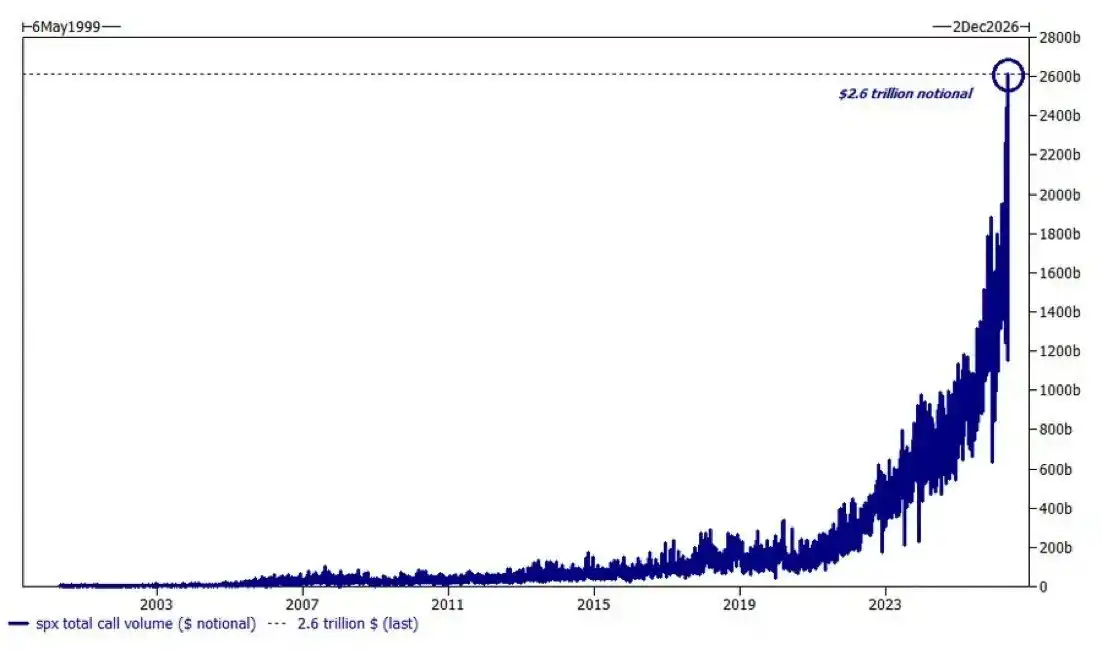
S&P Call Options Explode to Record $2.6 Trillion Volume: The Crash Risks Behind a Frenzied Gamble

marsbitОпубликовано 2026-05-08Обновлено 2026-05-08

Введение

The article discusses a record-breaking $2.6 trillion in S&P 500 call options traded in a single day, which the author sees as a sign of extreme market speculation. The piece explains that retail traders are aggressively buying these options, betting on further price rises. To hedge their risk, market makers who sell these options are forced to buy massive amounts of the underlying stocks, creating a self-reinforcing cycle known as a "gamma squeeze" that pushes prices higher independently of fundamentals. The author warns that this dynamic is unsustainable, comparing it to a casino or past bubbles like GameStop and Tesla. The risk, they argue, is that when these options expire or positions are unwound, the buying pressure could reverse into violent selling pressure, potentially triggering a sharp market decline. While expressing long-term optimism for U.S. stocks, the article cautions heavily leveraged or speculative investors about the inherent dangers in the current market environment.

Author: SOL, The Unseen

Guys, I have something scary to tell you.

The trading volume for S&P 500 call options hit $2.6 trillion yesterday.

What does that mean?

There has never been a single-day number this high in the history of the US stock market.

01) Retail Investors Go Wild for Options, Forcing Market Makers to Buy Stocks

This $2.6 trillion isn't real cash buying stocks.

In reality, it's retail investors and traders frantically buying call options.

What's a call option?

A small bet that the stock price will rise. Win big if right, lose everything if wrong.

With US stocks hitting new highs every day, everyone thinks they'll keep going up, so they're buying like crazy.

But there's a problem: who sold you that option?

The market maker.

Market makers aren't fools. When they sell you an option, they take on the risk of the stock price rising.

To hedge, they have to buy the corresponding stocks.

For every $1 of options you buy, they might need to buy $100 worth of stocks to hedge.

So behind the $2.6 trillion in option buying, there's an astronomical amount of stock buying.

This isn't investors believing in the companies; it's the options market forcing market makers to buy stocks.

02) Gamma Squeeze

The mechanism behind this is called a gamma squeeze.

The higher the stock price rises, the greater the risk from the options the market maker holds.

They have to buy even more stocks to hedge.

The more they buy, the higher the price surges.

The higher the price surges, the more they have to buy.

Round and round it goes, rocketing the market to the sky.

That's the real reason the S&P has been hitting new highs daily.

It's not about how great company earnings are, or how strong the economy is.

It's the buying force from the options market dragging the index upwards.

But can this cycle keep spinning forever?

No.

Options have an expiration date.

On expiry day, the bulls need to close their positions, and market makers need to close theirs.

At that point, the force that was buying stocks turns into the force selling stocks.

And the force is exactly the same.

As fierce as the rise was, the fall will be equally brutal.

03) The Current Market is Not About Pricing, It's About Gambling

Right now, the S&P 500 isn't being priced by investors.

What is pricing?

Looking at how much money a company makes, its growth, the depth of its moat, and then assigning a reasonable price.

And now?

No one cares how much money a company makes.

Everyone is just betting on whether it will go up tomorrow.

Record call option trading volume means the market has turned into a casino.

Retail is gambling, institutions are gambling, hedge funds are gambling.

$2.6 trillion in option buying is a $2.6 trillion bet.

The bigger the bet, the crazier the market.

The crazier the market, the more people bet.

What's the difference from the A-share leveraged bull run in 2015?

None.

Both are pushed by money, not by value.

What money pushes up, it can also smash down.

04) When Will This Bomb Explode?

Nobody knows.

But every market driven by options has eventually crashed.

GameStop in 2021: a gamma squeeze sent the stock from $20 to $480, then back down to $40.

Tesla in 2020: an options frenzy pushed valuations to the sky, then it got halved and halved again.

History doesn't repeat, but it often rhymes.

The current S&P 500 is GameStop magnified 100 times.

The day those $2.6 trillion in options expire, or the day funds rush to close positions en masse, is the day the bomb detonates.

And when it blows, no one will give you advance notice.

-------

Guys, I'm not bearish on US stocks.

In fact, I'm long-term bullish. The US market has good companies, real growth, hard tech.

But the current market action has nothing to do with company fundamentals anymore.

I need to warn the brothers who are using leverage, taking out loans, buying on hype without cash flow...

On the way up, the explosive force sends you to the heavens.

On the way down, it blasts you into the ground.

If you're on board this ship, don't ask when it will explode.

Ask, when it explodes, will you still be on board?

Связанные с этим вопросы

QWhat is the record-breaking daily trading volume for S&P 500 call options mentioned in the article, and why is it significant?

AThe article states that S&P 500 call option volume reached a record-breaking $2.6 trillion for a single day. This is significant because it is a historically unprecedented number, indicating extreme speculative activity in the options market rather than fundamental stock investing.

QAccording to the article, what is 'Gamma Squeeze' and how does it relate to the current market surge?

AA 'Gamma Squeeze' is a mechanism where, as the stock price rises, market makers who sold call options are forced to buy more underlying shares to hedge their risk. This buying pressure drives the price up further, forcing more hedging purchases. The article argues that this cycle, fueled by massive call option buying, is artificially pushing the S&P 500 to new highs, not fundamental economic strength.

QHow does the author characterize the current driving force behind the S&P 500's rise?

AThe author characterizes the current driving force as 'gambling' or a 'betting game,' not 'pricing.' They argue that investors are not pricing companies based on earnings, growth, or fundamentals, but are simply betting on whether the price will go up tomorrow, turning the market into a casino.

QWhat historical events does the article compare the current S&P 500 situation to, and why?

AThe article compares it to the 2015 Chinese A-share 'leveraged bull market' and the 2021 GameStop and 2020 Tesla squeezes. The comparison is made to highlight that price movements driven by speculative leverage or options mechanics (gamma squeezes) are unsustainable and have historically ended in sharp declines or crashes once the cycle reverses.

QWhat is the core warning the author gives to investors participating in the current market?

AThe core warning is for investors, especially those using leverage, loans, or who lack cash flow, to be aware of the extreme risk. The author states that while the 'explosive' force pushes prices up now, it will work with equal force in reverse when the cycle ends (e.g., at option expiration). The key question is not when the crash will happen, but whether you will still be exposed ('on the boat') when it does.

Похожее

Has Microsoft Lost Its Way in the AI Race, and Can Copilot Bring It Back on Track?

Microsoft, once seen as an early AI frontrunner due to its investment in OpenAI, is navigating a strategic shift amid increased competition. Its initial reliance on OpenAI’s GPT models has been complicated by OpenAI’s growing ambitions as a direct competitor, rapid advancements from rivals like Claude and Gemini, and the disruptive rise of AI agents, which challenge its traditional SaaS business model. These factors contributed to stock declines and slower-than-expected adoption of its flagship Copilot products. In response, CEO Satya Nadella has taken a hands-on role in product development, signaling the urgency of change. Microsoft is pivoting from a model-centric strategy to a "model-agnostic" enterprise platform approach. It aims to become the foundational layer connecting various AI models—from OpenAI, Anthropic, or its own new "Superintelligence" team—with enterprise workflows, data, security, and cloud services. Recent organizational changes merged consumer and enterprise Copilot teams to accelerate innovation, exemplified by new products like Copilot Tasks and Copilot Cowork. However, this transformation comes at a high cost. Microsoft faces massive capital expenditures, potentially reaching ~$190 billion by 2026, to support AI infrastructure. While its platform strategy shows early signs of traction with growing Azure AI revenue, it must balance startup-like agility with the reliability expected by enterprise clients. The core challenge is no longer being the sole AI winner but defending its position as the essential enterprise software entry point amidst rapid technological commoditization and the shift towards always-on AI agents.

marsbit42 мин. назад

Has Microsoft Lost Its Way in the AI Race, and Can Copilot Bring It Back on Track?

marsbit42 мин. назад

Why Haven't Forex Stablecoins Taken Off?

Why FX Stablecoins Never Took Off: A Path Forward via Synthetic FX Despite the explosive growth of stablecoin-powered digital banking, which has seen ~$6B in VC investment and a 24x surge in crypto card spending in under a year, a major limitation persists: these banks are essentially dollar-only accounts. This leaves 95-99% of global accounts, which are denominated in non-USD currencies, underserved. Attempts to create native foreign currency (FX) stablecoins (like EURC) have largely failed, with total FX stablecoin TVL at ~$600M compared to $400B for USD stablecoins—a 700x gap. These FX tokens face critical challenges: fragile pegs due to low liquidity, limited exchange/FinTech acceptance, poor on/off-ramps, complex regional compliance, and a chicken-and-egg adoption problem. The article argues that the solution lies not in competing with entrenched USD stablecoin networks (USDT/USDC), but in adopting a synthetic FX model inspired by traditional finance. Specifically, it advocates for Mark-to-Market Non-Deliverable Forwards (NDFs)—cash-settled FX derivatives that allow users to maintain underlying USD stablecoin holdings while having their account balance and P&L denominated in a foreign currency. This approach offers key advantages: strong oracle-based pegs, retention of deep USD stablecoin liquidity and yield, superior on/off-ramps, scalability to any currency with a reliable feed, and capital efficiency. It mirrors how modern institutional FX markets operate. Primary use cases for on-chain NDFs include: 1. **Digital Banks/Wallets:** Enabling multi-currency accounts for international users without leaving the USD stablecoin ecosystem, boosting deposits and retention. 2. **FX Carry Trade Vaults:** Offering access to sovereign interest rate differentials (e.g., earning yield on BRL) in a more stable and scalable format than crypto-native products like Ethena. 3. **Global Enterprise Payments:** Allowing merchants to receive payments in local currency equivalents while settling in USD stablecoins, similar to services offered by Stripe for fiat. The conclusion is that synthetic FX, not native FX stablecoins, is the viable path to integrating foreign exchange into the growing stablecoin digital banking landscape, potentially unlocking the next phase of institutional DeFi and multi-trillion-dollar global adoption.

链捕手1 ч. назад

Why Haven't Forex Stablecoins Taken Off?

链捕手1 ч. назад

IOSG Founder: Web3 Is 'Losing Blood,' How Can Practitioners Survive Better?

IOSG Founder: Web3 Is "Bleeding Out" – How Can Practitioners Survive Better? In a candid reflection, the founder of IOSG Ventures voices deep concerns about the current state of Web3, describing an ecosystem experiencing severe "blood loss." Despite the recent MuShanghai event showcasing a successful pivot towards a more diverse, global community, a somber reality persists: many crypto-native attendees were there exploring exits or new labels in biotech, AI, and robotics. The core issue is identified as a breakdown in the ecosystem's positive feedback loop. Alarmingly, underestimated "low-probability bad events" are occurring simultaneously: a significant brain drain of Chinese developers to AI, a lack of breakout applications despite massive funding, and a widening credibility gap for practitioners globally, often stigmatized as scam artists. This has created a dire接班人 (successor) problem, with the next generation seeing little professional prestige or financial upside in crypto compared to fields like AI. A significant portion of the critique focuses on Ethereum and Vitalik Buterin. While not pessimistic about Ethereum's technology, the founder worries that critical development windows were missed by focusing on niche technical narratives like ZK and L2 instead of mass-market applications. A more urgent concern is that Vitalik may be isolated in an "information bubble," shielded from the grassroots community's hardships by layers of intermediaries, preventing crucial feedback from reaching him. The call is for Vitalik to return to a founder's mindset, re-engage directly with the community, and rally efforts for the next decade. The divergence between U.S. and Chinese OG (Original Gangster) ecosystems is stark. While many U.S. builders reinvest their wealth into the ecosystem, the Chinese scene suffers from a severe lack of "造血能力" (blood-making ability), with most market-driven funds struggling and many early success stories cashing out entirely. This threatens the entire Asian Web3 ecosystem's survival. For individual practitioners, survival advice is pragmatic: find your core "why," maintain life balance beyond token prices, continuously learn new skills (like AI), form small, trusted alliances for mutual support, and practice self-compassion. The industry's greatest need is not money or tech, but lighthouses—individuals at all levels who offer mentorship, grants, referrals, and honest reflection to guide others. The piece concludes with a direct appeal: OGs must pay forward the opportunities the industry gave them; founders must not struggle alone; and builders must continue their work, ensuring it remains a viable profession. The survival of Web3's "cathedral" depends not on any single leader but on the collective responsibility of everyone who remains.

marsbit2 ч. назад

IOSG Founder: Web3 Is 'Losing Blood,' How Can Practitioners Survive Better?

marsbit2 ч. назад

Deficits, Inflation, and the New Fed: The Deep Logic Behind US Bond Yields Breaking 5% and the Market Reset

In the week of May 15-19, 2026, U.S. long-term Treasury yields surged to multi-year highs, with the 30-year yield hitting 5.2%, a level unseen since 2007, and the 10-year yield climbing to 4.687%. Equity markets declined in response. Four primary factors are driving the rise in yields. First, stubborn inflation persists, with April wholesale prices rising 6% year-over-year, fueling expectations of potential future Fed rate hikes instead of cuts. Second, newly confirmed Fed Chair Kevin Warsh inherits a complex inflation battle, with markets closely awaiting his first FOMC meeting. Third, deteriorating U.S. fiscal health, marked by large deficits and rising debt servicing costs, is eroding the traditional "safe-haven" premium for Treasuries. Fourth, the "One Big Beautiful Bill" tax cuts are projected to add trillions to the national debt, contributing to Moody's recent credit rating downgrade. Rising yields pressure stocks through several channels: a higher discount rate reduces the present value of future earnings (especially for growth stocks); rising risk-free rates compress equity risk premiums, making bonds relatively more attractive; higher borrowing costs impact consumers and corporations; and a stronger dollar affects multinational earnings. For investors, the environment favors value and financial stocks over long-duration growth stocks. Bond investors find attractive yields in short to intermediate maturities, while income investors see the best fixed-income opportunities in over a decade. Key developments to watch include Chair Warsh's first FOMC meeting, upcoming inflation data, Treasury auction demand, and whether the 30-year yield approaches 6%, a level that could trigger a more sustained equity valuation reset. The bond market's message is clear: the era of cheap government borrowing is over, posing a central challenge for markets in late 2026.

marsbit2 ч. назад

Deficits, Inflation, and the New Fed: The Deep Logic Behind US Bond Yields Breaking 5% and the Market Reset

marsbit2 ч. назад

Торговля

Спот
Фьючерсы

Популярные статьи

Как купить S

Добро пожаловать на HTX.com! Мы сделали приобретение Sonic (S) простым и удобным. Следуйте нашему пошаговому руководству и отправляйтесь в свое крипто-путешествие.Шаг 1: Создайте аккаунт на HTXИспользуйте свой адрес электронной почты или номер телефона, чтобы зарегистрироваться и бесплатно создать аккаунт на HTX. Пройдите удобную регистрацию и откройте для себя весь функционал.Создать аккаунтШаг 2: Перейдите в Купить криптовалюту и выберите свой способ оплатыКредитная/Дебетовая Карта: Используйте свою карту Visa или Mastercard для мгновенной покупки Sonic (S).Баланс: Используйте средства с баланса вашего аккаунта HTX для простой торговли.Третьи Лица: Мы добавили популярные способы оплаты, такие как Google Pay и Apple Pay, для повышения удобства.P2P: Торгуйте напрямую с другими пользователями на HTX.Внебиржевая Торговля (OTC): Мы предлагаем индивидуальные услуги и конкурентоспособные обменные курсы для трейдеров.Шаг 3: Хранение Sonic (S)После приобретения вами Sonic (S) храните их в своем аккаунте на HTX. В качестве альтернативы вы можете отправить их куда-либо с помощью перевода в блокчейне или использовать для торговли с другими криптовалютами.Шаг 4: Торговля Sonic (S)С легкостью торгуйте Sonic (S) на спотовом рынке HTX. Просто зайдите в свой аккаунт, выберите торговую пару, совершайте сделки и следите за ними в режиме реального времени. Мы предлагаем удобный интерфейс как для начинающих, так и для опытных трейдеров.

1.3k просмотров всегоОпубликовано 2025.01.15Обновлено 2025.03.21

Как купить S

Sonic: Обновления под руководством Андре Кронье – новая звезда Layer-1 на фоне спада рынка

Он решает проблемы масштабируемости, совместимости между блокчейнами и стимулов для разработчиков с помощью технологических инноваций.

2.2k просмотров всегоОпубликовано 2025.04.09Обновлено 2025.04.09

Sonic: Обновления под руководством Андре Кронье – новая звезда Layer-1 на фоне спада рынка

HTX Learn: Пройдите обучение по "Sonic" и разделите 1000 USDT

HTX Learn — ваш проводник в мир перспективных проектов, и мы запускаем специальное мероприятие "Учитесь и Зарабатывайте", посвящённое этим проектам. Наше новое направление .

1.8k просмотров всегоОпубликовано 2025.04.10Обновлено 2025.04.10

HTX Learn: Пройдите обучение по "Sonic" и разделите 1000 USDT

Обсуждения

Добро пожаловать в Сообщество HTX. Здесь вы сможете быть в курсе последних новостей о развитии платформы и получить доступ к профессиональной аналитической информации о рынке. Мнения пользователей о цене на S (S) представлены ниже.

活动图片