South Korea's 'Kimchi Premium' Turns Negative, The Crypto Trading Powerhouse Ultimately Becomes A Stock Trading Powerhouse

marsbitОпубликовано 2026-06-02Обновлено 2026-06-02

Введение

South Korea's cryptocurrency "Kimchi Premium," historically a hallmark of high retail speculation and capital controls, has turned negative for the first time. This indicates a significant shift: Korean retail investors are withdrawing funds from the crypto market, driven by several factors. Firstly, the broader crypto market, especially altcoins, is struggling, dampening speculative interest. Secondly, the Korean stock market has nearly doubled in value over the past year, attracting liquidity away from digital assets. Major tech companies like Samsung and SK Hynix have led this surge. Finally, the government's confirmed plan to implement crypto taxation starting next year is influencing market preferences. Real-time data from a Korean monitoring channel shows a consistent 2-3% discount ("reverse Kimchi Premium") for cryptocurrencies like USDT in Korea compared to global prices, confirming weak domestic buying pressure. This persistent discount underscores a sustained capital outflow. The shift from premium to discount is highly symbolic, reflecting Korea's transition from a "crypto trading powerhouse" to one increasingly focused on its booming stock market, which now ranks as the world's sixth-largest by market capitalization.

Author: Doo (Compound Foundation)

Compiled by: Deep Tide TechFlow

Deep Tide's Introduction: South Korea has long been one of the most fervent markets for global crypto retail investors, with the "Kimchi Premium" once reaching as high as 20%. Now, for the first time, this premium has turned negative, reflecting not only the collapse of altcoins but also a signal of massive retail capital flight from the crypto market. This holds significant reference value for understanding current market sentiment.

The South Korean cryptocurrency premium is turning negative, which is very unusual because South Korea typically has a premium. By the way, South Korea tends to have premiums or discounts because capital controls make arbitrage difficult.

Here are some thoughts on why a discount is appearing.

1. The Speculative Market is Declining

The South Korean market is famous for speculation, having once pushed premiums above 20%. However, as the crypto market has been struggling, especially altcoins, market interest has been declining.

2. The South Korean Stock Market is Performing Much Better, Siphoning Liquidity Away from Cryptocurrencies

The South Korean stock market has nearly doubled compared to last year, with several tech companies, including Samsung and SK Hynix, leading the growth. This means liquidity that was previously in cryptocurrencies is shifting to the South Korean stock market.

3. The Upcoming South Korean Cryptocurrency Tax is Also Shifting Market Preferences

South Korea's cryptocurrency tax has been delayed multiple times because the country lacks adequate infrastructure to levy it, and it's also a highly unpopular political topic. However, the current government has, at least for now, confirmed that it will begin taxing cryptocurrencies starting next year.

Translator's Supplement: Real-time Data Confirms the Discount is Occurring

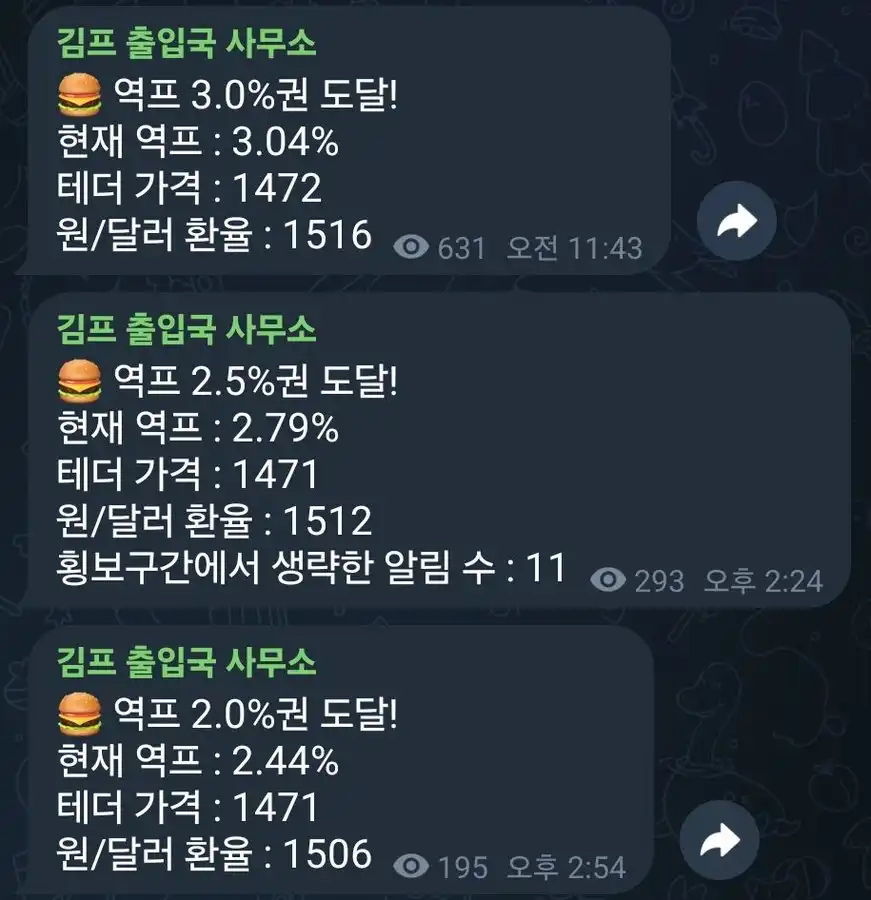
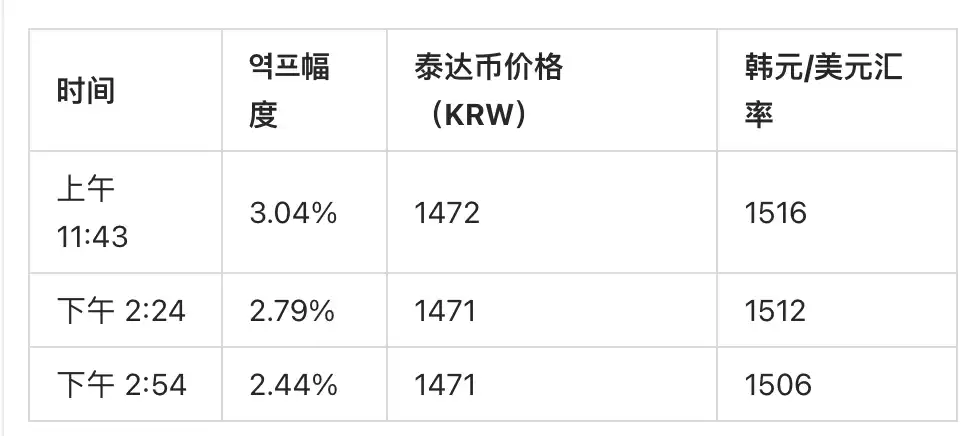
Real-time monitoring data from the South Korean Telegram channel "김프 출입국 사무소" (Kimchi Premium Immigration Office) provides direct evidence for the above judgment. This channel specializes in tracking the premium or discount of the South Korean crypto market relative to international markets. Here are three sets of data recorded on the same day:

"역프" is the abbreviation for "역 김치프리미엄", meaning Reverse Kimchi Premium – cryptocurrency asset prices in the South Korean market are lower than in international markets. In other words, buying crypto is cheaper in South Korea than overseas.

Several details can be observed from the data:

First, the discount narrowed from 3.04% to 2.44% on that day but consistently remained above 2%, indicating the discount is not a fleeting fluctuation but a market state with a certain degree of persistence.

Second, Tether (USDT) remained stable at 1471–1472 won, while the won/USD exchange rate was between 1506–1516 during the same period. The difference between these two is the direct source of the discount – there is insufficient demand for stablecoins in the South Korean market, with buying power significantly weak.

Third, the channel omitted 11 alert push notifications during the sideways trading range, meaning the discount persisted over a longer period, with the magnitude fluctuating little and not triggering the broadcast threshold.

This data set confirms the article's core judgment at the micro level: South Korean retail investors are withdrawing from the crypto market, and the trend of net capital outflow has already left clear traces on the price structure.

It's worth noting that such a meticulous premium monitoring system has spontaneously formed among the South Korean populace, which in itself shows that the "Kimchi Premium" has long been one of the core trading signals in the South Korean crypto market.

Now that this signal has turned negative for the first time, its symbolic meaning goes far beyond the number itself.

Data shows that the total market capitalization of South Korean listed companies has surged 86% this year to $5 trillion; meanwhile, India's total market cap has fallen back to $4.8 trillion. This year, the South Korean stock market has successively surpassed the stock markets of Canada, Germany, the UK, and France; its total market cap has risen to sixth globally.

Связанные с этим вопросы

QWhat is the significance of the 'kimchi premium' turning negative for the first time in South Korea?

AThe 'kimchi premium' turning negative indicates that cryptocurrency prices in South Korea are now lower than international market prices. This is significant because South Korea typically has a premium due to high retail investor demand and capital controls. Its shift to a discount signals a large-scale withdrawal of retail funds from the crypto market, reflecting waning speculative interest.

QAccording to the article, what are the three main reasons for the negative 'kimchi premium' in South Korea?

AThe three main reasons are: 1) A decline in the speculative market, especially for altcoins. 2) The South Korean stock market performing much better, attracting liquidity away from cryptocurrencies. 3) The upcoming implementation of a cryptocurrency tax next year, which is changing market preferences.

QWhat does the real-time data from the Telegram channel '김프 출입국 사무소' show about the current market situation?

AThe real-time data shows a persistent negative premium (or discount), with the 'reverse kimchi premium' ranging from 2.44% to 3.04%. The stable price of Tether (USDT) in Korean Won compared to the higher USD/KRW exchange rate indicates weak buying demand for stablecoins in South Korea, confirming a net capital outflow from the crypto market.

QHow has the performance of the South Korean stock market contributed to the crypto market shift?

AThe South Korean stock market has nearly doubled compared to last year, led by major tech companies like Samsung and SK Hynix. This strong performance is siphoning liquidity away from the cryptocurrency market, as investors shift their funds to the more profitable and currently thriving stock market.

QWhat is the symbolic meaning of the 'kimchi premium' turning negative, beyond the numerical value?

ABeyond the numerical discount, the negative 'kimchi premium' symbolizes a major shift in market sentiment and capital flow. It marks the end of South Korea's era as a hotbed for fervent crypto retail speculation ('crypto trading powerhouse') and its transition towards becoming a 'stock trading powerhouse,' as capital moves decisively into traditional equities.

Похожее

BitMart Research Institute Weekly Highlights: ETF Continued Outflows + AI Drain, Crypto Market Seeks Bottom Amid Volatility

**BitMart Research Weekly Highlights: ETF Outflows and AI Demand Weigh on Crypto Market** The crypto market saw a correction this past week, diverging from the all-time highs in U.S. equity markets. Bitcoin (BTC) fell roughly 6%, while Ethereum (ETH) declined about 4.5%. The primary pressure point was significant and sustained outflows from U.S. spot Bitcoin ETFs, which experienced a record nine consecutive days of net redemptions totaling approximately $2.8 billion. Spot Ethereum ETFs also faced continuous outflows. This weakness in digital assets contrasted with the continued surge in traditional markets, particularly AI-related stocks. The news of Anthropic's secret IPO filing, targeting a potential $750B IPO, and Alphabet's major new AI infrastructure funding further fueled the tech rally. The analysis suggests a potential "liquidity siphon" effect, where capital is being diverted from crypto into the dominant AI investment narrative. Other notable developments include DTCC's DTC announcing plans to integrate Stellar for tokenized asset services, signaling a major step for tokenized equities. Meanwhile, MicroStrategy paused its primary mechanism for funding Bitcoin purchases to focus on debt management, removing a key institutional buyer from the market. The report concludes that the crypto market remains under pressure from the competing AI narrative and major upcoming IPOs, with a potential for a broader market bottom if an AI-driven correction occurs later this cycle.

marsbit10 мин. назад

BitMart Research Institute Weekly Highlights: ETF Continued Outflows + AI Drain, Crypto Market Seeks Bottom Amid Volatility

marsbit10 мин. назад

The Death of the Three-Act Play: AI Ushers Enterprise Software Startups into the ‘Speedrun Era’

The Death of the Three-Act Play: How AI is Ushering in a 'Speedrun Era' for Enterprise Software Startups The traditional three-act play for building an enterprise software company—first, a niche wedge product; second, an expanded suite; third, a dominant platform—is becoming obsolete in the AI era. Previously, startups would spend 3-5 years perfecting a single-point solution to reach tens of millions in ARR (Act 1: The Wedge). Then, over another few years, they'd build adjacent products to form a suite and cross the $100M ARR threshold (Act 2: The Suite). Finally, with scale and user engagement, they could aim to become a foundational platform themselves (Act 3: The Platform). This model assumed a timeline measured in years. However, AI-driven tools have dramatically compressed software development costs and timelines. Companies like Cursor, Clay, and Harvey have scaled from near zero to approaching or surpassing $100M ARR in remarkably short periods, demonstrating a new competitive pace. The core argument is that in this rapidly changing market, relying on a small, "safe" wedge as a protective harbor may now be a conservative, even risky, strategy. The plummeting cost of building software means the time required for Acts 1 and 2 is approaching zero. Consequently, rational strategy now favors planning to build the entire vision from the outset. This shift changes the calculus for early-stage investment. The emphasis is moving from finding a defensible niche to backing founders with "unreasonable, relentless ambition" to reimagine entire workflows or replace incumbent platforms from day one. The age of gradual expansion is giving way to an era of immediate, full-scale ambition.

marsbit30 мин. назад

The Death of the Three-Act Play: AI Ushers Enterprise Software Startups into the ‘Speedrun Era’

marsbit30 мин. назад

After the 'Golden Finger' Points to IBM, the Stock God Trump's Next Target Emerges

The White House occupant is being called a "stock god." Financial disclosures show former President Trump executed 3,642 stock trades in Q1 2026, averaging 58 per trading day. More significantly, a pattern has emerged where companies he publicly praises often see their stock prices rise and frequently overlap with his personal portfolio holdings, government industrial policy, and federal funding. Since a high-profile Tesla event in March 2025, Trump has publicly endorsed at least nine companies, including Intel, Dell, Micron, Palantir, IBM, Apple, Thermo Fisher, Nvidia, and AMD. These "Trump concept stocks" share key traits: they are tied to AI, semiconductors, quantum computing, or "Made in America" narratives; they often receive government contracts, subsidies (like CHIPS Act funding), or regulatory favors; and their CEOs typically have strong personal or political ties to Trump. Timing raises questions. In several instances, such as with Palantir and Dell, Trump's personal account established or increased positions weeks before his public endorsements, which were followed by significant stock price jumps. While his assets are reportedly held in a blind trust managed by his children, the correlation is notable. Based on this pattern, analysis suggests the next companies likely to be endorsed are those where the US government has already taken a strategic equity stake but which haven't yet received a high-profile "call-out." Prime candidates include MP Materials (rare earths, 15% DoD interest), Lithium Americas (lithium, DoE-backed), and quantum computing firms like IonQ, Rigetti, and D-Wave, which are reportedly in talks for government equity-for-funding deals. Other potential names are Oracle (deep political ties) and GlobalFoundries (semiconductors and quantum funding). These stocks carry high political premium, meaning their valuations are highly sensitive to political favor, which can be volatile.

marsbit55 мин. назад

After the 'Golden Finger' Points to IBM, the Stock God Trump's Next Target Emerges

marsbit55 мин. назад

Торговля

Спот
Фьючерсы

Популярные статьи

Как купить S

Добро пожаловать на HTX.com! Мы сделали приобретение Sonic (S) простым и удобным. Следуйте нашему пошаговому руководству и отправляйтесь в свое крипто-путешествие.Шаг 1: Создайте аккаунт на HTXИспользуйте свой адрес электронной почты или номер телефона, чтобы зарегистрироваться и бесплатно создать аккаунт на HTX. Пройдите удобную регистрацию и откройте для себя весь функционал.Создать аккаунтШаг 2: Перейдите в Купить криптовалюту и выберите свой способ оплатыКредитная/Дебетовая Карта: Используйте свою карту Visa или Mastercard для мгновенной покупки Sonic (S).Баланс: Используйте средства с баланса вашего аккаунта HTX для простой торговли.Третьи Лица: Мы добавили популярные способы оплаты, такие как Google Pay и Apple Pay, для повышения удобства.P2P: Торгуйте напрямую с другими пользователями на HTX.Внебиржевая Торговля (OTC): Мы предлагаем индивидуальные услуги и конкурентоспособные обменные курсы для трейдеров.Шаг 3: Хранение Sonic (S)После приобретения вами Sonic (S) храните их в своем аккаунте на HTX. В качестве альтернативы вы можете отправить их куда-либо с помощью перевода в блокчейне или использовать для торговли с другими криптовалютами.Шаг 4: Торговля Sonic (S)С легкостью торгуйте Sonic (S) на спотовом рынке HTX. Просто зайдите в свой аккаунт, выберите торговую пару, совершайте сделки и следите за ними в режиме реального времени. Мы предлагаем удобный интерфейс как для начинающих, так и для опытных трейдеров.

1.4k просмотров всегоОпубликовано 2025.01.15Обновлено 2026.06.02

Как купить S

Sonic: Обновления под руководством Андре Кронье – новая звезда Layer-1 на фоне спада рынка

Он решает проблемы масштабируемости, совместимости между блокчейнами и стимулов для разработчиков с помощью технологических инноваций.

2.3k просмотров всегоОпубликовано 2025.04.09Обновлено 2025.04.09

Sonic: Обновления под руководством Андре Кронье – новая звезда Layer-1 на фоне спада рынка

HTX Learn: Пройдите обучение по "Sonic" и разделите 1000 USDT

HTX Learn — ваш проводник в мир перспективных проектов, и мы запускаем специальное мероприятие "Учитесь и Зарабатывайте", посвящённое этим проектам. Наше новое направление .

1.8k просмотров всегоОпубликовано 2025.04.10Обновлено 2025.04.10

HTX Learn: Пройдите обучение по "Sonic" и разделите 1000 USDT

Обсуждения

Добро пожаловать в Сообщество HTX. Здесь вы сможете быть в курсе последних новостей о развитии платформы и получить доступ к профессиональной аналитической информации о рынке. Мнения пользователей о цене на S (S) представлены ниже.

活动图片